Chemistry
 Call Kai
 Learn
Learn Practice Test
 Spaced Repetition
 Match
Match Flashcards
 Knowt Play
1/63

Earn XP
Description and Tags
AT2 Revision
Name | Mastery | Learn | Test | Matching | Spaced | Call with Kai |
|---|
No analytics yet
Send a link to your students to track their progress
64 Terms
What are the 7 SI base quantities and their base units (with their symbols)?
Length- Meter (m)
Mass- Kilogram (kg)
Temperature- Kelvin (K)
Luminous Intensity- Candela (cd)
Time- Second (s)
Electric Current- Ampere (A)
Amount of Substance- Mole (mol)
Define “accuracy”
The extent to which the measured result matches the actual value of a quantity being measured
Define “precision”
Measure of closeness of measurements to one another when repeated under the same conditions
Define “repeatability”
The closeness of measured results when repeated under identical conditions, and of the same measure
Define “uncertainty”
Quantification of doubt when interpreting and comparing measurements; there is always some degree of uncertainty
Significant figures and decimal places communicate ___ of measurements
Precision
What is the rule or multiplying or dividing measurements?
Round to match the value with the least significant figures (the least precise measurement)
What is the rule for adding or subtracting measurements?
Round to match the value with the least decimal places (the least precise measurement)
Define “atom”
The most basic unit of chemical elements, composed of neutron, proton, and electron subatomic particles
What is a proton?
A positively charged subatomic particle found in the nucleus of an atom. It determines the atomic number and identity of an element
What is a neutron?
A subatomic particle found in the nucleus of an atom with no charge. The number of neutrons determines the type of isotope of an element.
What is an electron?
A negatively charged subatomic particle that surrounds the nucleus of an atom, making up the electron cloud.
What is a period on the periodic table?
The horizontal rows, in which elements are arranged so that atomic number increases across each period from left to right
What is a group on the periodic table?
The vertical columns. Elements in a group have similar properties, with the same number of valence electrons. Atomic number also increases down each group.
List some trends that can be observed on the periodic table
Increase in atomic number
Increase in radius
Increase in electronegativity
Increase in electron affinity
Increase in electron shells
Increase in nuclear charge
What is the trend for atomic number on the periodic table?
Increases down each group and across each period to the right
What is the trend for atomic radius on the periodic table?
Increases moving down and left
What is the trend for electronegativity on the periodic table?
Increases moving up and right
What is the trend for ionisation energy on the periodic table?
Increases moving up and right
What is the trend for electron affinity on the periodic table?
Increases moving up and right
What is the trend for electron shells on the periodic table?
Increases moving down
What is the trend for nuclear charge on the periodic table?
Increases moving right
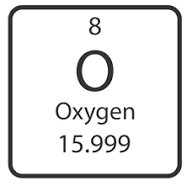
What does “8” represent here, and what is it?
Atomic number- the number of protons, which is also equal to the number of electrons
What does “15.999” represent here, and what is it?
Atomic weight- average atomic mass of all isotopes
What is atomic mass?
The sum of protons and neutrons in an atoms; the atomic mass is also the molar mass of an element
What are isotopes?
Atoms with the same number of protons but a different number of neutrons. Therefore, they have different atomic masses.
What is molar mass?
a measure of the mass of a given substance (g) per amount of the substance (mol), expressed as g/mol. Molar mass is the mass of one mole of particles of that substance
What is a solution?
The result of a solute being dissolved in a solvent
What is a solvent?
The substance that dissolves the solute. It is the larger amount.
What is a solute?
The substance dissolved by the solvent. It is the smaller amount.
What is dilution?
The process of reducing the concentration of a solute in a solution by adding more solvent.
What is molarity?
A unit of concentration; the number of moles of solute per litre of solution (mol/L)
What is the formula for molarity?
M= number of mols in solute (n) / volume of solution (L)
What is a chemical equation
A representation of a chemical reaction, which is the process where reactants undergo a change, forming new products
What is an element?
Substances with only 1 type of atom, and are the simplest form of matter.
What are molecules?
Smallest units of chemical compounds that retain chemical properties of the compound. They can contain the same or different elements.
What are compounds?
a type of molecule where substances of 2 or more different elements chemically bonded together.
Which of the following is true?
All compounds are molecules, but not all molecules are compounds
what does the bohr model say about electron configuration?
the orbit of electrons around a nucleus of an atom is fixed, and each shell has a certain energy level and can hold a certain number of electrons
What are 3 key points on the octet rule and electron configuration?
atoms tend to lose, gain or share electrons to achieve a stable electron configuration, resembling the noble gases (which usually have a full valence shell with 8 electrons).
The number of valence electrons determines the tendency to gain, lose, or share electrons to achieve a full shell
Atoms gain, lose, and share electrons to achieve a stable electron configuration by forming chemical bonds with other atoms
What is a stable electron configuration
When an atom has a full valence shell, usually of 8, making them chemically stable and unreactive
What is an ion?
an electrically charged atom formed by gaining or losing electrons. They can be cations or anions
what is a cation
an ion with a positive charge formed by losing electrons
what is an anion
an ion with a negative charge formed by gaining electrons
What is covalent bonding?
where atoms share pairs of electrons to achieve a stable electron configuration, usually occurring between non-metals
What are the 3 types of covalent bonding?
Single covalent bonding- share one pair of electrons
Double covalent bonding- share two pairs of electrons
Triple covalent bonding- share three pairs of electrons
What is ionic bonding?
when electrons are transferred from one atom to another, resulting in positively and negatively charged ions.
What are the 2 types of ionic bonds
Electron transfer- atom loses one or more electrons to another atom which gains the electrons
Electrostatic attraction- when cations and anions (oppositely charge ions) are attracted by electrostatic forces
What are the properties of an acid, according to the Arhenius definition?
pH of less than 7, and release hydrogen (H) ions when dissolved in water. The more hydrogen ions released, the stronger the acid.
What are the properties of bases, according to the Arhenius definition
pH of more than 7, and release hydroxide (OH) ions when dissolved in water. The more hydroxide ions released, the stronger the base.
What is the Arhenius definition of acids/bases?
Classifies as an acid/base by ability to produce protons/hydrogen ions without electron (acids) or hydroxide ions (bases) in aqueous solutions.
what is the Bronsted-Lowry definition of acids/bases?
Classifies acid/base by ability to donate or accept protons. Acids donate protons, bases accept protons.
An acid and a reactive metal forms…
Hydrogen and salt
An acid and a carbonate forms…
Carbon dioxide, water, and salt
An acid and metal oxide forms..
Salt and water
An acid and a metal hydroxide forms…
salt and water
What is neutralisation?
the reaction of an acid and base to form salt and water.
What are the products of an acid/base reaction, and why?
Salt and water. H ions from the acid comine with OH ions from the base to form H2O, and the remaining ions form salt.
What is standardisation?
determining the exact concentration of a solution through volumetric analysis using a primary standard
What is volumetric analysis
quantitative method of chemical analysis, where a volume of a titrant needed to react with a titrand is measured to determine concentration of the unknown solution
What is a primary/standard solution?
Solutions of known formula and concentration, with high purity and molar mass. They should be unreactive to air and soluble in water.
What is the equivalence point of a titration?
When the ratio of both reactants are exactly equal, measured using an indicator
What is a titrant?
Solution of known concentration
What is a titrand?
Solution of unknown concentration