Food intake and Energy Expenditure
 Call Kai
 Learn
Learn Practice Test
 Spaced Repetition
 Match
Match Flashcards
 Knowt Play
1/28

Earn XP
Description and Tags
Lecture 2 & 3: What makes us decrease and increase feeding behavior
Name | Mastery | Learn | Test | Matching | Spaced | Call with Kai |
|---|
No analytics yet
Send a link to your students to track their progress
29 Terms
Homeostasis
Maintains the internal environment within narrow physiological range
Energy intake vs Energy Expenditure is equal
Not as realistic in today’s sedentary society (in the US)
Three components of neuronal response of homeostasis
Humoral
Visceromotor
Somatic
Role of Hypothalamus
regulates homeostasis
Humoral Response
t
Roles of Oxytocin on the boday/brain
facilitates bonding
reduces anxiety
rewards caloric intake
News and Views
study of oxytocin and intake of food in men
context dependent
resting state
food is chosen
Glucose
our body’s energy “cash”
instant supply of energy needs
via food or produced by liver
Glycogen
our body’s “standby reserve” of energy
we break down glycogen when glucose runs low
Fat
our body’s 3rd reserve of energy and “certificate of deposit”
fat forms into triglycerides and energy
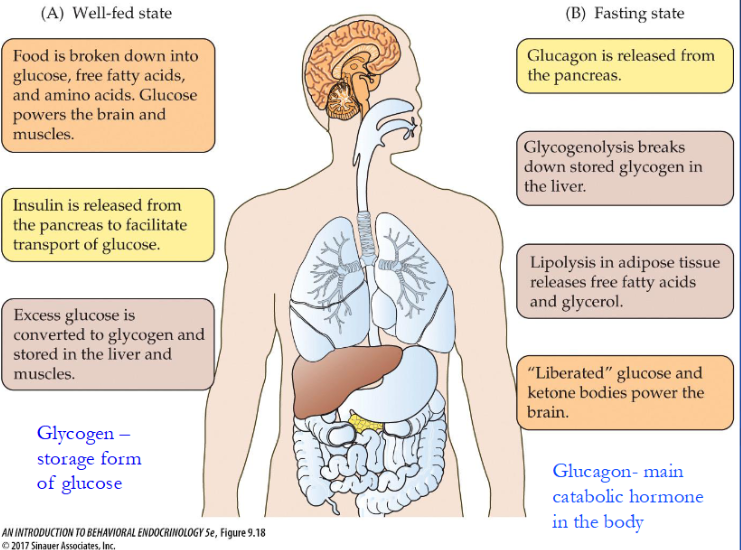
Well-fed state vs Fasting state
know briefly, not in detail
Process of High Blood Sugar to Low
know well
High Blood Sugar
promotes insulin release
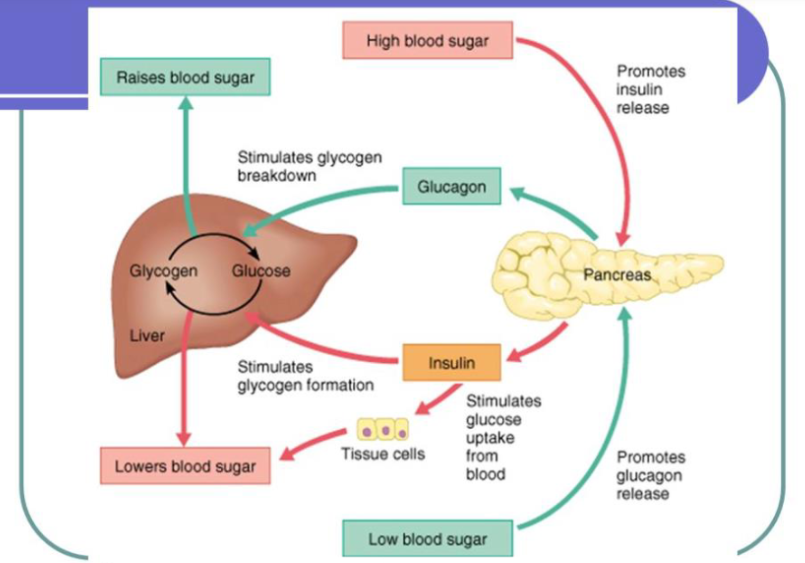
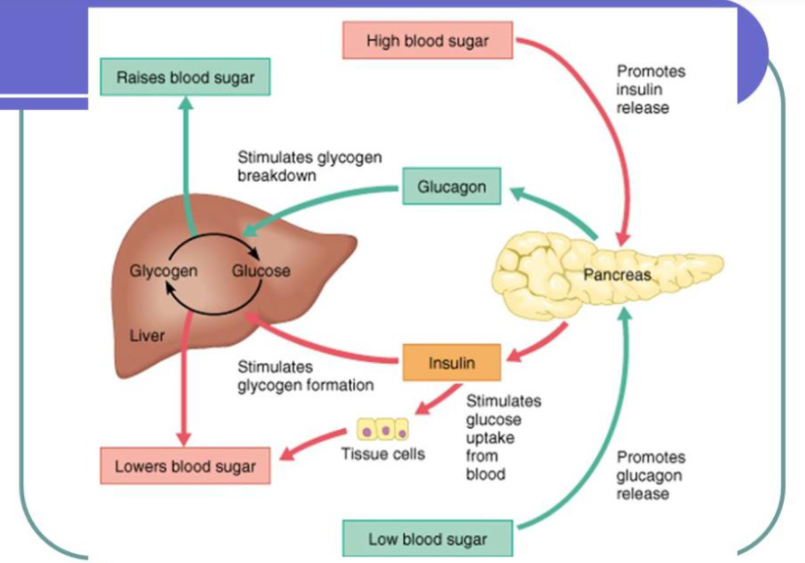
Process of low blood sugar to high
know well
Low blood sugar
promotes glucagon release
Pancreas
Glucagon
simulates glycogen breakdown
Glucose → Liver → Glycogen
Raises blood sugar
Type 1 Diabetes
Autoimmune Disease
body attacks itself, destroying beta cells as it recognizes it as a foreign body
you don’t produce insulin, which is necessary for body to use glucose for energy
No glucose regulation
issues - brain problems, energy
Type 2 Diabetes
Insulin Resistance: Tissues cannot respond to insulin
Glucose stays in the blood
No glucose regulation
issues: hard on cells
osmotic water loss
damage of blood vessels
Controlling glucose levels
diet
exercise
Lipid levels: Adipose Tissue
releases leptin
Satiety
being satisfied and not having hunger or motivation to seek out food
Catabolic Factors do what
Decrease appetite
Decrease food intake
Increase metabolism
Anabolic factors do what
Increase appetite
Increase food intake
Decrease metabolism
Hunger Homeostatic feedback loops
Short-term feeding behavior: Maintenance of blood glucose levels
Long-term feeding behavior: Maintenance of fat stores
hunger can also be affected by mood
Long-term feeding behavior goal
Maintain long-term energy stores (fat)
fat have 2x energy as glucose, doesn’t require excess water storage like glucose
body has set-point for amt of fat
Role of set-point in the body
rat study: fasting and overfeeding resulted in same weight
reality show: guy went from 444-289lbs back to 450
Lipostatic Hypothesis
Lipostatic Hypothesis
states that the brain monitors fat levels and maintains them at some fixed set-point amount
which requires the fat communicates with the brain in some way
a theory suggested a blood-borne hormone played a role
Evidence: 1960s study of Parabiosis
fused two animals to share the same blood
genetically obese mouse and normal mouse
1994: Discovered presence of hormone: Leptin
mutation of OB: recessive mutation that causes weight gain
reduced and didn’t produce leptin
injected obese mice with leptin: restored normal weight
Leptin
suppresses hunger and feeding, increased energy expenditure, reproductive competence
“Starvation signal”
lowers amount of food intake
lowers amount of body fat
what is leptin deficiency?
How brain controls/detects leptin levels
Leptin theorized that leptin effects hypothalamus
Known: leptin activates a-MSH and CART in arcuate nucleus of hypothalamus
What happens when there’s excess adipose tissue (Humoral, visce., Somatic)
Integrated response
Humoral: high secretion of TSH and ACTH, raises metabolic rate of cells in body
Visceromotor: higher activity of sympathetic response, raises metabolic rate and body temperature
Somatic motor: decrease in feedin behavior
Where in the brain is leptin binding to coordinate this response that will eventually reduce adipose tissue?
Arcuate Nucleus
Function of Arcuate Nucleus
makes a-MSH and CART