BIOL 1620 Module 1
 Call Kai
 Learn
Learn Practice Test
 Spaced Repetition
 Match
Match Flashcards
 Knowt Play
1/54

There's no tags or description
Looks like no tags are added yet.
Name | Mastery | Learn | Test | Matching | Spaced | Call with Kai |
|---|
No analytics yet
Send a link to your students to track their progress
55 Terms
Typological Thinking
Every organism has a perfect essence, essentially unchanging and unrelated
Lamarck
Evolution is progressive, “better” species over time, inheritance of acquired characters
Darwinian Evolution
Chnage in species over time, not linear, variation among individuals in populations
Artificial Selection
Shows the extent of genetic diversity within a single species
Gene
Section of DNA that influences one or more hereditary traits
Genotype
Combination of alleles
Phenotype
observable features
Fitness
The ability of an individual to produce surving, fertile offspring relative to that ability in other individuals in the population.
Adaptation
A heritable trait that increases an individual’s fitness in a particualr enviroment
Darwins Four Postulates
Individuals in a population vary in their traits
Some of these differences are heritable; they are passed on to offspring
In each generation, many more offspring are produced that can survive
Individuals with certain heritable traits are more likely so survive and reproduce
Evolution
The change in the allele frequencies of a population over time
Modern Darwin Postulates
Heritable variation lead to
Differential reproductive success
Evidence of change through time
Petrified fossils
molds and casts
carbon films
trace fossils
preserved remains
Homology
Descent from a common ancestor
Genetic Homology
a similarity in the DNa nucleotide sequcnes, RNA, or amino acids
Developmental Homology
Seen in embryos of different species
Structural Homology
A similarity in adult morphology
Acclimation
Individuals phenotype changes in repsonse to changes in the enviroment
Adaptation
occurs when allele frequencies ina population change in repsonse to natural selection
Vestigial Trait
A reduced or incompletely developed structure that has no (or reduced) function
Fitness Trade-off
A compromise between traits
Genetic Variation
The number and relative frequecny of alleles that are present in a particular population
Types of Natural Selection
Directional Selection
Stabalizing Selection
Disruptive Selection
Balancing Selection
Always increases fiteness
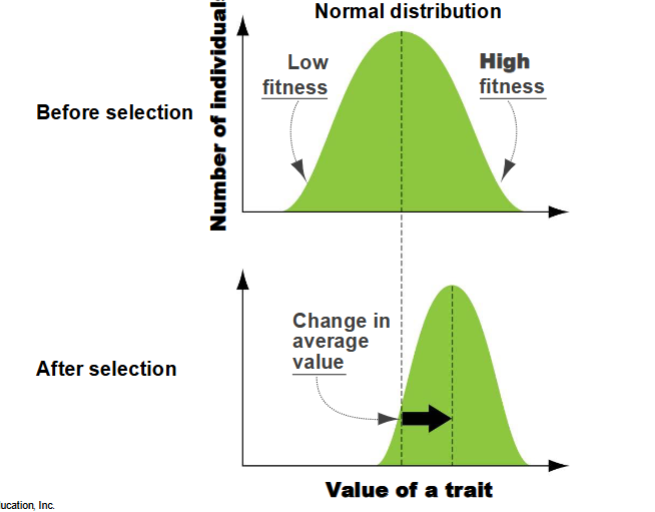
Directional Selection
Chnages the average phenotype in the population in one direction
Reduces genetic diveristy
Increases Fitness
Positive Selection
Increases the frequecny of an adavantageous alleles
Negative Selection
Decreases the frequency of a deleterious allele
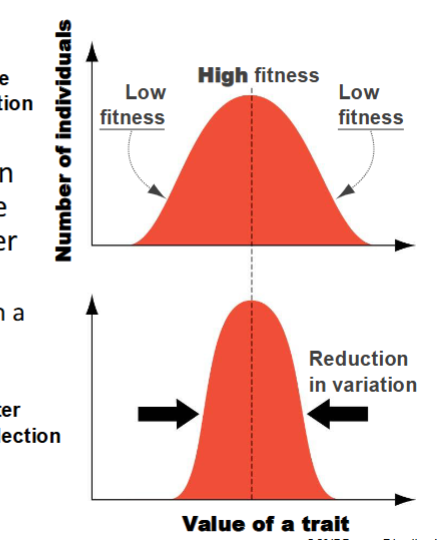
Stabilizing Selection
Reduces both extremes in a population
Reduces genetic variation
Favors intermediate phenotypes
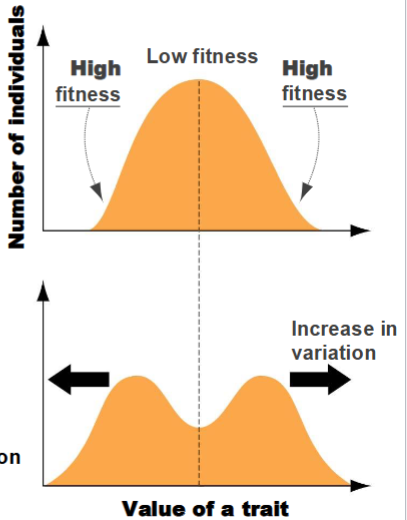
Disruptive Selection
Extreme Phenotypes are favored
Increases genetic variation
Can causes speciation
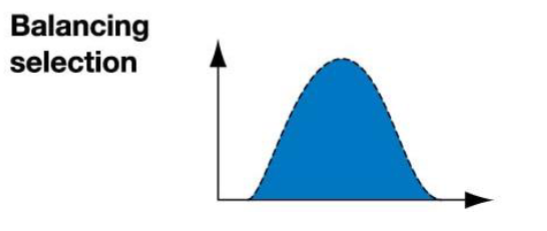
Balancing Selection
Occurs when no single allele has a distinct advantage
allele variation is maintainted
Heterozygous Advantage
Frequency-dependent selection
Natural Selection
Increase the frequency of alleles that contribute to reprodcutive success in a particular enviroment
Mutation
modifies allele frequencies by continually introducing new alleles
Genetic drift
Any change in allele frequencies in a population due to chance
Decreases fitness
Prevelant in small populations
Horizonal Gene Transfer
The transfer of genetic material between organisms that are not parent offspring
Central Dogma
DNA-RNA-Protiens
Transcription
The process of using a DNA tremplate to make a complementary RNA
Translation
The process of using the information in mRNA to synthesize proteins
Germ Cell
The reprocuctive cells that produce sperm or eggs
Somatic Cells
nonreproductive cell
Founder Effect
when a group of individuals establishes a new population in a new area
Bottleneck Effect
A sudden decrease in population size
Gene Flow
the movement of alleles between populations
reduces genetic variation
Reproduction
replication of DNA and trsnsmission to offspring
Asexual Reproduction
Through mitosis
Produces clones in which the offpspring are geneticallly identical to one another and to their parent
Sexual Reproduction
Occurs through meiosis
Produces offspring that are genetically distinct from one another and from their parents
Gametes
Reproductive cells
Eggs and sperm
Fertilization
results in a dilpoid zygote
Mitosis
Ploidy doesn’t change
Meiosis
Ploidy is cut in half
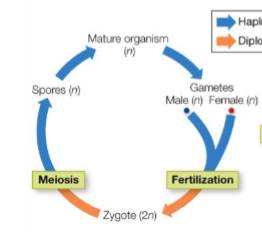
Haplontic Life cycle
Gametes - Fertilization - zygote - meisis - spores - mature organism
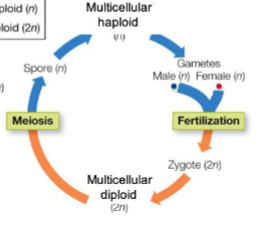
Alternation of Generations
Gametes - Fertilization - zygote - Multicellular diploid - meiosis - spores - multicellular haploid
Diplontic Life Cyle
Gametes - fertilization - zygote - mature organism - meiosis
2-fold+ cost
Asexual reporduction is much more efficient producing twice as many offspring
+: finding a mate, courtship, cost of meiosis
Why we pay 2-fold+
Faster adaptation to changing enviroments
Faster reduction of accumulating deleterious mutation
Muller’s Ratchet and Mutational Meltdown
Enough deleterious mutations accumulate that the organism undergoes mutational meltdown
Traits that reduce the 2-fold+ cost of sex
Sex swithcing
Both asexual and sexual life cyle
Increase the parental investment allowing 2-fold increase in offspring #s