Skeletal Anatomy

0.0(0)
Studied by 0 people
call kaiCall Kai
learnLearn
examPractice Test
spaced repetitionSpaced Repetition
heart puzzleMatch
flashcardsFlashcards
GameKnowt Play
Card Sorting

1/54

encourage image

There's no tags or description

Looks like no tags are added yet.

Last updated 12:15 AM on 6/19/26
Name
Mastery
Learn
Test
Matching
Spaced
Call with Kai

No analytics yet

Send a link to your students to track their progress

55 Terms

1
New cards

What is the skeleton

  • Skeleton: A structural framework providing support and integrity to the bodies of some animals

  • Can be made of different materials based on the type of skeleton
<ul><li><p>Skeleton: A structural framework providing support and integrity to the bodies of some animals</p></li><li><p>Can be made of different materials based on the type of skeleton</p></li></ul><p></p>
2
New cards

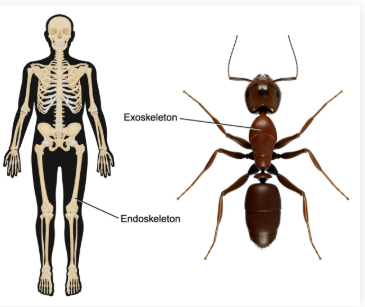
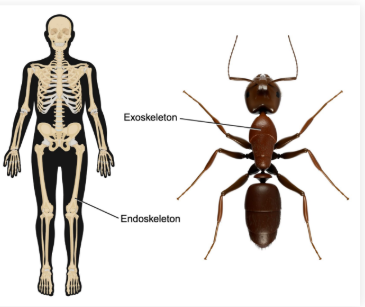
Exoskeleton

Exoskeleton: An external skeleton

  • Utilized by many invertebrate animals and all Arthropods

  • Composed of two protein layers

<p><strong>Exoskeleton</strong>: An external skeleton</p><ul><li><p>Utilized by many <strong>invertebrate </strong>animals and all <strong>Arthropods</strong></p></li><li><p>Composed of<strong> two protein layers</strong></p></li></ul><p></p>
3
New cards

Endoskeleton

An internal skeleton

  • Utilized by vertebrate animals

  • Composed of bone and cartilage

<p>An internal skeleton</p><ul><li><p>Utilized by <strong>vertebrate animals</strong></p></li><li><p>Composed of <strong>bone </strong>and <strong>cartilage</strong></p></li></ul><p></p>
4
New cards

Endoskeleton parts

The endoskeleton can be broken up into the axial and appendicular skeletons
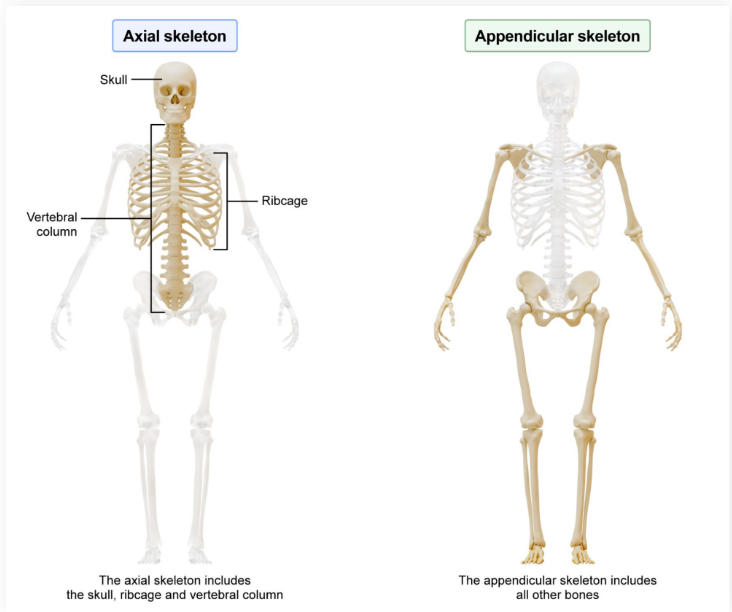
<p>The endoskeleton can be broken up into the <strong>axial </strong>and <strong>appendicular </strong>skeletons</p>
5
New cards

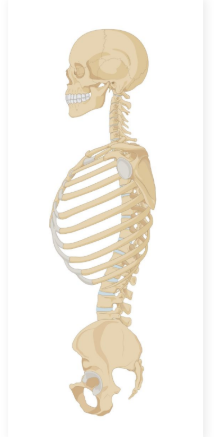
Axial skeleton

The “central bones” of the endoskeleton

  • Includes the skull, vertebral column, and rib cage
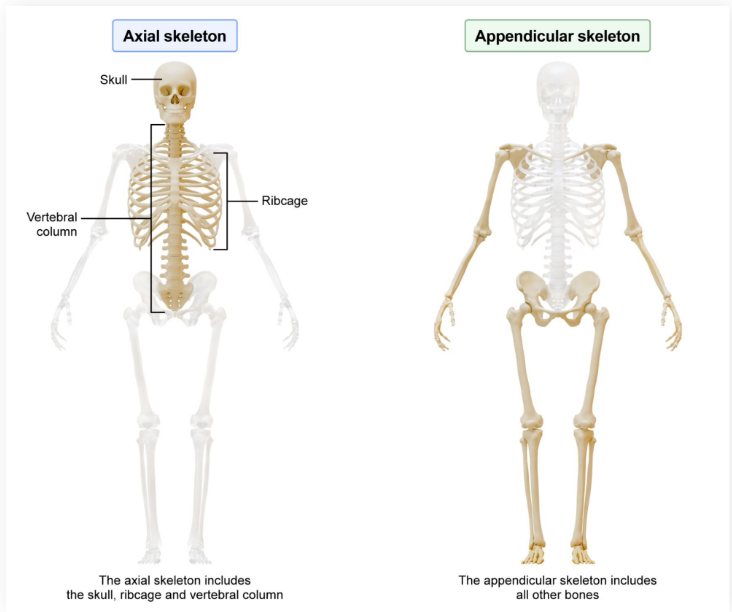
<p>The “<strong>central bones</strong>” of the endoskeleton</p><ul><li><p>Includes the skull, vertebral column, and rib cage</p></li></ul><p></p>
6
New cards

Appendicular Skeleton

The bones of the appendages
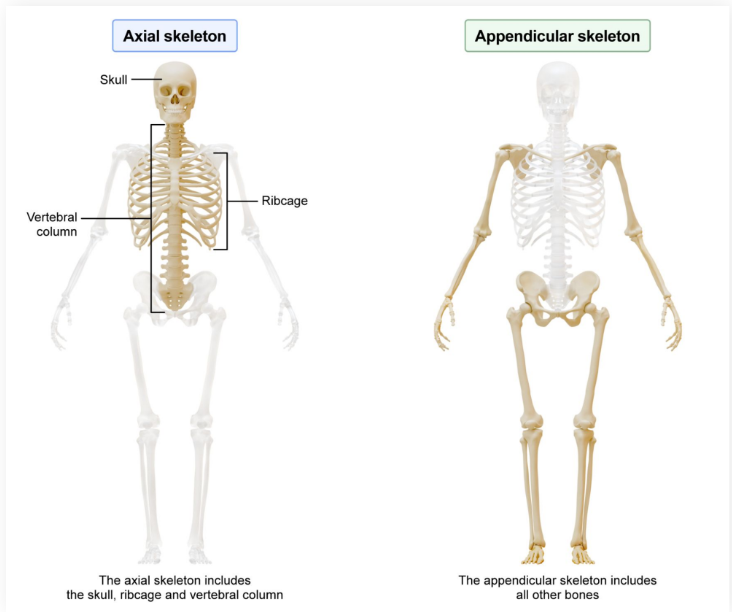
<p>The bones of the appendages</p>
7
New cards

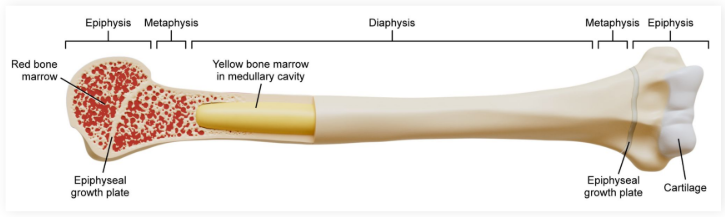
Long Bones

  • Long bones: Cylindrical bones of the appendicular skeleton

  • Longer than wide

  • Important roles include support, movement, and hematopoiesis
<ul><li><p><strong>Long bones: </strong>Cylindrical bones of the appendicular skeleton</p></li><li><p>Longer than wide</p></li><li><p>Important roles include support, movement, and hematopoiesis</p></li></ul><p></p>
8
New cards

Hematopoiesis

Blood cell production

<p><strong>Blood cell production</strong></p>
9
New cards

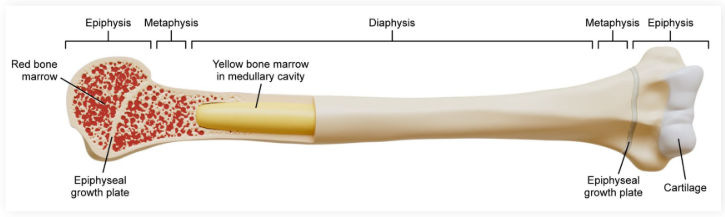
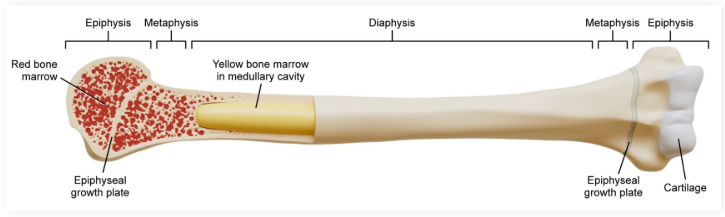
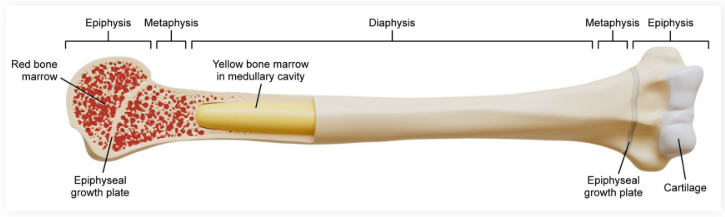
Epiphysis

The end of a long bone that forms joints with other bones

  • Contains red bone marrow

<p>The end of a long bone that forms <strong>joints </strong>with other bones</p><ul><li><p>Contains<strong> red bone marrow</strong></p></li></ul><p></p>
10
New cards

Diaphysis

Long, hollow shaft in the center of the bone
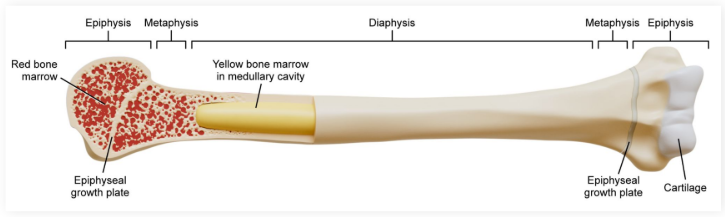
<p>Long, hollow shaft in the center of the bone</p>
11
New cards

Medullary Cavity

Located within the diaphysis

  • Contains red and yellow bone marrow

<p>Located within the <strong>diaphysis</strong></p><ul><li><p>Contains <strong>red and yellow bone marrow</strong></p></li></ul><p></p>
12
New cards

Red Bone Marrow

Produces stem cells capable of generating red and white blood cells
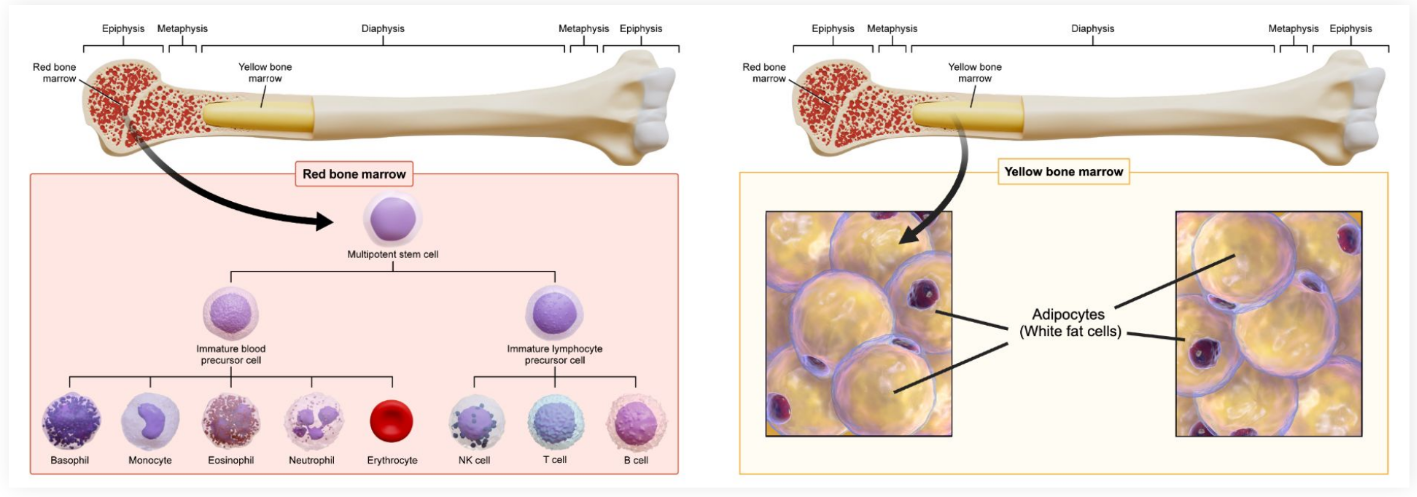
<p>Produces <strong>stem cells </strong>capable of generating <strong>red </strong>and <strong>white blood cells</strong></p>
13
New cards

Yellow Bone Marrow

Produces stem cells capable of generating fat, bone, cartilage, and muscle. Fat can be stored in addition to its production
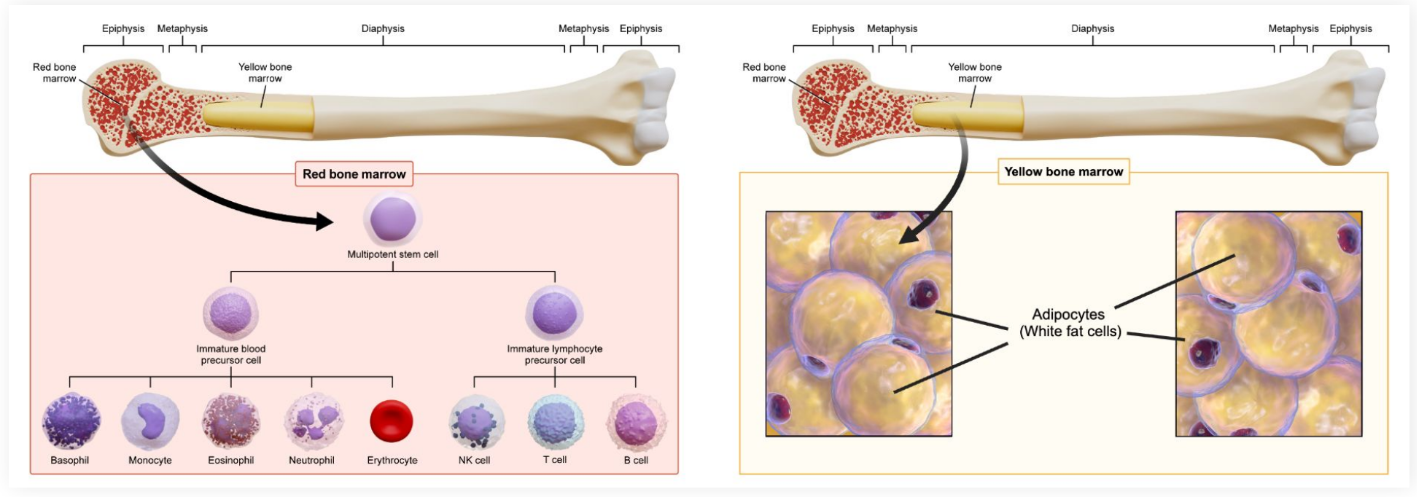
<p>Produces <strong>stem cells </strong>capable of generating <strong>fat</strong>, <strong>bone</strong>, <strong>cartilage</strong>, and m<strong>u</strong>scle. <strong>Fat </strong>can be <strong>stored </strong>in addition to its production</p>
14
New cards

Metaphysis

Found between the medullary cavity and epiphyseal plate

● Similar to the epiphysis

15
New cards

Epiphyseal Plate

Epiphyseal plate:

  • Capable of lengthening the diaphysis through ossification

16
New cards

What are long bones made of?

Pockets of cancellous bone

  • google def: “honeycombed tissue found at ends of long bones”
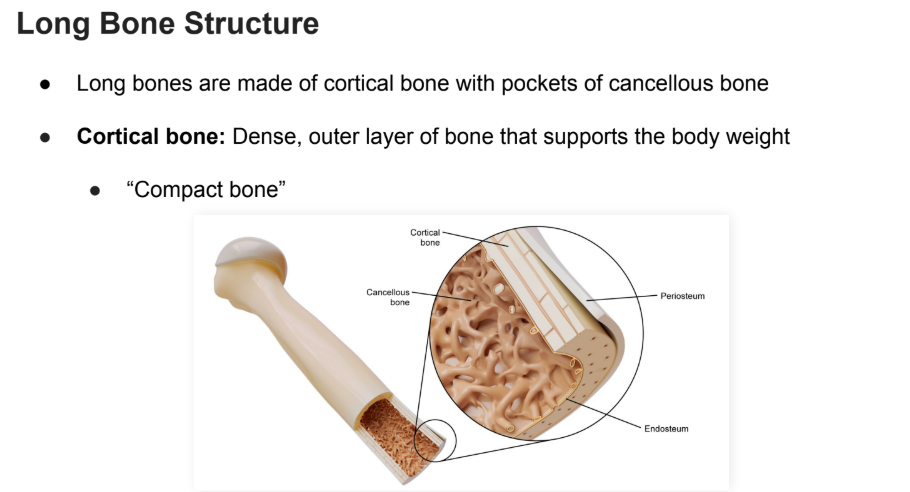
<p><strong>Pockets of cancellous bone</strong></p><ul><li><p>google def: “honeycombed tissue found at ends of long bones”</p></li></ul><p></p>
17
New cards

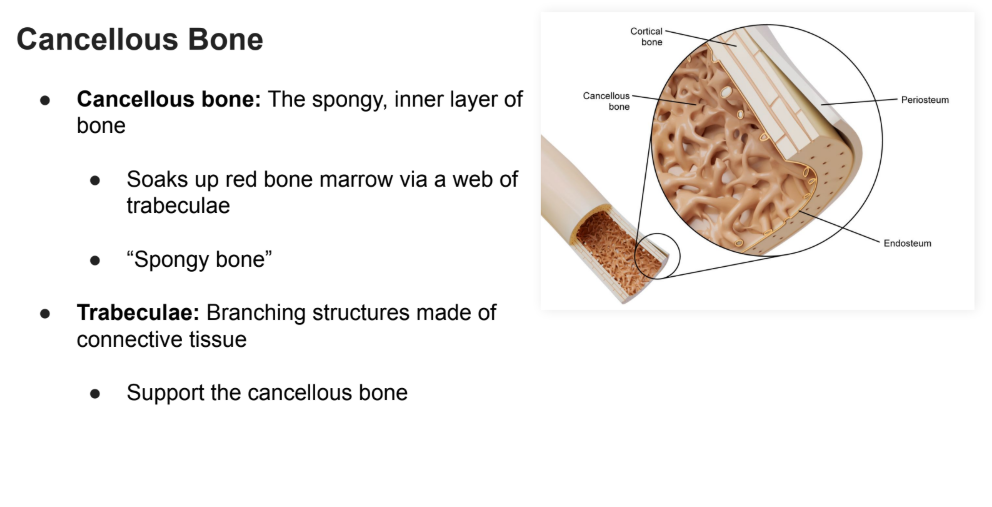
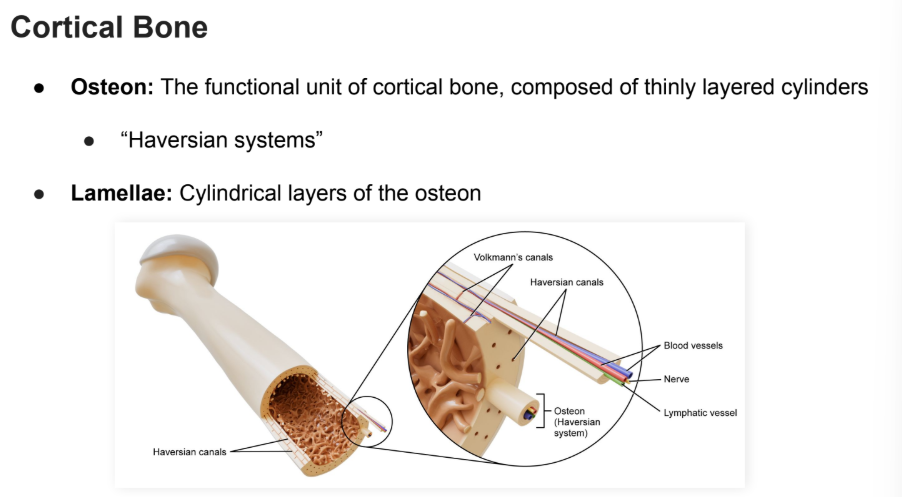
Cortical bone

Dense, outer layer of bone that supports the body weight

A.K.A: “Compact bone”
<p>Dense, outer layer of bone that supports the body weight</p><p></p><p>A.K.A: “Compact bone”</p>
18
New cards

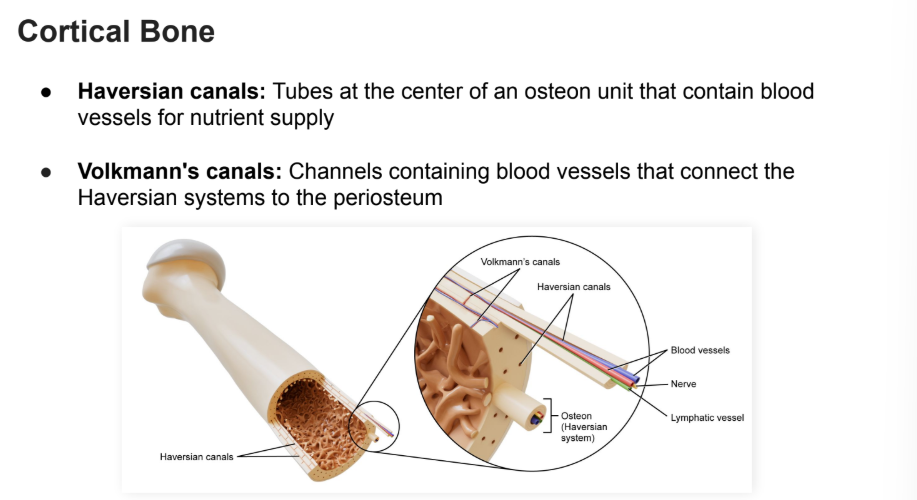
Osteon

The functional unit of cortical bone, composed of thinly layered cylinders

  • “Haversian systems”

Google def: “the fundamental functional and structural unit of compact bone. It acts as a microscopic transport and support network, giving dense bone its incredible strength and ability to heal.”
<p>The functional unit of <strong>cortical bone</strong>, composed of thinly layered cylinders</p><ul><li><p>“Haversian systems”</p></li></ul><p></p><p>Google def: “the fundamental functional and structural unit of compact bone. It acts as a microscopic transport and support network, giving dense bone its incredible strength and ability to heal.”</p><p></p>
19
New cards

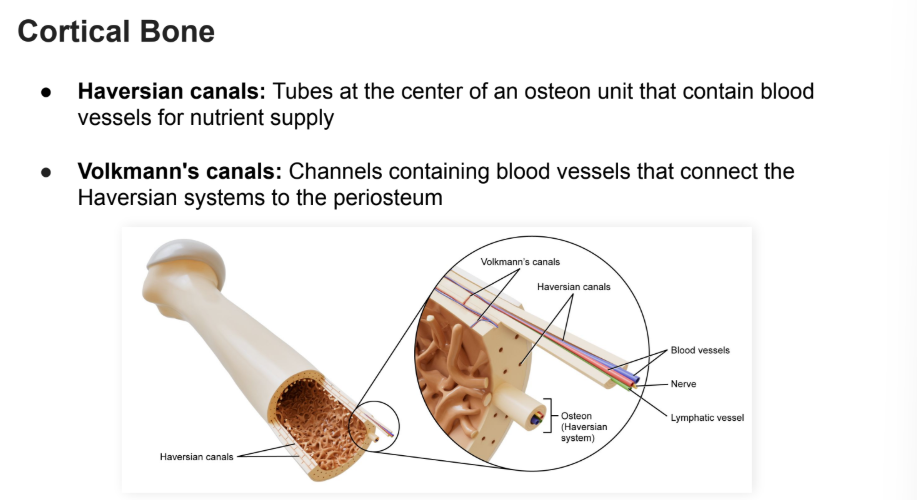
Lamellae

Cylindrical layers of the osteon
<p><strong>Cylindrical layers of the osteon</strong></p>
20
New cards

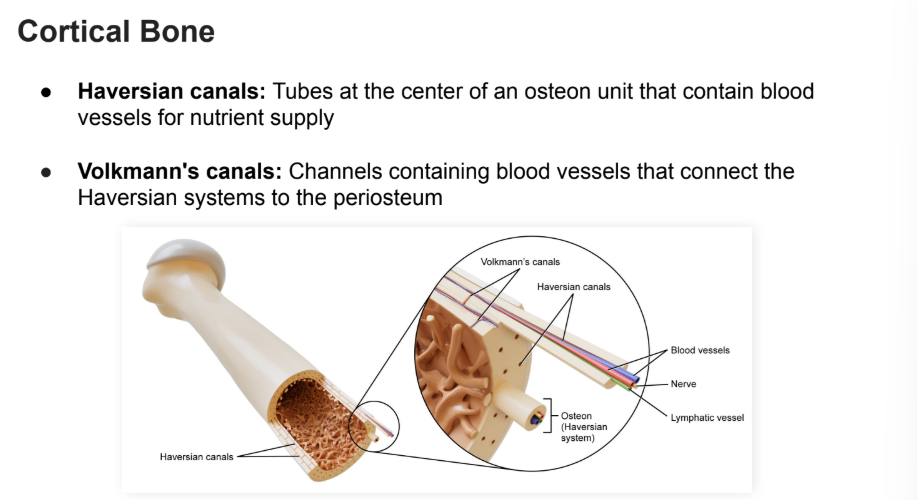
Haversian Canals

Tubes at the center of an osteon unit that contain blood vessels for nutrient supply
<p><strong>Tubes </strong>at the center of an <strong>osteon unit </strong>that contain <strong>blood vessels </strong>for <strong>nutrient supply</strong></p>
21
New cards

Volkmann’s Canals

Channels containing blood vessels that connect the Haversian systems to the periosteum.
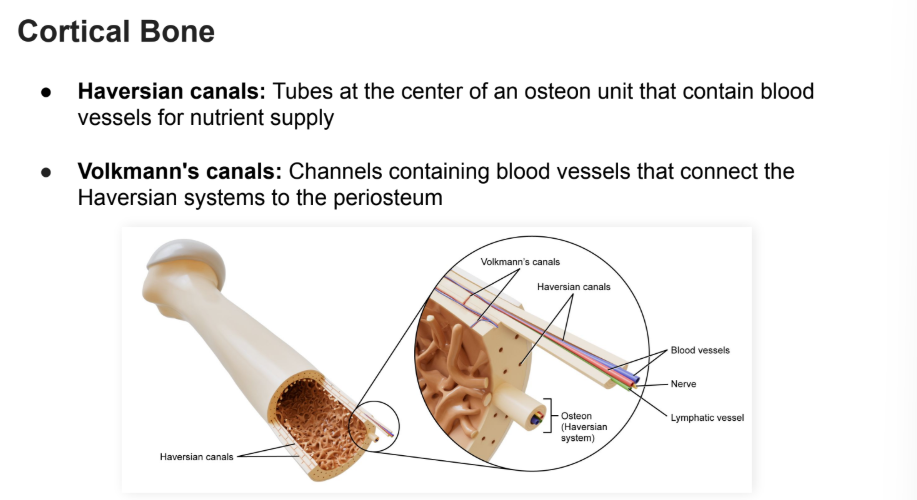
<p>Channels containing <strong>blood vessels </strong>that connect the <strong>Haversian systems </strong>to the <strong>periosteum</strong>.</p>
22
New cards

Periosteum

An external sheath surrounding the cortical bone that provides nutrients in order to promote growth and healing
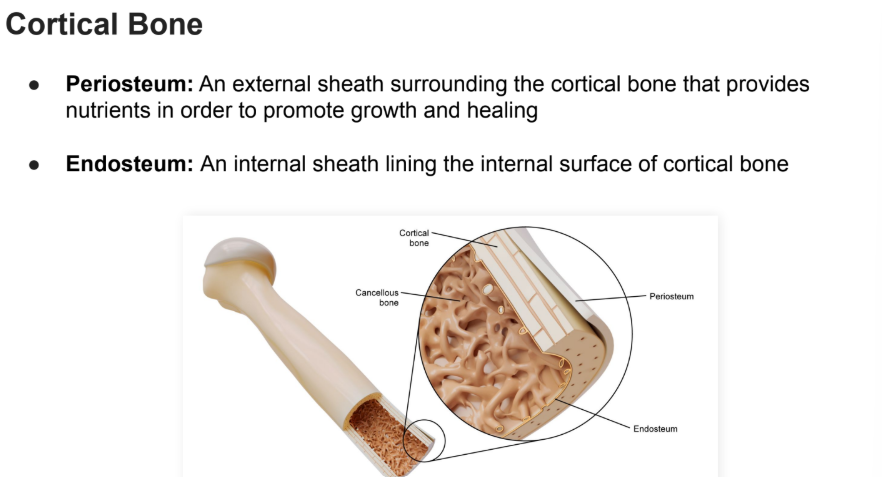
<p>An <strong>external sheath </strong>surrounding the <strong>cortical bone </strong>that provides <strong>nutrients </strong>in order to promote<strong> growth and healing</strong></p>
23
New cards

Endosteum

An internal sheath lining the internal surface of cortical bone
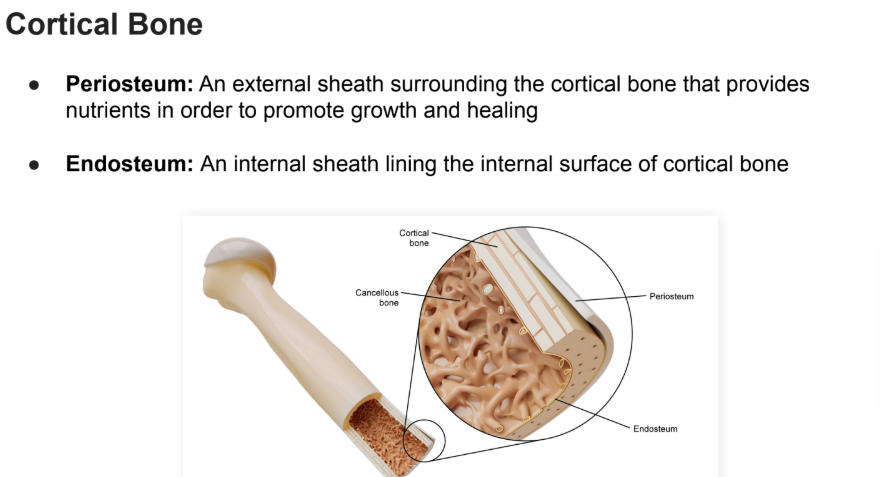
<p>An internal sheath lining the <strong>internal surface </strong>of <strong>cortical bone</strong></p>
24
New cards

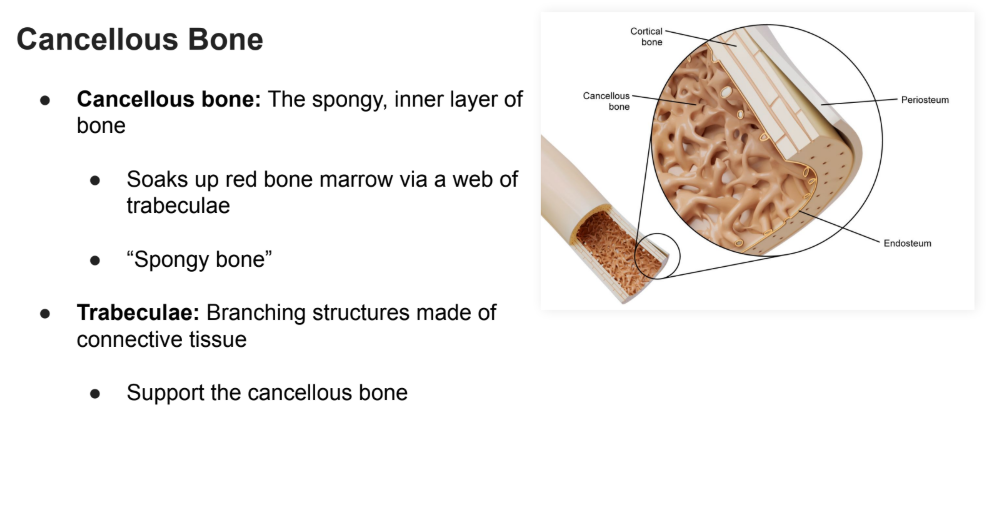
Cancellous Bone

The spongy, inner layer of bone

  • Soaks up red bone marrow via a web of trabeculae

  • Spongy bone”

<p>The <strong>spongy</strong>, inner layer of bone</p><ul><li><p>Soaks up <strong>red bone marrow </strong>via a web of <strong>trabeculae</strong></p></li><li><p>“<strong>Spongy bone”</strong></p></li></ul><p></p>
25
New cards

Trabeculae

Branching structures made of connective tissue

  • Support the cancellous bone

<p><strong>Branching </strong>structures made of <strong>connective tissue</strong></p><ul><li><p>Support the <strong>cancellous bone</strong></p></li></ul><p></p>
26
New cards

Bone Remodeling

● Bone remodelling: The process of alternating between ossification (bone formation) and resorption (bone loss)

● Old bone can be replaced with new bone

27
New cards

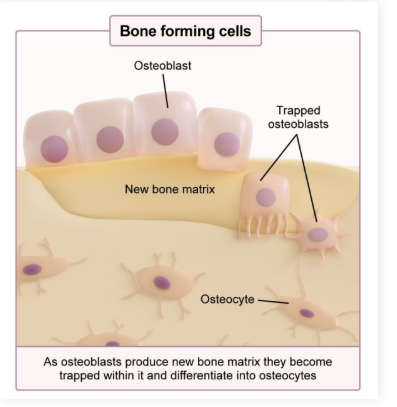
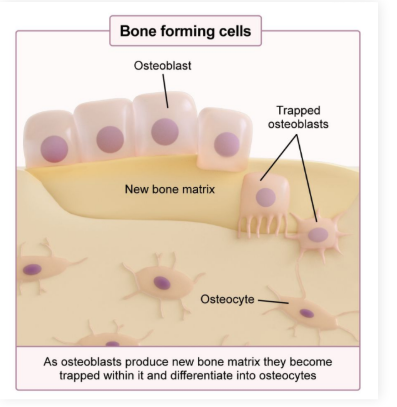
Osteoblasts

Bone building cells

  • Secrete proteins and utilize calcium from the blood

  • Mature into osteocytes

<p>Bone building cells</p><ul><li><p>Secrete proteins and utilize calcium from the blood</p></li><li><p>Mature into <strong>osteocytes</strong></p></li></ul><p></p>
28
New cards

Osteocytes

Mature osteoblasts that have been trapped within the bony matrix

● Live within osteons

Maintain bone

<p>Mature osteoblasts that have been <strong>trapped </strong>within the bony matrix</p><p>● Live within <strong>osteons</strong></p><p>● <strong>Maintain bone</strong></p>
29
New cards

Osteoclasts

Bone Degrading cells

Eat and resorb bone by releasing enzymes and reducing pH (increasing acidity)

  • Release calcium and phosphate back into the blood
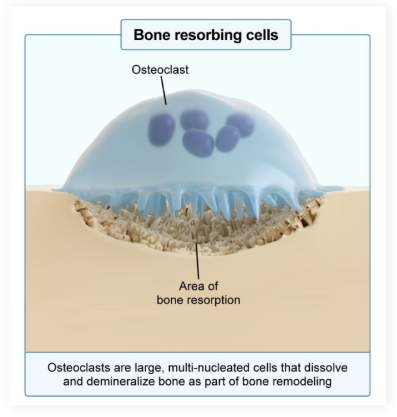
<p><strong>Bone Degrading cells</strong></p><p></p><p><strong>Eat </strong>and <strong>resorb </strong>bone by <strong>releasing enzymes </strong>and <strong>reducing pH </strong>(increasing acidity)</p><ul><li><p>Release <strong>calcium </strong>and <strong>phosphate </strong>back into the <strong>blood</strong></p></li></ul><p></p>
30
New cards

Bone Composition

What is bone made of?

  • Osteoid

  • Hydroxyapatite

31
New cards

Osteoid

Osteoid: Bone’s organic component

  • Contains many proteins, including collagen fibers

  • Provides tensile strength to bone (pulling or stretching without deforming)

32
New cards

Hydroxyapatite

Bone’s inorganic component

  • Mineralized material embedded within the osteoid

  • Contributes to bone density and strength (durability)

33
New cards

Bone remodelling and calcium homeostasis

  • Bone remodeling is involved in maintaining the homeostatic balance of the molecules used to generate bone

    • Key molecule is calcium

    • Increased bone production requires calcium usage, decreasing systemic blood calcium

    • Increased bone resorption frees up calcium from the bone, increasing systemic blood calcium

34
New cards

Calcium Homeostasis Hormones

  • Hormones can manipulate the homeostatic balance of calcium

35
New cards

PTH (parathyroid hormone)

  • Parathyroid hormone (PTH): Increases calcium in the bloodstream

  • Stimulates osteoclasts, increasing bone resorption and releasing calcium

  • Increase reabsorption of calcium in the kidney, decreasing calcium excretion in the urine

36
New cards

Calcitonin

  • Calcitonin: Decreases calcium in the bloodstream

  • Inhibits osteoclast activity, decreasing bone resorption, allowing calcium to remain in bone

  • Decreases reabsorption of calcium in the kidney, increasing calcium excretion in the urine

  • Mnemonic: Calcitonin “tones down” the calcium in the blood

37
New cards

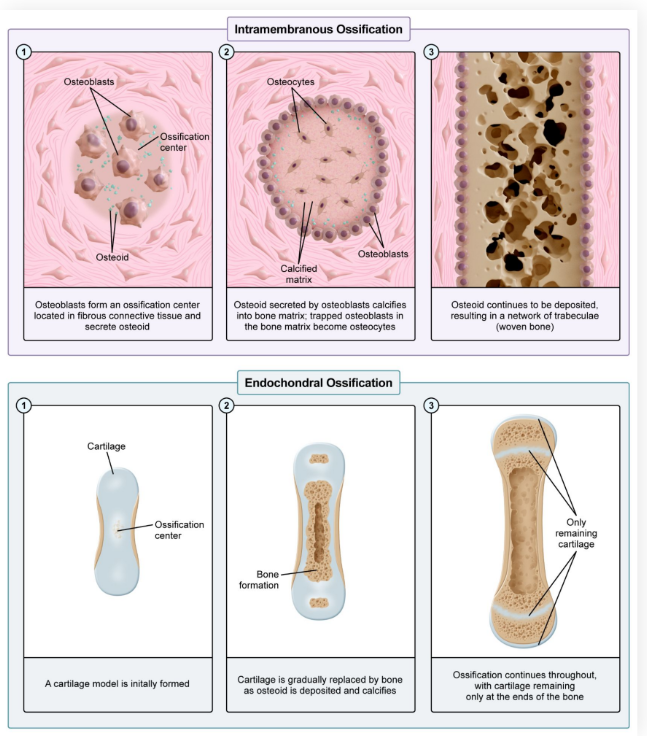
Embryonic Ossification

  • Embryonic ossification: Bone formation during fetal development

    • Models of embryonic ossification:

    • Intramembranous ossification

    • Endochondral ossification

<ul><li><p><strong>Embryonic ossification</strong>: Bone formation during fetal development</p><ul><li><p>Models of embryonic ossification:</p></li><li><p>Intramembranous ossification</p></li><li><p>Endochondral ossification</p></li></ul></li></ul><p></p>
38
New cards

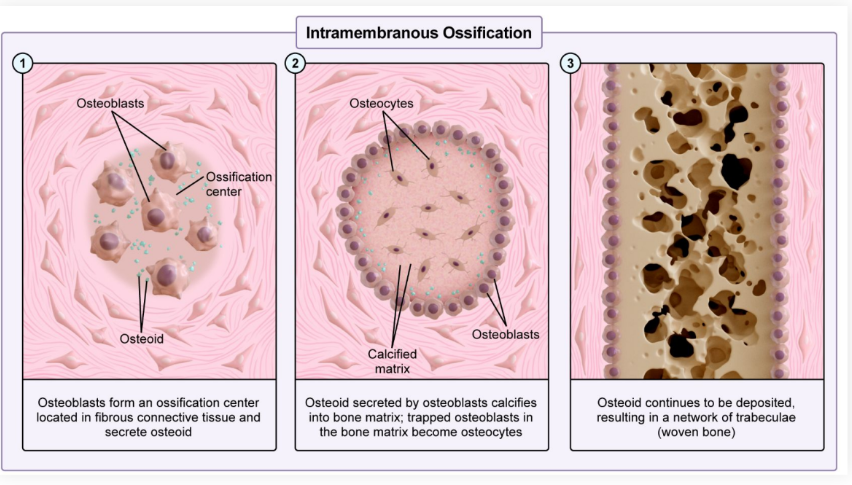
Intramembranous Ossification

Intramembranous ossification: Direct bone formation within sheets of embryonic connective tissue

  • Osteoblasts deposit osteoid

  • Osteoid calcifies and forms cortical bone

  • Occurs mostly in flat bone

  • Include bones of the skull, etc.

<p>● <strong>Intramembranous ossification</strong>: <strong>Direct bone formation </strong>within sheets of embryonic <strong>connective tissue</strong></p><ul><li><p><strong>Osteoblasts </strong>deposit <strong>osteoid</strong></p></li><li><p>Osteoid <strong>calcifies </strong>and forms <strong>cortical bone</strong></p></li><li><p>Occurs mostly in <strong>flat bone</strong></p></li><li><p>Include <strong>bones </strong>of the <strong>skull</strong>, etc.</p></li></ul><p></p>
39
New cards

Endochondral Ossification

  • Endochondral ossification: Indirect bone formation requiring cartilage replacement with bone

  • An initial cartilage model forms first

  • Osteoid is deposited, gradually replacing the cartilage

  • The osteoid calcifies and forms cortical bone

  • Most bones in the body use this model, including long bones and the ribs
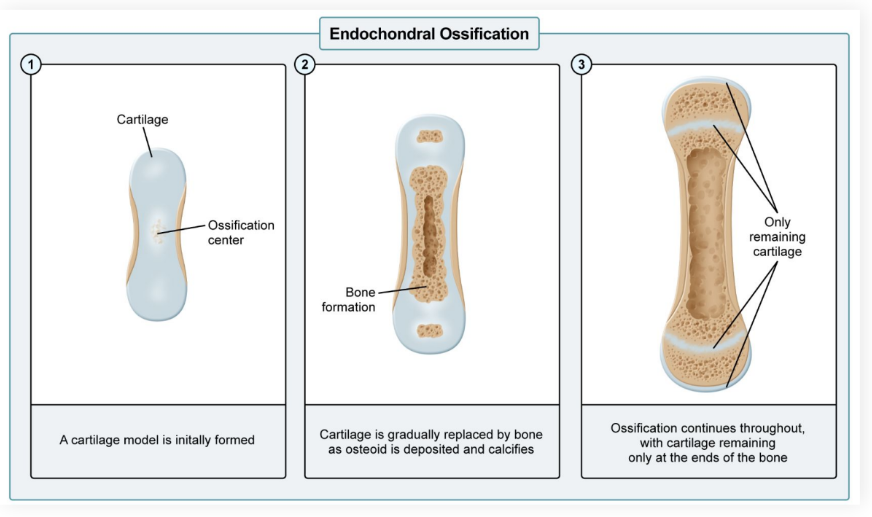
<ul><li><p><strong>Endochondral ossification</strong>: <strong>Indirect bone formation </strong>requiring <strong>cartilage </strong>replacement with bone</p></li></ul><ul><li><p>An<strong> initial cartilage </strong>model forms first</p></li><li><p><strong>Osteoid </strong>is deposited, gradually <strong>replacing </strong>the <strong>cartilage</strong></p></li><li><p>The osteoid <strong>calcifies </strong>and forms <strong>cortical bone</strong></p></li><li><p><strong>Most bones </strong>in the body use this model, including <strong>long bones </strong>and the <strong>ribs</strong></p></li></ul><p></p>
40
New cards

Connective tissue (CT)

A supportive matrix that can be composed of cells, fibers, and a gel-like filler substance

41
New cards

Fibroblasts

  • Fibroblasts: CT resident cells which secrete the constituents of the fibrous connective tissue, maintaining and remodeling the matrix

42
New cards

Fibrous Connective Tissue

CT that contains a high concentration of fibers
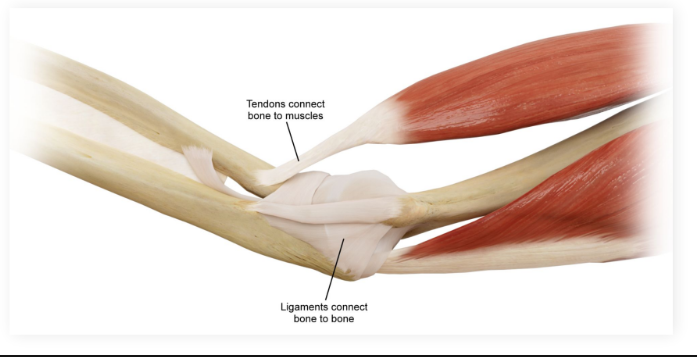
<p>CT that contains a high concentration of fibers</p>
43
New cards

Fibrous Connective Tissue Functions

  • Fibrous connective tissue offers different function throughout the body
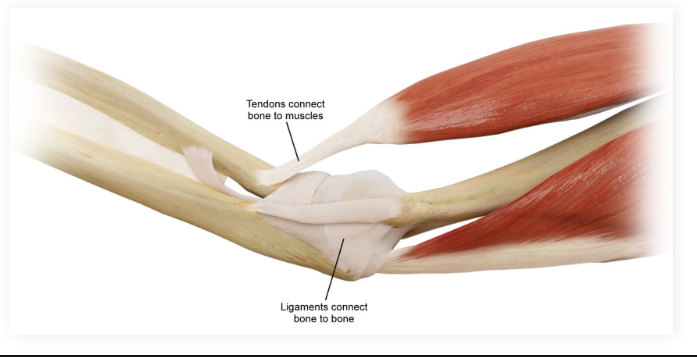
<ul><li><p>Fibrous connective tissue offers different function throughout the body</p></li></ul><p></p>
44
New cards

Tendons

Tendons: Attach muscle to bone

Two types (Muscle to Bone)
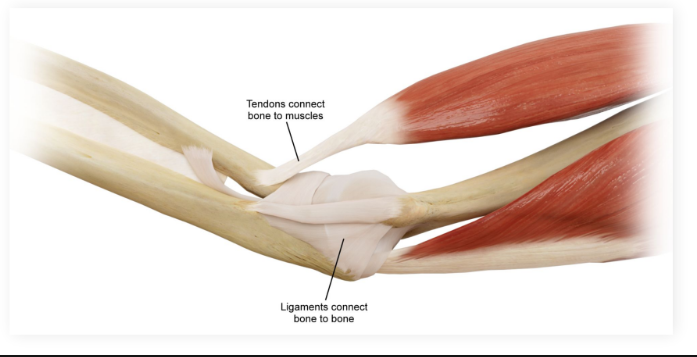
<p><strong>Tendons</strong>: Attach muscle to bone</p><p>Two types (Muscle to Bone)</p><p></p>
45
New cards

Ligaments

Ligaments: Attach bones to other bones

(Like to Like)
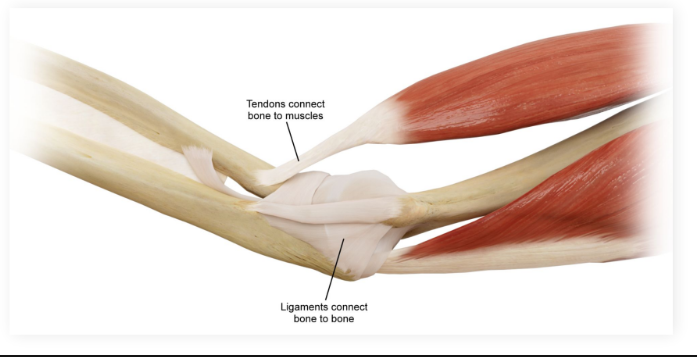
<p><strong>Ligaments</strong>: Attach bones to other bones</p><p>(Like to Like)</p>
46
New cards

Periosteum

External sheath surrounding cortical bone

  • Provides nutrients and innervation to the bone
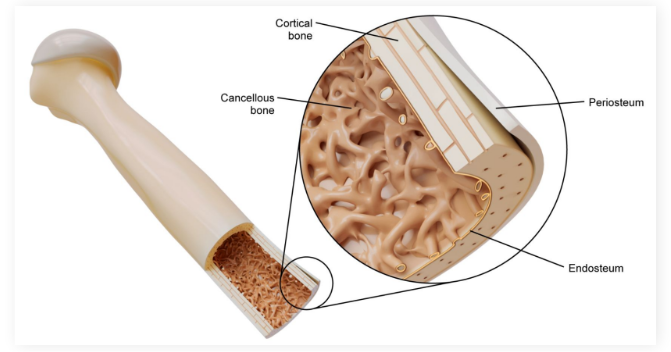
<p>External sheath surrounding cortical bone</p><ul><li><p>Provides nutrients and innervation to the bone</p></li></ul><p></p>
47
New cards

Endosteum

Internal sheath that exists between the cortical and cancellous bone
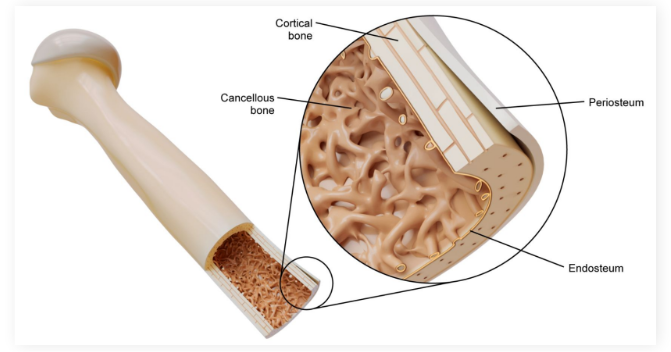
<p>Internal sheath that exists between the cortical and cancellous bone</p>
48
New cards

Cartilage

  • Cartilage: Fibrous connective tissue that does not possess blood vasculature or nerve innervation

  • In comparison, bone is highly vascularized and innervated
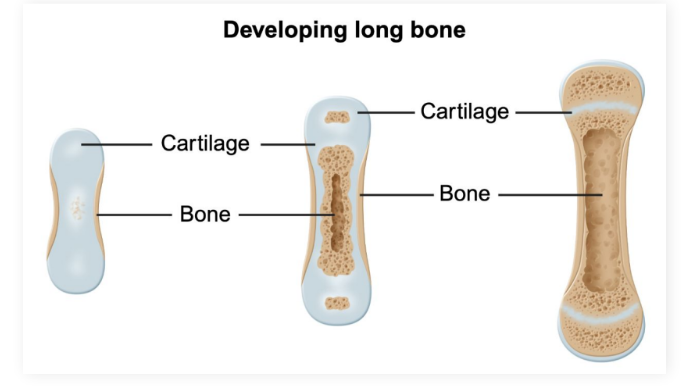
<ul><li><p><strong>Cartilage</strong>: Fibrous connective tissue that does not possess <strong>blood vasculature </strong>or <strong>nerve innervation</strong></p></li></ul><ul><li><p>In comparison, bone is <strong>highly vascularized </strong>and <strong>innervated</strong></p></li></ul><p></p>
49
New cards

Joints

Meeting points between two or more bones

  • Vascularized, innervated, and contains connective tissue

  • Muscles can generate movement at joints

  • Muscles originate on one side of a joint, insert onto the bone(s) on the opposite side of the joint, and contract to generate movement
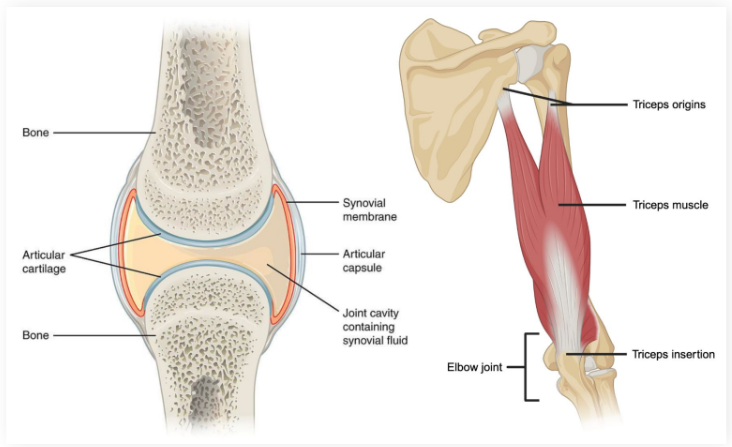
<p>Meeting points between <strong>two </strong>or <strong>more bones</strong></p><ul><li><p><strong>Vascularized</strong>, <strong>innervated</strong>, and contains <strong>connective tissue</strong></p></li><li><p><strong>Muscles </strong>can <strong>generate movement </strong>at joints</p></li><li><p><strong>Muscles </strong>originate on <strong>one side </strong>of a joint, <strong>insert </strong>onto the <strong>bone</strong>(s) on the opposite side of the joint, and contract to <strong>generate movement</strong></p></li></ul><p></p>
50
New cards

What is in charge of secreting calcitonin?

Thyroid Gland

51
New cards

When does the epiphyseal plate ossify?

It ossifies at puberty, turning into bone and preventing further growth.

52
New cards

What is the epiphyseal plate made of?

Hyaline cartilage

53
New cards

What does the epiphseal growth plate lengthen?

The diaphysis

54
New cards

Where does hematopoeisis occur in the bone?

The epiphysis

55
New cards

What do osteoclasts get derived from?

Monocytes, with their primary function being to resorb bone.