EXAM 2 JOHN REIDY (SUMMER 8 WEEK)
 Call Kai
 Learn
Learn Practice Test
 Spaced Repetition
 Match
Match Flashcards
 Knowt Play
1/219

There's no tags or description
Looks like no tags are added yet.
Name | Mastery | Learn | Test | Matching | Spaced | Call with Kai |
|---|
No analytics yet
Send a link to your students to track their progress
220 Terms
What are components of the skeletal system?
ligaments, bones, cartilage
Cartilage
It is more flexible than bone.
It is found in the head, arms, legs, and trunk of the body.
It contains cells and a matrix.
Growth from within cartilage is called ______.
interstitial growth
The matrix of bone is solid due to deposition of minerals in the matrix, known as_____
calcification
What is the best description of the skeletal system?
It is composed of dynamic, living tissues.
What type of tissue is cartilage?
connective
functions of cartilage
It supports soft tissues.
It provides a gliding surface at joints.
It provides a model for the formation of bones.
Growth along the periphery of cartilage is called _______growth.
appositional
Functions of bone include ______.
-support
-mineral storage
-blood cell formation
-protection
Another term for calcification is_____
mineralization
Bones provide structural support for the body by serving as a(n)_____ for the entire body.
framework
Bone A, in the picture provided, is classified as a(n) ______ bone.
Long
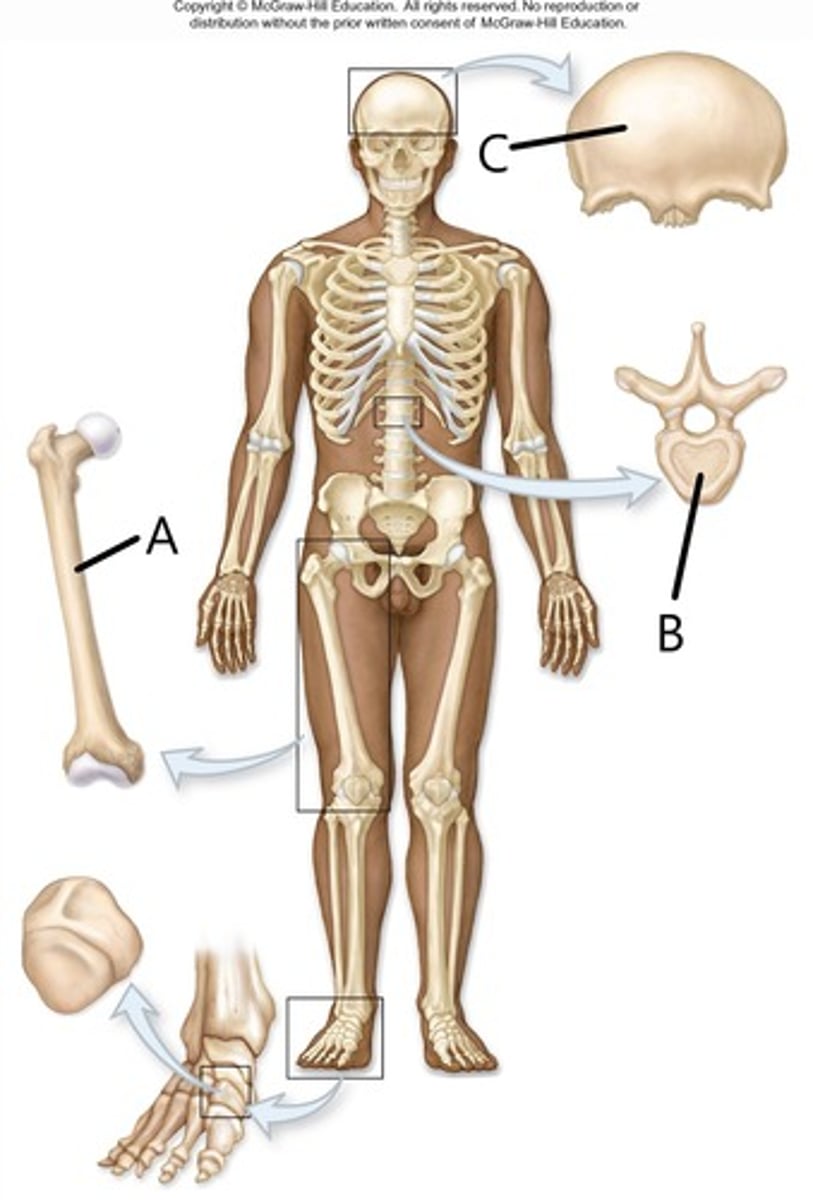
The elongated cylindrical shaft of a long bone is called its ______.
diaphysis
Which is a function of bone?
Protection of organs
The expanded end of a long bone is called the_____
epiphysis
Which organs are protected by bones?
brain, heart, lungs, reproductive organs
In adults, the remnant of the epiphyseal plate is the
epiphyseal line
Bone B, in the picture provided, is classified as a(n) ______ bone.
irregular
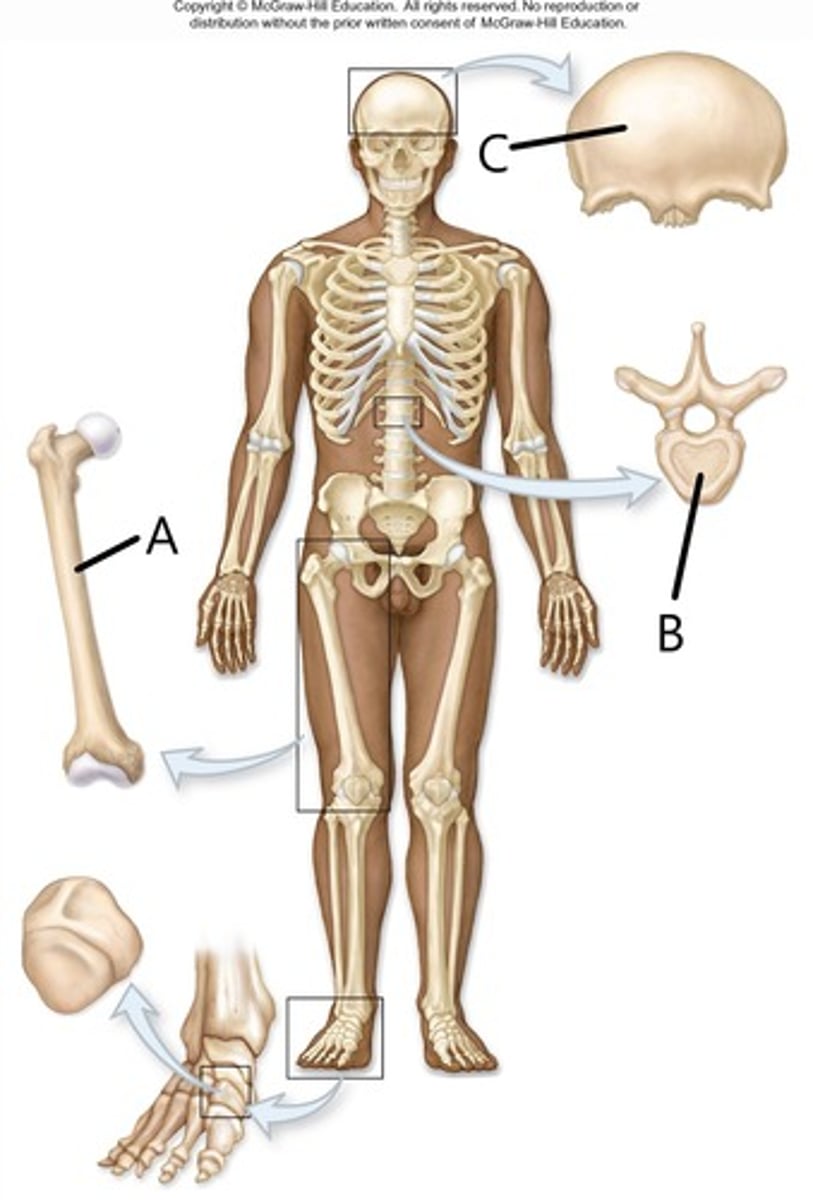
The major weight support of a long bone is provided by the______
diaphysis
What are the basic components of osteology?
bones, cartilage, ligaments/flexible organs
Bones
The rigid organs that form the frame
cartilage
pliable organs
Ligaments
flexible organs that connect Bone-to-Bone/Cartilage
Skeletal system apparent functions
•Acts as anchors and levers
•Forms the frame for the body
•Protects the viscera from injury
skeletal muscle inapparent functions
•Balances acids & bases partiallyin ExtraCellular Fluid (ECF)
•Contains HematoPoietic Tissue, i.e. Blood-Producing Tissue
•Stores energy & mineral reservoirs, e.g. Calcium (Ca2+) & Phosphate
•DeToxifies heavy metals, e.g. Lead (Pb) from ECF
A Skeletal ArcheType exists for all_______
Vertebrates
All Crania of Vertebrates evolved from________
common skeletal units
All Carpi of TetraPods evolved from______
common skeletal units
What does Cartilaginous Tissues consist of?
•Consist of ChondroBlasts that mature into ChondroCytes
•Which are in Lacunae
Produce Extra-Cellular Matrices that appear____and_______
gelatinous and semisolid
Which are AVascular so it repairs poorly
Cartilaginous tissues are made up of_____
•PeriChondrium
•Except Articular Hyaline Cartilages and all of the Fibrous Cartilages
Cartilaginous Tissues 3 major tissue types?
Hyaline Cartilage decreases friction
•Fibrous Cartilage provides durability
•Elastic Cartilage provides elasticity
ChondroGenesis proceeds by___ processes
2
Appositional Growth
•Occurs on their Cartilaginous Surfaces
•Within its PeriChondrium
Interstitial Growth
•Occurs in their Cartilaginous Matrix
•Within its Lacunae
Name the osseous tissues in order from immature to mature.
3.OsteoProGenitors
2.OsteoBlasts
1.OsteoCytes
how does the long bone grow?
What are OsteoProGenitors?
•Appear as squamous Cells
•Are ancestral MultiPotential Stem Cells
•Generate multiple OsteoBlasts
•Developing Humans to produce new Osseous Tissue
•Developed Humans to repair old Osseous Tissue
•Located in EndOsteum & in PeriOsteum
What are OsteoBlasts?
Builders
•Appear as cuboidal Cells
•Are immature “Bone Building” Cells
•Participate in OsteoGenesis
•Produce Osteoid
•Which is a pre-mineralized, gelatinous Matrix
•Secrete Proteins, e.g. Alkaline Phosphatase
•Which will mineralize the gelatinous Osteoid
•Located in EndOsteum & in PeriOsteum
What are OsteoCytes?
•Appear as stellate Cells
•Are mature “Bone Manage” Cells
•Manage organic & inorganic components of its ExtraCellular Matrix (ECM)
•Located in Lacunae separated by Lamellae
•With their processes in Canliculi
What are OsteoClasts?
Bone-recyclers cells
Where are osteoblasts located?
On bone surface, lining bone of resorption canals.
Where are osteocytes located?
Lacunae and canaliculi of bone matrix.
Where are osteoclasts located?
Bone surface, lining bone of resorption canals.
What is the function of osteoblasts?
Deposit bone matrix; initiate mineralization by releasing matrix vesicles.
What is the function of osteocytes?
Maintain bone matrix; secrete mineral-related signals, regulate calcium and phosphate homeostasis.
What is the function of osteoclasts?
Resorb bone by enzymatic hydrolysis of the mineralized bone matrix.
What is the lifespan of an osteoblast?
1-12 days.
What is the lifespan of an osteocyte?
Years (10-20 years).
What is the lifespan of an osteoclast?
3-14 days.
The ECM of Osseous Tissue include two major classes of Components. What are they?
•Organic
•InOrganic
What is the main organic component of bone?
Type I collagenous fibers.
What fraction of the extracellular matrix (ECM) is made up of the organic component?
One-third (⅓) of the ECM.
How does the organic component of bone respond to compression?
It fails under compression.
What types of mechanical stress does the organic component resist?
It resists bending and twisting.
What is the function of the organic component of bone?
Provides durability to bones.
What is OsteoGenesis Imperfecta?
•Caused by a defect in Type I Collagenous Fibers
•So their Bones fail bending & twisting
•Causes “Brittle Bones”
What is the inorganic component of bone?
Hydroxyapatite — crystals of Ca₁₀(PO₄)₆(OH)₂
What is the chemical formula of Hydroxyapatite?
Ca₁₀(PO₄)₆(OH)₂
What fraction of the extracellular matrix (ECM) is made up by the inorganic component?
⅔ of the ECM
How does the inorganic component respond to bending and twisting?
It fails — not resistant to bending or twisting
What kind of force does the inorganic component resist?
Compression
What property does the inorganic component provide to bones?
Rigidity
What is OsteoMalacia?
•Caused by deficiency of Vitamin D that causes deficiency of Calcium
•So their Bones fail compressing
•Causes “Soft Bones”
•If skeletally immature, termed Rickets
What are Osteons?
•AKA Haversian Systems
•functional/structural “Bone Units”
•Contain Central Canals
•Which contain Vein, Artery, & Nerve (VAN)
•Encircled by ConCentric Lamellae
•Interconnected by Connecting Canals
•Which contain Vein, Artery, & Nerve (VAN)
ConCentric Lamellae have Collagenous Fibers that________
•Alternate orientation
•Are helicoidal
•Resist compression/tension
•Resist rotation/separation
Lacunae contain_____
osteocytes
_______contain their processes that allow diffusion of O2, CO2, etc.
Canaliculi
_______connect a Central Canal to its central Lacunae
Canaliculi
What are the Two Types of Osseous Tissue?
osseus and spongy bone
Compact Bone
•external
•Contains dense, numerous Osteons
•Forms external Cortex
Spongy Bone
•internal
•Contains spaces between Trabeculae
•Lines Medullary Cavity & EpiPhyses
Compact Bone consists of three types of Lamellae:
Circumferential Lamellae
Concentric Lamellae
InterStitial Lamellae
Circumferential Lamellae
•covers its surface
•Which surround the Bone
Concentric Lamella
•forms its Osteons
•Which surround the Central Canals
InterStitial Lamellae
Which are between the Osteons
Compact bone forms______
the Cortices of Bones
What isCompact Bone?
•Along external Lines of Stress, Osteons conduct forces, e.g.
•Compression
•Tension
What isSpongy Bone?
•Consists of both columns and plates that form lamellaeted Trabeculae, which
•Line Medullary Cavities
•Support EpiPhyses
•Contains no Osteons
Along internal Lines of Stress, Trabeculae support the_____
cortex
What is the EndOsteum?
•Is an incomplete, single layer
•Participates in OsteoGenesis & Repair
•Lines the Medullary Cavity
What is the edosteum composed of?
•OsteoProGenitors
•OsteoBlasts
•OsteoClasts
What is the PeriOsteum anchored by?
perforating fibers
what does the periosteum consist of?
•superficial Fibrous Layer
•deeper OsteoGenic Layer
What does the periosteum contain?
•OsteoProGenitors, OsteoBlasts, & OsteoClasts
What does the periosteum cover?
external surface of the bone
Except at Articular Surfaces
Where does the periosteum attach to?
Ligaments & Tendons to Bones
The periosteum participates in____
OsteoGenesis & Repair
What does the periosteum provide route for?
•Innervation by the Nervous System
•Vascularization by the Circulatory System
How are Bones innervated?
•Bone Nerves distributed
•in the Central Canals
•regulate flow of Blood
•Bones Nerves distributed
•in the PeriOsteum
•sensitive to pain
EpiPhyseal Vessels
•both Proximal & Distal
•Vascularize the EpiPhyses
MetaPhyseal Vessels
•both Proximal & Distal
•Vascularize the DiaPhyseal Side of MetaPhyses
Diaphyseal/Nutrient Vessel
•Enters the Nutrient Foramen of the DiaPhysis
•Penetrates Cortex to enter Medullary Cavity
PeriOsteal Vessels
•distributed in PeriOsteum
•Vascularize the Circumferential Lamellae
“Red” Marrow
•Consists predominantly of HematoPoietic Tissues
•In immature Humans, is in the Medullary Cavities of all Bones
•In mature Humans, is in theMedullary Cavities of Axial Bones only
“Yellow” Marrow
•Consists predominantly of Adipose Tissue
•In mature Humans, replaces “Red” Marrow in Appendicular Bones only
Three factors effect Ossification
•EndoCrine Signals, i.e. Hormones
•Nutrients
•Vitamins
growth hormone
hormone secreted by anterior pituitary gland that stimulates growth of bones
thyroid hormone
modulates activity of growth hormone, ensuring proper proportions
calcitonin
Lowers blood calcium levels