AEC/ECON 352 study material
 Call Kai
 Learn
Learn Practice Test
 Spaced Repetition
 Match
Match Flashcards
 Knowt Play
1/32

There's no tags or description
Looks like no tags are added yet.
Name | Mastery | Learn | Test | Matching | Spaced | Call with Kai |
|---|
No analytics yet
Send a link to your students to track their progress
33 Terms
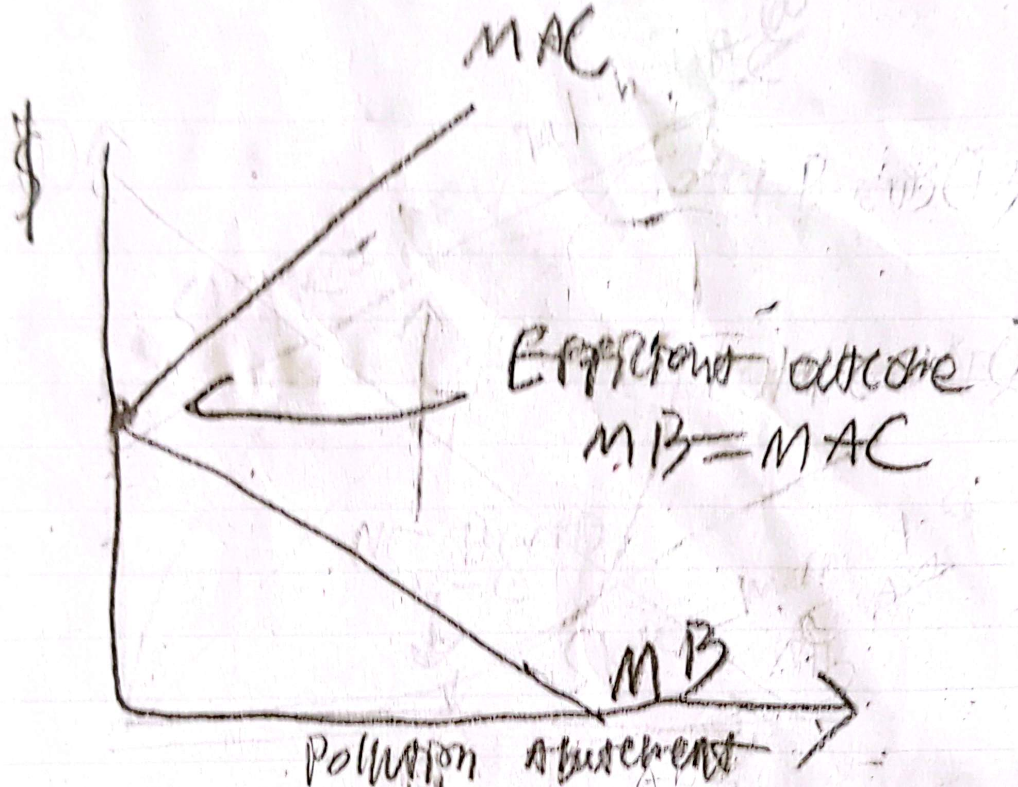
Can the optimal level of pollution ever be zero-pollution? Draw a graph with pollution abatement on the horizontal axis and marginal benefits/costs on the vertical axis and illustrate your answer.
According to the Equimarginal rule. The efficient level of abatement (A*) occurs when the marginal benefits equal the marginal costs, MB(A*)=MC:(A*). Yes, the optimal level of pollution can theoretically be zero.
Markets can result in efficient outcomes only if certain conditions are met. Please list and discuss those three conditions. Of the three, the failure of which condition drives the majority of our society’s environmental problems? Explain using a specific example.
The conditions that have to be met in order to have an efficient market is the following
1. Perfectly Competitive markets
Many firms produce identical products, Lots of buyers, Lots of sellers, Firms are price-takers, Free entry and exit into and out of the market.
2. Perfect Information
Consumers and firms have perfect and instantaneous knowledge of: Market prices, Product Quantity, Product Cost
3. Markets are complete
All relevant costs and benefits are borne by market participants.
The condition failure that drives the majority of our society’s environmental problems would be the condition in which markets are complete because it needs well-defined property rights since it provides security as well as investment. For example if a person’s car doesn’t have property rights, People will steal it.
Define externality. Make sure to include in your answer the three key characteristics related to the impacts of an externality.
An externality results when the actions of one individual or firm have a direct, unintentional, and uncompensated effect on the well-being of other individuals or profits of other firms.
There are four elements of property rights – name and define these elements that must be present for the property right to be well-defined and for markets to be complete.
The four elements of property rights is:
1. Universal or Comprehensive: All resources are privately owned and all entitlements are specified.
2. Exclusive: All benefits and costs incurred as a result of owning and using the resource go to the owner either directly or indirectly.
3. Transferable: Resource owner can transfer rights to others.
4. Secure and Enforceable: Nobody can take away or use a resource in any way not desired by the owner.
The key characteristics for markets to be complete that property rights fail to meet is exclusivity.
State and discuss 3 problems associated with using standards to control emissions.
The problems associated with using standards to control emissions are the following.
1. Standards with the equimarginal principle: When pollutants mix, cost-effectiveness arises from equimarginality. All sources must be controlled so as to have the same MAC. This creates a situation where some abate more, some less. Regulators would have to know the MAC for each and every source of the pollutant to achieve equimarginality.
2. Lack of Incentives: In the short Run: Once standards is met, there is no incentive to do better. One-size-fits-all-policy: doesn’t give flexibility to polluter. In the long run: There won’t be any incentives to create new abatement technology to lower cost of abatement.
3. Enforcement: Penalties are not neccessarily enough to ensure compliance. Enforcement is expensive. Enforcement costs rise with strictness of a standard.
Explain the concept of diminishing marginal returns in the context of open access resources and externalities. After this explanation, demonstrate your understanding of the concept with a specific example.
Diminishing Marginal Returns: They have a deep connection to externalities. It implies that each user of the resource imposes a negative externality on the other users. Open Access externality occurs when unrestricted use will result in over exploitation of the resource. In other words, As the number of people using a resource increases, the benefits from using that resource increase at slower rates. For example, the 1st fisher only cares that they caught 1 kg of fish (marginal private benefit, and ignores that they lowered the catch of others by say 5 kg total. If this continues, the fish population will be depleted, and all of the fishers will suffer lower total returns.
Explain the fundamental reason why environmental problems are difficult to solve (think about the incentives) using market failures such as externalities, public goods, and open access resources to formulate your answer.
A negative externality could result in the output being too large, in prices too low, or no incentives to reduce pollution. With a positive externality people would have to use subsidies to incentives to increase the production and consumption. Environmental problems are expensive to solve and can result in free riding. Lots of parties involved won’t have an easy time trying to bargain.
Consumption of an open access resource is both:
Rivalrous and nonexcludable
The potential Pareto improvement criterion is satisfied if the winners from a given environmental policy could compensate the losers and still be better off - but doesn’t require payment to actually occur.
True
What is the primary component of property rights that is lacking with a public good?
Exclusive
From the article “How Economists see the Environment” by Don Fullerton and Robert Stavins, which of the following is NOT one of the myths about environmental economics discussed in the paper AND in class:
Economists always advocate against environmental justice
An economic cost that is measured by what you give up by doing one thing instead of another (i.e. the value of the best foregone alternative) is called:
Opportunity cost
Each point along a supply curve measures:
Marginal cost

Calculate the net value if 150 people use the playground.
Total Social Value: ∫150 and 0 (129-0.6Q)dQ = [129 -
0.3Q²]150 and 0
129(150) - 0.3(150²) = 19,350 - 6,750 = $12,600
Total Opportunity Cost: 150 x $15 = $2,250
Net Value: $12,600 - $2,250 = $10,350

Calculate the net value is 270 people use the playground.
Total Social Value: ∫270 and 0 (129-0.6Q)dQ = [129 -
0.3Q²]270 and 0
129(270) - 0.3(270²) = $34,830 - $21,870 = $12,960
Total Opportunity Cost:
270 x $15 = $4,050
Net Value: $12,960 - $4,050 = $8,910

How many people use the playground at the market equilibrium? Calculate net value at this equilibrium.
Equilibrium Quantity (Qm): 129-0.3Q = 15 => 0.3Q = 114
=> Qm = 114/0.3 = 380
Net Value at Q = 380
Total Social Value: 129(380) - 0.3(380²) = $49,020 -
$43,320 = $5,700
Total Opportunity Cost: 380 x $15 = 5,700
5,700 - 5,700 = $0
Net Value: $0

How many people use the playground at the social optimum? Calculate net value at this equilibrium.
Social Optimum Quantity (QS):
129 - 0.6Q = 15 => 0.6Q = 114 => Qs = 114/0.6 = 190
Net Value at Q = 190:
Total Social Value: 129(190) - 0.3(190²) = 24,510 - 10,830 =
$13,680
Total Opportunity Cost: 190 x $15 = $2,850
$13,680 - $2,850 = $10,830
Net value $10,830
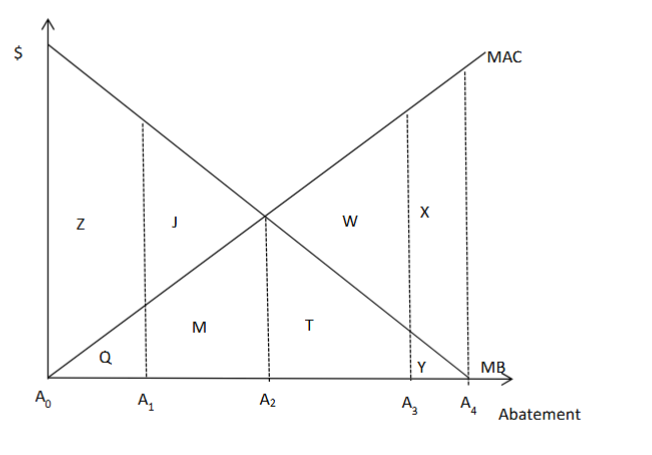
At what level of abatement would a regulator set a standard to maximize net social benefits and what are the net benefits at that level?
A2
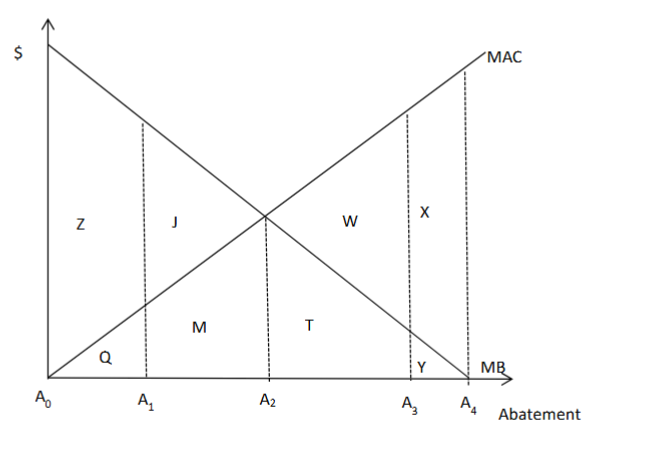
What lettered areas represent the loss in net benefits if the regulator sets the standard at A1 compared to the optimal level?
J
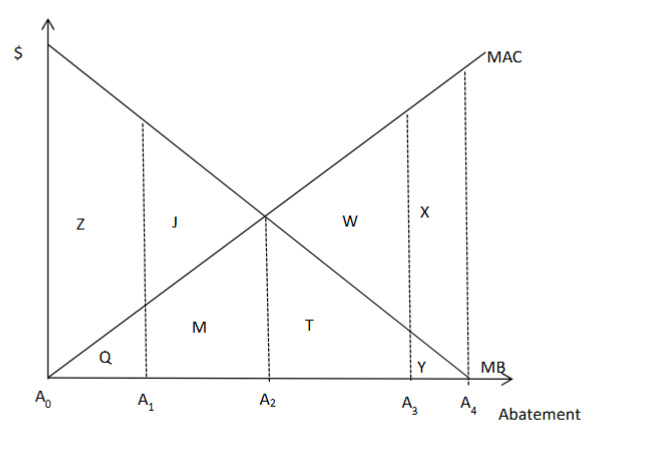
What lettered areas represent the loss in net benefits if the regulator sets the standard at A4 compared to the optimal level?
W + X
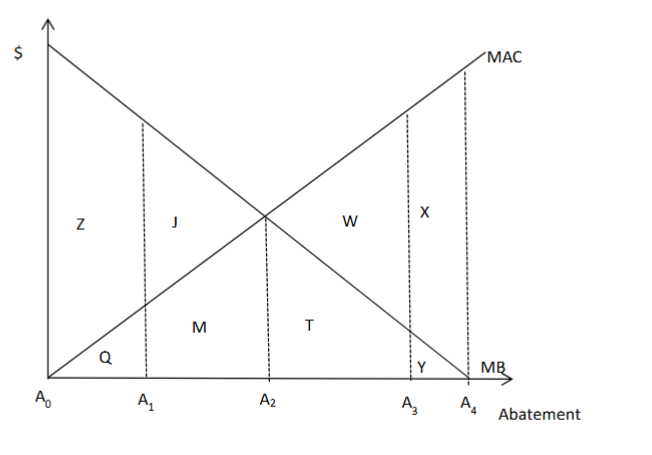
What lettered area represents extra costs the firm would take on if they mistakenly set their abatement level to A4 instead of the optimal level A2?
W + Y + X + T

In the graph above, carefully draw in the market demand curve for this public good.
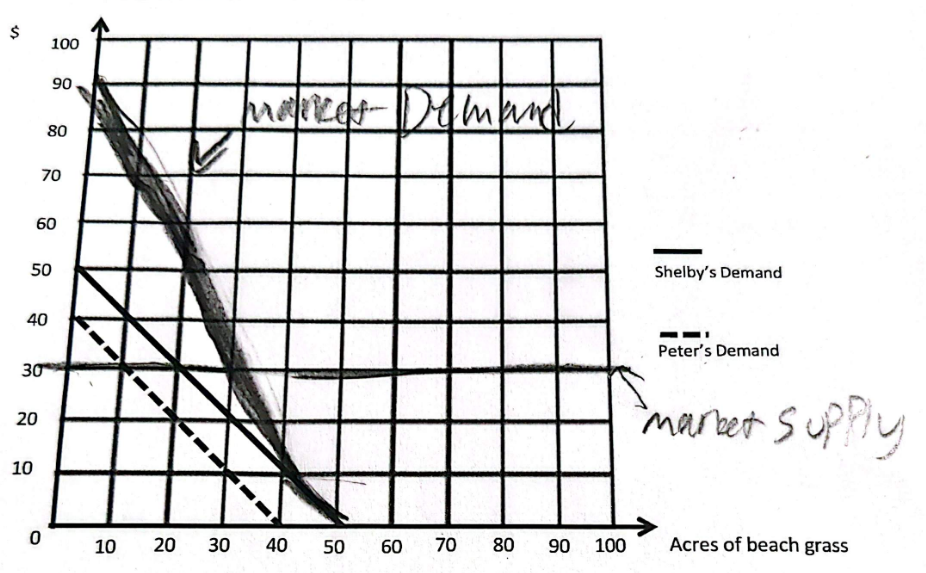
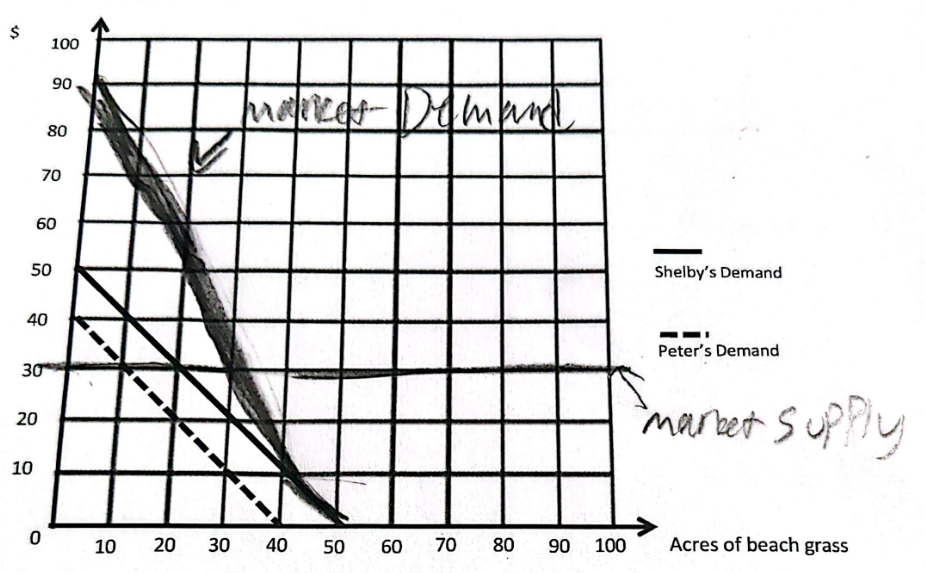
How many acres would be planted in the unregulated market outcome?
At least 20 Acres
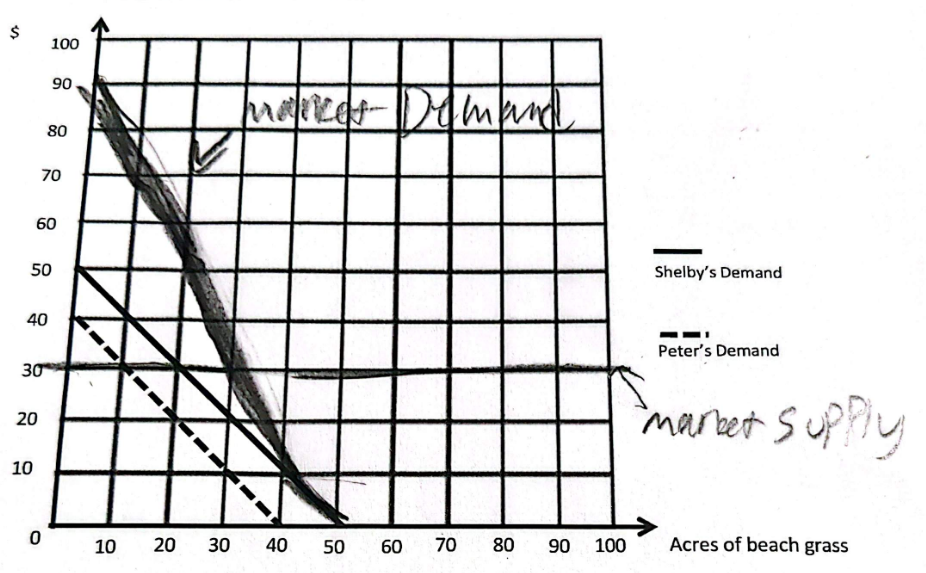
Assume Shelby and Anne are the only two people in the market for beach grass and they ask Shelby for donations first, then they ask Peter. How much of the total amount does Peter purchase?
Peter purchases 0 additional acres
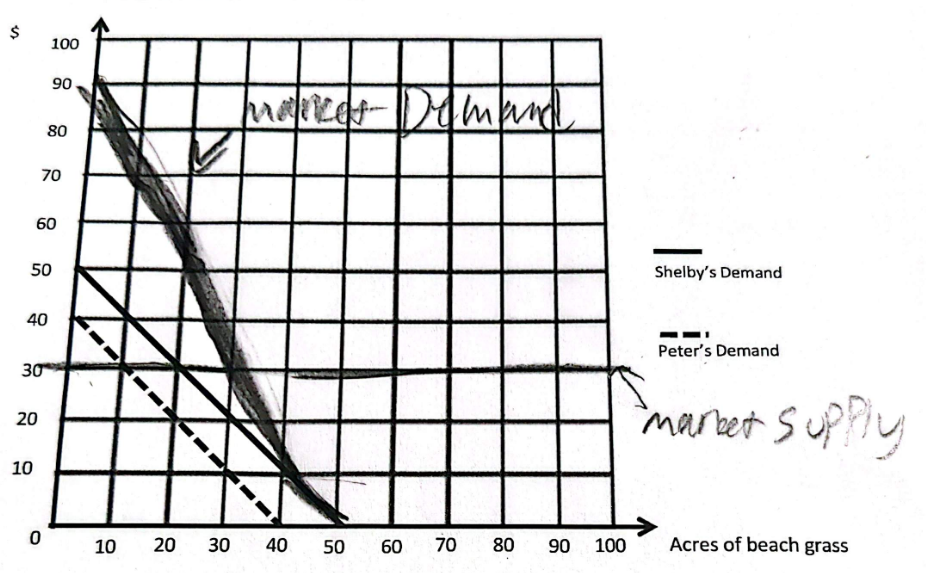
If it costs $30 to purchase & plant an acre of beach grass, what is the socially optimal number of acres to be planted?
Socially optimal amount: 30 acres
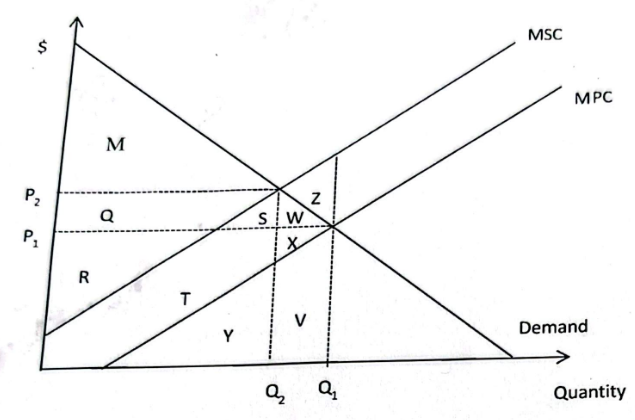
What is the private market equilibrium price and quantity?
Q1, P1
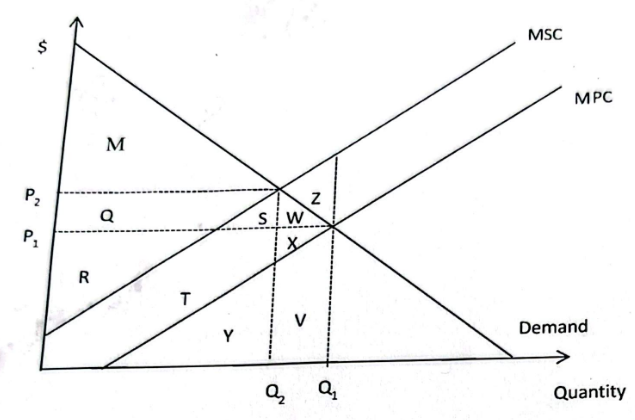
What is the socially optimal price and quantity?
Q2, P2
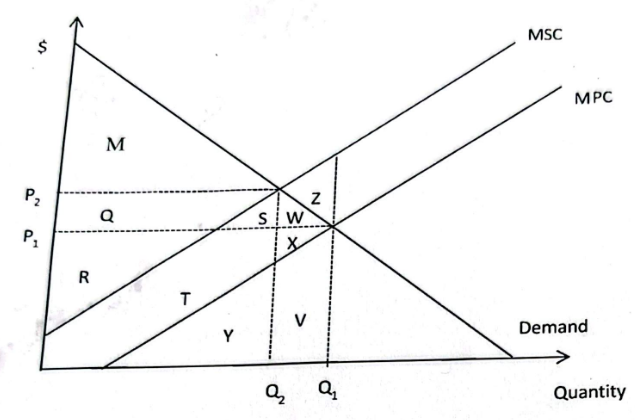
What is the external cost associated with steel production at the private market equilibrium? The socially optimal equilibrium?
At Private Market Equilibrium: Q1 = STWXZ
At Socially Optimal Equilibrium: Q2 = ST
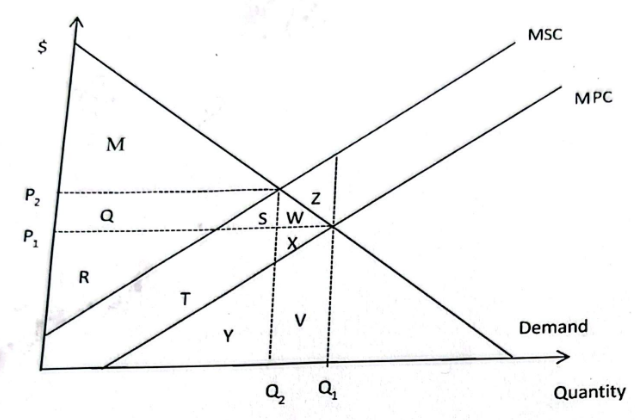
What is the consumer surplus associated with steel production at the private market equilibrium? The socially optimal equilibrium?
At Private Market Equilibrium: M+Q+S+Z
At Socially Optimal Equilibrium: M
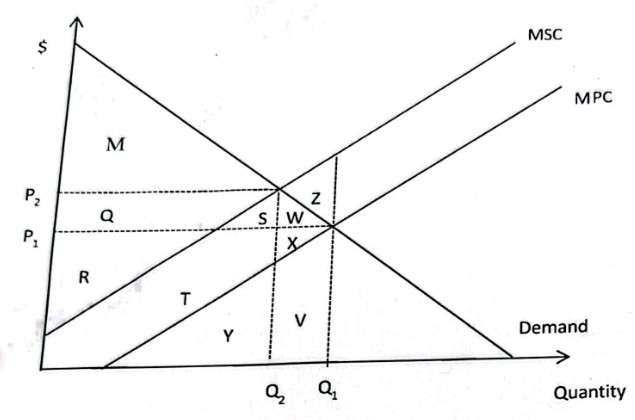
What is the producer surplus associated with steel production at the private market equilibrium? The socially optimal equilibrium?
At the Private Market Equilibrium: R+T+X
At the Socially Optimum Equilibrium: Q+R+T+S
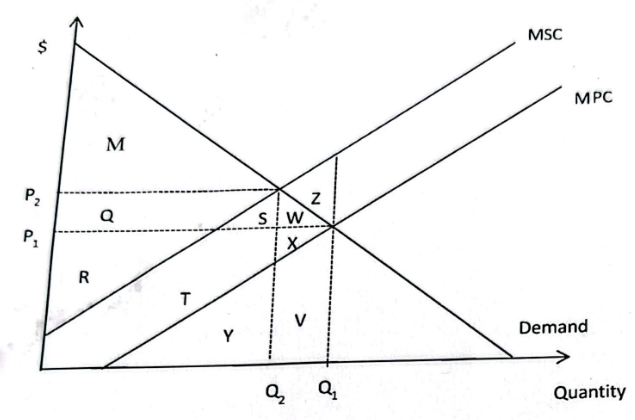
What are the net benefits to society at the social optimum?
NB = CS + PS - EC = M + QRTS - ST = MGR
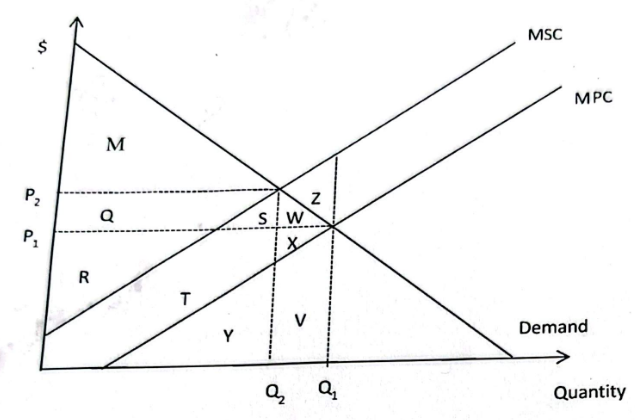
What are the net benefits to society at the market equilibrium?
NB = CS + PS - EC = MQSW + RXT - STWXZ = MQR - Z
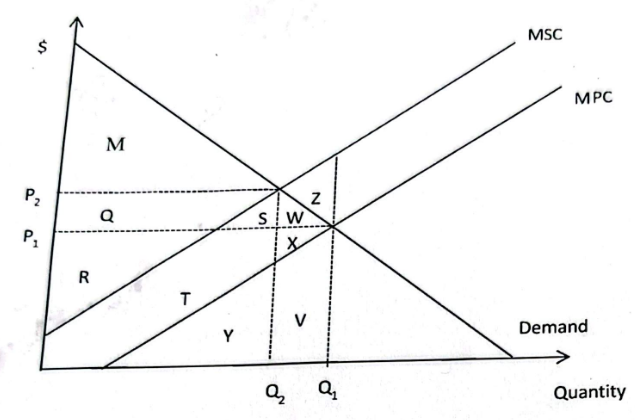
What is the difference in net benefits between the two equilibria? What does it represent and why?
Z is the difference between two equilibria and the deadweight loss because at the private equilibrium (Q1), the marginal social cost of producing those last units exceeds the marginal social benefit.