Partitioning, Counting Principles, and Basic Probability
 Call Kai
 Learn
Learn Practice Test
 Spaced Repetition
 Match
Match Flashcards
 Knowt Play
1/26

Earn XP
Description and Tags
Stats234 week 1 notes
Name | Mastery | Learn | Test | Matching | Spaced | Call with Kai |
|---|
No analytics yet
Send a link to your students to track their progress
27 Terms
Disjoint Events
Also known as mutually exclusive events
Events that are disjoint cannot occur at the same time, as a positive result from one, prevents a positive result in the other events.
For example: when tossing a coin once, you cannot get both heads and tails
Partitioning
Occurs for a sample space (S);
Is a division of S into a collection of events, either simple or compound, such that all of the events are mutually exclusive (disjoint) and mutually exhaustive
Both must be true for a valid partition:
A∪Ac =S
A∩Ac = ∅
Mutually Exhaustive
All of the events in a sample space add up exactly to the sample space, with no leftover space or events.
A∪Ac =S
Mutually Exclusive
Same as Disjoint,
None of the events in a sample space can overlap.
A∩Ac = ∅
What are the requirements for a partition of sample space (S) to be valid?
The events must be:
disjoint (or mutually exclusive),
mutually exhaustive,
CANNOT be independent
Cardinality
The number of elements in the set
For some set, A, cardinality is denoted as N(A)
Fundamental Counting Principle
Also known as the multiplication rule
The number of ways in which a series of successive things can occur is found by multiplying the number of ways in which each thing can occur.
Works best when there are no restrictions…ALL possible choices.
Example: If you own 5 pairs of jeans, 30 t-shirts, and 3 pairs of shoes, you have 5 × 30 × 3 = 450 possible outfits in your wardrobe
Permutation
The number of ways the arrange r out of n DISTINCT (no repeats) items in a row, keeping track of order
read as “choosing r out of n,” with order taken into consideration
formula:
n!
(n - r)!
Combination
The number of ways to choose r out of n distinct items regardless of order
Is read as “n choose r”
Formula:
n!
r!(n-r)!
Factorial
The number of ways to arrange n DISTINCT items in a row:
Used when arranging or grouping objects
n!
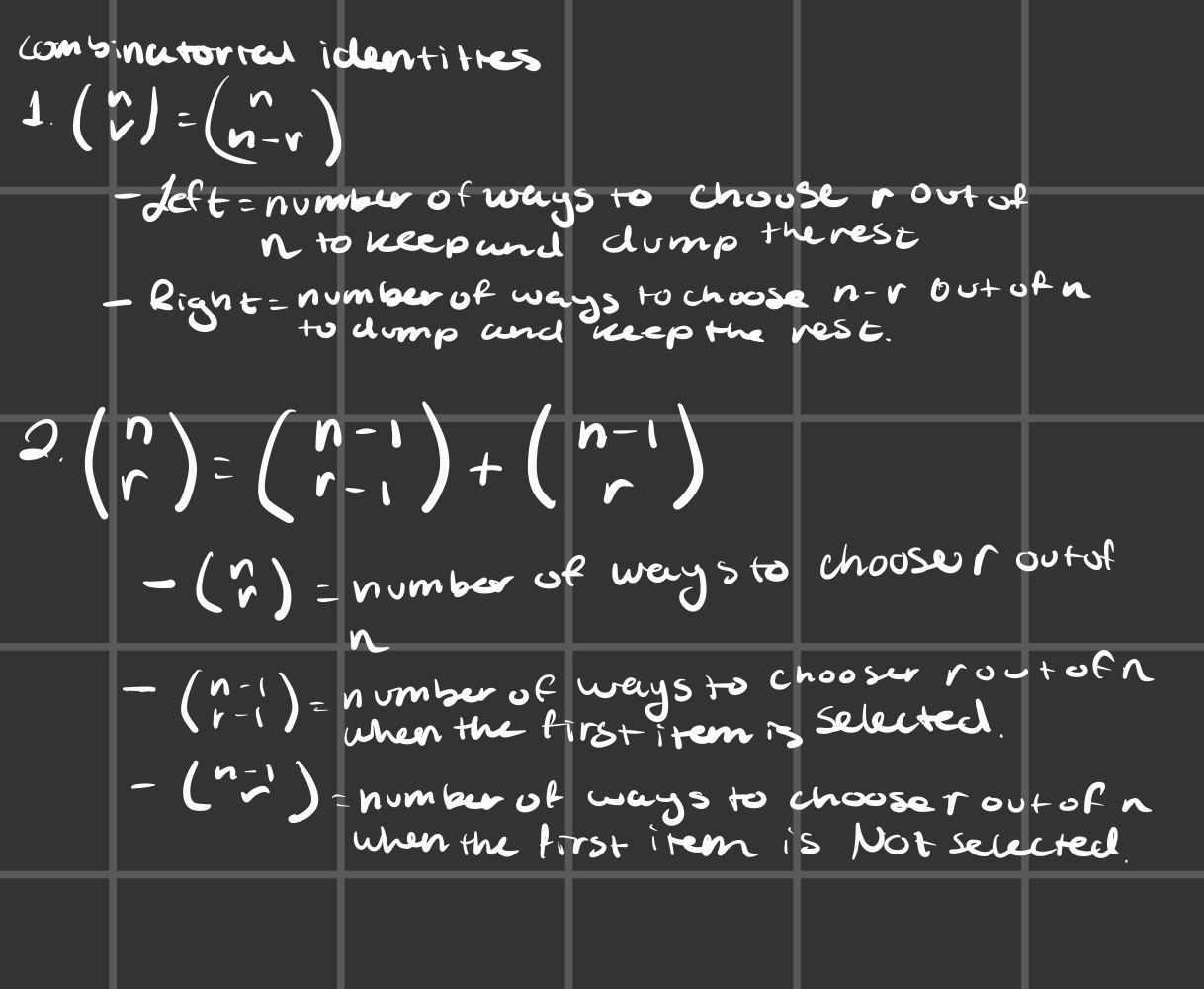
Combinatorial Identities
De Morgan’s Laws
(A∪B)c = Ac ∩ Bc
(A∩B)c = Ac ∪ Bc
Equally Likely Events
The probability of an an event, A, in sample space, S, is equal to the cardinality of A (N(A)) divided by the cardinality of S (N(S)).
N(A)
N(S)
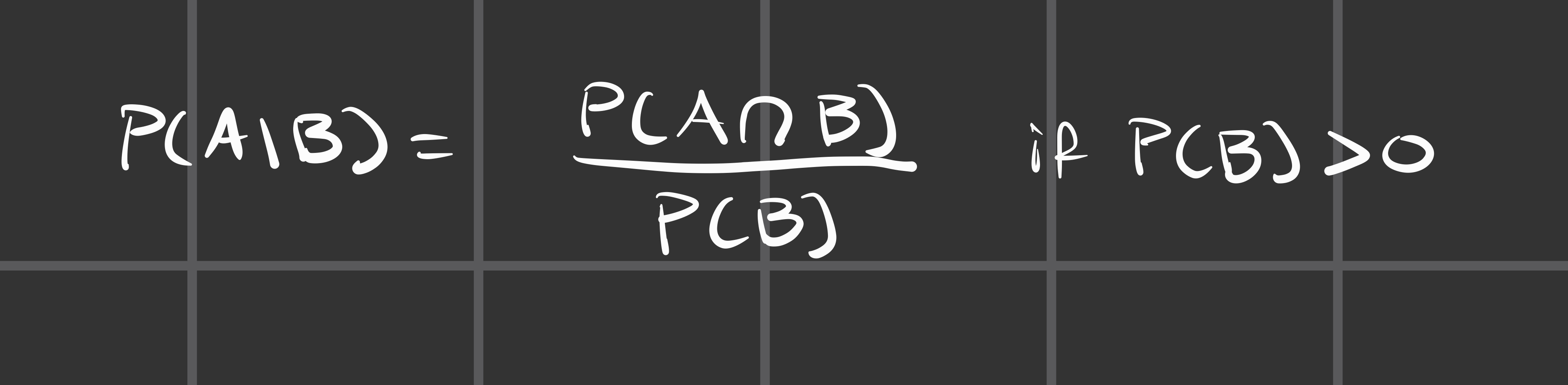
Conditional Probability
Given two events, A and B, we denote the probability of event A happening, given that event B is known to happen as: P(A|B)
This reads as “A given B”
The current information, or the certainty of event B, changes the sample space or the possible outcomes
General Addition Rule
P(A∪B) = P(A) + P(B) - P(A∩B)
The formula above only applies to disjoint event. For independent events,
P(A∪B) = P(A) + P(B)
General Multiplication Rule
P(A∩B) = P(A) x P(B|A)
Probability Axioms
Axiom 1: For any event, A, P(A) > 0
Axiom 2: P(S) = 1, where S = Sample Space
Axiom 3: If A1, A2, A3, … is an infinite collection of disjoint events, then:
P(A1∪A2∪A3∪…) = P(A1) + P(A2) + P(A3) + …
Compliment Rule
P(Ac) = 1 - P(A)
Independence Checks
Two events A and B are said to be independent if any of the following are true:
P(A|B) = P(A)
B happening does not affect A happening
P(A|B) = P(A|Bc)
How likely A is to happening is not affected by B happening or not
P(B|A) = P(B)
A happening doesn’t affect how likely B happens
P(A∩B) = P(A) x P(B)
If any are true, then all are true
Multiplication Rule for Independent Events
P(A∩B) = P(A) x P(B)
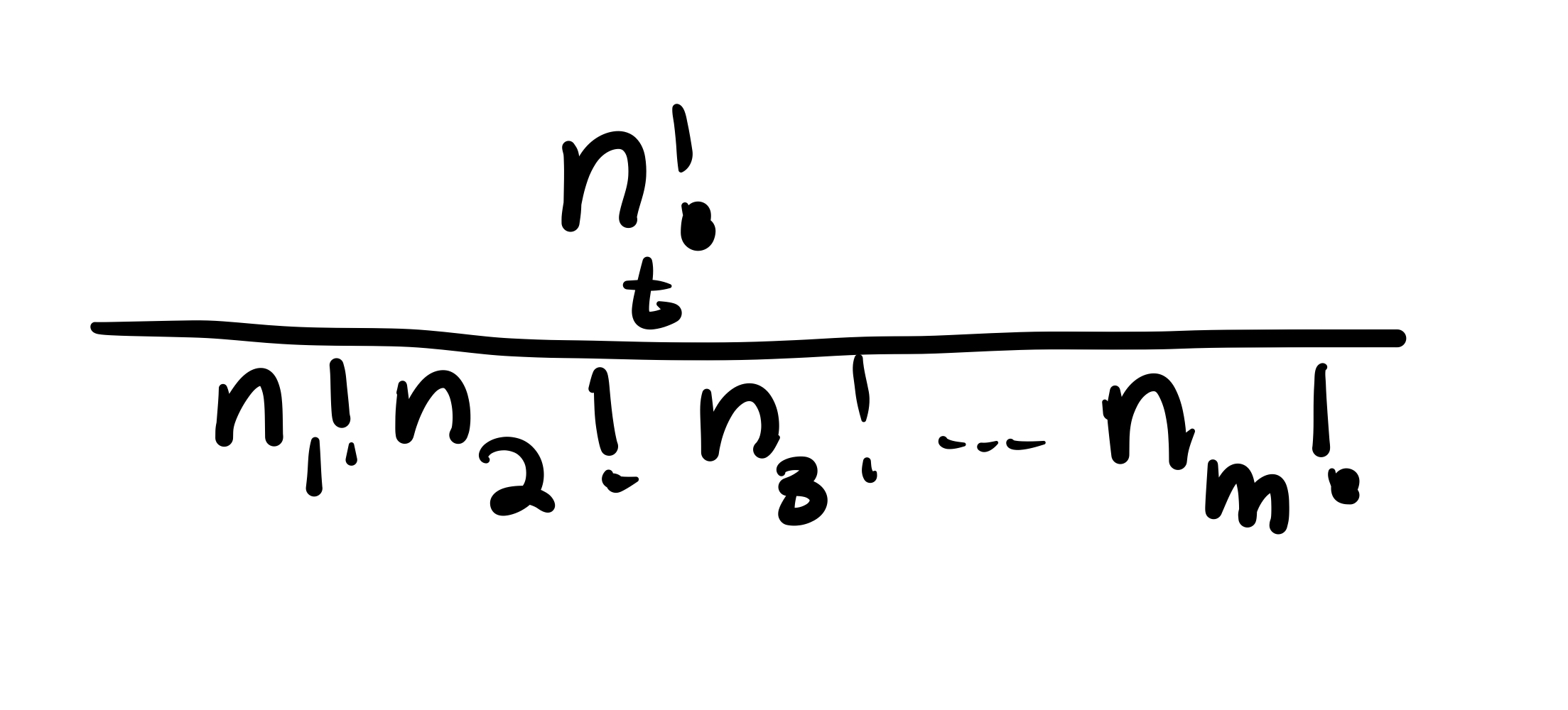
Multinomial Arrangement Formula
Is used to find the number of unique arrangements when arranging objects that have repetitions:
If you have:
n total objects
with repeats of sizes n1, n2, n3, etc.
When a problem that deals with counting asks about arranging objects, use:
factorials
How to prove if an event is disjoint?
P(A∩B) = ∅
Or, in other words, there can be no intersection between the events.
Can a Disjoint event be an Independent Event?
No, disjoint events cannot be an independent event and an independent event cannot be disjoint.
What are the similarities and differences between combinations and permutations?
Similarities:
Both are used for selecting groups
Both deal with distinct, or non repeating, items
Differences
Slightly different formula
order DOES NOT matter for combinations
order MATTERS for permutations
Can you do combinations with replacement of objects?
Yes! This is known as a combination with repetition or a multiset selection
For this type of combination, order does not matter, and items can be repeated.
The formula is different:
(n+r-1)!
r!(n-1)!
General Multiplication Rule for several events
P(A∩B∩C) = P(ABC) = P(A) x P(B|A) x P(C|AB)
P(A∩B∩C∩D) = P(ABCD) = P(A) x P(B|A) x P(C|AB) x P(D|ABC)
etc