WAM II Exam 1
 Call Kai
 Learn
Learn Practice Test
 Spaced Repetition
 Match
Match Flashcards
 Knowt Play
1/130

There's no tags or description
Looks like no tags are added yet.
Name | Mastery | Learn | Test | Matching | Spaced | Call with Kai |
|---|
No analytics yet
Send a link to your students to track their progress
131 Terms
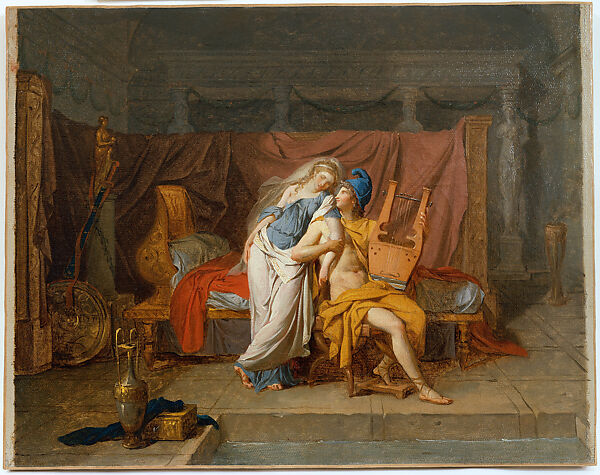
Jacques Louis David
Leading neo-classical painter—”Paris and Helen”
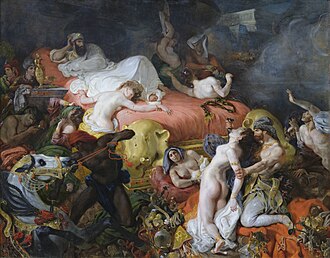
Eugène Delacroix
Painted “death of Sardanapalus" - an assyrian monarch died in fire, romantic. Also painted the tiger hunt
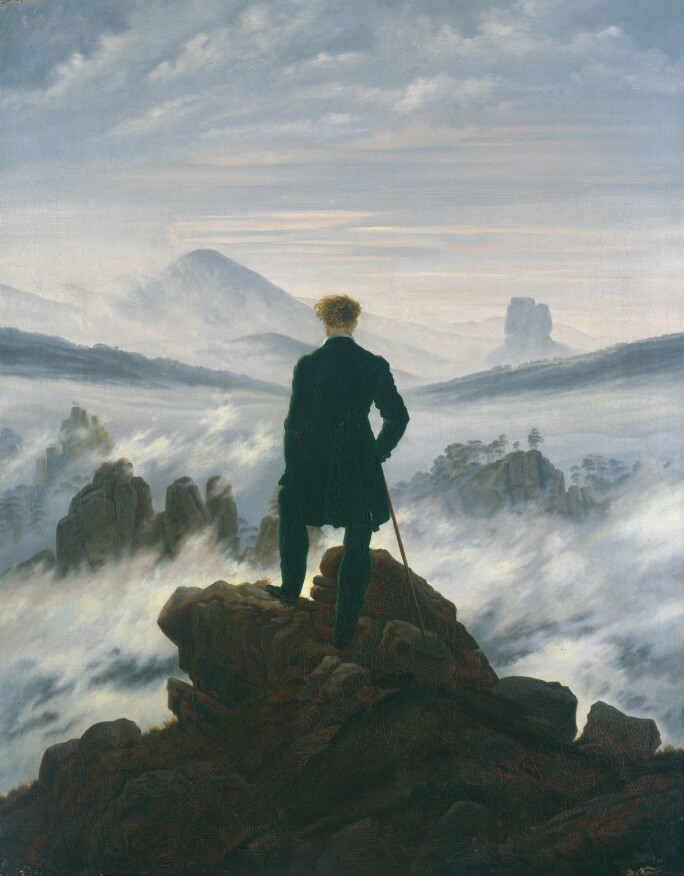
Caspar David Friederich
German Romantic Landscape painter—painted “The wanderer above the sea of fog”
Jean Jacques Rousseau
-Celebrated the power of emotions and individuals over culture and progress
-18th century Swiss philosoph/writer—emphasis on natural man (Noble savage)
-”I may not be better but at least I am different”—apostle of individualism
-Wrote “the social contract”—enlightenment figure
Victor Hugo
-French Romantic author, political liberal
-The Hunchback of Notre Dame (Cathedral bells ringing (holistic interconnectedness of all things/reconciliation of opposites)), Les Miserables (Some works served as the basis for future operas)
-The role of poetry is to reconcile
Friederich Schlegel
-German literary critic, philosopher, and Indologist-Romantic
-Talked about the fragment—poetry/art is always evolving and can’t be pinned down
-Born into a fervently Protestant family, Schlegel rejected religion as a young man in favor of atheism and individualism.
Arthur Schopenhauer
-Had the idea of “the will”—the life force that drives you to long for things, resulting in everyone being fundamentally unsatisfied-irony
-Music is a copy of the will (unlike other arts, music is open-ended/sublime (esp. instrumental music))
-If we really got what we wanted, we’d die of boredom
Richard Wagner
1813-1883
-Reformed opera-Gesamtkunstwerk (new ideal for musical theater where it is a ritual and he is the high priest)
-Music drives the drama
-Born in Leipzig (German), writing librettos by age 20, married an soprano
-He lived in Paris where he was unsuccessful at music publishing
-Found more success in Germany, was 2nd Kappelmeister for king of Saxony in Dresden
-Supported 1848 revolution, fled Germany for Switzerland for 12 years
-King Ludwig II of Bavaria supported him (income helped pay his gambling debts)
-Channels his love affair into Triston/Isolde
-Wanted a permanent festival of operas in specially designed theater
-Died of a heart attack, buried in Bayreuth
-Typical works: Opera/Music drama
Robert Schumann
1810-1856
-Concentrated on piano music until 1840, mostly short character pieces. Focused on larger works after
-1840 was his leider year (120 songs)—first important leid successor to Schubert
-Restless and intense style
-Wrote 4 symphonies, many in 1841, scared of living up to Beethoven
-Wrote chamber music 1842-3
-Uses musical cyphers—represented names with notes
-Got a law degree then studied piano with Clara’s dad, had finger injury
-Founded Neue Zeirschriff Fur Music
-Wanted to marry Clara but had to sue her dad to do so
-He was a little crazy, died after 2 years alone in an asylum
-Hated extravagant operas
-German
-Dichterliebe, Symphony 1, In Der Nacht, Carnaval
-Typical genres: Lieder/Song Cycle, Symphonies, Chamber works, character pieces and piano(!)
Hector Berlioz
-1803-1869
-Big fan of Beethoven
-Byronic hero—emulated literature in his music
-Courted actress (Smithson), she rejected him then relented, but the relationship actually sucked (as seen in Symphonie Fantastique)
-Hated opera tenors, extravagant operas
-Went to med school (French son of a doctor) but hated it, dropped out and studied at Paris conservatory
-Outlived all his friends and died doubting the acceptance of music
-Progressive
-Expansive instrumentation, innovative orchestration
-Heterogenous scoring
-Program music w/extramusical associations
-French
-Symphonie Fantastique
-Symphonies
Franz Liszt
1811-1886
-Piano virtuoso and composer
-Transferred orchestral music to piano
-Hungarian but studied in Paris, extroverted womanizer, showy, admired Pagainini, long fingers that could play tenths
-Son of an official of Esterhazy
-Resigned from performance at height of his career
-Court music director at Weimar
-Moved to rome in 1861, joined clergy
-Socialist—wanted music and art to play a primary role in society (St. Simons)
-Wrote 13 symphonic poems—foremost proponent of program music after Berlioz
-Hungarian
-Les Preludes, Un Sospiro
-Typical Genres: Piano, Symphonic poem
Niccolò Paganini
Violin virtuoso, wrote some very difficult violin music, Italian
Franz Schubert
1797-1828
-Wrote 600 songs, many first performed at home gatherings (schubertiads)—simple, folksy
-Used chromatic coloring, complex modulations
-Known for alternating between major and minor forms of a triad
-Set poetry by other writers
-Son of a schoolteacher and grew up in cosmopolitan Vienna (NOT Germany)
-Won a free education at a 1st class boarding school, taught for 3 years before composing full time
-Nicknames Schwammerl (Mushroom)—not handsome, never married
-Hedonistic and self-destructive, died of syphillis
-Austrian
-Nahe, Gretchen, Impromptu, String quintet in C major
-Typical Genres: Piano character pieces, Lieder
Johann Wolfgang von Goethe
-Created new shape of art called Organicism—works should be shaped so that all the parts are unified by being derived from a common source
-Weimar classicism
Felix Mendelssohn
1809-1847
-Many works were compared to Berlioz
-Mastered sonata and concerto forms, counterpoint, fugue
-Well-travelled son of an affluent family (2 symphonies have geographic titles (Italian/Scottish))
-Child prodigy better than Mozart—virtuoso pianist, wrote concertos to perform
-Balanced audience appeal and sophistication
-Composed St. Paul and Elijah oratorios for choral festivals (amateurs)
-Grandson of Moses Mendhellson (Leading Jewish philosopher), family converted to Protestant as a child (Bertholdy was new surname)
-Musical director of Dusseldorf, Leipzig, founded Leipzig conservatory where Clara and Robert Schumann worked.
-One of the first to have regular concert series—responsible for creation of canon/standard repertory—middle-class listeners wanted to hear the same pieces (Philistines)
-Conductor (Famous for Bach revival) and arts administrator, NOT a journalist
-Popular in England
-German
-Violin Concerto in E minor, Lieder Ohne Worte (Song without words), st paul
-Typical genres: Concertos, oratorios, character pieces
Stephen Foster
1826-1864
-Wrote parlor songs (Domestic music for bourgeoise)
-First American to earn a living solely as a composer
-Jeanie with the Light brown hair
-Parlor songs
Fanny Mendelssohn Hensel
-1805-1847
-Felix’s sister
-Well-trained in music but couldn’t make it a career because she was upper class woman (her family was rich (Jewish roots))
-Married William Hensel (An artist), led a salon where she could play
-Died of a stroke less than 1 year after her first publication
-Put Lutheran Chorale in December (shows assimilation away from Judaism)
-Pieces were played in salons
-German
-December
-Typical genres: Character pieces
L. M. Gottschalk
1829-1869
-Trained on Piano in Paris
-American—sought to imitate new world rhythms, spent time in New Orleans
-Souvenir from puerto rico
-Typical genres: Character pieces
Clara Wieck Schumann
1819-1896
-Pianist, composer, teacher—married to Robert Schumann
-Wrote several Leider collections, co-composed one with Robert
-Stopped composing after Robert died, still performed and taught
-Edited first complete collection of Robert’s works w/Brahms’s help
Style had poetic sensitivity, masterful technique—interpreted Beethoven, Bach, Chopin
-Thought Piano Trio in Gm was her best piece
-German
-Piano trio in G major
-Typical genres: Character pieces, piano pieces
Frederic Chopin
(1810-1849)
-Wrote almost exclusively for solo piano (200 pieces—etudes, nocturnes, etudes, preludes)
-75% of rubato occurances are in his Mazurkas (Stolen time)
-Fan of Bach
-Polish but settled in Paris, popular, had an affair w/George Sound
-Had TB for 10 years then died
-Mazurka, Nocturne in Gb
-Typical genres: Character pieces for piano
E.T.A. Hoffmann
(1776–1822)
In an influential essay, poet, novelist, critic, and composer he lauded instrumental music as the most Romantic art.
Johannes Brahms
1833-1897
-Used traditional and sonata forms but added new and folk idioms
-German-born but lived in Vienna (like Beethoven)
-Liked Hungarian/Gypsy music
-Piano music had full sonorities, rich textures, broken-chord figuration, chross-rhythms, chromatic harmony similar to Chopin/Liszt, songlike, similar style to Schumann
-Generally avoided programmatic titles
-Created developing variation (term dubber by Arnold Schoenberg)
-Friends w/Schumanns—Robert’s printing launched his career, he was in love with Clara
-Worked slowly, very self-critical—only wrote 4 symphonies
-Edited works by CPE Bach, Couperin, etc
-Died of liver cancer 1 year after Clara’s death, buried in Vienna near Beethoven and Schubert
-Composed choral works for amateur performers (En Deuches requiem has german christian lyrics, not latin)
-Critics label him conservative, Schoenberg says progressive
-Piano quintet in F minor, Symphony 4 in e minor, Feldeinsamkeit
-Symphonies, Lied, chamber works
Ludwig van Beethoven
1770-1827
-Bridged classical and romantic styles
-Had early, middle, late period
-Slowly went deaf
-German-born but lived in Vienna
-Symphony 9
-All genres tbh
Thomas Mann
1875-1955
-One of the greatest German writers of the 19th century
-Explored impacts of Beethoven and Romantic thought (Interconnection of all things, sublimation of self in embrace of the infinite)
Anton Bruckner
1824-1896
-Revived 16th century a-capella style (cecilian movement) (Historicism)
-Can tell Palestrina’s music apart because Bruckner’s has chromaticism/harmonic color
-Absorbed Wagner’s style/ethos into traditional symphony and church music
-Wagnerian symphonies—Large and long, lush harmonies, sequential repetion
-Massive blocks of sound (you can see his organ experience in his style)
-Catholic, really good at counterpoint—wrote music that could be liturgy or concert rep
-Served as organist at Linz and Vienna
-Taught at University of Vienna and Vienna Conservatory
-Austrian, progressive
-Christus factus est
-Typical genres: church music (vocal)
Gustav Mahler
1860-1911
-Leading Austro-German composer of symphonies after Brahms and Bruckner (same stuff, just BIGGER)
-Made living as tyrannical/expressive conductor, composed in summer breaks
-Born to Jewish parents in Bohemia, converted to Catholicism to direct Vienna Opera
-Conducted in NYC (Met. Opera, Philharmonic) a lot after 1907
-Symphonies were bold personal statements with implied programs
-Drew from styles of Austrian folk songs/dances—urban nostalgia for rural themes
-Unusually large ensembles (instrumentation)
-Austrian
-Conservative side—suppressed program to symphonies 1-4, symphonies 5-7 and 9 are absolute music
-Nun will die Sonn’ so hell aufgeh'n
-Typical genre: orchestra (BIG)
Richard Strauss
1864-1941
-Lived in 2 musical eras, also conducted (Like Mahler)
-Many works were based on literature or personal experiences
-The enfant terrible/bad boy of modern music
-Extended techniques (flutter tongue in Don Quihote)
-Progressive: thematic transformation, chromaticism, expanded instrumentation, heterogenous scoring
-Retreated from modernism after 1910, forced into conservatism in 1933 by nazis
-German
-Don Quijote variations 1 and 2
-Symphonic poem
Edward Elgar
1857-1934
-First internationally prominent English composer in 200 years
-Gained popularity after Enigma Variations
-Nationalist but happy to adopt wagnerian/brahmsian/german tradition
-Music is untouched by folk songs but linked to national tradition of English Cathedral Choir Festivals
-Used developing variation
-Typical genres: Variations
aesthetics
-Vibe. important to look pleasing in Romanticism
-The ideas behind something
Absolutism
Absolute power in ruling class/king (baroque idea). Art resultingly shows up as heavy, ornamental, extravagant (Think French King Louis XIV)
Enlightenment (Age of reason)
-Resulted in a lot of revolutions
-Emphasis on reason and rationality
-Using reason for reform and social improvemnet
Galant/Rococo
-1725-1770
-Style period between baroque and classical, light, graceful, simplicity
-Bourgeois was starting to move away from absolutism
Classicism
1770-1825
-Clarity/lighter
-Enlightenment rationalism
-Duty, civic values
-Greek/Roman Thought
-Balanced, ordered
-Stasis
-Reconciled galant/rococco and sturm/drang (balanced/tame rollercoaster)
Romanticism + its themes
-1800-1914
-Imbalanced rollercoaster—asymmetrical phrases, keys moving away from tonic/dominant, thematic integration keeps the coaster on its tracks
-Reaction to and outgrowth classicism and enlightenment
-Faith cannot be nailed down by rationality
-Emphasizes nature as a transcendental version of God (Transcendentalism)
-Continues some Classical thought (Emotion, civic values, dynamic balance/symmetry)
-Importance of individual (Economic, political, aesthetic)
-Term “Romantic” comes from medieval romance, narrative verse/prose about heroic figures in exotic settings. First applied to literature, then art and music
-Nostalgia for medieval and religious times
-Against Greek Universalism (The idea that there is one universal truth) because it denies individual viewpoints
Individualism (including capitalism + democracy)
Capitalism—arose from industrial revolution (Improve yourself economically)—war and revolution impoverished the aristocracy, middle class grew—also creates pressure to conform, materialism (bad)
Democracy—Each individual gets a vote
Grew with romanticism (Focus on individual experiences/emotions)
artist vs. society
-Tension between writing music to express yourself (losing out) vs. selling out
-Self-expression vs. marketplace
-Artists criticize but rely on it to make money
fragment
-A musical piece that is small but opens up infinite possibilities
-Aesthetic goal
-Miniatures that are short are fragments because they are open-ended (aesthetically important)
-”What it does”
miniature
-Category of work
-Songs/Lieder and character pieces—new romantic genres
-Imply holistic connections
-Reflect ideal folk simplicity (they’re not overeducated/distracted from authenticity)
-1-3 min long
-Emerge because of individualism—innovative, intimate/personal
-Poetry and music often based on folk ballads
-Simplicity in narrative—end rhyme, 4-line stanzas, often strophic
-Can stand alone or be part of a larger work (Suite, cycle)
-”What it does”
The myth/idealization of “the folk” (Noble savage)
-Folk (agricultural laborer) was the romantic ideal—their lives were simpler, they weren’t overeducated or distracted from living authentic lives
-Noble savage coined by Rosseau, they are the folk
imitation folk ballad/poetry
-Folk-like poem by sophisticated class (Think Nahe des gelibten)
-4-line stanzas, consistent rhyme scheme/end rhyme, a story or narrative is present
harmonic color
-Many Romantic composers used it to aid emotional expression, especially Schubert
-Use of harmony/dissonance
instrumental/timbral color
-The use of various instrument combinations to make emotions more dramatic
figuration
-Textural writing for piano that involves use of repeated lines or motifs—fills in spaces or functions as decoration
-Schumanns and Schubert typically used only one figuration throughout a Lied, similar for Foster and Gottschalk
-Mendelssohn and Chopin used imaginative figuration
-Brahms—broken chord figuration
Three basic formal approaches setting poetry
Strophic (For single image/mood), modified strophic (if there is some contrast/change), through-composed (for longer ballads)
Chromaticism (incl. chrom. mediant/submediant)
-Became more common in the Romantic era—could powerfully express emotions
-By using chrom. (Sub)mediants of the main key, composers create even more tension in their modulations
“making music matter”
-Romantic artists wanted to educate society in art/poetry so they’d have a better shot at making a living from their music without throwing away their authenticity
-Art for art’s sake—worthwhile for itself (The Poetic)
Davidsbund
-Group created by Schumann (because he was crazy) for his journal—alter ego imaginary critics
-Named after David vs Goliath (This group is the good educators)
-Members are fictional, each is an aspect of Schumann’s identity—Florestan (Dreamer), Eusebius (Like a cat)
-Some are named in his “Carnaval”
Neue Zeitschrift für Musik
-A German music journal founded and edited by R. Schumann
-Translates to “New Journal for Music)
-Still around today
-Gave R. Schumann space to oppose empty virtuosity and instead study old music
-Would write from pov of his Davidsbund
public concerts vs. salon
-Public concerts—accessible to middle class, for virtuosic performers—could benefit individual causes or be arranged by a sponsor/entrepreneurs
-Salon—Music can be a bit more amateurish—music played in living room group gatherings—provided good profit opportunity for freelance composers like Schubert and Chopin. Fanny Hensel also led a salon herself
concert virtuoso
With the publicization of music, artists began to specialize on one instrument—Liszt, Paganini
old vs.new patronage system
-Old-aristocrat pays $2000 for composer to write symphony, invites all his friends to watch
-New—100 people pay $20 to watch public concert (musicians no longer servant class, have more free creative expression)
character pieces for piano (typical genres)
-Miniature/fragments, usually for piano
Had poetic title (Ex. in der nacht)
Generic (no title) but still poetic—prelude, etude, nocturne (close to a poetic title), impromptu
-Publishers sometimes tacked on names
-Preludes—Often in ternary form
-Nocturne—Quiet, slow, flat keys (softer), flowing, lyrical melody, sonorous timbre (pedal), rubato, gently rocking boat accompaniment (Barcoroll), compound meter, sense of spontaneity/improvisation, harmonic color
-Dances (Polonaises, mazurka)
Romantic piano texture
Split accompaniment in 2 hands, double melody, pedal legato
the “poetic”
-Edgar Allen Poe defined it as the rhythmic creation of beauty
-Making music matter
Innigkeit
German romantic idea—inward reflection of emotions, intimacy of feeling in music
extramusical
Music has an idea based in reality, not abstract
tempo rubato
“Stolen time” - when you mess with given tempo
nationalism vs. exoticism
Nationalism: Became stronger as national identities settled, had some controversial takes (Wagner’s antisemitism)—grew more popular in the 2nd half of 19th century—a sense of pride in language and native voice
Exoticism: Because Romanticism liked powerful/unique experiences, they enjoyed exoticism in music (Like Chopin’s polishness)—it’s new
dance rhythms in Chopin + Gottschalk
Chopin: Often triple, Mazurka is 2 8ths/dotted 8th+16th plus 2 quarter notes, emphasis on 2nd beat
Gottschalk: Afro-caribbean rhythms—Tresillo, 2 cinquillos, Habanera
barcarolle accompaniment
Gently rocking compound meter accompaniment (Nocturne)
religion of art (“art religion”)
Art substitutes/supplements religion by being the thing that is asking why we are here (Go to concerts the same way we go to church)
the Will (desire and longing)
-The life force that drives you to long for things, resulting in everyone being fundamentally unsatisfied
-Shows irony
-The best part of the weekend is Thursday night
-Coined by Schopenhauer
the Infinite
-Romantics used this idea a lot (transcendent, divine)
-Shows up in fragments—pieces are small but have big implications, opening up endless possibilities
-Big emotions and experience of the sublime were the closest we’ll get
holistic interconnection of all things
-Humanity, nature, and the divine are all intertwined (Spiritual)
-Shows up in music with organicism and thematic integration
Intimate vs Heroic Romanticism (Characteristic genres and styles)
Intimate—Smaller pieces both in length and instrumentation, greater emotion/message is implied
Heroic—Expansive (Epic length, powerful orchestration, dynamic range, new keys and tonal contrast, thematic statement areas, bigger emotional campus, linkage of movements w/o break, asymmetrical/unbalanced construction of themes)
Romantic expansiveness (6 techniques)
Epic length, powerful orchestration, huge dynamic range, new keys, linkage of mvmts, asymmetrical/developmental thematic construction)
Rom Intimacy
Lyricism, contemplation, short length, harmonic expressivity/color
Rom thematic integration (four techs.)
Permeation of motivic or thematic material throughout a theme/mvmt/work for purposes of formal/structural unity
Organic thematic/motivic development (Theme develops in an open-ended fashion—asymmetrical themes)
Cyclicism (Material from 1 mvmt reappears in different mvmt)
Thematic transformation (Where a melody is altered via [] to have a different mood)
Developing variation (Brahms) (theme that is symmetrical but developing simultaneously, can influence accompaniment—structural technique that links to later themes, philosophically shows underlying unity in universe)
“conservatism” vs. “progressivism
Conservatism—Brahms, Schumanns, Mendelssohn; 18th century classical forms—symmetrical construction, classical number and sequence of movements; absolute music; emotional restraint (shorter); less chromaticism; musical historicism
Progressive—Berlioz, Liszt, Wagner, Bruckner, Mahler, Strauss; Non-classical forms—asymmetrical melodic construction (Organic development); non-classical approaches (mess w/number of sequence of movements); program music; innovative orchestration; emotional abandon (epic length); more chromaticism; less musical historicism; unusual form w/thematic integration
Both thought Beethoven was the bible
Motto
-As seen in Schumann’s Symphony no. 1, a small, repeating phrase imbued with meaning (shows up throughout work)
-Main theme, kernel of whole piece
program music
-Instrumental music with extramusical associations
-Vivid subject matter of story inspires new sounds/extremes in orchestration/instrumentation (progressive)
absolute music
Music with no extramusical meaning, not “about” anything
opera vs. concert overture
An opera overture is a musical preface that immediately precedes an opera, introducing its mood and musical themes, while a concert overture is a self-contained, standalone orchestral work performed at a concert without any accompanying opera or ballet. The opera overture's purpose is to prepare audiences for the story and characters of the opera that will follow. In contrast, the concert overture functions as a concert "curtain-raiser," often inspired by literature, history, or a particular scene, and is designed to be enjoyed as a complete musical piece in itself
program symphony
-First hinted at by Beethoven
-Symphony that tells a story or has an extramusical intention
-Ex. Berlioz’s Symphonie Fantastique
symphonic (tone) poem
-1-mvmt programmatic work with contrasting sections, content and form suggested by aspects of title
-Instrumental music that tells a story
-Having a subject matter results in new sounds, making it progressive—next stage of program music
idée fixe
As seen in Symphonie Fantastique, his obsesive image of the beloved that returns across movements with various transformations (Idea of fixation)
keyboard transcription
Arrangement of work for not-originally-intended instruments
instrumentation v. orchestration
Instrumentation=selection, Orchestration=use
homogenous v heterogenous
Homogenous=more than one part doubled/playing same (doesn’t have to be exactly the same)
Heterogenous=No doubling, often sections take turns
Instruments (Innovations, transpositions, Fr/It/German names, string techniques
-Piano had pedal, could better play multiple voices
-New string techniques—double stops, parallel/broken octaves
-Fagotti=bassoon, cornetti or trombe=trumpet, posaune=trombone, pauken=timpani, bratcha=viola
Lutheran chorale
As seen in Fanny Hensel’s “December”
Chaconne
-Brahms Symphony E minor stole Bach’s chaconne
-Chacone is a baroque dance in triple with repeating melody (canon-ish), usually in the bass but gets passed around
-Passacaglia is a type of chaconne (melody stays in bass)
-Example of historicism (forgotten technique revived)
Cecilianism
-Bruckner choir style
-19th century return to Palestrina/stile antico
-A capella, mixed texture (homorhythmic, imitative polyphony), dissonance treatment (Controlled suspensions, resolutions)
-Revival of Renaissance choral church music
Austro-German tradition
-Nationalism! Intellectualism! Prestige!
-Known for thematic integration
-Canon—Brahms, Bach, Beethoven, Mozart, etc
New German School
-Most progressive side of Austro-German tradition
-Most progressive of progressives
-Liszt, Strauss, Mahler, Bruckner, Wagner
Progressive tonality
NOT Dominant
extended techniques
Beyond traditional playing style (pizz, collegno, etc)
Lithography
Quick and cheap method of publishing for music
Lied
New German song style—good outlet for feelings, literary and lyrical. Often grouped by characteristic and organized in a song cycle to help tell a story
Chamber music
Not as popular during the romantic era because it was not not as flexible
Vague des passions
Void of passions, fixate on objects of desire—symphonie fantastique
Sturm+Drang
-Proto-Romantic style period, "Storm and stress” - German
-1770-1780
-Lots of minor mode, syncopation, jagged melodies
-The Revolutionary war was Rough
Athenaum
Vienese romantic journal
Philistine
The tribe of Goliath—Schumann called the perpetuators of trashy music this (it’s an insult)
Tin Pan Alley
Located in NYC, early pop music basically—lots of sheet music publishing
Print culture
Market of reading—very important trend for musicians to make money (Sheet music, journals, etc)
Changing orchestra format
It grew—Esterhazy’s orchestra had less than 25 players, Beethoven’s 9th had 61 plus a chorus, it was common to have 70-80 by 1830s
Historicism
Revival of works and composers that had been forgotten and fallen out of repertoire (Conservative Romantic trait)
Quintet for Piano and Strings in Fm, Op. 34, 1st mvmt
-Johannes Brahms
-1862-4
-Piano quintet
-Motto at beginning is big on developing variation throughout piece
Les Preludes
-Liszt
-1854
-Symphonic/tone poem (Programmatic music)
-Loosely sonata form
-Spring/love, storms/struggle, comfort/life (can hear shepherd pipe), ultimate victory
-Organic thematic development, thematic transformation of a motive (all themes come from opening), cyclicism (sort of 4 mvmts)