Cognitive and Perceptual Disorders
 Call Kai
 Learn
Learn Practice Test
 Spaced Repetition
 Match
Match Flashcards
 Knowt Play
1/48

There's no tags or description
Looks like no tags are added yet.
Name | Mastery | Learn | Test | Matching | Spaced | Call with Kai |
|---|
No analytics yet
Send a link to your students to track their progress
49 Terms
unilateral neglect
inability to register and integrate stimuli and perceptions from one side of the body (body neglect) and the environment or hemispace (spatial neglect of the area surrounding one side of the body), which is not due to sensory loss
neglect is most common following ______ cerebral infarction
right (affecting the left side of the body)
unilateral neglect: contralesional personal space
shaving only the fight half of the face or failing to wash the left side of the body
unilateral neglect: contralesional peripersonal space
failing to use objects on the contralesional side of the meal tray
(within arm distance)
unilateral neglect: contralesional extrapersonal space
failing to negotiate obstacles, doorways, and so forth during locomotion
(beyond arm length)
left sided hemianopia
actual loss of vision from the left visual filed of both eyes
lesion area for unilateral neglect
inferior-posterior regions of the right parietal lobe
what test can be used to examine unilateral neglect
behavioral inattention test (BIT)
Remedial approach
Typically addresses body functions and structures; aims to fix underlying impairments. Often used in the early stages of recovery and rehabilitation.
compensatory approach
the pt is initially educated about the condition, and then strategies to assist managing everyday activities are devised
anosognosia
a lack of awareness, or denial, of a paretic extremity as belonging to the person, or a lack of insight concerning, or denial of, paralysis and disability
example of ansognosia
the pt maintains that there is noting wrong and may disown the paralyzed limbs and refuse to accept responsibility for them
tx suggestions for anosognosia
often resolves spontaneously w/in first 3 months following stroke
right-left discrimination
inability to identify the right and left sides of one's own body or that of the examiner
example of right-left discrimination
the pt cannot tell the therapist which is the right arm and which is the left arm
lesion area of right-left discrimination
parietal lobe of either hemisphere
finger agnosia
the inability to identify the fingers of one's own hands or of the hands of the examiner
example of finger agnosia
difficulty naming fingers on command, identifying which finger was touched, and mimicking finger movements
spatial relations disorders
difficulty in perceiving the relationship between the self and tow or more objects
(right parietal lobe)
figure-ground discrimination
inability to visually distinguish a figure from the background in which it is embedded
example of figure-ground discrimination
the pt cannot locate items in a pocketbook or drawer, locate buttons on a shirt, or distinguish the armhole from the remainder of a solid-colored shirt
pt may not be able to tell when one step ends and another step begins on a flight of stairs, especially when descending
form discrimination
inability to perceive or attend to subtle differences in form and shape
the pt is likely to confuse objects of similar shape or not to recognize an object placed in an unusual position
clinical example of form discrimination
the pt may confuse a pen with a toothbrush, a vase with a water pitcher, a cane with a crutch and so forth
spatial relations disorder
inability to perceive the relationship of one object in space to another object, or to oneself
clinical examples of spatial relations disorder
pt may find it difficult to place the cutlery, plate and spoon in the proper position when setting a table
the pt may be unable to tell the time from an analog clock because of difficulty in perceiving the relative positions of the hands
the pt may have difficulty learning to position his or her arms, legs and trunk in relation to the WC to prepare for transferring
position in space impairment
inability to perceive and to interpret spatial concepts such as up, down, under, over, in, out, in front of, and behind
clinical examples of position in space impairment
if a pt is asked to raise the arm above the head during ROM activities or is asked to place the feet on the footrests, the pt may behave as if he or she does not know what to do
topographical disorientation
difficulty in understanding and remembering the relationship of one location to another
as a result, the pt is unable to get from one place to another with or without a map
clinical examples of topographical disorientation
the pt cannot find the way from his or her room to the physical therapy clinic, despite being shown repeatedly
the pt cannot describe the spatial characteristics of familiar surroundings, such as the layout of his or her bedroom at home
depth and distance perception disorder
experiences inaccurate judgement of direction, distance, and depth
clinical example of depth and distance perception disorder
the pt may have difficulty navigating stairs, may miss the chair when attempting to sit, or may continue pouring juice once a glass is filled
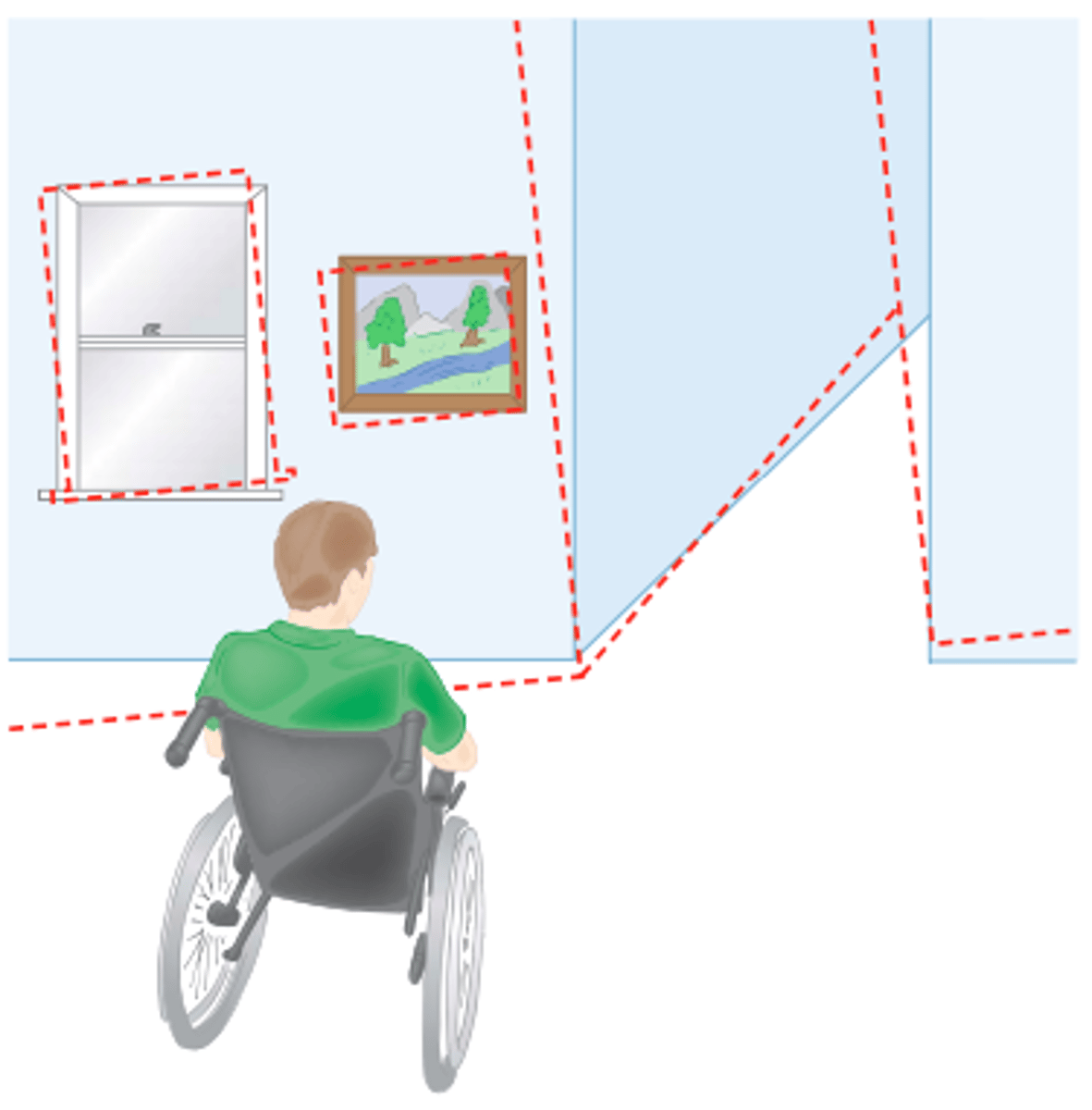
vertical disorientation
distorted perception of what is vertical
clinical example of vertical disorientation
views the world differently and this may affect upright posture
agnosia
inability to recognize or make sense of incoming information despite intact sensory capacities
visual agnosias
most common form of agnosia
inability to recognize familiar objects despite normal function of the eyes and optic tracts
simultanagnosia (Balint's syndrome)
inability to perceive a visual stimulus as a whole
the pt perceives an entire array one part at a time
prosopanosia
inability to recognize familiar faces
related to visually ambiquous stimulus, the recognition depends on evoking a memory context such as different species of bird or different cars
color agnosia
inability to recognize colors; it is not color blindness
the pt is unable to identify or name colors on command, although color chips can be correctly paired
pt no longer associates a duckling as yellow or the sea as blue
auditory agnosia
inability to recognize nonspeech sounds or to discriminate between them
examples of auditory agnosia
cannot tell the difference between the ring of a doorbell and that of a telephone, or between a dog barking and thunder
tactile agnosia or asterognosis
inability to recognize forms by handling them, although tactile, proprioceptive and thermal sensations may be intact
example of tactile agnosia
if a pt is handed a familiar object (key, comb, safety pin) with vision occluded, he or she will fail to recognize it
apraxia
inability to perform purposeful movements
ideomotor apraxia
breakdown between concept and performance
disconnection between the idea of movement and its motor execution
pts can carry out habitual tasks automatically and describe how they are done, but are unable to imitate gestures or perform on command
examples of ideomotor apraxia
pt is unable to "blow" on command however, if presented with a bubble wand, the pt will spontaneously blow bubbles
ideational apraxia
failure in the conceptualization of a task. inability to preform a purposeful motor act, either automatically or on command, bc the pt no longer understands the overall concept of the act, cannot retain the idea of the task, or cannot formulate the motor patterns required
examples of ideational apraxia
when presented with a toothbrush and toothpaste and told to brush the teeth, the pt may put the tube of toothpaste in the mouth or try to put toothpaste on the toothbrush without removing the cap
buccofacial apraxia or oral apraxia
difficulties with performing purposeful movements with the lips, tongue, cheeks, larynx, and pharynx on command
clinical example of buccofacial apraxia
a pt may have difficulty responding to the command "pretend to blow out a candle" or "blow a kiss"