AP Psychology terms
 Call Kai
 Learn
Learn Practice Test
 Spaced Repetition
 Match
Match Flashcards
 Knowt Play
1/139

There's no tags or description
Looks like no tags are added yet.
Name | Mastery | Learn | Test | Matching | Spaced | Call with Kai |
|---|
No analytics yet
Send a link to your students to track their progress
140 Terms
Behavioral school of psych
A psychological perspective that emphasizes the study of observable behaviors and the importance of the environment in shaping behavior. It focuses on how external stimuli influence actions and reactions, often using principles of conditioning. (Nurture, environment, conditioning)
psychodynamic school of psych
A psychological perspective that emphasizes the influence of unconscious processes, early childhood experiences, and interpersonal relationships on behavior and mental states. It focuses on internal drives and conflicts as primary factors in human psychology. (Iceberg theory)
humanist school of psych
A psychological perspective that emphasizes personal growth, self-actualization, and the inherent goodness of people. It focuses on individual experiences and the importance of free will and human potential.
cognitive school of psych
A psychological perspective that emphasizes the study of mental processes such as perception, memory, and problem-solving. It focuses on how people understand, think, and learn, highlighting the importance of internal cognitive processes in shaping behavior.
biological school of psych
A psychological perspective that emphasizes the influence of biological factors such as genetics, brain structure, neurotransmitters, and hormones on behavior and mental processes. It focuses on how physiological processes impact thoughts, emotions, and actions. (Doctor perspective)
evolutionary school of psych
A psychological perspective that emphasizes the role of evolutionary processes in shaping behavior and mental traits. It focuses on how biological adaptations and natural selection influence human psychology and social behaviors.
sociocultural school of psych
A psychological perspective that emphasizes the importance of social and cultural factors in shaping behavior and mental processes. It focuses on how societal norms, values, and interactions influence individual psychology.
hindsight bias
The tendency to see events as having been predictable after they have already occurred, suggesting that outcomes were obvious or foreseeable.
confirmation bias
Only paying attention to data that supports your beliefs
Over confidence
Thinking you’re right when you’re wrong
Experiment
A method of research in psychology that involves manipulating one or more variables to determine their effect on a dependent variable, used to establish cause-and-effect relationships. (CAUSATION)
correlational study
A research method used in psychology that examines the relationship between two or more variables to determine if a change in one variable corresponds with a change in another variable. It does not imply causation.
case study
Small study used to understand the minority of the population (form of correlational study)
Naturalistic Observation
Watching with no comments, simply writing things down. (common with animals)
Meta-analysis
Comparing previous results and replicating previous studies.
independent variable
Manipulated in an EXPERIMENT
dependent variable
Measured in an EXPERIMENT
confounding variable
“third variable” - confuses research
operational definition
specific definition, usually with numbers. EX: “research team wanted to measure how smart Chris is, so they measured how many math questions Chris got correct on his exam.”
causation
Only established in an experiment.
Sample population
All the people in an experiment
random sampling/selection
HOW people were chosen to be part of an experiment. EX: “drawing a random sample of people from a town”
convenience sampling/sampling bias
non-random collection of research participants, leads to inaccurate results
generalizability
if the research applies to the general population
random assignment
Selecting control vs. experimental group randomly.
control group
Does not change, often the group that is given the normal things. EX: “one group of subjects saw a non-violent cartoon, compared to the other group which saw the violent cartoon”.
experimental group
the group that gets tested on, provides accurate results. EX: “one group of subjects saw a non-violent cartoon, compared to the other group which saw the violent cartoon.”
qualitative measurement
interviews, observations
quantitative measurement
Numbers (how much)
Likert scale
scale between 1-5 with 1 being the lowest and 5 being the highest
social desirability/self report bias
saying what you think sounds good rather than what is real. (EX: respondents to surveys often report they are healthier, happier, and less prejudiced than would be expected based on the results of other research)
informed consent
agreeing to participate in a study
protection from harm
protecting participants from any possible harm in a study
confidentiality
not revealing the participants identity at any given point
deception
researchers are not supposed to lie unless absolutely necessary
debriefing
talking with participants about the study such as what the goal was and if it was successful or not
positive correlation on a graph
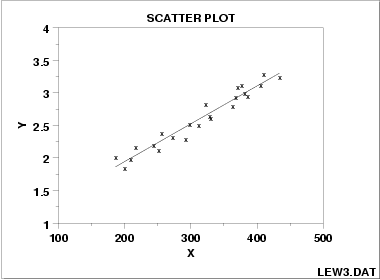
coefficient = 0 to 1 (ex: hot outside, ice cream sales go up)
negative correlation on a graph
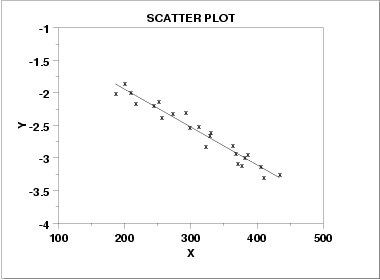
coefficient = -1 to 0 (ex: hot outside, winter coat sales go down)
mean
the average
median
middle number
mode
the number that appears most
range
the biggest number - smallest number
regression to the mean
extremes are not normal so more results yield to less extreme averages (should not draw any conclusions until get more people)
statistical significance
not likely due to chance
Negative skew

some low outliers pull overall average down
normal skew
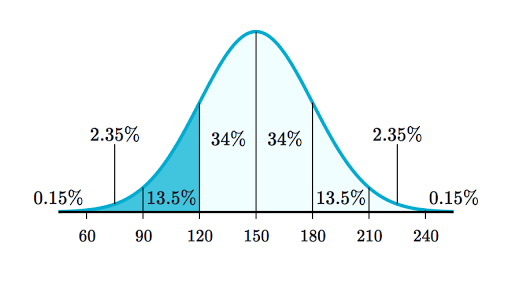
mean, median, and mode are the same
positive skew
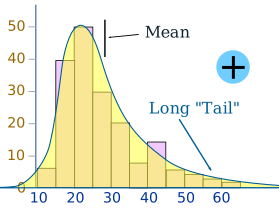
high outliers pull overall average up
standard deviation
how close to the average most scores are on a graph
validity
does the test reveal what was intended?
reliability
does the test reveal the same result each time?
replication
doing the same test over and over accurately
Nature
things you are born with (genes, heredity)
Nurture
things you learn over time (how you’re raised, friends and family influences)
sympathetic nervous system
fight or flight response
Parasympathetic nervous system
rest and digest (paramedic would want you to calm down)
sensory neurons
sensation
motor neurons
movement
multiple sclerosis
breakdown of myelin sheath
myasthenia gravis
autoimmune issue impacting connection between nerves and muscles
agonist
encourages neuron transmission
antagonist
discourages neuron transmission
refractory period
momentary break period in neural transmission process
reuptake inhibitor
prevents a neuron from reabsorbing messages from the synapse
cerebellum
hindbrain - balance, repetitive movement
corpus callosum
neural highway between hemispheres (labeled in green)
:background_color(FFFFFF):format(jpeg)/images/library/1856/K0N85HhHdfNuTbpyntCTuA_Corpus_callosum_1.png)
thalamus
first step for sensory information (EXCEPT SMELL)
hypothalamus
runs the endocrine system
hippocampus
memory
amygdala
emotion (fear)
Broca’s Aphasia
damage to the broca - loss of motor control
Wernicke’s Aphasia
damage to the Wernicke - loss of comprehension
motor cortex (frontal lobe)
area in the brain that sends messages to muscles
somatosensory cortex (parietal lobe)
area in brain that receives sensory information
frontal lobe
advanced thoughts - personality, decision-making
temporal lobe
hearing (temporal - temples, by your eyes)
plasticity
ability for the brain to adapt
long term potentiation
building '“muscle” in the brain
N-REM
all stages during sleep that aren’t REM sleep
REM
paradoxical sleep (low muscle tone, high brain activity)
activation synthesis
dreams as random neural transmission
consolidation theory
dreams as brain reviewing information from the day
absolute threshold
minimum amount of sensation needed to notice something
just noticeable difference
minimal amount of change needed to notice change
sensory adaption
getting used to a sensation (bright light)
sensory interaction
interplay between senses (smell + taste)
rods
photo receptor that notices light and dark
cones
photo receptor that notices color
trichromatic theory
cones for red, blue, green
opponent process theory
cones for shared pairs (red/green, blue/yellow) - think of after images
wavelength (sound wave)
pitch
amplitude (sound wave)
volume
vestibular sense
balance
kinesthetic sense
location of body in space (knowing where one part of your body is without looking, dancers are good at this)
Stimulant
speeds up nervous system (caffeine, cocaine)
depressant
slows down nervous system (alcohol)
opioid
reduces paid (heroin)
hallucinogen
altered sensations and thoughts (marijuana)
top-down processing
a cognitive approach where the brain uses prior knowledge, expectations, and context to interpret sensory information, moving from high-level concepts to lower-level specific (schema)
bottom-up processing
a data-driven approach to perception where the brain builds understanding from sensory input (light, sound, smell) rather than prior knowledge
visual perceptual constancies
understanding things stay the same despite visual change