Social Psychology #3 Study Guide
 Call Kai
 Learn
Learn Practice Test
 Spaced Repetition
 Match
Match Flashcards
 Knowt Play
1/79

There's no tags or description
Looks like no tags are added yet.
Name | Mastery | Learn | Test | Matching | Spaced | Call with Kai |
|---|
No analytics yet
Send a link to your students to track their progress
80 Terms
Hostile Aggression
Aggression driven by anger and performed as an end in itself with the intent to injure.
Instrumental Aggression
Aggression used as a means to some other end, such as a professional hitman or a football tackle.
Instinct Theories of Aggression
The belief that aggression is an innate, unlearned behavior pattern common to all members of a species.
Frustration-Aggression Theory
Posits that frustration—the state emerging when circumstances interfere with a goal-directed response—increases the probability of aggressive behavior.
Evolution of Frustration-Aggression (Berkowitz)
A revision stating the original theory overstates the connection; frustration produces anger (emotional readiness), but the actual response depends on many possibilities.
Relative Deprivation Theory
The perception that one is worse off relative to those with whom one compares oneself.
Social Learning Theory
The theory that social behavior is learned primarily through observation, imitation, and modeling.
Vicarious Reinforcement
Learning that occurs by seeing others receive rewards for aggressive behavior.
Influences of Aggression
Environmental or physical factors such as pain, heat, and physical attacks, as well as interpersonal triggers like insults.
Bushman's Study on Catharsis
Research finding that doing nothing was more effective at reducing aggression than venting or ruminating.
Displacement Theory
The redirection of aggression to a target other than the source of the frustration.
Reciprocity Norm
An expectation that people will help, not hurt, those who have helped them.
Social Responsibility Norm
An expectation that people will help those who need help.
Bystander Effect
A phenomenon where individuals are less likely to offer help to a victim when other people are present.
Diffusion of Responsibility
A psychological state where each person in a group feels less personal accountability because they assume others will intervene.
Pluralistic Ignorance
A psychological barrier where people assume an event is not an emergency because no one else is reacting.
The 5 Steps of Helping
The sequential process of noticing the event, interpreting it as an emergency, assuming personal responsibility, knowing how to help, and implementing the help.
Darley & Batson's Good Samaritan Study
Research showing that situational variables (being in a hurry) overrode personal values regarding helping behavior.
Latané & Darley's Studies
Research demonstrating that the likelihood of an individual helping in an emergency decreases as the number of bystanders increases (Kitty Genovese).
How to Increase Helping Behavior
Strategies include reducing anonymity, teaching moral inclusion, and modeling altruism so others observe and imitate it.
How Ostracism Affects Us
Social exclusion leads to lowered self-esteem, feelings of invisibility, and triggers brain regions associated with physical pain.
Influences of Attraction (Proximity)
Geographical nearness or "functional distance" that facilitates liking.
Similarity
The tendency to like those who are like us.
Instrumentality
The tendency to like those who help us achieve our goals.
Complementarity
The largely unsupported idea that opposites attract or that partners complete what is missing in each other.
Mere Exposure Effect
The phenomenon where repeated exposure to novel stimuli increases the liking of them.
Matching Phenomenon
The tendency to select partners who are about equal in attractiveness to ourselves.
Gain-Loss Hypothesis
The idea that increases in rewarding behavior from another have more impact than constant positive behavior; we like people most when their opinion of us moves from negative to positive.
Physically Attractive Stereotype
The "what is beautiful is good" assumption.
Social Exchange Theory
The idea that we "trade off" one thing to make up for another in relationships.
Social Penetration Theory
The theory that relationship development occurs through a gradual process of self-disclosure.
Attachment Styles
Patterns of relating to others categorized as Secure (trusting), Avoidant (dismissive/fearful of intimacy), and Anxious (insecure/possessive).
Equity Theory
The condition where the rewards people receive from a relationship are proportional to what they contribute to it.
Self-Disclosure & Disclosure Reciprocity
The tendency for one person's level of intimacy in self-disclosure to match that of their conversational partner.
Passionate Love
An aroused state of intense positive absorption, usually occurring at the beginning of a relationship.
Companionate Love
A deep, affectionate attachment involving trust and concern for a partner's well-being.
Consummate Love
Love that includes all three components of the Triangle Theory: intimacy, passion, and commitment.
Relationship Dissolution Steps
Stages of breaking up involving distress, preoccupation with the lost partner, and eventual emotional detachment.
Correlational Research
A design that measures the relationship between two or more variables without manipulating them.
Experimental Research
A design where a researcher manipulates an independent variable to determine its effect on a dependent variable.
Observational Research
Systematically recording behavior as it occurs in a natural or controlled setting without intervention.
Random Assignment
Assigning participants to experimental conditions such that every person has the same chance of being in any given group.
Independent Variable
The factor manipulated by the researcher.
Dependent Variable
The behavior or outcome being measured in response to manipulation.
Experimental Group
The group that receives the treatment or manipulation.
Control Group
The group that does not receive treatment and serves as a baseline for comparison.
Correlations
A statistical index ranging from -1 to +1 indicating the relationship between two things.
Spotlight Effect
Overestimating the extent to which others are paying attention to our appearance and behavior.
Self-Fulfilling Prophecy
A belief that leads to its own fulfillment.
Self-Monitoring
Being attuned to one's social presentation and adjusting performance to create a desired impression.
Self-Handicapping
Protecting one's self-image by creating excuses for potential failure.
System 1 vs. System 2
System 1 is fast, intuitive, and automatic; System 2 is slow, deliberate, and controlled.
Attribution Theory
How we use information to arrive at causal explanations, categorized as Dispositional (Internal) or Situational (External).
Fundamental Attribution Error (FAE)
Overemphasizing personal characteristics and ignoring situational factors when judging others.
Availability Heuristic
Judging the likelihood of things based on how readily instances come to mind.
Representativeness Heuristic
Making snap judgments of whether someone fits a specific category.
Hindsight Bias
The "I-knew-it-all-along" phenomenon; believing after an outcome that one could have foreseen it.
Confirmation Bias
The tendency to search for information that confirms one's existing preconceptions.
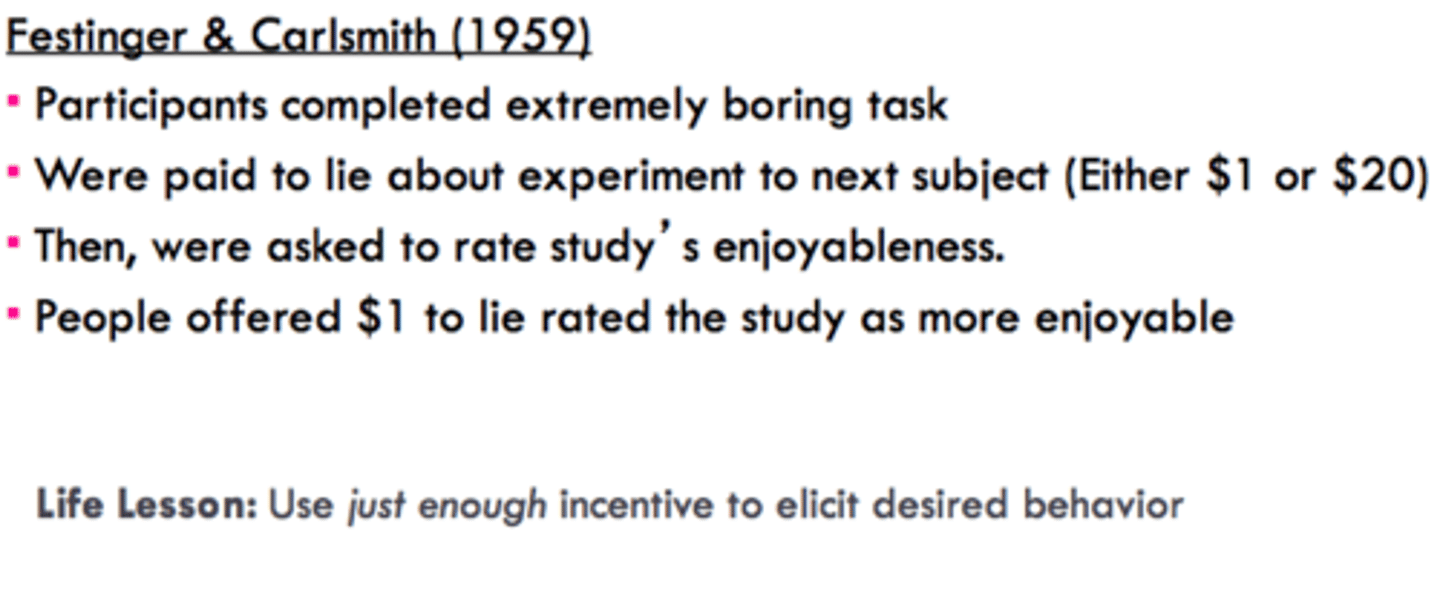
Cognitive Dissonance
Discomfort experienced when holding conflicting beliefs, leading individuals to change beliefs to reduce tension.
Insufficient Justification Effect
Reducing dissonance by internally justifying behavior when external rewards are lacking.
Illusion of Transparency
The belief that our internal feelings are more apparent to others than they truly are.
BIRG & CORF
Basking In Reflected Glory (associating with successful others) and Cutting Off Reflected Failure (distancing from those who fail).
Sherif's Norm Formation Study
Used the autokinetic effect to show how individual estimates eventually merge into a shared group norm.
Milgram's Obedience Study
Measured willingness to obey an authority figure instructing acts that conflict with conscience.
Persuasion Elements
Includes the communicator (Who), the message (What), the channel (How), and the audience (To Whom).
Foot-in-the-door
Securing agreement to a small request to increase compliance with a larger one later.
Door-in-the-face
Making a large request that is rejected, followed by a smaller, reasonable one.
Low-ball Technique
Gaining commitment to a low-cost offer, then raising the price or terms.
Reactance
A motive to protect or restore one's sense of freedom when it is threatened.
Robber's Cave Experiment
Study showing intergroup hostility could be resolved through Superordinate Goals.
Superordinate Goals
Shared objectives that require the cooperation of two or more groups to achieve.
Social Facilitation Theory
Strengthening of dominant responses in the presence of others.
Co-actor Effect
Influence on behavior caused by the presence of others completing the same task.
Audience Effect
Influence on behavior caused by the presence of bystanders.
Stereotype Threat
A disruptive concern that one will be evaluated based on a negative stereotype, which can hinder performance.
Realistic Group Conflict
Theory that prejudice arises from competition between groups for scarce resources.
Groupthink
A mode of thinking where the desire for group harmony overrides realistic appraisal of alternatives.
Credibility
Comprised of Expertise (seeming knowledgeable) and Trustworthiness (arguing against self-interest).
Attractiveness/Likability
People are more persuaded by those they find physically attractive or similar to themselves.
What is the 'insufficient justification' effect?
A psychological phenomenon where individuals experience higher cognitive dissonance when they have little external justification for an action, leading them to internally justify it by changing their attitude.