More Malthusian Economics
 Call Kai
 Learn
Learn Practice Test
 Spaced Repetition
 Match
Match Flashcards
 Knowt Play
1/8

Earn XP
Name | Mastery | Learn | Test | Matching | Spaced | Call with Kai |
|---|
No analytics yet
Send a link to your students to track their progress
9 Terms
What are the 2 key ideas in Malthus’ model?
1: Law of diminishing average product of labour
2: Population expands if living standards increase
What is a subsistence level in a Malthusian world?
-The level of living standards, measured by consumption or income, such that the population will not grow / decline
Apply Malthus reasoning to a human population that has been well fed?
-They would multiply like mice in a barn and eventually fill the nation up
-Further population growth diminishes APL to such a large extent that incomes per head fall drastically
-Falling living standards as a result from loss of income would cause death rates to exceed birth rates.
-Thus, incomes would increase back towards the subsistence level
In Malthus’ model, where is the equilibrium? And if conditions change?
-Where an income level is at a level such that a subsistence level of consumption is achieved
-The variables that stay constant to achieve this is:
Size of the population
Income level of the people
-Any change in conditions would lead to population and income changes, but the economy will eventually return back to a income level at subsistence level.
Using Malthus’ logic, what would happen to the economy if a technological improvement occurred, in the very long run?
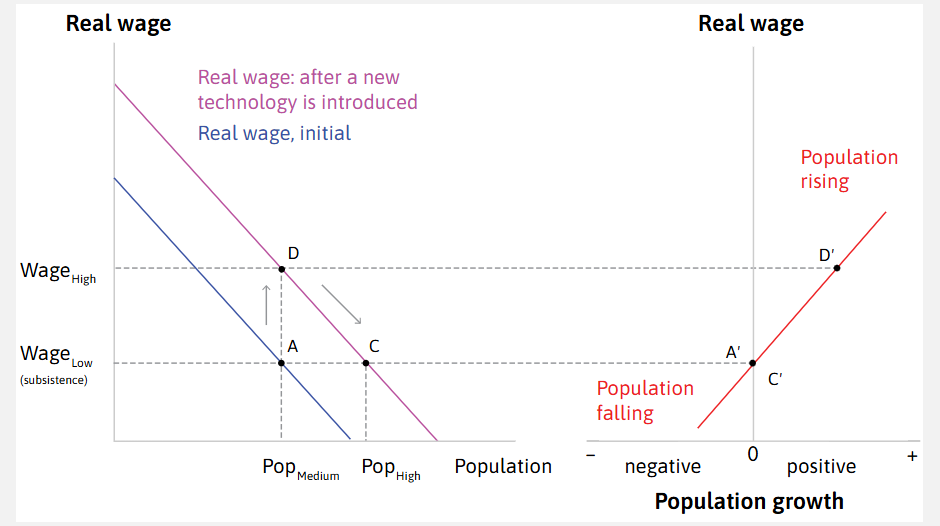
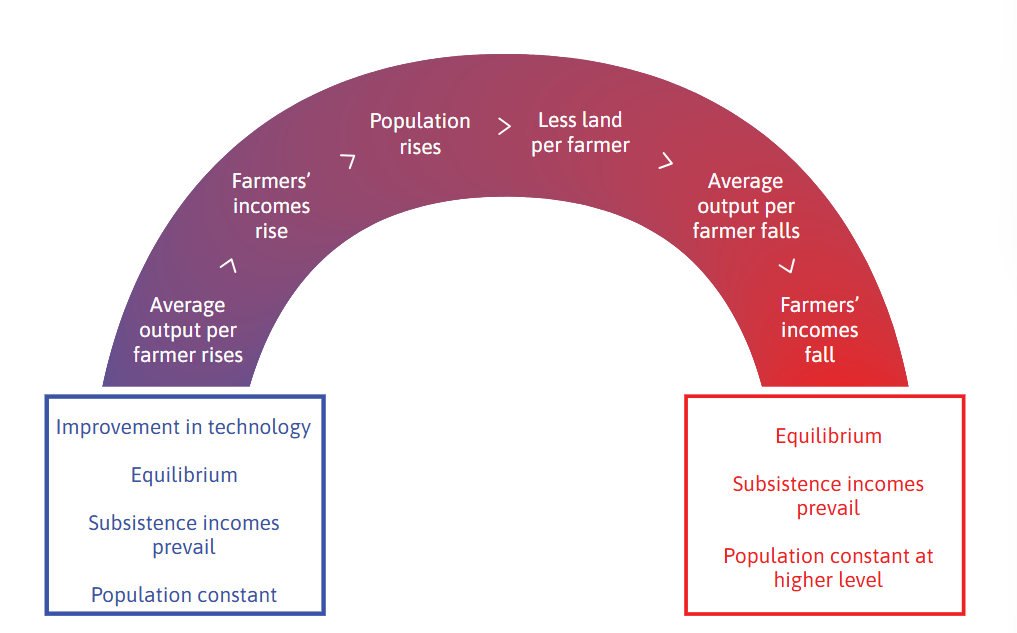
-We start at equilibrium. We have a subsistence level of income and a stable population. Now, a technological improvement occurs.
-This improvement boosts the APL of farmers, thus also boosting their incomes. This leads to population growth across the nation
-However, more people on a fixed amount of land inevitably leads to less land per farmer. So the APL falls downwards, leading to incomes falling downwards.
-So the sustainable income prevails yet again, and the population is stable at just a higher level.
Why may the population be higher in the very long run after a technological improvement, according to Malthus?
-Output per farmer, or APl, is now higher for each number of farmers.
-Thus population falling back to its original level means that income would exceed the subsistence level.
-Better technology can provide subsistence income for a larger population.
So, according to Malthus, why may improvements in technology not raise living standards?
-If the APL diminishes as more labour is applied to a fixed amount of land
OR
-Population grows in response in real wages.
Thus, we have unearthed Malthus’ Law
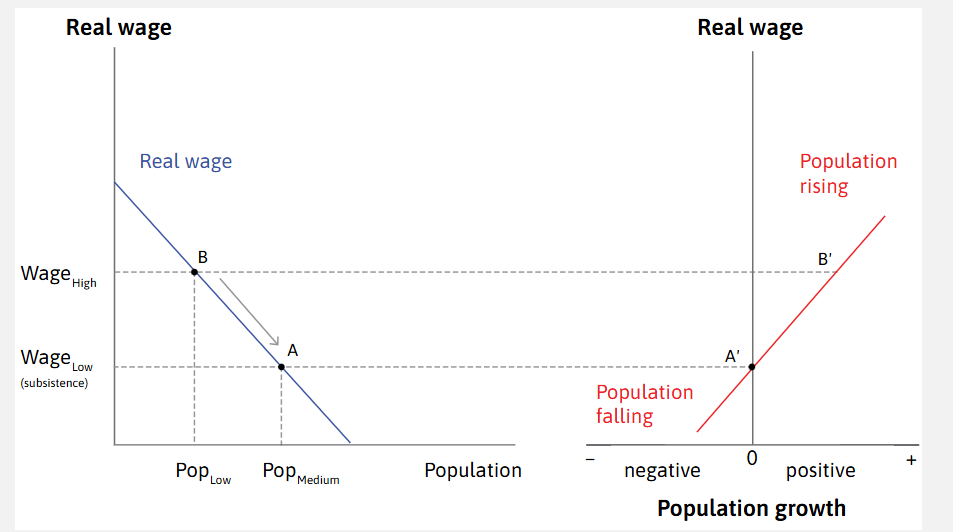
Model Malthus’ argument, about when real wages increases.
-Note that the equilibrium occurs when the growth rate of the population is neutral which occurs on the right-hand graph
Model Malthus’ argument about when a new technology is introduced
-Note that the real wage and population growth is neutral and unchanging, but the absolute population is higher than its original level