Bending in Beams (wk 4)
 Call Kai
 Learn
Learn Practice Test
 Spaced Repetition
 Match
Match Flashcards
 Knowt Play
1/9

There's no tags or description
Looks like no tags are added yet.
Name | Mastery | Learn | Test | Matching | Spaced | Call with Kai |
|---|
No analytics yet
Send a link to your students to track their progress
10 Terms
what is Equilibrium
· Statics to work out bending moment -> FBDs
· No unbalanced forces
· Sum is zero, moments sum to zero (ΣF=0, ΣM=0)
When does bending occur
Bending is when force is perpendicular the plane of the member
→ mostly for beams
one side is in tension
the other side is in compression
neutral axis = not in tension of compression
impacted by second moment of area + young’s modulus
stress vs strain graph for a bending moment
Strain is max at bottom (compression), decreases to zero at neutral axis (no compression or tension), then increases again (tension)
Same happens for stress
are proportional
how to calculate bending moment
M = Fr
→ or can use second moment of intertia
Note: bending moment is the internal couple at a cut section of a member → like how shear force is the internal force
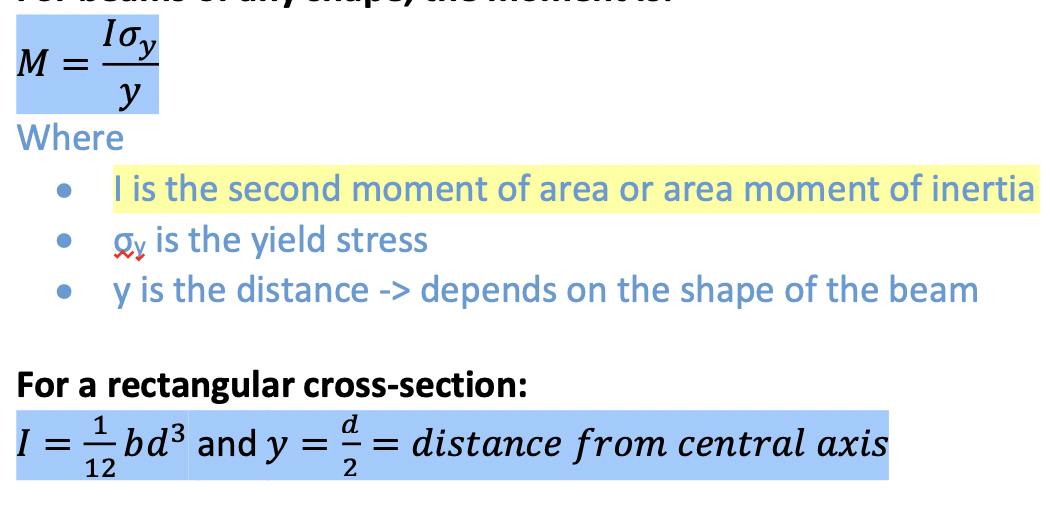
what is Second Moment of Area (I)
geometric property of the cross section of a beam
To do with flexibility -> how prone a beam is to bending
The bendiness of a beam
Relies only on the overall dimensions
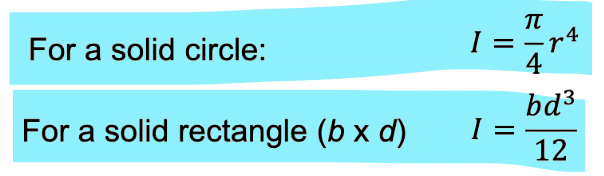
second moment of area for:
rectangle
circle
for composite shapes → sum up the moment of area of the individual/sub shapes
how does Bending in Concrete Beams differ to other materials
Concrete can undergo compression, but not tension
since inflexible
Cannot have bending without both compression and tension
Parts in compression balance parts in tension -> otherwise no equilibrium
comcrete is assumed to have zero tensile strength -> in simple design
Concrete will break -> needs to be reinforced by other materials (mostly steel)
young’s modulus for steel >>> concrete
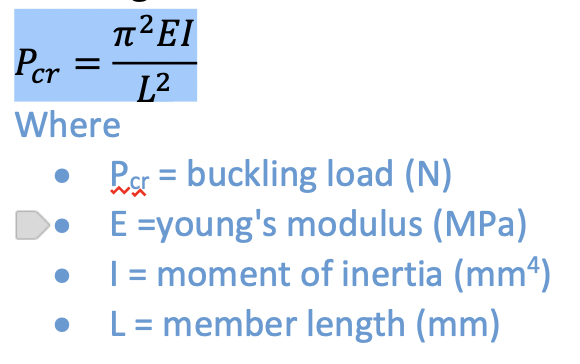
what is Buckling
sudden deformation of a structural member that is loaded in compression
When force is parallel to the plane of the member (long and slender)
Buckles in the direction with the lowest I value
How height impacts buckling failure
Long/slender members in compression are more likely to buckle
Forces can cause it to bend to the side and break
More likely to buckle before yielding
Short members will not buckle as severely/at all
more likely to fail due to crushing/reaching yield stress
Buckling Load/Formula