Neuronal Synapses - 11.4
 Call Kai
 Learn
Learn Practice Test
 Spaced Repetition
 Match
Match Flashcards
 Knowt Play
1/34

There's no tags or description
Looks like no tags are added yet.
Name | Mastery | Learn | Test | Matching | Spaced | Call with Kai |
|---|
No analytics yet
Send a link to your students to track their progress
35 Terms
What’s a synapse?
the structure or mechanism where a neuron communicates (meets) with its target cell
Neuronal Synapse
a neuron meets its target cell, in which the target cell is another neuron
neuronal synapses can be electrical or chemical
What is Axodendritic Synapses?
axon that communicates with dendrites of another cell/neuron
What is Axosomatic Synapses?
axon that communicates with soma of another cell/neuron
What is Axoaxonic Synapses?
a neuron communicating with an axon (axon + axon synapse)
Presynaptic neuron
the neuron that is sending the message from its axon terminal - the messenger of the synapse
Postsynaptic neuron
the dendrite, cell, or axon that is receiving the message from the presynaptic axon - the message receiver of the synapse
Where is the synaptic cleft located?
located in the space between the axon terminal and the target cell
the axon terminal and target cell do not touch
within the synaptic cleft are where neurotransmitters are released into the extracellular space
Synaptic transmission
the transfer of chemical or electrical signals between neurons at a synapse
allows voluntary movement, cognition, sensation, emotion, etc.
each neuron has a large number of synapses
each axon splits into 1000 or more axon terminals, which each terminal meeting up with another axon, dendrite, or soma
1 presynaptic neuron → 1,000-10,000 postsynaptic neurons
Electrical Synapse
occurs between cells that are electrically coupled via gap junctions
the axolemmas are nearly touching
gap junctions = have price, aligned channels that allow ions and substances to travel between the 2 neurons
gap junctions replace the synaptic cleft that is found in chemical synapses
What are the 2 unique features electrical synapses has?
Synaptic Transmission of Electrical Synapses are bidirectional
either neuron may act as the presynaptic or postsynaptic neuron
the current flows in either direction between the 2 cells
Synaptic Transmission of Electrical Synapses are nearly instantaneous
the delay between depolarization of the presynaptic neuron and the change in potential of the postsynaptic neuron is extraordinarily fast (less than 0.1 ms)
These two features allow the activity of a group of cells to be synchronized when stimulated and the cells produce AP’s in unison
The current in electrical synapses become _ as it dissipates in the ECF
weaker
Where are electrical synapses located in?
Areas of the brain for automatic/programmed behaviors like breathing
Present in the development of nervous tissue in the embryo and fetus and thought to assist in development of the brain
Found in cardiac and visceral smooth muscle, allowing coordinates muscle activity
What are Chemical Synapses?
synapses that convert electrical signals into chemical signals
electrical signal of the neuronal AP is converted into acetylcholine and then converted back into the electrical signal of the muscle AP
more common because it’s more effective; the current eventually becomes weaker as it dissipates into the ECF
How do chemical synapses convert between chemical and electrical signals?
Electrical signals are converted to chemical signals in the axon terminal of the presynaptic neuron
A controlled chemical signal allows it so that no strength is lost within the current
The chemical signal is reconverted into an electrical signal in the postsynaptic neuron
Structure of Chemical Synapses that differs from Electrical Synapses
Synaptic Vesicles:
vesicles contain neurotransmitters (the chemical messengers)
this is the point in which chemical signals are used instead of electrical
found in the axon terminal
Synaptic Cleft:
chemical synapses are separated by a large microscopic space
filled with ECF and proteins
Neurotransmitter Receptors
in chemical synapses, the postsynaptic neuron must have receptors for the neurotransmitters to bind to
this is where the chemical signal reverts back to electrical signal
Chemical synapses have signals that can vary in size because they can control how many neurotransmitters are released. Electrical signals are always the same size
What are the steps (events) at a chemical neuronal synapse?
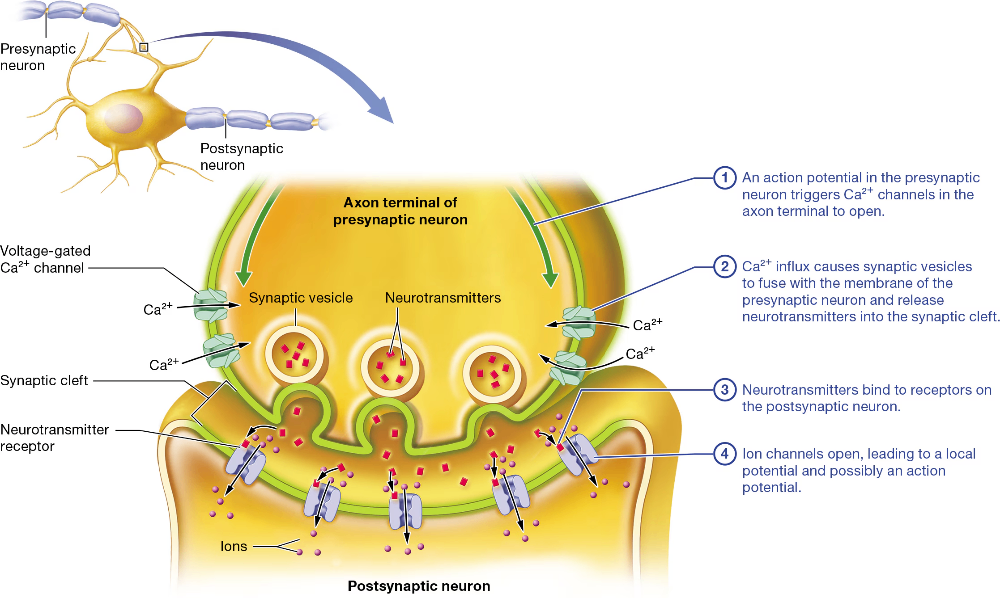
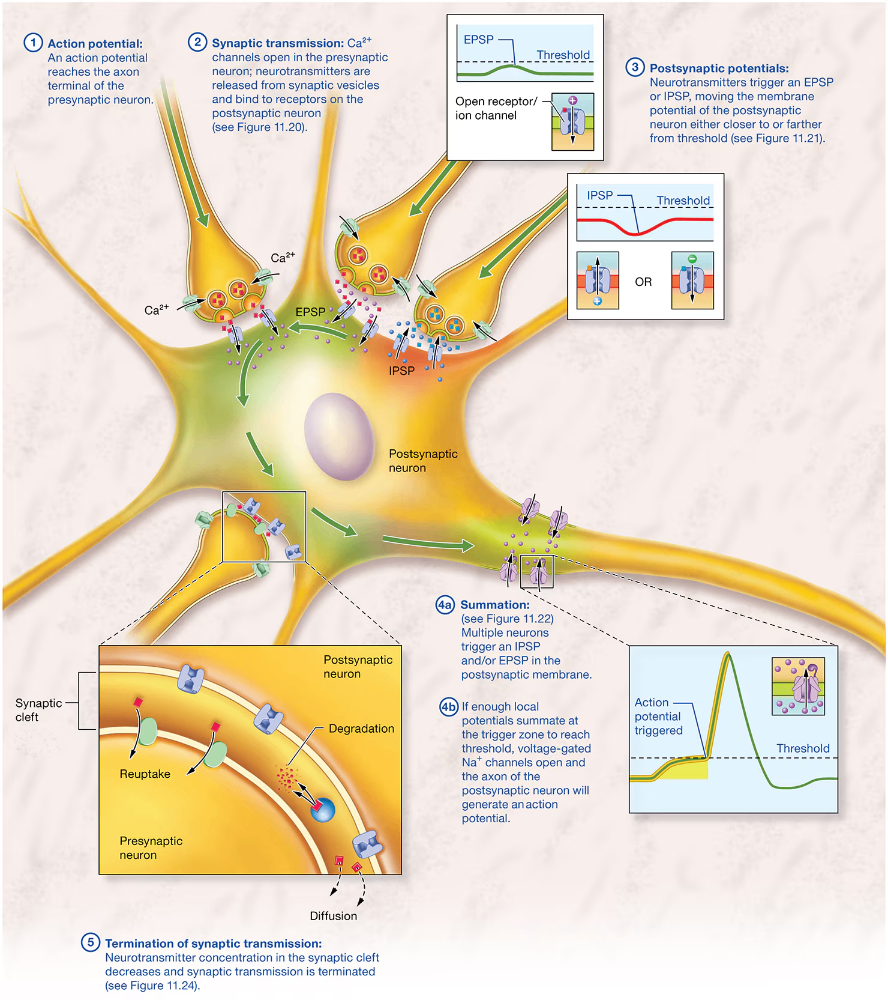
An AP reaches the axon terminal in the presynaptic neuron which triggers voltage-gated calcium ion channels in the axon terminal to open
Influx of calcium ions in the axon terminal causes synaptic vesicles to fuse with the membrane of the presynaptic neuron to release neurotransmitters in the synaptic cleft
Neurotransmitters diffuse across the synaptic cleft and bind to receptors on the postsynaptic neuron
Ion channels open, leading to a local potential and possibly an action potential if threshold is reached
What are postsynaptic potentials?
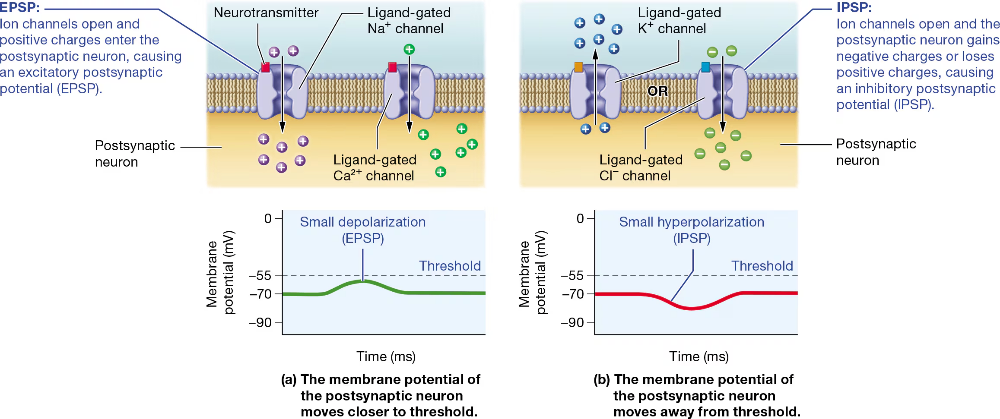
local potentials found in the membrane of the postsynaptic neuron which can move the membrane either closer to or further away from threshold
What are the 2 possible events depending on which channels are opened in regards to postsynaptic potentials?
The MP of the postsynaptic neuron moves closer to threshold
Excitatory Postsynaptic Potential (EPSP) occurs, resulting in depolarization
Moves the MP at the trigger zone closer to threshold
AP’s are most likely to fire
The MP of the postsynaptic neuron moves away from threshold
Inhibitory Postsynaptic Potential (IPSP) occurs, resulting in hyperpolarization
inhibits AP’s from firing
How are EPSP’s produced?
produced when ligand gated channels like Na+ and Ca+ open, and positive ions enter, resulting in depolarization
Each EPSP is small but brings the MP closer to threshold more possible
Multiple EPSP is required to create an AP and must be a higher value than IPSP
How are IPSP’s produced?
Ligand gated K+ channels open; positive ions leave membrane, resulting in hyperpolarization
Ligand gated Chloride ion channels open; negative ions enter membrane, resulting in hyperpolarization
What is Neural Integration?
Input from all presynaptic neurons combines to have one cumulative effect on the postsynaptic neuron
a neuron very rarely receives input from a single source
input can cause both EPSP or IPSP
EPSP and IPSP determine whether the neuron will fire an AP or not
What is Summation?
the phenomenon of adding the input of several postsynaptic potentials to affect the MP at the trigger zone (net effect of GP)
a single EPSP is useless, depolarizing the neuron only a little
groups of EPSP can produce greater depolarization, making it more likely to generation AP’s
What are the 2 types of summation?
Temporal Summation
Spatial Summation
What is Temporal Summation?
Neurotransmitters are released repeatedly from the axon terminal of a single presynaptic neuron
EPSP and IPSP lasts for a short duration so EPSP and IPSP must occur rapidly for temporal summation to occur
results in incremental increases/decreases in membrane potential
What is Spatial Summation?
simultaneous release of neurotransmitters from the axon terminals of multiple presynaptic neurons while also opening chemical gates
results in a smooth increase/decrease in MP. simultaneous release of neurotransmitters from the axon terminals of multiple presynaptic neurons
Summation and Temporal Summation can be combined
when several presynaptic neurons fire together and trigger EPSP’s in the postsynaptic neuron, spatial summation occurs
as MP gets closer to threshold, it is more likely that the next round of EPSP’s from the group of presynaptic neurons will trigger an AP due to temporal summation
Both EPSP’s and IPSP’s can summate temporally and spatially
An AP will only be generated if threshold is reached, which means that the sum of the EPSP’s must be enough to overcome the sum of the IPSP’s
If the sum of IPSP’s is greater than EPSP’s, hyperpolarization occurs, then threshold will not be reached, an an AP will not exist
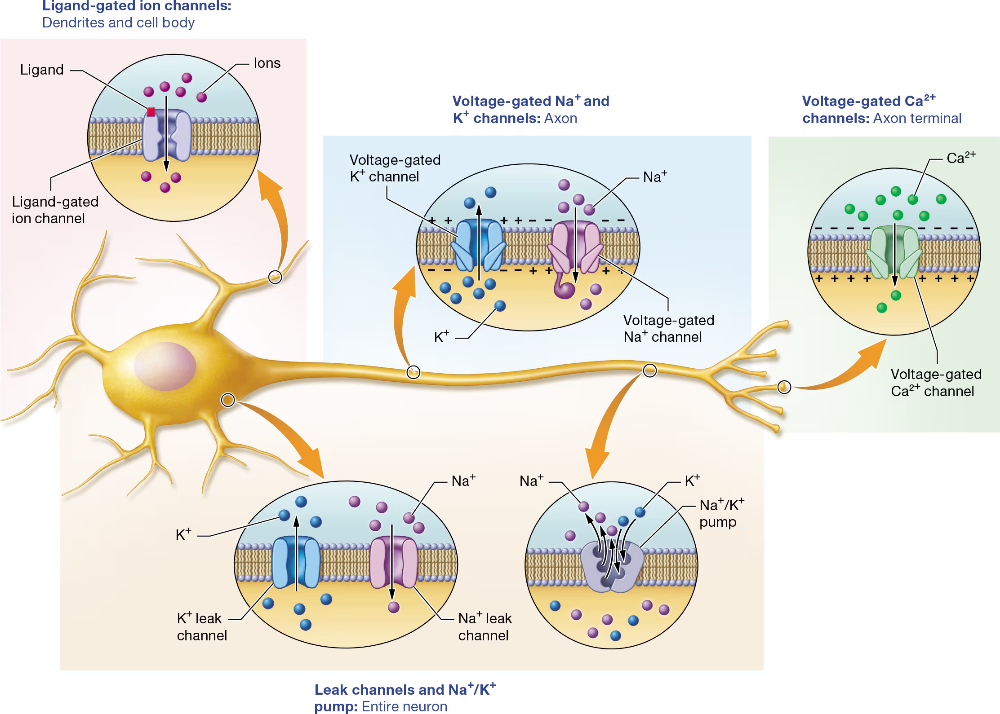
Voltage-gated sodium and potassium ion channels (Na+ and K+)
When do these channels open/close
Where are they found
Affects on membrane potential
Channels that open/close during an action potential, functions to send signal to another cell.
These are found on the axon of the neuron that sends signals to other cells by generating and transmitting action potentials.
Sodium Channels = Depolarization of the membrane due to influx of positive ions. If this cannot inactivate, action potentials will continue to fire.
Potassium Channels = Repolarization/Hyperpolarization of the membrane due to efflux of positive ions. If this cannot inactivate, the membrane potential will continue to get farther from threshold.
Voltage-gated calcium ion channels (Ca++)
Location
Gradient direction
What results
A channel found in the axon terminal.
When opened, Ca+ diffuses into the terminal
Triggers exocytosis of synaptic vesicle neurotransmitters out into the synaptic cleft
Leak Channels + Na+/K+ Pump
Function
Involved in generation of RMP and maintains ion gradients critical to the neuron's physiology.
RMP applies to the entire neuron, so leak channels are found throughout every part of the neuron's membrane.
N/A
What is Termination of Synaptic Transmission?
the halting of the transfer of chemical/electrical signals between neurons at a synapse
the messenger of the synaptic transmission is the neurotransmitter released (chemical synapses)
Synaptic Transmission terminates by ending the effects of the neurotransmitters, what are the 3 ways it gets terminated?
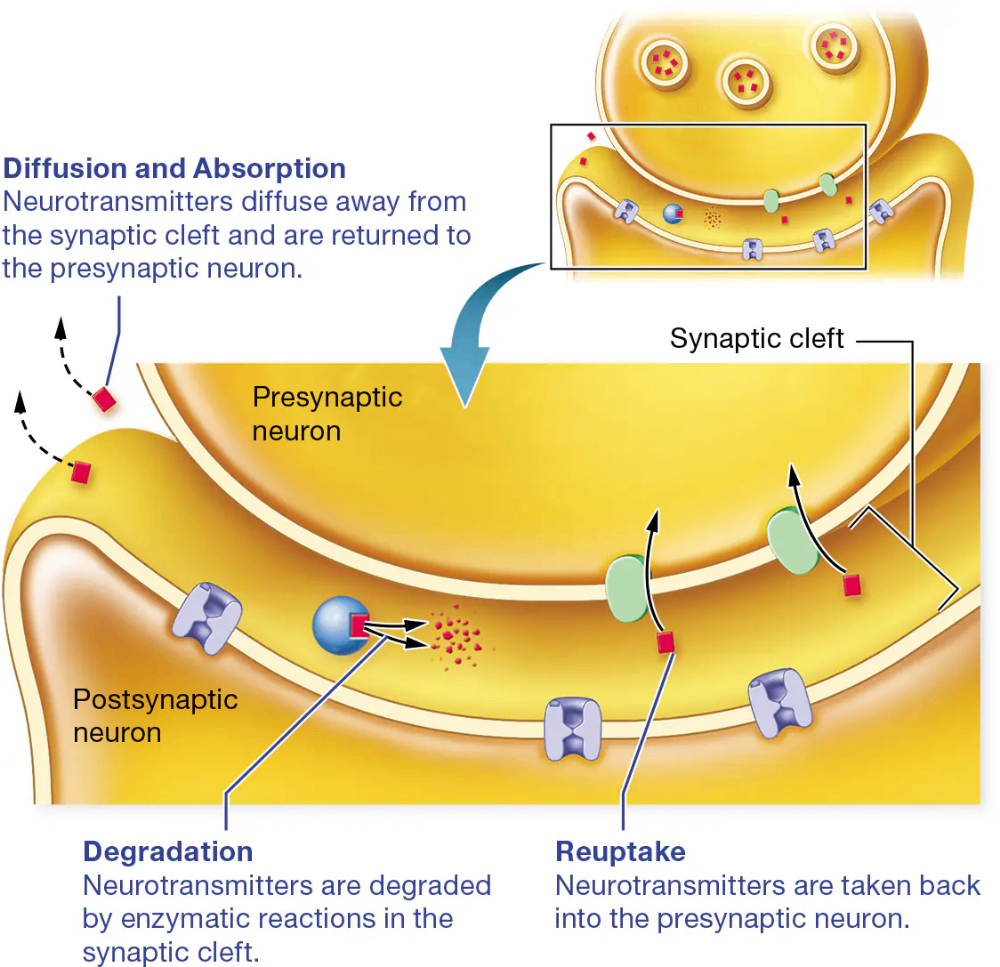
Diffusion and Absorption:
neurotransmitters diffuse away from synaptic cleft and return to presynaptic neuron
Degradation in the Synaptic Cleft:
some neurotransmitters are broken down by reactions catalyzed by enzymes residing in the ECF
destroyed neurotransmitters are absorbed and resynthesized by the presynaptic neuron
ex: Acetylcholineasterase
Reuptake into the Presynaptic Neuron
Neurotransmitters are transported back to the presynaptic neuron via proteins in the axolemma
they are either put back in synaptic vesicles or degraded
N/A 2