1 Evaluation of Patients with Facial Trauma Exam 4 Terms & Definitions | OMFS Study Guide
 Call Kai
 Learn
Learn Practice Test
 Spaced Repetition
 Match
Match Flashcards
 Knowt Play
1/38

There's no tags or description
Looks like no tags are added yet.
Name | Mastery | Learn | Test | Matching | Spaced | Call with Kai |
|---|
No analytics yet
Send a link to your students to track their progress
39 Terms
ATLS (Advanced Trauma Life Support)
_______ is the gold standard for triaging and caring for patients with traumatic injuries
•Prepare, Transport, Triage
•Primary Survey
•Secondary Survey
•Continued monitoring and re-evaluation
•Tertiary Survey
•Definitive Care
What are the 6 steps for ATLS (Advanced Trauma Life Support):
Airway and C-spine stabilization
What does the A stand for in the Primary survey ABC's:
Breathing (respiratory)
What does the B stand for in the Primary survey ABC's
Circulation
What does the C stand for in the Primary survey ABC's
Disability
What does the D stand for in the Primary survey ABC's
Exposure
What does the E stand for in the Primary survey ABC's
Airway
Placing an endotracheal tube or performing a circothyoidotomy falls under which Primary Survey Step:
- Airway
- Breathing
- Circulation
- Disability
- Exposure
Breathing
Auscultating, placing a pulse ox, and obtaining a chest x-ray all fall under which Primary Survey Step:
- Airway
- Breathing
- Circulation
- Disability
- Exposure
Circulation
Monitoring heart rate, BP, and surveying for hemorrhage all fall under which Primary Survey Step:
- Airway
- Breathing
- Circulation
- Disability
- Exposure
Disability
Asking a patient what year it is and evaluating eye movement all fall under which Primary Survey Step:
- Airway
- Breathing
- Circulation
- Disability
- Exposure
brain function:
- eye response
- motor response
- verbal response
What aspects are you surveying as a part of Disability survey?
Glasgow Coma Score
What tool is used to survey a patient's level of disability?
15
What's the highest score you can get on a Glasgow Coma Score?
3
What's the lowest score you can get on a Glasgow Coma Score?
8
A Glasgow Coma Score of less than ____ indicative of substantial intracranial injury and the patient may not be able to reliably maintain their own airway, thus requiring intubation
Exposure
Cutting off a patient's clothes for a physical survey falls under which Primary Survey Step:
- Airway
- Breathing
- Circulation
- Disability
- Exposure
Allergies
What the the A in AMPLE history stand for:
Medications
What the the M in AMPLE history stand for:
Past history/Pregnancy
What the the P in AMPLE history stand for:
Last oral intake (both food and liquids)
What the the L in AMPLE history stand for:
Events leading up to injury
What the the E in AMPLE history stand for:
1. Scalp/Calvarium
2. Globe/Periorbital Region
3. Ears
4. Nose
5. Mid and Lower face
In what order should you evaluate a patient for a physical exam:
Inspect the forehead/frontal region for
- lacerations, contusions, edema
- Assess sensation and movement
Inspect the entirety of the scalp
- Close scalp wounds
Palpate for any step deformities
- Note any crepitus
- Note areas of tenderness
What things are evaluated in the Scalp/Calvarium:
•Pupils (shape, reactivity), Iris, and Conjunctiva/Sclera
•Globe position (enophthalmos, exophthalmos)
•Eyelids (lacerations, ptosis, entropion/ectropion)
•Racoon eyes (bilateral "black eyes" from a skull base fracture)
• Evaluate intraocular pressure
•Check for step deformities of the orbital rims
•Check for telecanthus
•Eye movements
•Vision
What things are evaluated in the Globe/Periorbital Region:
skull base fracture
bilateral "black eyes" can indicate a ______
globe injury
non-round pupils (outside of being congenital) are indicative of a _______ and require immediate ophthalmologic treatment
•Lacerations
•Malformations
•Tympanic membranes
•Otorrhea
•Hearing
What things are evaluated in the Ear Region:
•Clean the skin to look for lacerations
•Check for asymmetry, deformity, deviation, mobility or crepitus
•Check the septum for deviation or hematoma
•Address epistaxis/nose bleeding
•Rhinorrhea
What things are evaluated in the Nose Region:
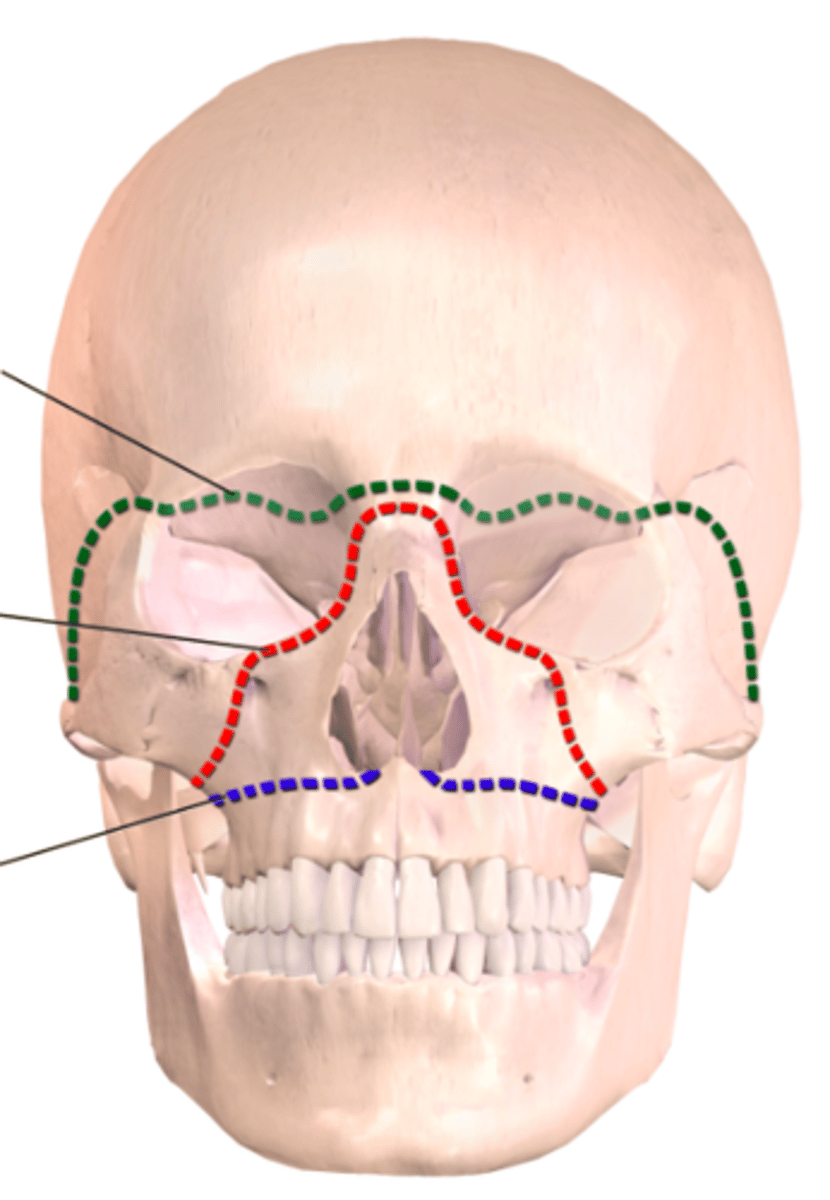
Le Fort III
ID the fracture indicated by the green line:
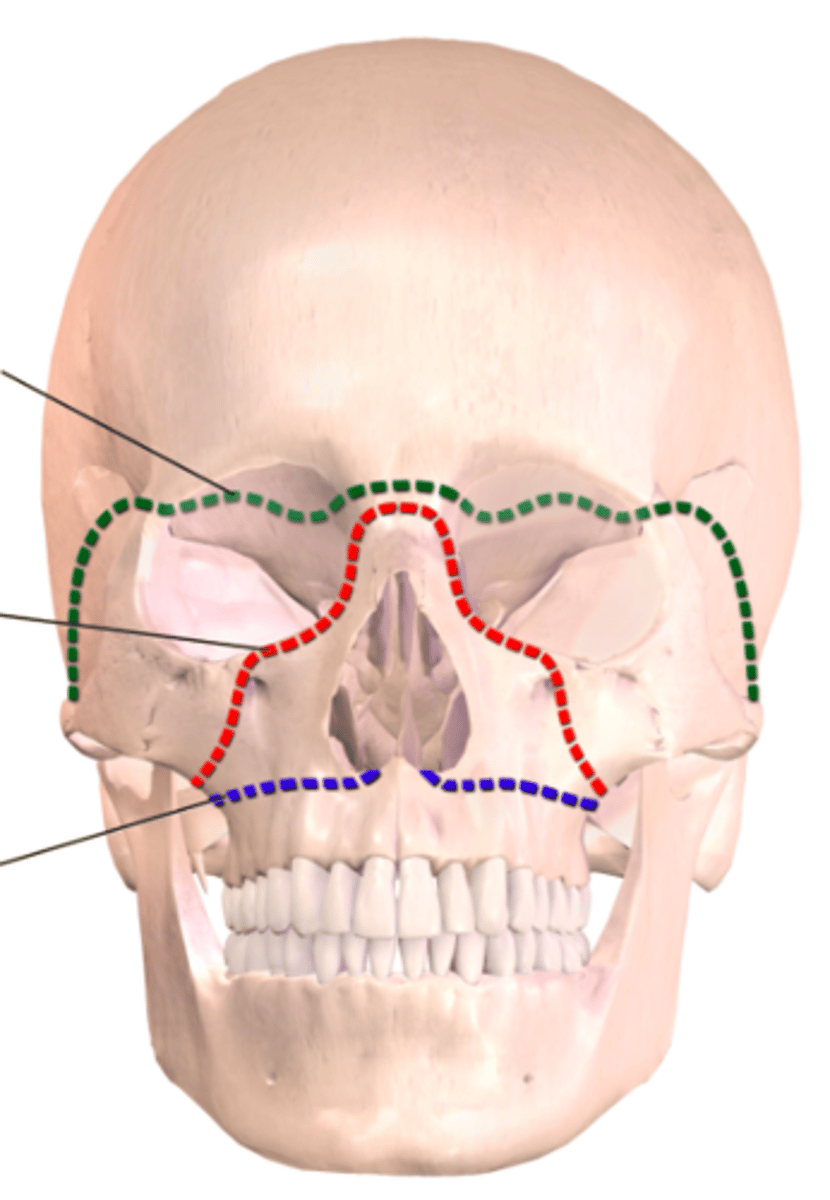
Le Fort II
ID the fracture indicated by the red line:
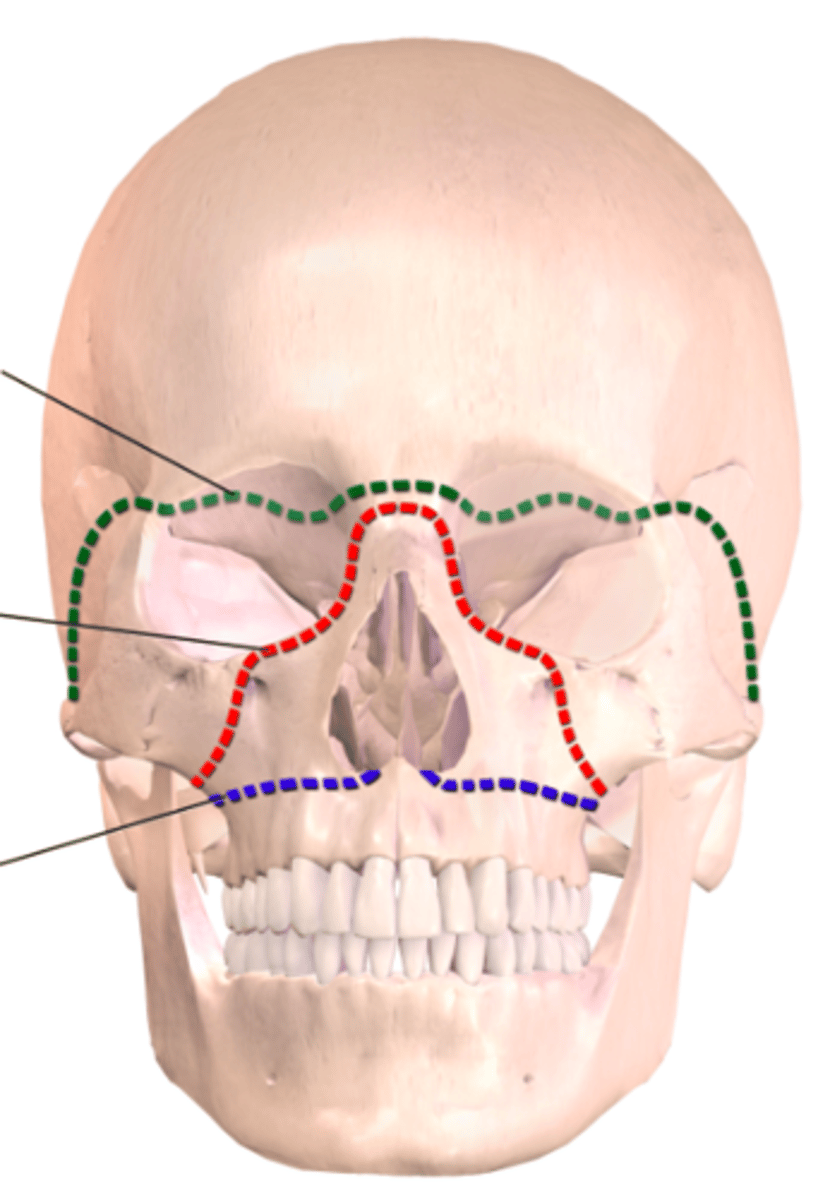
Le Fort I
ID the fracture indicated by the blue line:
CT? CBCT
What is the Gold Standard imaging modality when evaluating trauma?
- CT/CBCT
- Pano
- Bitewing
- PA
Pano
This imaging modality is good evaluation of mandibular angle, body, and symphysis/parasymphysis fractures:
Lateral Ceph
This imaging modality is less valuable in trauma, better for orthodontics and orthognathic planning:
SMV (submentovertex)
This imaging modality is taken with the neck extended
•Good for viewing the zygomatic arches, sometimes helpful for looking at mandible fractures:
PA Ceph
This imaging modality, Prior to CT, was very commonly used to evaluate facial fractures:
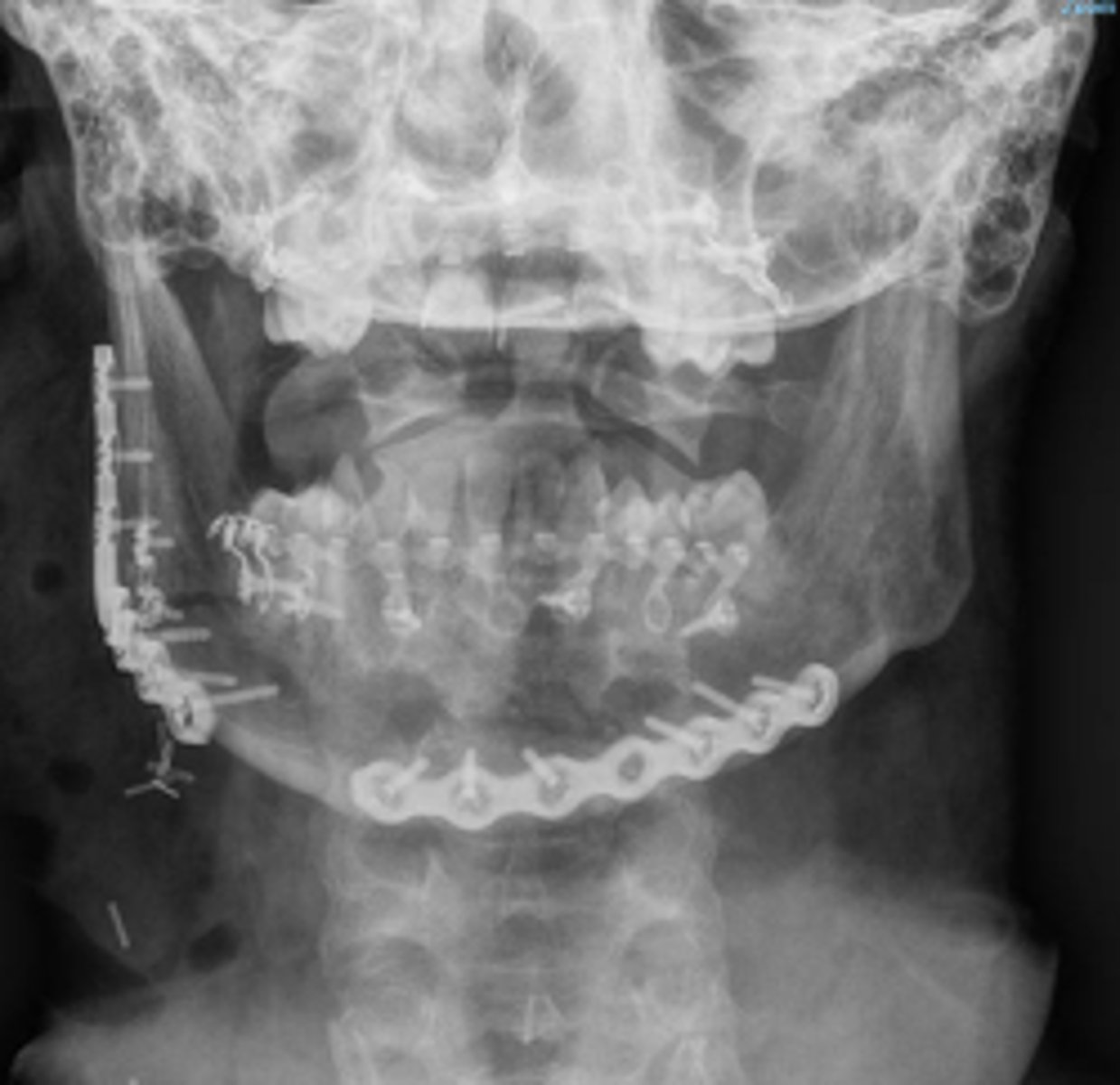
Plain Film Imaging
This imaging modality is markedly less helpful than a PAN in many cases
•When taken intraoperatively, may have significant angulation concerns
3D imaging
_______ is increasingly popular and the standard of care in the setting of upper and mid face trauma as well as significant odontogenic infections