Parasitology. Nematodes
 Call Kai
 Learn
Learn Practice Test
 Spaced Repetition
 Match
Match Flashcards
 Knowt Play
1/159

Earn XP
Description and Tags
Intro. Nematodes. Infective in Egg Stage. Infective in Larval Stage. Tissue Nematodes
Name | Mastery | Learn | Test | Matching | Spaced | Call with Kai | Chat |
|---|
No analytics yet
Send a link to your students to track their progress
160 Terms
Mutualism
interaction between two or more species where each species has a net benefit (+, +)
Commensalism
association between two organisms where one benefits and the other derives neither benefit nor harm (+, 0)
Symbiosis
close union of two dissimilar organisms (living together in intimate association)
Parasitism
relationship between species where one organism (parasite) lives on or in another organism (host) causing it some harm and is adapted structurally to this way of life (+, -)
Facultative Parasite
may resort to a parasitic lifestyle but does not rely on host for completion of life cycle
Obligatory Parasite
cannot complete its life cycle without relationship with suitable host
Endo-parasite
parasite that lives within a host and causes an infection
Ecto-parasite
parasite that lives on a host and causes an infestation
Definitive Host
supports the adult or sexually reproductive stage necessary for parasite survival
Intermediate Host
supports the immature or non-sexual reproductive forms that are necessary for parasite survival.
Transfer Host
can move or relocate parasite stages from one location to another
Vector Host
transfers parasite to the next host. acts as a definitive or intermediate host
Reservoir Host
serves as a source of infection and potential reinfection of humans. sustains a parasite within a population/ecosystem
Exposure
being in contact with an infectious organism
Colonization
presence of infectious agent on/in a body surface without causing disease in the person
Infection
invasion and growth of infectious agents germs on/in the body
Sign
any objective evidence of disease that can be observed by others (e.g. rash fever, pulse, lump)
Symptom
subjective evidence of disease only apparent to the patient (e.g. back pain or fatigue)
Incubation Period
period between exposure to infection and the appearance of the first signs and symptoms
Latency
time from infection to infectiousness (being able to pass the infection)
Infection
first step; occurs when infectious agents that may cause disease enter the body (invasion) and begin to multiply. transitions to disease when cells are damaged
Disease
characterized by signs and symptoms of an illness and tissue damage leading to pathological features/conditions
Infectivity
ability of an organism to establish an infection
Invasiveness
ability of an organism to spread to adjacent or distant tissues
Pathogenicity
ability to produce substances that damage tissues
Parasite Virulence
ability of a parasite to cause disease and tissue damage to host
Host Resistance
ability of an organism to limit growth, reproduction, or survival of invading parasite
Eosinophilia
increased production of eosinophils (a white blood cell) that is part of host defence against parasitic infections
Erythropoiesis
increased production of red blood cells due to anemia caused by parasite feeding
Neoplasia
uncontrolled proliferation of cells due to excessive parasite induced tissue damage and repair
Toxocara canis/cati
Dog/Cat Roundworm
Enterobius vermicularis
Pinworm
Pinworm Life Cycle (normal)
ingestion of eggs
eggs hatch in small intestine
mature in large intestine
lay eggs on anus
contaminate fingers
Pinworm Life Cycle (abnormal)
migrate to appendix or vagina → uterus → fallopian tubes
Pinworm Epidemiology
cold climates, young children, group infections
Pinworm Transmission
direct (anus → fingers → mouth) or indirect (airborne eggs and fomites)
Pinworm Pathology
pinpoint necrosis (large intestine)
benign tumors and itching (perianal area)
appendicitis (appendix)
vaginitis (vagina)
scarring and salpingitis (fallopian tubes)
irritability, insomnia, convulsions (toxic metabolites)
Pinworm Diagnosis
anal swab with Q-tip (eggs)
scotch tape test (eggs)
worms in feces (mature parasites)
Pinworm Treatment
mebendazole - has to be repeated after 3 weeks
Pinworm Prevention
personal hygiene
mass chemotherapy (group treatment)
detergent
sunlight/UV light
Trichuris trichiura
Whipworm
Whipworm Life Cycle
eggs are ingested
hatch in small intestine
migrate to rectal area
attach into gut wall
eggs in feces
Whipworm Epidemiology
young children, night soil as fertilizer, warm climate with rain (southeastern U.S.)
Whipworm Pathology
tissue injury necrosis (intestine)
hemorrhage (intestine)
bacterial infection (intestine)
pain (intestine)
loss of appetite
Whipworm Pathology (heavy infection)
anemia
dysentery (diarrhea but with blood)
fever
rectal prolapse
Whipworm Diagnosis
fecal smear (eggs)
protoscopic exam (mature worms)
colonoscopy (mature worms)
Whipworm Treatment
mebendazole
Whipworm Prevention
sanitary disposal of night soil
personal hygiene
Ascaris lumbricoides
Giant Roundworm
Giant Roundworm Life Cycle
ingest eggs
hatch in small intestine
migrate to lungs
larva are coughed up and swallowed
mature in small intestine
lay eggs
Giant Roundworm Epidemiology
warm moist climate (southeastern U.S.)
areas that use night soil as fertilize
pigs are common reservoir hosts
Giant Roundworm Pathology (lungs)
petechial hemorrhage
sero-cellular exudate
allergic reaction to molting fluid
cough/asthma-like symptoms
Loeffler syndrome
Giant Roundworm Pathology (small intestine)
no tissue invasion
feeds on intestinal contents (not on tissue)
moves against peristaltic movement
Giant Roundworm Pathology (abnormal)
intestinal obstruction
appendicitis
gut penetration
Giant Roundworm Pathology (abnormal migration)
pancreatic duct
bile duct
esophagus or trachea
mouth
ears
Giant Roundworm Diagnosis
fecal smear (eggs)
Giant Roundworm Treatment
albendazole
Giant Roundworm Prevention
sanitation of night soil, washing food, personal hygiene

Enterobius vermicularis (Life Cycle)
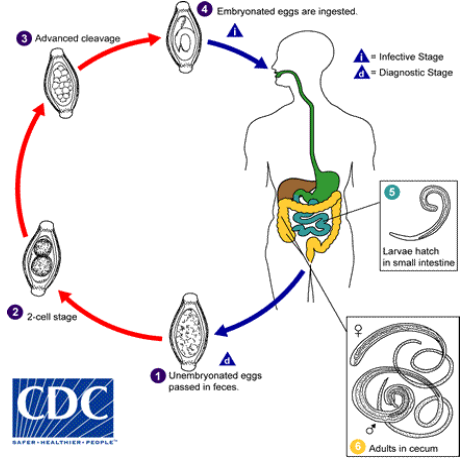
Trichuris trichiura (Life Cycle)

Ascaris lumbricoides (Life Cycle)
When is pinworm infective?
egg stage
When is whipworm infective?
egg stage
When is giant roundworm infective?
egg stage
Ancylostoma duodenale
Hookworm (Old World)
Necator americanus
Hookworm (New World)
Main difference between necator americanus and ancylostoma duodenale
necator has lunar cutting plates
duodenale has fangs/teeth
Hookworm Life Cycle
eggs in soil
hatch as rhabditiform larvae
revert to filariform larvae
attach through skin
migrate to lungs
coughed up and swallowed
mature in small intestine
Hookworm Epidemiology
tropics, subtropics, temperate climates; all ages are susceptible; mixing due to population migration
Ancylostoma duodenale History
spread through silk road (Europe-Asia)
Necator Americanus History
spread through slavery (Africa-Americas/Europe-Asia)
Human Hookworm - Skin Penetration
itching (puritis)
swelling (edema)
“ground itch“
redness (erythema)
papule/vesicle.lesion
Human Hookworm - Larval Migration
“break out“ of blood vessels (circulation)
petechial hemorrhage (lungs)
attachment/reattachment damage (small intestine)
Human Hookworm - Pathology
anemia
iron deficiency
pica
Human Hookworm - Diagnosis
eggs in stool
Human Hookworm - Treatment
albendazole (reinfection likely)
Human Hookworm - Prevention
sanitation/disposal of feces
proper treatment of night soil
personal hygiene
shoes
Ancylostoma canium
Hookworm (Dog)
Ancylostoma braziliense
Hookworm (cat)
Animal Hookworm - Pathology
serpiginous tunnels
inflammation and damage from migration
cutaneous larva migrans
Animal Hookworm - Diagnosis
observation
Animal Hookworm - Treatment
albendazole
mebendazole
ivermectin
thiabendazole
anti-itch and anti-inflammatory creams
resolve in 4-5 weeks without treatment
Animal Hookworm - Prevention
no pets in sandboxes/beach
care when working in animal quarters
plastic cloth when working in crawl spaces under houses
When is hookworm infective?
larval stage

Ancylostoma duodenale and Necator americanus (Life Cycle)

Ancylostoma braziliense and Ancylostoma canium (Life Cycle)
What can hookworm be used for?
to treat allergies; gives immune system something to react to and dampens inflammation response
Trichinella spiralis
Pork Roundworm
Pork Roundworm Life Cycle
consumption of contaminated, undercooked meat
larvae mature in small intestine
attach to mucosa and produce larvae (viviparous)
larvae enter circulation
larvae encyst in muscle
Where do pork roundworm larvae prefer to burrow?
well oxygenated muscle (diaphragm, tongue, eye muscles, intercostal)
Pork Roundworm Epidemiology
maintenance cycles
large gatherings with uninspected meat
undercooked meat
Pork Roundworm Pathology (stage 1)
1-10 days after infection
ingestion of larvae and maturation
necrosis
panmucosal inflammation
vomiting
nausea
diarrhea
fever
Pork Roundworm Pathology (stage 2)
7-14 days after infection
adults are expelled and larvae migrate to muscle
small capillary hemorrhage (fingernails)
bilateral ocular edema (primary sign)
hyper eosinophilia
Pork Roundworm Pathology (stage 3)
3 weeks after infection
larval encystment
muscle inflammation (myositis)
muscle pain (myalgia)
degeneration of muscle fibers
Pork Roundworm Pathology (stage 4)
calcification of larvae
symptomless
Pork Roundworm Diagnosis
history of eating pork, bear, boar
ocular edema (10-14 days post-infection)
muscle biopsy (21 days post-infection)
serology (antibodies)
Pork Roundworm Treatment
early diagnosis → albendazole or mebendazole
supportive care and anti-inflammatory drugs
treatment is often not necessary
Pork Roundworm Prevention
freeze/cook pork
remove rodents from pig farms
cook garbage before feeding to pigs
Which animals are part of T. spirals domestic cycle?
pigs and rats through cannibalism/food scraps
Which animals are part of T. spirals sylvatic cycle?
bears, wild boars, and rats through scavenging/predation