PSYCH 355 Quiz 3
 Call Kai
 Learn
Learn Practice Test
 Spaced Repetition
 Match
Match Flashcards
 Knowt Play
1/48

There's no tags or description
Looks like no tags are added yet.
Name | Mastery | Learn | Test | Matching | Spaced | Call with Kai |
|---|
No analytics yet
Send a link to your students to track their progress
49 Terms
Creativity
Generating novel & useful ideas
Problem Solving
Figuring out a path toward a goal
Definition of distributed cognition
The idea that cognition extends into the world & that cognitive artifacts (notes, images, diagrams) should be considered part of the cognitive process
Examples of distributed cognition
Examples include using a pen and pencil to solve long division is part of the cognitive process you go through in your mind to figure out the solution. It can also be planner you use to better understand the timing you need to get stuff done. Overall its tools you use alongside your mind.
"Hill-climbing" strategy
The strategy of always moving toward your goal, (going straight up the hill) BUT sometimes you have to temporarily move away from your goal to succeed
could be useful is speed is important (more than finding the optimal solution), or if the path is straightforward
"Means-end Analysis"
what means do I have to do to make the current state and the goal state more alike
Like you would for the tower of Hanoi
requires a clearly define end goal; breaks a problem into sub-goals
analogical reasoning
Its where you map one domain of a problem to another domain
Ex: Using a solution you used to solve a tumor (having multiple rays target the tumor) to help solve a solution of overtaking a fortress (sending different sets of troops on different paths so they all meet at the fortress at once)
requires focusing on deep structure; people do better if told to have a “rational mindset” from the beginning
Explain what "Einstellung" is and examples
We tend to stick with a strategy that works rather than re-inventing the solution, even if the solution is not particularly good.
Ex: You always take the same route to school or work; one day there is a traffic jam, but you still take the same route instead of considering an alternate path that maybe faster
also called reproductive thinking

Identify symptoms of amygdala damage
- Amygdala is involved in both producing & recognizing facial expression
- Damage creates "flattened affect" of expression
- Damage also disrupts recognition of others' emotions (especially fear)-- Lack response to threatening items
Identify and distinguish between symptoms and patterns of damage that characterize emotional facial paresis vs. volitional facial paresis
volitional facial paresis-- primary motor cortex (M1)...inability to create facial expressions when prompted
emotional facial paresis-- damage to the basal ganglia... (opposite) inability to crete facail expressions when appropriate... laughing when hearing a joke
Identify the brain areas that represent pain and disgust
Insula-- disgust
Cingulate gyrus- pain
Identify what the letters H, P, and A stand for in the term "HPA Axis"
Hypothalamus-- pituitary gland-- adrenal glands
Hypothalamus stimulates pituitary gland to release a hormone into the bloodstream which signals to the adrenal glands to produce cortisol (the "stress hormone")
Distinguish between the "emotional high road" and the "emotional low road" in terms of brain areas and function
Low Road – projections from thalamus
First alert system – fast – no details
“Something suddenly appeared in my periphery!”
High Road – projections from cortex
Slower affective reaction (more synapses) that considers the complexity & context of situation
“It’s just my friend playing around”
Explain why it is difficult to study emotional regulation (aka cognitive reappraisal) in an ecologically valid way
Difficult to study emotions in a lab setting, not generalizable, ethical problems!!
- Emotional regulation taxes cognitive resources
Decreased performance on executive control tasks
- Stress (an emotion?) also taxes cognitive resources
Stressful tasks decrease effectiveness of cognitive reappraisal strategies
Define the social brain hypothesis and the cooperative eye hypothesis
Many primates live in large cooperative social groups, which offer huge advantages, but require a lot of brain power to keep track of...
- Maybe complex societies created selective pressure for bigger brains?
- Primates have (proportionally) larger brains than other species
- Relative size of brain correlates with group size
Identify ways in which our tactile and auditory systems may be specialized for detecting social variables
Define the uncanny valley
People are upset by lifelike things that appear almost but not quite human--- movement makes it more scary!
Recognize human abilities to perceive social variables in thin slides (especially in cases of motion)
Explain what so-called "mirror neurons" do
"Mirror cells" respond when a subject sees/feels self performing familiar action AND when seeing another individual perform that same action
functional fixedness
The tendency to think of objects as only being capable of being used for their normal function, which can be limiting
For example thinking of a chair as only something to sit on. But it can also be used as a stepping stool to reach the ceiling so you can put that new poster on it. Or using your high heel as a hammer
Parts of the brain that are involved with general problem solving tasks
The Frontal Lobe
For abstract & conceptual thinking, deducing rules & regularities, flexibly responding to novelty and making judgment and decisions
Parts of the brain that are involved with creative insight-type tasks
right temporal areas are active right before the moment of insight
also burst of alpha activity in occipital lobe immediately before insight
convergent thinking + examples
An ability to spot ways in which seemingly distinct ideas might be interconnected.
For example in math, you have different numbers (distinct ideas) how can you solve these numbers to come together and create a solution?
divergent thinking + examples
The ability to move one's thoughts in novel, unanticipated direction.
Ex: List every possible use for a brick you can think of in 1 minute.
forward flow + examples
How much one's current thinking breaks away from past thoughts.
Ex: breaking away from Einstellung in the water pouring activity, or buying a smaller ham to fit your oven instead of cutting the ends off or realizing you don’t actually need to cut the ends off in the first place!
Definition and examples of availability heuristics
Using availability as a proxy for frequency Ex: You assume there are more geese than ducks in the world since you see geese all the time on campus.
Define and recognize examples of Representativeness heuristics
Using resemblance as a proxy for probability. You see someone at Target in a red shirt and khaki pants, and assume they work there (they're wearing the outfit)
Define and recognize examples of affect heuristics
Using anticipated affect as a proxy for risk/reward. Ex: You imagine winning the lottery will make you super happy, so you buy a lotto ticket.
Define and recognize examples of effort heuristics
Using effort as a proxy for value. You believe that the cupcakes you spent hours baking are the most delicious ones EVER made.
Explain what the base rate fallacy is and how it can influence our perception of categorization or covariation
The base rate fallacy is your interpretation of a base rate of how often something generally occurs. For example you think at base rate, coyotes are more likely to kill a person than a cow. When in reality, cows are around and handled by people a lot more making the likely for cows to kill people than coyotes.
Identify "Type 1" modes of thinking & factors that influence which we use
Type 1: Fast & automatic thinking. Relies on heuristics and typically is good for familiar, everyday judgements. Like what will be easier to cook for dinner.
Identify "Type 2" modes of thinking & factors that influence which we use
Type 2: Slow and effortful thinking. More likely to be correct. Good for novel or complex judgment. Like figuring out if you have an finances to buy a brand new car.
Define and identify examples of the framing effect
The way a question is worded (framed) will impact what a person choices and how they answer.
Identify how framing influences human decision making
The way rewards or risks are worded will impact a decision. For example, people will choose a safer option with a small gain rather than a riskier option with a potentially larger gain. On the flip side, people will choose a riskier option with a slim chance of avoiding a large loss rather than a safer option with a guaranteed small loss.
Define and recognize examples of the endowment effect
We place higher value on things we already have and don't want to give them up. For ex: people are less likely to opt out of something than to opt in.
Define and identify examples of inductive reasoning
Make predictions about new cases based on past observed cases. Ex: All swans are white.
Define and identify examples of deductive reasoning
Starts with "givens" and ask what follows from these premises. Ex: The butler committed the murder
Explain how confirmation bias can influence both inductive and deductive reasoning
For inductive reasoning, we see what we believe. Our evidence is collected, interpreted and recalled in ways that match our belief. For deductive reasoning, when introduced with proof, we see it more believable and valid if it aligns with things we already believe.
Distinguish between categorical and conditional syllogisms
Categorical syllogism describes a relationship between two categories using words such as all, none, some, and ending in therefore, thus, or hence. Ex: All flowers are animals. All animals can jump, therefore all flowers can jump.
Meanwhile conditional syllogism also has two premises and a conclusion, however the premise has the form of "if then". Ex: If its raining, My wife will need an umbrella. Premise: it is raining ---> therefore, wife needs an umbrella.
James-Lange Theory
Emotions start as a bodily reaction to physical stimuli & then we give them an after-the-fact label
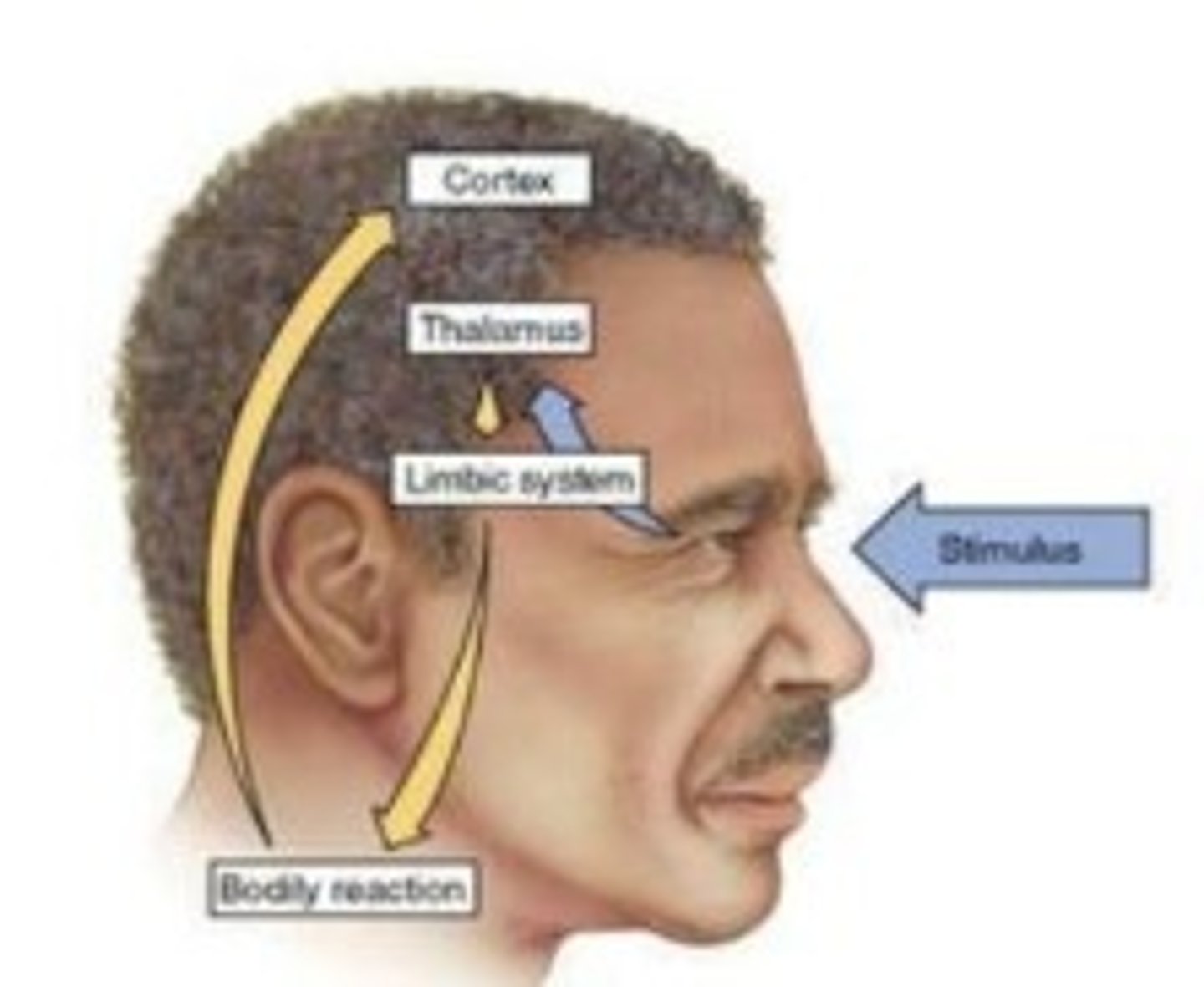
Cannon-Bard Theory
Emotions (caused by stimuli) travel simultaneously up to the brain (cognitive awareness) and down to the body (visceral sensation)
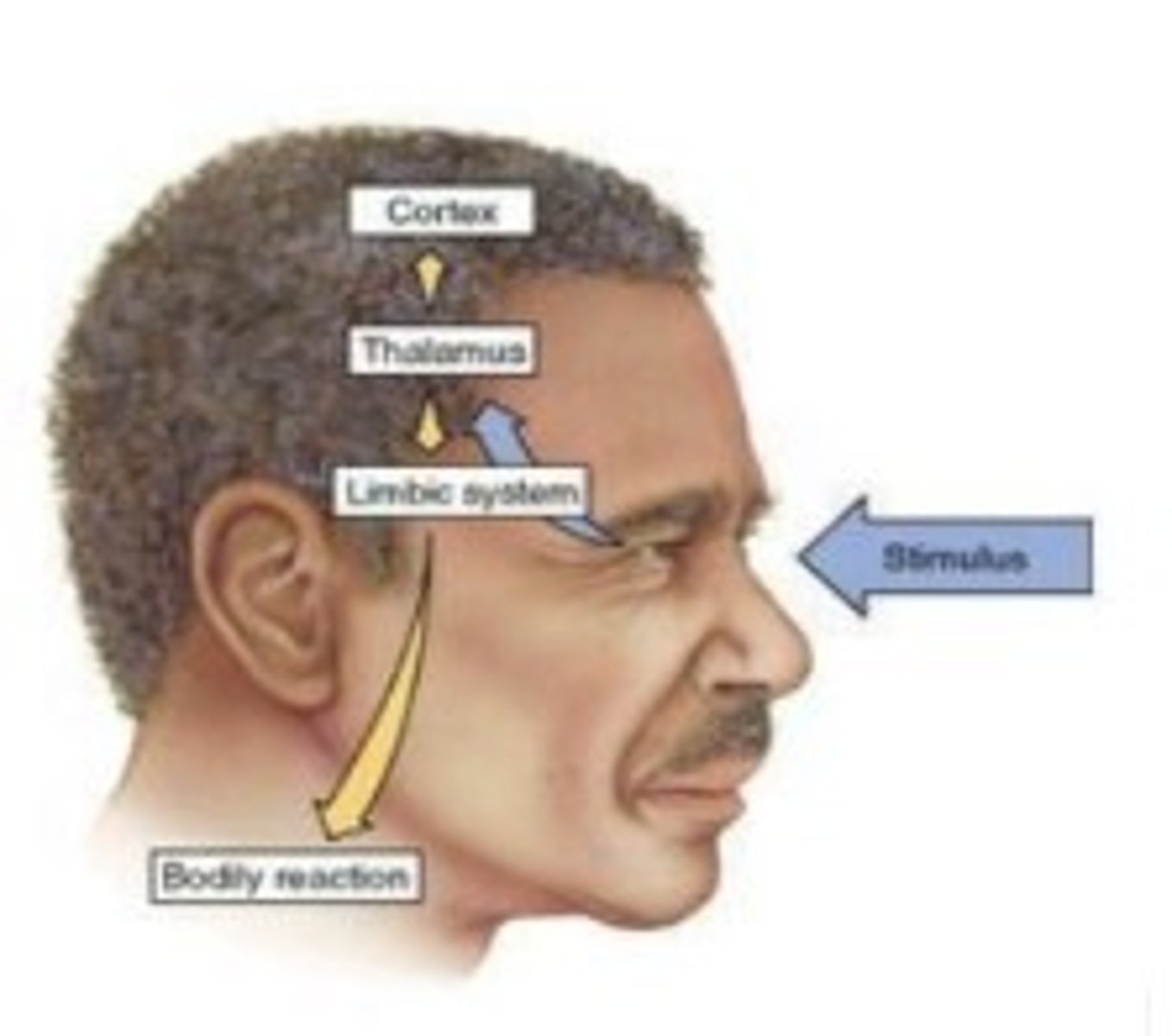
Schacter-Singer theory
Emotions (caused by stimuli) travel both up and down AND there is feedback between the systems.
Categorizing Emotions: Approach-Withdraw
Approach is more left frontal lobe while withdrawal is more right frontal lobe.
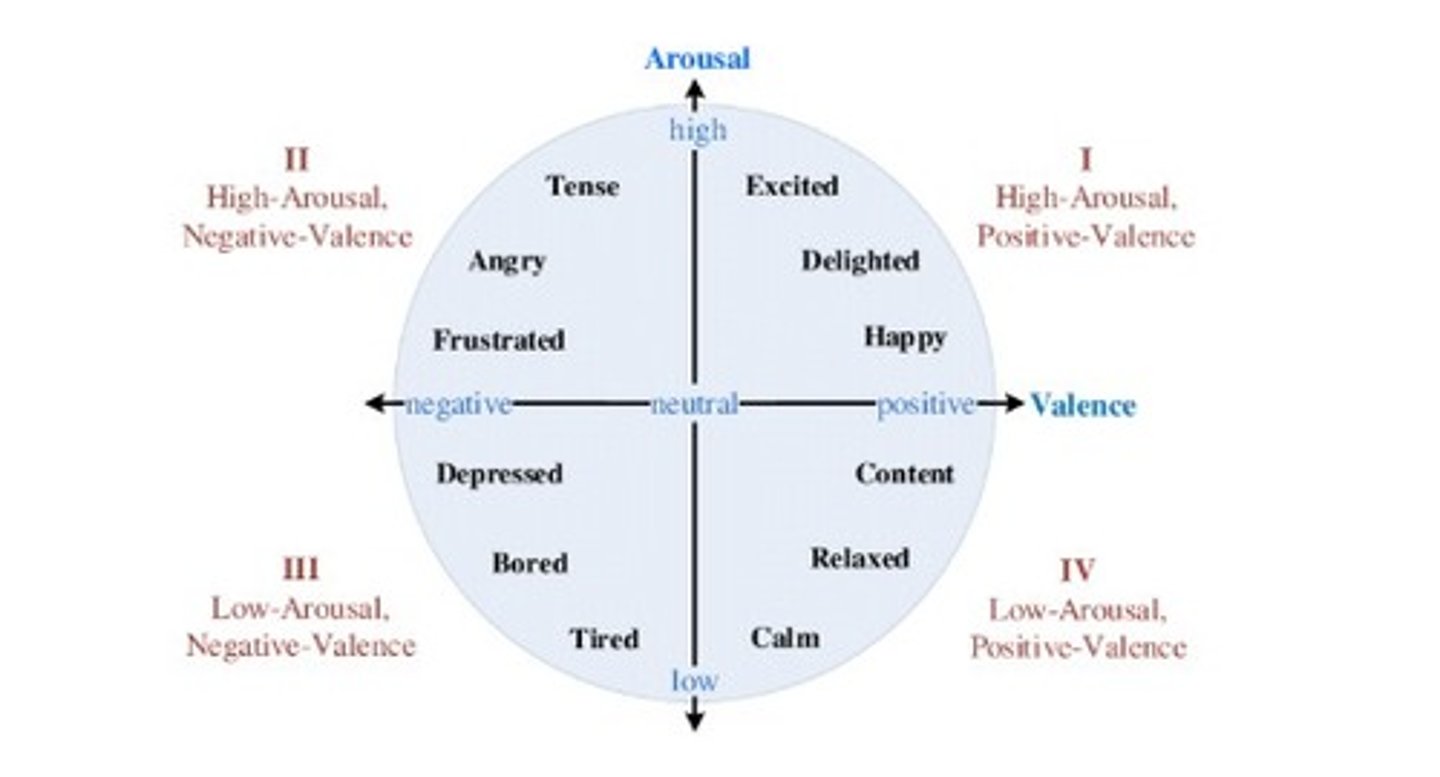
Categorizing Emotions: Valence & Arousal
Simplified way to describe emotions. Arousal is its connection to sympathetic nervous system. Valence is positive emotion versus negative emotion.
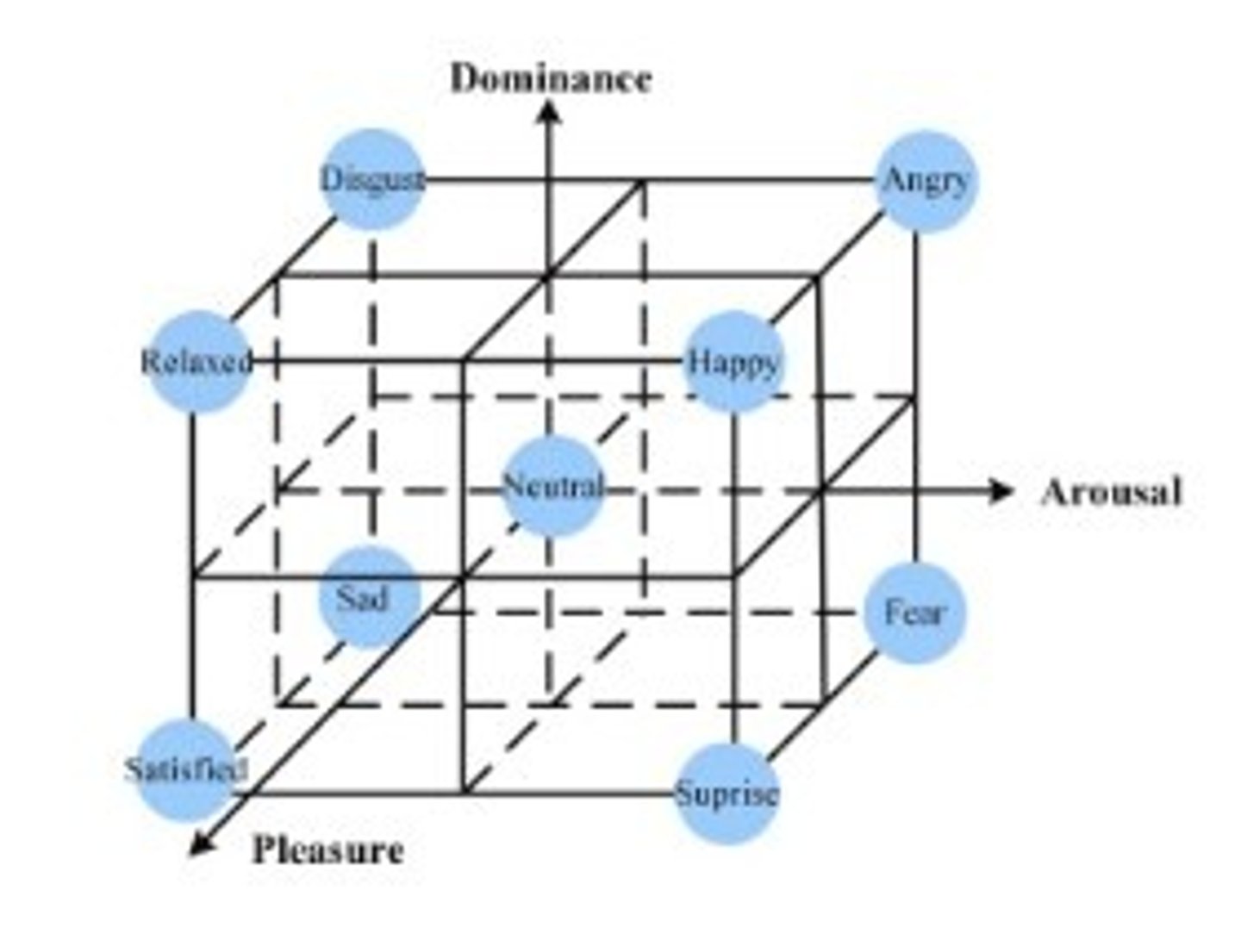
Categorizing Emotions: 3 axes: Valence, Arousal, Dominance
Its like Length Width and Height type of model. For example, fear is high arousal, submissive, and negative valence.
Categorizing Emotions: Color wheel
The color wheel has "basic emotions" as primary colors and the more complex emotions are secondary colors or different shades of a certain color. It shows the complexity of emotions, with different intensities and combinations of emotions.
Define the Facial Action Coding System & recognize key features of it.
Quantifiable way to read emotions on faces. Looks different parts of the face to find key movements or features of the face that align with different emotions. Ex: Anger has eyebrows pulled down and together, eyes opened wide, staring hard, lips pressed tightly together.
Explain how the left and right sides of our faces and our brains interact to send & receive emotional signals through facial expressions
Right Hemisphere is dominant for both producing and perceiving emotional facial expressions. Viewers left visual field is most sensitive to expressions as left side of poser's face is more expressive.
Explain challenges to using the "mirror test" as a measure of self-awareness.