🏘️ Welfare Inputs/Outputs
 Call Kai
 Learn
Learn Practice Test
 Spaced Repetition
 Match
Match Flashcards
 Knowt Play
1/23

There's no tags or description
Looks like no tags are added yet.
Name | Mastery | Learn | Test | Matching | Spaced | Call with Kai |
|---|
No analytics yet
Send a link to your students to track their progress
24 Terms
Learning objectives
Understand the core principles of animal-welfare assessment at the group level
Identify and describe different methods used to assess welfare in groups of animals (including resource-based and animal-based measures)
Recognize when and why group-level welfare assessment is applied in farming, wildlife, or monitoring programs
Explain the purpose and structure of animal-welfare protocols, including how they combine different types of measuresUse the Welfare Quality® protocol as an example to understand how systematic welfare assessment is carried out in practice
Animal Welfare – Key Concepts
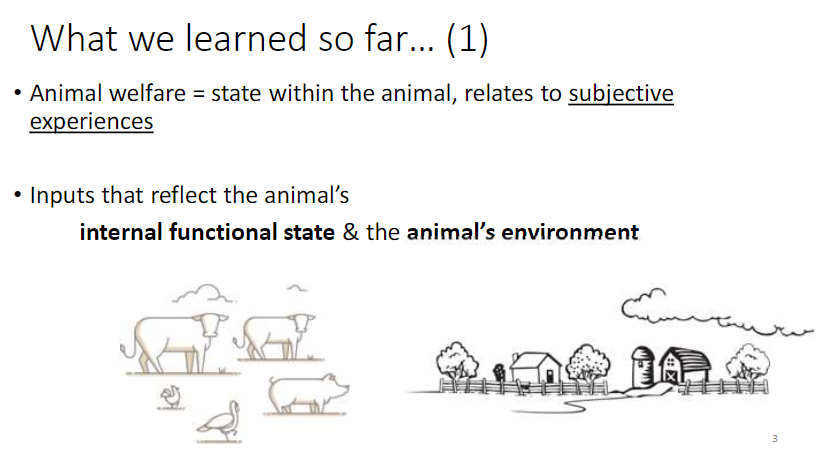
Definition
Animal welfare = internal state of the animal reflecting subjective experiences
Depends on internal functional state and environmental inputs
Animal Welfare – Negative Experiences
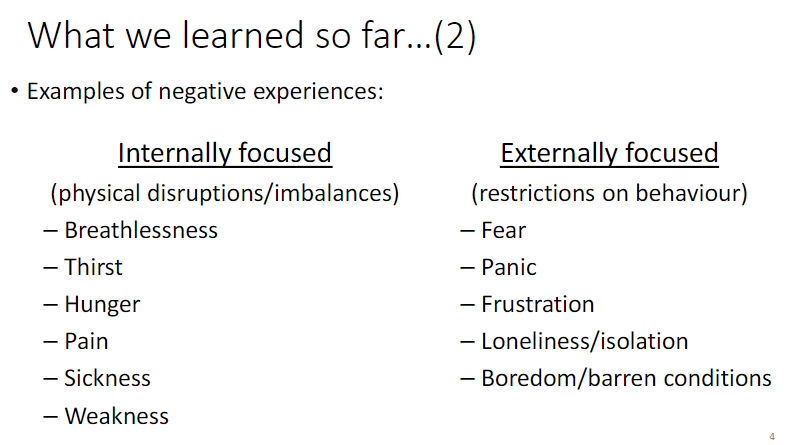
Externally Focused (restrictions on behaviour)
Fear
Panic
Frustration
Loneliness / isolation
Boredom / barren conditions
Internally Focused (physical disruptions / imbalances)
Breathlessness
Thirst
Hunger
Pain
Sickness
Weakness
Animal Welfare – Positive Experiences
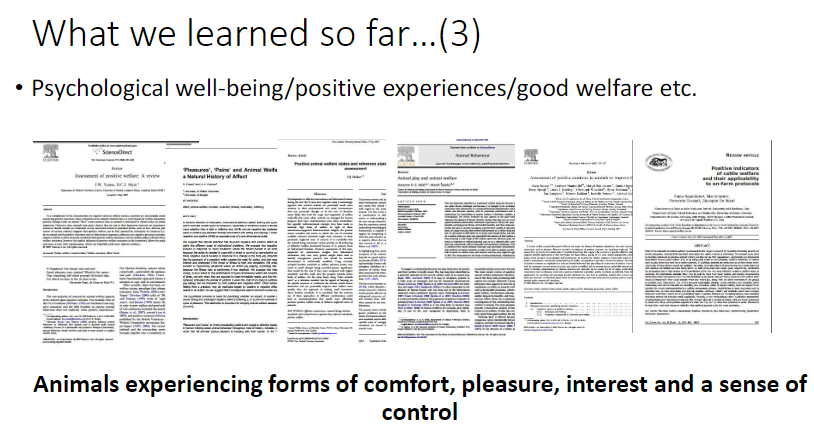
Psychological Well-Being
Includes comfort, pleasure, interest, and a sense of control
Reflects good welfare and positive experiences
Animal Welfare – Examples of Good Experiences
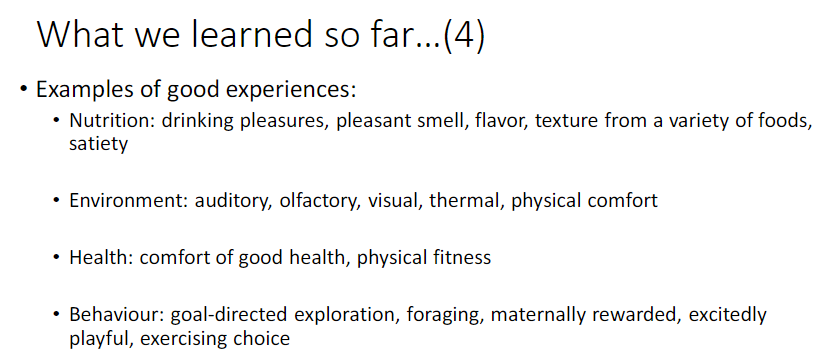
Nutrition
Drinking pleasures, pleasant smell, flavor, texture from a variety of foods, satiety
Environment
Auditory, olfactory, visual, thermal, physical comfort
Health
Comfort of good health, physical fitness
Behaviour
Goal-directed exploration, foraging, maternally rewarded, excitedly playful, exercising choice
Five Domains Model – Behavioural Interactions
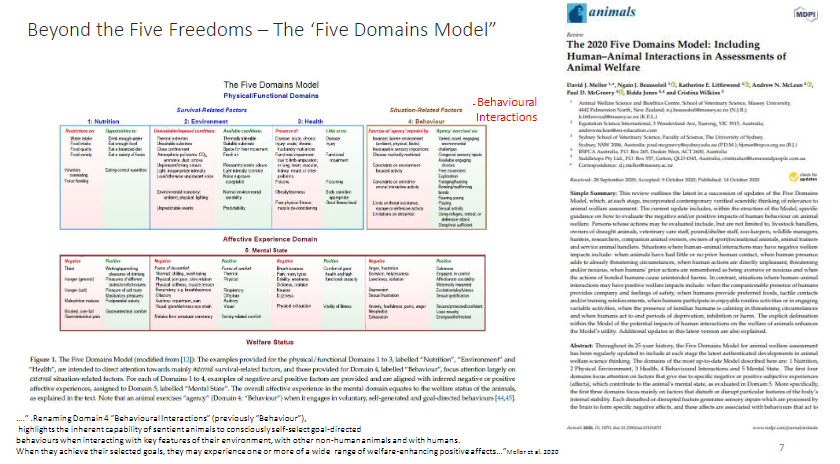
Renaming of Domain 4
Previously called Behaviour, now Behavioural Interactions
Definition
Highlights the ability of sentient animals to consciously self-select goal-directed behaviours
Interactions
Occurs with key features of the environment, other non-human animals, and humans
Outcome
Achieving these selected goals can produce a wide range of welfare-enhancing positive affects
Animal Welfare Assessment – In Practice
Core Concept
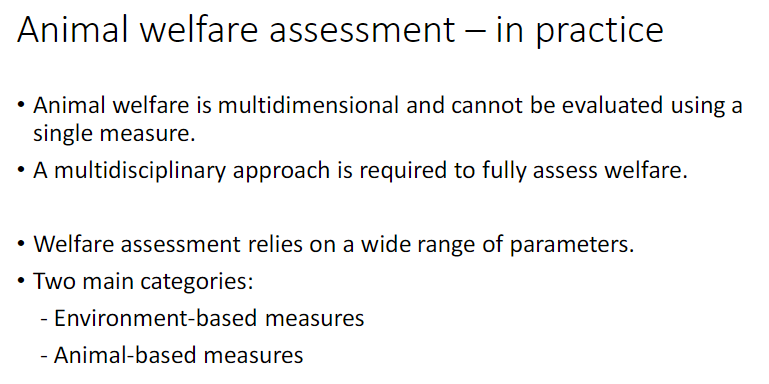
Animal welfare is multidimensional and cannot be assessed with a single measure
Approach
Requires a multidisciplinary approach to fully evaluate welfare
Assessment Basis
Relies on a wide range of parameters
Two main categories:
Environment-based measures – based on the animal’s environment
Animal-based measures – based on the animal itself
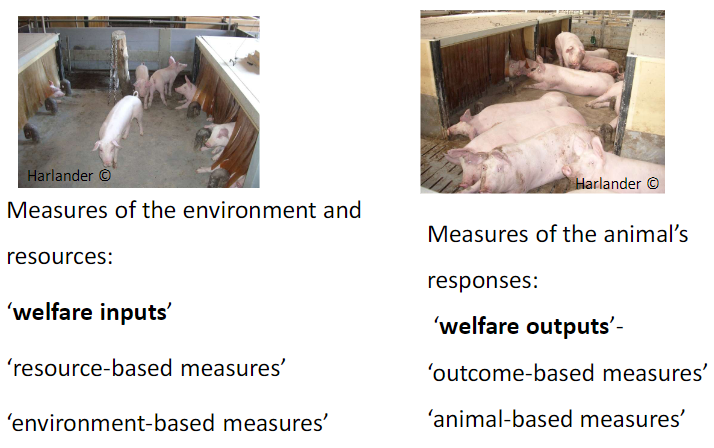
Welfare Measures – Inputs vs Outputs
Environment and Resource Measures
Also called: welfare inputs, resource-based measures, environment-based measures
Animal Response Measures
Also called: welfare outputs, outcome-based measures, animal-based measures
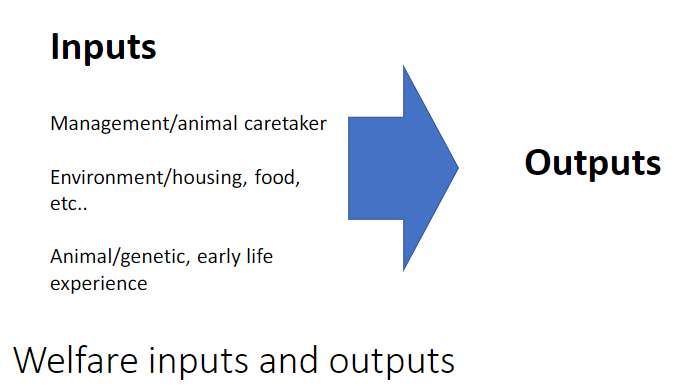
Welfare Inputs and Outputs – Overview
Inputs
Management / animal caretaker
Environment – housing, food, etc
Animal factors – genetics, early life experience
Outputs
Resulting animal responses
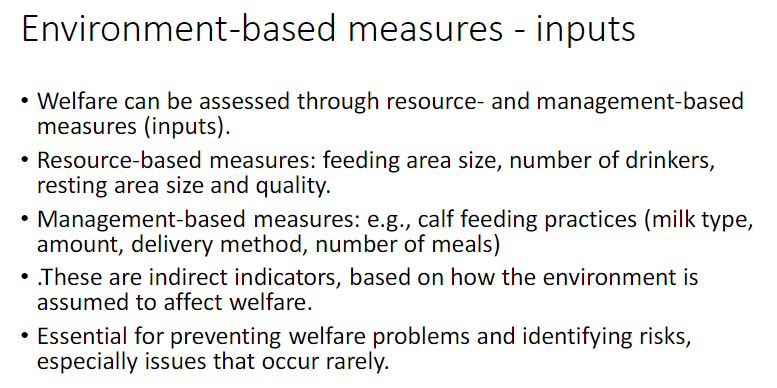
Environment-Based Measures – Inputs
Assessment Basis
Welfare can be assessed using resource-based and management-based measures (inputs)
Types of Measures
Resource-based – feeding area size, number of drinkers, resting area size and quality
Management-based – calf feeding practices: milk type, amount, delivery method, number of meals
Key Characteristics
Indirect indicators – based on how the environment is assumed to affect welfare
Essential for preventing welfare problems and identifying risks
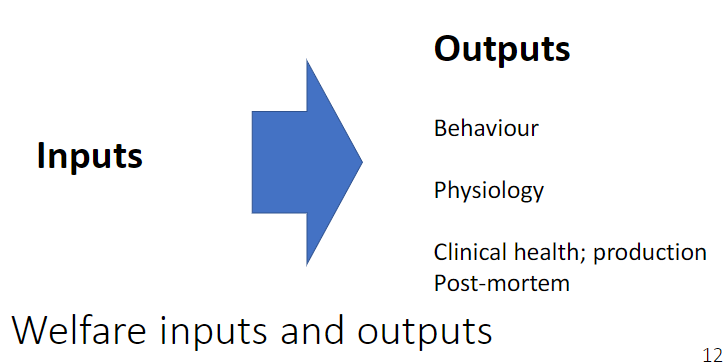
Welfare Outputs – Overview
Categories
Behaviour – observable actions reflecting welfare
Physiology – internal body responses (e.g., stress responses)
Clinical health / production – disease status and production performance
Post-mortem – findings after death indicating past welfare
Animal-Based Measures – Outputs
Assessment Basis
Direct observation of animals – outcome measures
Key Characteristics
Reflect effects of environment and management
More valid than environment-based measures
Include use of farm / lab records
Categories
Health, physiology, behaviour, performance, post-mortem findings
Combining Welfare Measures
Core Idea
Environment-based and animal-based measures each have advantages and limitations
Why Combine Them
Using both gives a more complete and reliable welfare assessment
Outcome
Allows assessment of current welfare state
Helps identify potential risks to future welfare
Assessment of Individual vs Group Animals
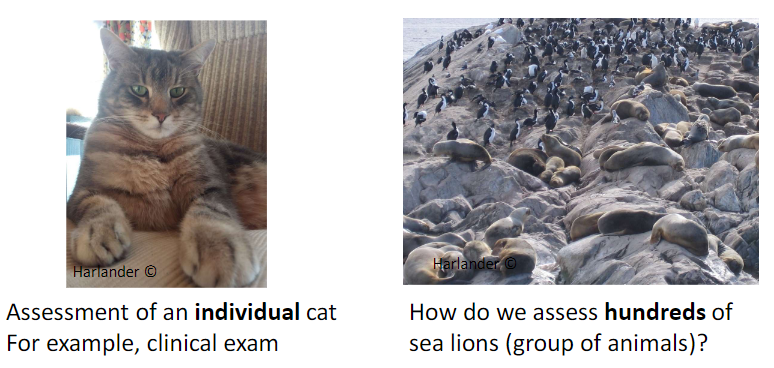
Individual Assessment
Example: clinical exam
Group Assessment
Different methods needed for large numbers of animals
Welfare Assessment – Large Flocks
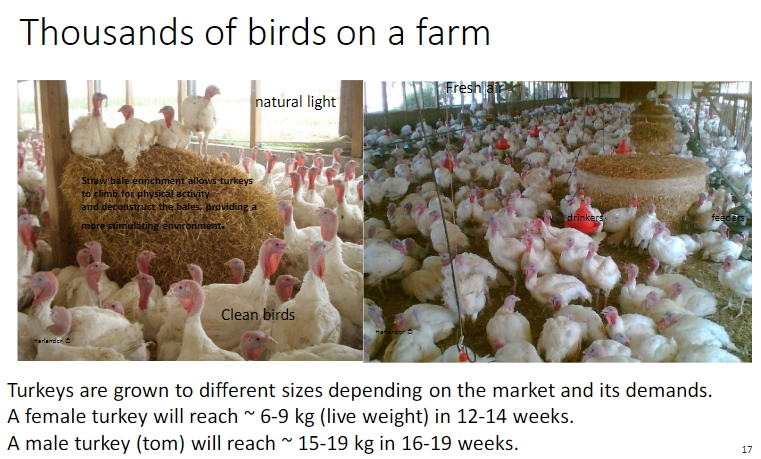
Growth Targets
Female turkey – ~6–9 kg in 12–14 weeks
Male turkey (tom) – ~15–19 kg in 16–19 weeks
Environmental Features
Natural light, fresh air
Straw bale enrichment – climbing, physical activity, deconstructing bales for mental stimulation
Drinkers – access to water
Clean birds – hygiene and health
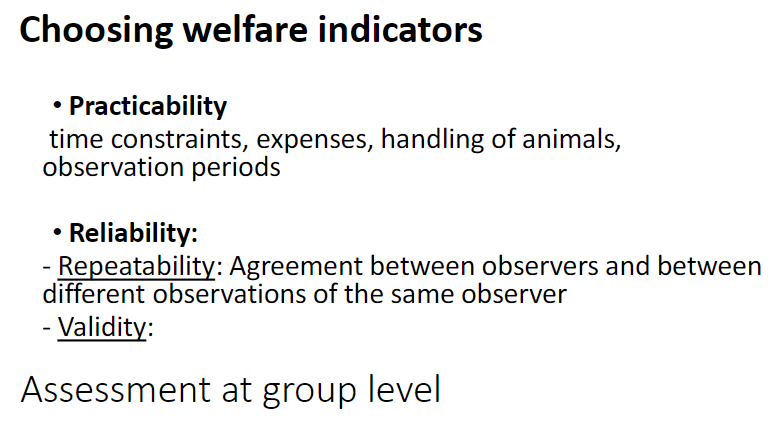
Choosing Welfare Indicators
Practicability
Consider time, cost, animal handling, and observation periods
Reliability
Repeatability – agreement between observers or repeated observations by the same observer
Validity – measures what it is intended to assess, including at the group level
Validity of Welfare Measures
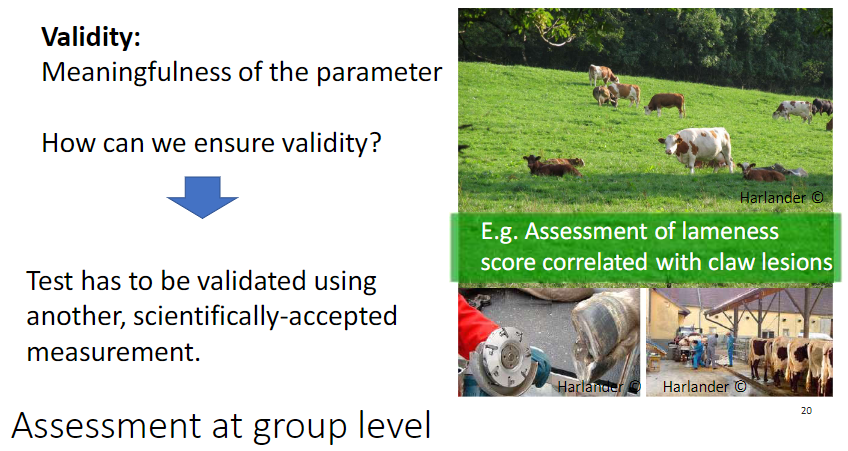
Definition
Validity – meaningfulness of the parameter
Ensuring Validity
Test must be validated using another scientifically accepted measurement
Example: lameness score correlated with claw lesions
Application
Can be assessed at the group level
Lameness in Dairy Cows – Case Study
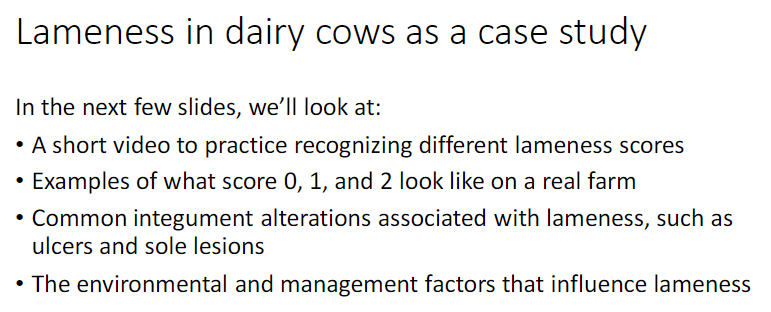
Assessment Practice
Recognize lameness scores 0, 1, 2 using videos or real farm examples
Associated Signs
Integument alterations – ulcers, sole lesions, hairless patches, swelling
Influencing Factors
Environmental factors – flooring, housing quality
Management factors – stockperson care, feeding practices, herd management
Lameness – Definition
Reduced mobility or impaired gait in animals
Often caused by pain, injury, or integument alterations

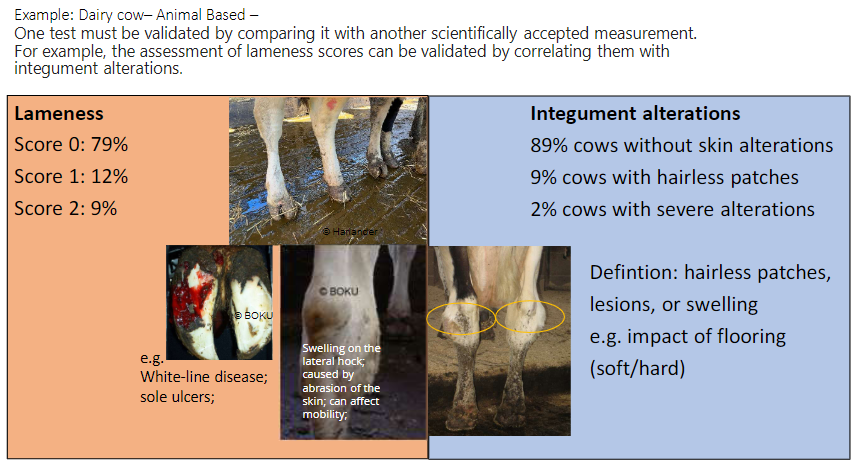
Lameness Assessment – Dairy Cow Example
Validation
One test must be validated against another scientifically accepted measurement
Example: lameness scores correlated with integument alterations
Lameness Scores
Score 0 – 79%
Score 1 – 12%
Score 2 – 9%
Integument Alterations
89% cows without skin alterations
9% cows with hairless patches
2% cows with severe alterations
Common Causes / Examples
White-line disease, sole ulcers, swelling on lateral hock caused by skin abrasion
Definition of alterations – hairless patches, lesions, swelling
Influencing factor – flooring (soft / hard)
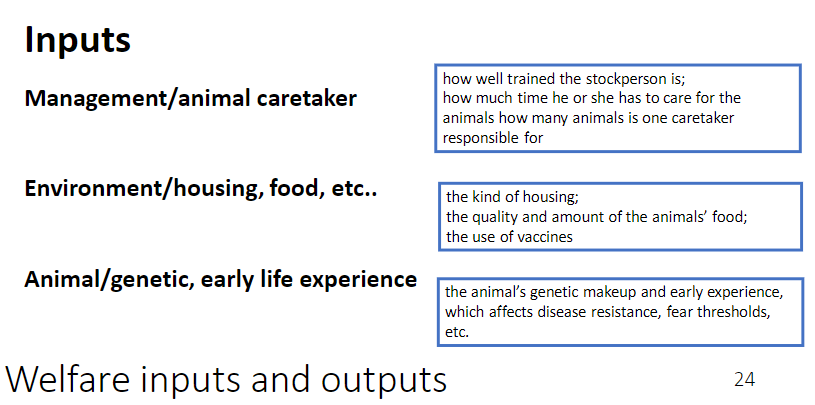
Welfare Inputs
Management / Animal Caretaker
Training, time available, number of animals per caretaker
Environment / Housing / Food
Housing type, quality and quantity of food, use of vaccines
Animal Factors
Genetics and early life experience – affect disease resistance, fear thresholds, and overall welfare
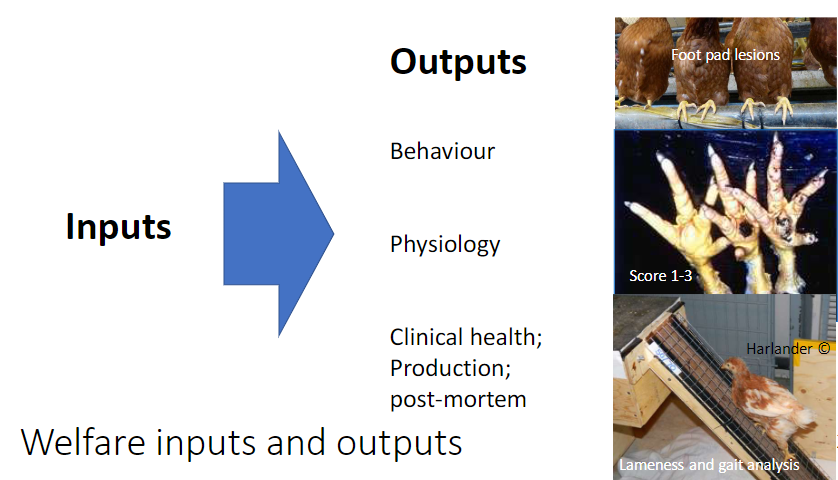
Welfare Outputs
Observation Categories
Behaviour – how the animal acts
Physiology – internal responses (e.g., stress indicators)
Clinical health / Production – disease, injuries, growth, or performance
Post-mortem – findings after death
Scoring
Examples: lameness / gait analysis scored 1–3
Relation to Inputs
Outputs reflect the effects of management, environment, and animal factors
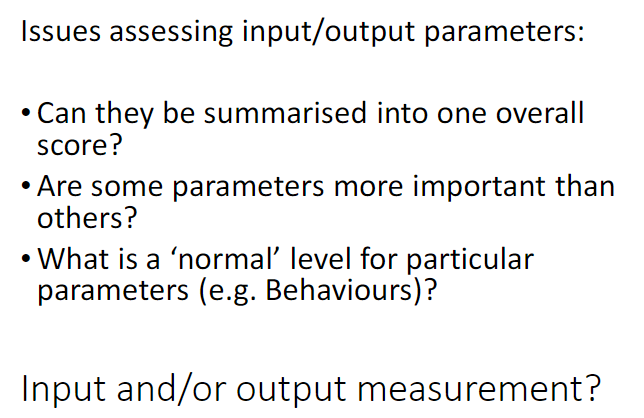
Issues in Assessing Welfare Parameters
Key Questions
Can inputs and outputs be combined into a single overall score
Are some parameters more important than others
What is a normal level for specific parameters (e.g., behaviours)
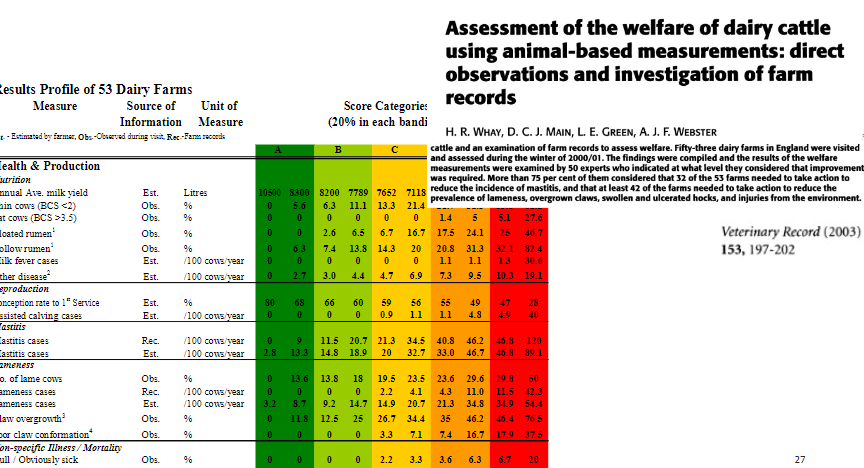
Dairy Cattle Welfare Assessment – Animal-Based
Method
Use direct observations of animals and investigation of farm records