PHYSICS UNIT 4 TOPIC 1 - Special Relativity
 Call Kai
 Learn
 Practice Test
 Spaced Repetition
 Match
 Flashcards
 Knowt Play
1/52

53 Terms
What observations of natural phenomena cannot be explained by classical physics?
Muons surviving long enough to reach Earth's surface from the upper atmosphere.
High-speed particles in particle accelerators having greater momentum than predicted by classical physics.
Why does the presence of muons in the atmosphere challenge classical physics?
Muons have a very short lifetime and should decay before reaching Earth's surface. However, many are detected at ground level. This can only be explained by special relativity, where time dilation causes the muons' internal clocks to run slower relative to Earth observers.
Why can't classical physics explain the momentum of high-speed particles in particle accelerators?
Classical physics predicts momentum using p = mv, but particles moving close to the speed of light gain much more momentum than this equation predicts. Special relativity is required to accurately describe their motion.
What is a frame of reference?
A frame of reference is a viewpoint from which an observer measures and describes the position, motion and events of objects.
What is an inertial frame of reference?
An inertial frame of reference is a frame that is either at rest or moving with constant velocity, where Newton's laws of motion hold true.
What is the difference between a frame of reference and an inertial frame of reference?
A frame of reference is any observer's viewpoint.
An inertial frame of reference is a special type of frame that is not accelerating and moves at constant velocity.
Give an example of an inertial frame of reference.
A train moving in a straight line at constant speed is approximately an inertial frame of reference. An observer on the train can use Newton's laws normally.
Why is an accelerating car not an inertial frame of reference?
Because the car is accelerating, Newton's laws do not appear to work normally without introducing additional apparent forces (such as the feeling of being pushed back into your seat).
Why are inertial frames of reference important in special relativity?
The laws of physics, including the speed of light, are the same in all inertial frames of reference. Special relativity only applies directly to inertial frames.
What are the two postulates of special relativity?
The laws of physics are the same in all inertial frames of reference.
The speed of light in a vacuum is constant for all observers, regardless of the motion of the light source or observer.
What is the first postulate of special relativity?
The laws of physics are identical in all inertial frames of reference. No inertial frame is preferred over another.
What is the second postulate of special relativity?
The speed of light in a vacuum is always 3.00 × 10^8 m/s for all observers, regardless of their relative motion.
Why is the second postulate of special relativity different from everyday experience?
In everyday life, speeds usually add together (e.g. a ball thrown from a moving car). Light does not behave this way. All observers measure the same speed of light, regardless of their own motion.
What does it mean to say that motion can only be measured relative to an observer?
Motion is not absolute. Whether an object is moving or stationary depends on the observer's frame of reference.
Give an example showing that motion is relative to an observer.
A passenger sitting on a moving train appears stationary to another passenger on the train, but appears to be moving to an observer standing on the platform.
Why is the concept of relative motion important in special relativity?
Special relativity is based on the idea that there is no absolute frame of reference. Measurements of distance, time and motion depend on the observer's frame of reference.
Can an object be moving and stationary at the same time?
Yes. An object can be stationary relative to one observer and moving relative to another observer in a different frame of reference.
What is simultaneity?
Simultaneity is the concept of two events occurring at the same time. In special relativity, whether events are simultaneous can depend on the observer's frame of reference.
Why is simultaneity relative in special relativity?
Observers moving relative to each other may disagree about whether two events occurred at the same time. Events that are simultaneous in one frame of reference may not be simultaneous in another.
How does the train-and-lightning example demonstrate simultaneity?
If lightning strikes both ends of a train at the same time:
An observer standing on the platform may see the strikes as simultaneous.
An observer moving with the train may see one strike before the other.
What does special relativity say about simultaneous events?
There is no universal agreement on whether distant events occur simultaneously. Simultaneity depends on the observer's motion.
What are the consequences of the constant speed of light in a vacuum?
Because all observers measure the same speed of light, even when moving relative to one another, measurements of time and length must change. This leads to time dilation and length contraction.
What is time dilation?
Time dilation is the effect where time passes more slowly for an object moving at high speed relative to an observer.
What is length contraction?
Length contraction is the effect where the length of an object moving at high speed appears shorter in the direction of motion to a stationary observer.
Why do time dilation and length contraction occur?
They occur because the speed of light in a vacuum is constant for all observers, regardless of their relative motion.
What is the proper time interval?
The proper time interval (Δt0) is the time measured by an observer who is present at both events being measured.
What is the relativistic time interval?
The relativistic time interval (Δt) is the longer time interval measured by an observer who sees the object moving relative to them.
What is proper length?
Proper length (L0) is the length of an object measured when the object is at rest relative to the observer.
What is relativistic length?
Relativistic length (L) is the shortened length measured by an observer who sees the object moving relative to them.
What is rest mass?
Rest mass (m0) is the mass of an object measured in its own rest frame.
What is relativistic momentum?
Relativistic momentum is the momentum of an object moving at speeds close to the speed of light and is given by:
p = γ mv
where γ is the Lorentz factor.
What is the mass-energy equivalence relationship?
The mass-energy equivalence relationship is:
E = mc²
where:
E = energy (J)
m = mass (kg)
c = speed of light in a vacuum (3.00 x 10^8 m/s²)
What does the equation E = mc² mean?
Mass and energy are equivalent and can be converted into each other. A small amount of mass corresponds to a very large amount of energy.
Why does a small amount of mass produce a large amount of energy?
Because the speed of light squared (c²) is extremely large:
c² = 9.0 × 10^16 m²/s²
so even a tiny mass corresponds to a huge amount of energy.
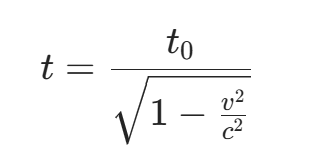
What equation is used to calculate time dilation?
where:
t = relativistic time interval
t0 = proper time interval
v = relative velocity
c = speed of light
Remember: t > t0
What equation is used to calculate length contraction?
where:
L = relativistic length
L0 = proper length
v = relative velocity
c = speed of light
Remember: L < L0

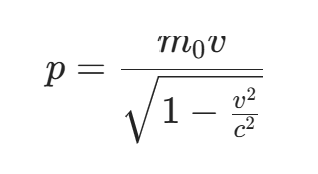
What equation is used to calculate relativistic momentum?
where:
p = relativistic momentum
m0 = rest mass
v = velocity
c = speed of light
What equation relates mass change to energy change?
where:
ΔE = energy released or absorbed
Δm = mass change
c = speed of light

Which is larger: proper time or relativistic time?
Relativistic time is larger.
t > t0
A moving clock appears to run slower.
Which is larger: proper length or relativistic length?
Proper length is larger.
L0 > L
Moving objects appear shorter.
What happens to an object's relativistic momentum as it approaches the speed of light?
Its momentum increases rapidly and becomes much greater than predicted by classical physics.
What is the implication of relativistic momentum increasing as an object approaches the speed of light?
Increasingly large amounts of energy are required to produce smaller and smaller increases in speed.
Why can an object with mass never reach the speed of light?
As its speed approaches the speed of light, its relativistic momentum increases towards infinity, requiring an infinite amount of energy to reach the speed of light.
How does relativistic momentum affect particles in particle accelerators?
Even when large amounts of energy are added, particles close to the speed of light gain relatively little speed, with most of the energy contributing to increased momentum instead.
Why is classical momentum inaccurate at very high speeds?
Classical momentum (p = mv) does not account for relativistic effects and underestimates the momentum of particles moving close to the speed of light.
What happens when energy is added to a particle already moving close to the speed of light?
The particle's momentum increases significantly, but its speed increases only slightly because it cannot exceed the speed of light.
Why do paradoxes arise in special relativity?
They arise because concepts such as time, length and simultaneity depend on the observer's frame of reference, often leading to results that seem to contradict common sense.
What is the twins' paradox?
One twin travels through space at a speed close to the speed of light and returns to Earth. Upon returning, the travelling twin is younger than the twin who remained on Earth.
How is the twins' paradox explained by special relativity?
The travelling twin experiences time dilation due to their high-speed journey. Less time passes for the travelling twin than for the twin who remains on Earth, so the travelling twin ages less.
What is the flashlight-on-a-train paradox?
A flashlight is switched on inside a moving train. Both passengers on the train and observers on the platform measure the light's speed as c, even though they are moving relative to each other.
How is the flashlight-on-a-train paradox resolved?
The speed of light is constant for all observers. Instead of light speeds adding together, measurements of time and distance adjust through relativity to ensure both observers measure the same speed of light.
What is the ladder-in-the-barn paradox?
A ladder moving close to the speed of light appears length contracted and may seem short enough to fit entirely inside a barn, even though its rest length is longer than the barn.
How is the ladder-in-the-barn paradox resolved?
Different observers measure different lengths and disagree about simultaneity. The stationary observer sees the ladder contract and fit inside the barn, while the observer moving with the ladder sees the barn contract. Both descriptions are correct in their own frames of reference.