Bio Unit 3 Final
 Call Kai
 Learn
Learn Practice Test
 Spaced Repetition
 Match
Match Flashcards
 Knowt Play
1/78

There's no tags or description
Looks like no tags are added yet.
Name | Mastery | Learn | Test | Matching | Spaced | Call with Kai |
|---|
No analytics yet
Send a link to your students to track their progress
79 Terms
True or false: “Photosynthesis occurs in plant cells, whereas respiration occurs in animal cells.”
False: all eukaryotic cells respirate.
How does carbon enter a photosynthetic cell?
Through openings called stromata that allow any gas through
What is the process of the carbon cycle
carboxylation, reduction, regeneration
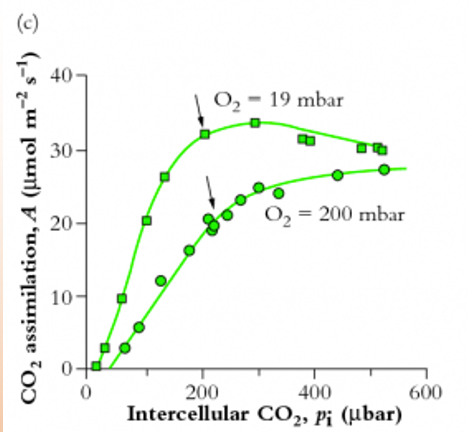
how is CO2 assimilation affected by the presence of O2
CO2 assimilation is decreased because rubisco will fix both O2 and CO2
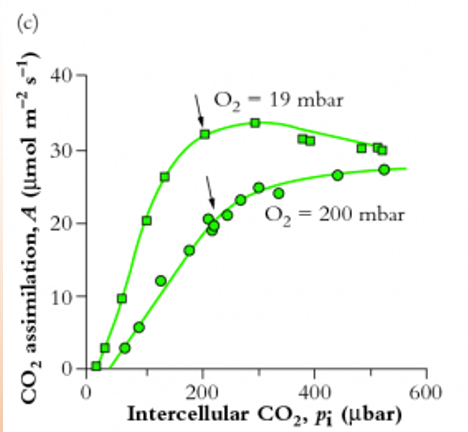
what are the 2 main outcomes of photorespiration
Can cause the plant to overproduce CO2
Can limit plant growth
Oxygenase activity
causes photorespiration
Why rubisco?
it can fix inorganic carbon
transpiration
the loss of water through the stromata
Why is C3 photosynthesis more common then C4 photosynthesis?
C4 photosynthesis is only efficient in high temperatures
Bulk Flow
the movement of molecules that exceeds the rate of diffusion
What is the function of the lungs/diaphragm
To facilitate ventilation (breathing)
what is the structure of the lungs/diaphragm and how does it aid its function
a dome shaped mussel that creates a vacuum to pull air into the lungs
what is the function of the alveoli
to serve as the primary site for gas exchange between the lungs and blood
what is the structure of the alveoli and how does it aid its function
it has thin walls to minimize the distance gasses have to travel for diffusion
what is the function of the Arteries, veins, and capillaries
to transport blood, waste, and nutrients throughout the body
what is the structure of the Arteries, veins, and capillaries and how does it aid its function
it has valves to prevent blood from flowing backwards
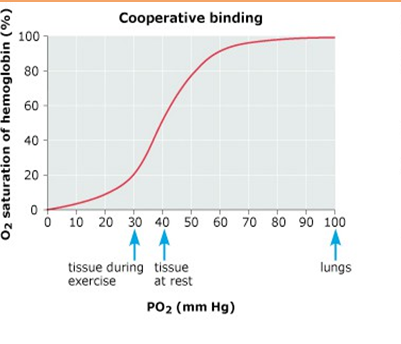
what is the main difference between cooperative and non cooperative binding
in cooperative binding once the first molecule binds to the protein the protein becomes more willing to take more molecules
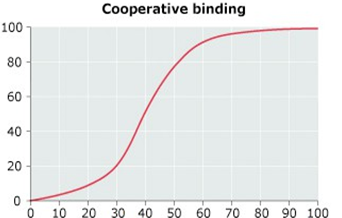
what are the x and y axis titles
x axis: O2 saturation of hemoglobin
y axis: partial pressures of oxygen
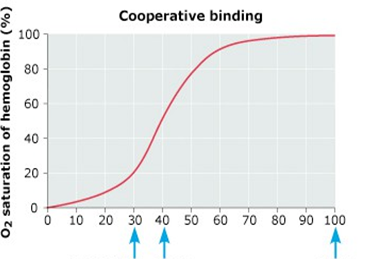
if the last arrow represents the lungs what does the middle arrow represent
tissues during exercise
Acclimation
Short term physiological response
Adaptation
long term genetic response
homeostasis
when an environment is regulated by its inhabitants to remain stable
EPAS1
A regulatory transcription factor
Hemoglobin can shift between how many states, what are they called
2 states, tense state and the relaxed state
Lag phase
low affinity to binding
log state
high affinity to bonding
saturation state
full capacity
why is the graph for hemoglobin an S shape
because it is very hard for the first molecule to bond then it becomes very easy then it levels out once saturated
while humans breath through their nose and mouth birds…
can only breath through their nostrils
what do birds not have that humans use to regulate breathing
a diaphragm
for birds, instead of lungs air in drawn into…
air sacks
true or false: birds lungs are NOT a fixed volume
False
Plants use what kind of system to get food and water
the vascular system
what is the force that causes pressure in trees
water potential
is the pressure in trees positive or negitive?
negative
does the bulk flow process use energy in trees
No
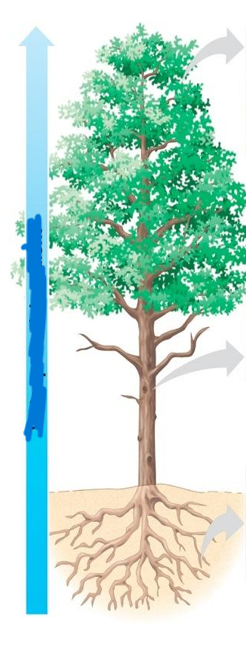
what does the arrow represent
the water potential gradient
collapse
caused by negative water pressure
cavitation
when an air bubble replaces water and bloats the water chain
what effect does droughts have on CWD, and at what point does this lead to plant mortality?
droughts are directly related to an increase in CWD, CWD causes plants to die
what is the point at which plant mortality rate skyrockets due to CWD called
the CWD limit
biotic components
organisms
abiotic components
physical environment
competition
interactions between individuals that use the same resource
what is the 1st tropic level called
the primary producers
what is the 2nd tropic level called
the primary consumers
what is the 3rd tropic level called
the secondary consumers
what is the 4th tropic level called
tertiary consumers
tropic cascade
a powerful indirect action that controls an entire ecosystem
keystone species
a species that affects an ecosystem disproportionally
considering the electrons that are involved in the redox reactions that occur during the light reactions of photosynthesis:
what molecule did the electron originate from and what is the final acceptor of that electron
H2O, O2
Explain why a decrease in CO₂ concentration inside a leaf would increase photorespiration.
Lower CO₂ causes RUBISCO to bind O₂ instead of CO₂, increasing photorespiration.
A plant is moved from a cool, moist environment to a hot, dry environment. Predict what happens to stomata opening, CO₂ levels, photorespiration, and growth rate.
Stomata close, CO₂ decreases, photorespiration increases, growth decreases.
Compare C3 and C4 plants in terms of RUBISCO function and efficiency under heat stress.
C3 plants have more photorespiration; C4 plants concentrate CO₂ so RUBISCO works better in heat
In the light reactions, what is the role of water and what is its final electron fate?
Water is split to replace electrons; oxygen is released as waste.
Explain how ATP is produced during the light-dependent reactions using the proton gradient.
H⁺ builds up in thylakoid space and flows through ATP synthase to make ATP.
If a plant cannot regenerate RuBP, what happens to the Calvin cycle and why?
The Calvin cycle stops because CO₂ cannot be fixed without RuBP.
Explain how the structure of alveoli increases the efficiency of gas exchange. Include at least 3 structural features.
Thin walls, large surface area, moist surface, and many capillaries allow fast diffusion.
Why must blood capillaries be only one cell thick for gas exchange to occur efficiently?
It shortens diffusion distance so gases move quickly.
Describe how cooperative binding in hemoglobin improves oxygen delivery to tissues.
Each oxygen bound makes it easier for more oxygen to bind or be released.
Interpret this scenario: a patient has blood with low pH and high CO₂. What happens to hemoglobin’s oxygen affinity and why?
Affinity decreases so hemoglobin releases more oxygen (Bohr effect).
On an oxygen dissociation curve, what does a right shift indicate about oxygen affinity, oxygen delivery to tissues, and CO₂ levels?
Lower affinity, more oxygen delivered, higher CO₂.
If the middle point on a hemoglobin dissociation graph represents exercise tissue, explain why oxygen is unloaded there.
Tissues need oxygen for energy and CO₂ is high, causing release.
Explain how bulk flow moves water from roots to leaves without ATP.
Transpiration creates pressure that pulls water upward through xylem.
What causes cavitation in xylem, and why is it dangerous for plants?
Air bubbles form and block water transport, stopping flow.
A drought occurs. Explain the sequence of events that leads to plant death using CWD and water potential concepts.
Drought lowers water potential, causes cavitation, blocks transport, and kills plant.
Distinguish between acclimation and adaptation using an altitude example.
Acclimation is short-term increased breathing; adaptation is genetic changes like EPAS1.
How does the EPAS1 gene help humans survive at high altitude?
It improves oxygen efficiency without excessive red blood cell production.
Why is increased red blood cell production not always beneficial at high altitude?
It thickens blood, making circulation harder.
Predict what happens to an ecosystem if a keystone predator is removed. Include trophic cascade effects.
Prey increase, resources get overused, ecosystem becomes unstable.
Explain how abiotic factors can indirectly influence species competition.
Stressful conditions reduce resources, increasing competition.
A graph shows population decline after removal of a top predator. Identify the likely ecological relationship and explain the trend.
Predator-prey relationship; prey increases and disrupts balance.
How does photosynthesis impact Earth’s atmosphere and allow for aerobic life?
It produces oxygen and reduces CO₂, enabling aerobic life.
Explain how structure and function are linked in chloroplasts and alveoli.
Both have structures that maximize efficiency of gas exchange or energy conversion.
Describe how climate change could affect photosynthesis, transpiration, and plant survival simultaneously.
Heat increases water loss and photorespiration, reducing growth and survival.
A mutation causes RUBISCO to have higher oxygen affinity than carbon dioxide affinity. Predict the effect on plant survival.
More photorespiration, less glucose, reduced survival.
If ATP synthase stops working in the chloroplast, what happens to the Calvin cycle and why?
Calvin cycle stops because no ATP is produced.
Birds survive at high altitude better than mammals. Explain using respiratory structure and gas exchange efficiency.
Birds have one-way airflow and more efficient oxygen extraction.
A population of plants evolves thicker leaves over time in a dry environment. Is this acclimation or adaptation? Justify using genetics.
Adaptation because it is a genetic change over generations.