Decision Making
 Call Kai
 Learn
Learn Practice Test
 Spaced Repetition
 Match
Match Flashcards
 Knowt Play
1/31

There's no tags or description
Looks like no tags are added yet.
Name | Mastery | Learn | Test | Matching | Spaced | Call with Kai |
|---|
No analytics yet
Send a link to your students to track their progress
32 Terms
Participants answering questions about geography incorrectly claim that Montreal, Canada is farther north than Seattle, Washington. This suggests spatial info is sometimes stored in:
long-term memory as propositions
- our LTM organizes the world into hierarchical categories (propositions)
When participants are shown close-up photo of an object, and are later asked to draw the scene from memory, they consistently draw more of the background and surroundings than were actually present. This is known as:
boundary extension
3 multiple choice options
What does the orbitofrontal cortex do?
Plays a large role in judgements/decisions
- Damage to OFC can impair the ability to make decisions
What is judgement?
the process through which people draw conclusions about the world based on available evidence
What is a frequency estimate?
When we assess how often various events have occurred before
- Many judgements begin with this
What is an attribute substitution?
A strategy of relying on easily assessed info as a substitute for needed info
- Because when we make frequency estimates, we often don't have access to direct info
What are some examples of attribute substitution?
Availability, representativeness, affect, effort heuristic
What is a heuristic?
efficient strategies that usually lead to the right answer, but not always
What is the availability heuristic, and what errors can it lead to?
We judge the frequency/likelihood of an event based on how available it is in our minds
- Can lead to people overestimating the frequency of rare events
How was the availability heuristic tested by recalling assertiveness?
People were asked to give either 6 (ease of retrieval) or 12 (amount of info retrieved) examples of times they've been assertive
- those asked to recall only 6 examples rated themselves as more generally assertive, because they had an easier time recalling that info
Which of the following best illustrates the availability heuristic?
homeowner overestimating likelihood of their house being broken into because they saw it on the news
3 multiple choice options
How was the availability heuristic tested by estimating how much of a contribution one's home country has made to world history?
National Narcissism effect: participants estimated their own nation's contributions were 10x more than its actual contribution estimate
What is the representativeness heuristic?
assuming that a resemblance to the prototype is the determining factor of likelihood
What is the assumption of homogeneity?
expectation that each individual is representative of the overall category
- when encountering an individual exemplar, you immediately map the characteristics of the prototype onto them and see what matches
What is the gambler's fallacy?
the belief that the odds of a chance event increase if the event hasn't occurred recently
What is covariation?
X and Y covary if the presence of one can be predicted by the presence of the other
- ex. exercise and stamina, education years and annual salary, etc.
What are some illusions of covariation?
We can have incorrect perceptions that one variable predicts another, shown in:
- astrological signs to personality
- stereotypes
- superstitions
What is base-rate info and diagnostic info?
Base-rate info: about how frequently something occurs generally
Diagnostic info: Does an individual case belong to the category
- Base-rate neglect is to neglect the base-rate info in favor of the diagnostic info > less likely for frequencies than probabilities/proportions
How was base rate neglect tested by lawyers ad engineers?
Base rate condition was 70 lawyers and 30 engineers, hypothetical person (Jack) is statistically more likely to be a lawyer but strongly resembles most peoples' prototypes of an engineer in his profile.
With the base-rate and diagnostic info on if Jack is a lawyer or engineer, people showed base-rate neglect by failing to consider the statistical odds enough
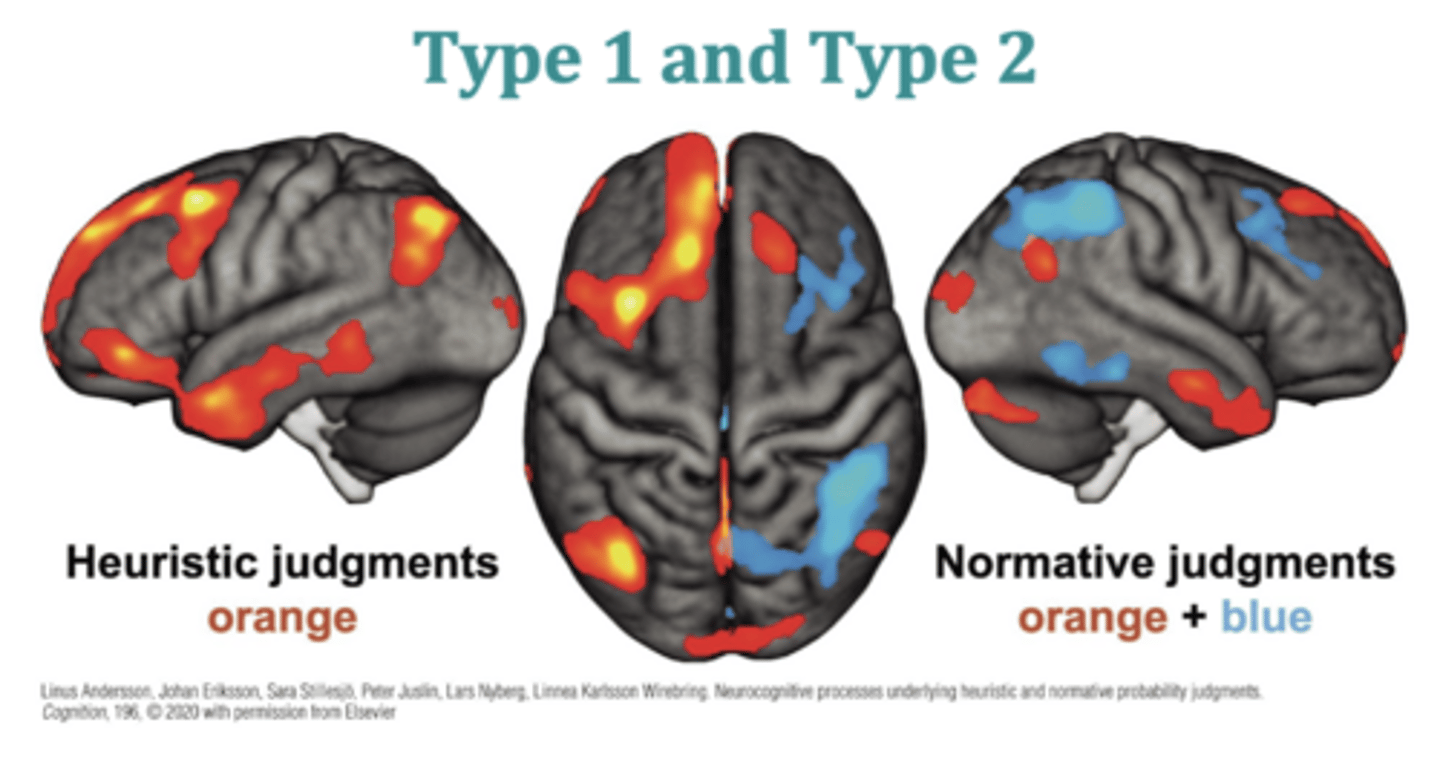
What are the two types in the dual process model, and when are we more likely to use them?
Type 1: fast, automatic, reliance on heuristics
- more likely to be used when we're under time pressure
Type 2: slow, effortful, more likely to be correct
*different brain areas activate in each type
When are type 1 and 2 decisions more accurate?
type 1 is more accurate when the role of random chance is emphasized
type 2 is more accurate when we are in an educational setting, or have had formal education
What is induction and deduction?
Induction: the process through which you forecast about new cases based on observed cases
Deduction: the process through which you start with givens and ask what follows from these
What gets in the way of induction and deduction?
Confirmation bias: we selectively look for info that confirms our hypothesis and overlook evidence against it
How was confirmation bias tested?
participants given 3 numbers (2, 4, 6), then tasked with figuring out the rule, and creating new trios to determine the rule
- found that participants sought out only to confirm the rules they were proposing
What is belief perseverance?
Continuing to endorse a belief even when disconfirming evidence is fully undeniable
What are categorical syllogisms, and what affects our ability to reason with these?
categorical syllogisms: logical arguments containing 2 premises and a conclusions
belief bias: if a syllogism's conclusion is something people believe to be true anyway, they're more likely to judge the syllogism's conclusion as logical without actually following along with its own logic, and vice versa
What is the principle of utility maximization?
Choosing the option with the greatest expected value
- However, decisions are often guided by factors that have
little to do with utility maximization.
How does the framing of outcomes impact choices?
People tend to choose differently depending on the framing of the question (either positively or negatively), when the question itself has the exact same utility
What is the endowment effect?
We place more value on things we already own than things we don't already own
What is reason-based choice in comparison to utility maximization?
- Our goal is simply to make decisions that we feel good
about because we feel they are reasonable and justified
- Framing effects owing to a change in factors are relevant
to particular justifications.
According to the dual-process model, one mode of thought is ___ while the other mode is ___
automatic, effortful
You're introduced to a new toy called "Dax." You're shown 10 Daxes, all are blue, and you conclude that Daxes are blue. This is:
inductive reasoning