Language and Literacy Midterm
 Call Kai
 Learn
Learn Practice Test
 Spaced Repetition
 Match
Match Flashcards
 Knowt Play
1/96

There's no tags or description
Looks like no tags are added yet.
Name | Mastery | Learn | Test | Matching | Spaced | Call with Kai |
|---|
No analytics yet
Send a link to your students to track their progress
97 Terms
The Simple view of Reading
word reading x language comprehension = reading comprehension
Basically, you can predict reading comprehension score if word reading (decoding) and language comprehension are known
cognitive theory of language acquisition
language is driven by our cognitive representations and processes. cognitive representations (schemas) change developmentally.
schema
Building block of knowledge. ex. schema of restearant : sit down, recieve menu, waiter takes order, etc. changed through assimilation or accommodation
assimilation
New information added to exsistingschema. ex. l have a white dog. l see a brown dog. I am told it is a dog. MYschema has been added to, now I know 2 types of dogs.
accommodation
Newinfo is so different schema must be restructured. ex. child learns new lexical category and no longer calls neighbors dog "cat"
Piaget's stages of cognitive development
sensorimotor, preoperational, concrete operations, formal operations
sensorimotor
language functions primarily egocentric and socialized. language production includes crying and babbling.
0-2 years
Pre operational
language becomes symbolic, language production goes from siingle words to simple sentences
2-7 years
concrete operations
language becomes socialized, understand concepts like time, gain reasoning skills, learn language rules when made visible
7-11 years
formal operations
higher order reasoning and ability to abstractly think, can engage in hypotheticals, non literal language, morals and politics
12years- adulthood
behaviorist theory of language acquisition,
NO internal mechanism for learning language, language is learned behavior.Children imitate caregivers then modify language due to operant conditioning
3 challenges to behaviorist theory
positive punishment
adding something unpleasant to discourage benavior. ex. scolding child for swearing
negative punishment
taking away something desirable to discouragebehavior.ex taking away iPad when child is misbehaving
positive rein-orcement
giving something toencourage behavior. Ex. give child fret for cleaning
negative reinforcement
taking away something unpleasant to encouragebehavior. ex-removing curfew after chores
Nativist theory of language acquisition
children have innate instinct, hardwired for learning language.LAD, critical period, universal grammar
Language acquisition device (LAD)
neurological basis for language and its acquisition
all children share internal constraints which charactericize construction of grammar
how children know that when you point to an animal and say bunny, yourrneferring to the animal and not the ground, the fluffiness of the bunny, etc.
universal grammar
innate template for language
critical periods
ability to learn language has biological limits, cuts off at puberty
interactionist theory of language acquisition
while then is biological basis, social interaction is fundamental to l anguage acquisition, Language Acquisition support system
Language support acquisition support system
Parents/caregiver, teachers, peers, media, environment
Phonology
speech sound system
Study of sounds and the rules that govern combining them in a language
can you hear the sounds that make up words
subfields: phonetics, phonemes, phonological awareness
Phonological system
includes inventory of sounds and their features, and the rules of a language that specify how sounds interact
phonetics
descriptions of the sounds itself. ex. saying the 'duh' sound - puff of air or not?
subfields:articulatory phonetics, acoustic phonetics, auditory phonetics
phonemes
sounds that have meaning within a language
phonological awareness
explicitly an identify manipulate soundsin language . hear the sound, play with it, identify it, change it, be able to think about it, critical for learning the sound connections
Phonemes
basic unit of speech sounds
Place of articulation
where does air get obstructed in the vocal track? Bilabial, labiodental, interdental, alveolar, Palatal, velar, glottal
manner of articulation
how is the airflow obstructed? Stops, fricatives, affricates,nasals,liquids, glides
voicing
voiced: vocal cords vibrate. unvoiced: no vibration
vowels
unobstructed vibration in the vocal tract. resonance caused by position of tongue, oral pharynx, jaw
Physical dimensions of vowels
tongue height: high, mid, low
frontness: front, back
Lip rounding: round, spread
tenseness: tense, lax
internal structure syllables
onset and rime
rime -> nucleus and coda
Phonemic awareness
subtype of phonological awareness , explicitly identify and manipulate phonemes
critical for learning to read an alphabetic language
matching and identifying - blending - deletion- substitution
Development of phonological awareness
word level - rhyming- syllable- onset and rime - phoneme
word level stage of phonological awareness
recognition that streams of speech can be broken down into single words, appears around 3yrs
rhyming
recognition and appreciation of rhymes (around age4) generation of rhymes ( ages 5)
syllables
Blending:What word does CAN DY make? appears 4 Yrs
segmenting: say CANDY slowly, each syllable clear, appears kindergarten
deleting: say CANDY. now say CANDY but don't say DY. appears kindergarten
onset and rime
segmenting onsets: children asked to identify onsets of words.ex. what is the first sound in CAT
blending onsets and rimes: Children asked to combine an orset and rime to form a new word.ex. what word does ST - OP make?
relevant for beginning reading with word families
morphology
system of forming words
governs how meaningful units of language can be combined to form words.
morpheme
smallest grammatical unit, smallest unit in language that contains meaning
word
fundamental unit of Iinguisticmeaning, contain one or more morphemes
Lexicon
vocabulary or inventory of words
3 tiers, tier 1: basic, tier 3: big words
Free morphemes
units of meaning that can standalone as words, do not have to be combined with other morphemes. ex. sky, play, elephant
independent bases
most free morphemes can be combined with at least some other morphemes , ex. SKYline, rePLAY,
content, function
Bound morphemes
sublexical meaning units that can't stand independently as words.
convey important meaning when added to base/root words, some rootwords are also bound morphemes. ex FLATE : de FLATE
subfields: bound roots, affixes, contracted forms
bound root
the base of the word which must have an affix attached
ex. ‘rupt’, needs inter-rupt, e-rupt, etc.
affix
a morpheme that must be attached to a base. ex. re, non, ing
prefixes, suffixes, combining forms
contracted form
word made up of 2 words, drops some letters, and uses an apostrophe in their place
ex. do not → don’t
content
free morpheme, consists of nouns, verbs, adjectives, adverbs
function
free morpheme, word necessay for grammar
Prefixes
affix that occurs before base
suffix
affix that occurs after base. ex: -ness, -ly
inflectional, derivational
combining form
Affix that can occur before or after base
inflectional morphology
combination of stem and morpheme resulting in word of same grammatical class and general meaning remains the same
usually fills syntactic feature such as agreement.
ex. plural -s, past tense -ed
derivational morphology
combination of stem and morpheme usually results in a word of a different class, meaning of New word can be hard to predict ex. verbs into nouns : spell →speller , nouns into verbs: random → randomize .
morphological awareness
explicitskill at identifying and manipulatinf morphemes
knowledge of morphemes can help reading and writing development
discriminates good and poor readers
also strong relationship with text reading fluency and vocabulary
historic layers of english
anglo saxon-Norman French - latin-Greek
Anglo-saxon layer
short, monosyllabic words. Highfrequency words, often refer to everyday things . ex. sky, sheep, father
Norman French layer
Often have special endings, such as -ine, -ette, -elle
source of the spellingrule : c and G are pronounced /s/ and /j/ when followed by E, I and Y
words for food and fashion, abstract social ideals, relationships
ex.cousin, peace, beautiful
Latin layer
constructed aroundroots whose meanings are changed by adding prefixes and suffixes
contentwords found in social sciences, physical sciences, and literature
ex. terrestrial, soar, aquarium
Greek layer
uses combining forms
can combine with other bound morphemes in flexible order
often used in modern scientific, philosophical, and mathmatical terms
hypnosis, neuropsychology
orthography
study of writing systems
ideographies
Writing system where:
graphemes represent meanings
pictographs represent concrete objects
ideographs represent abstract ideas
ex. egyptian hieroglyphs ?
logo graphy
writing system where graphemes represent individual words
ex. Chinese, Japanese kanji
Syllabary
each grapheme represents a syllable
ex. Japanese hiragana
alphabets
abugida: syllabic alphabet.ex. devanagari
abjads: letters are all consonants, vowels are diacritical marks. ex. Arabic
Full alphabet: each grapheme represents a phoneme (both vowels and consonants) ex. english
shallow orthographies
consistent relationships between graphemes and phonemes.ex. Spanish, german
Deep orthographies
less consistent relationship between individual graphemes and phonemes.ex english
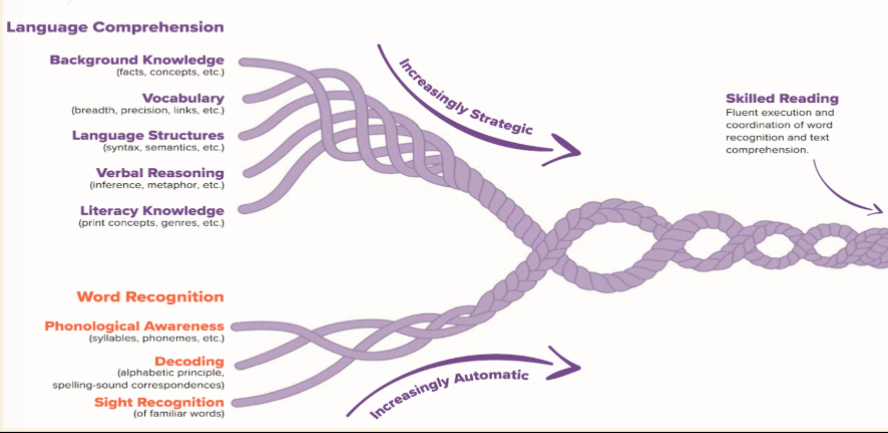
The reading rope
language comprehension -word recognition= skilled reading
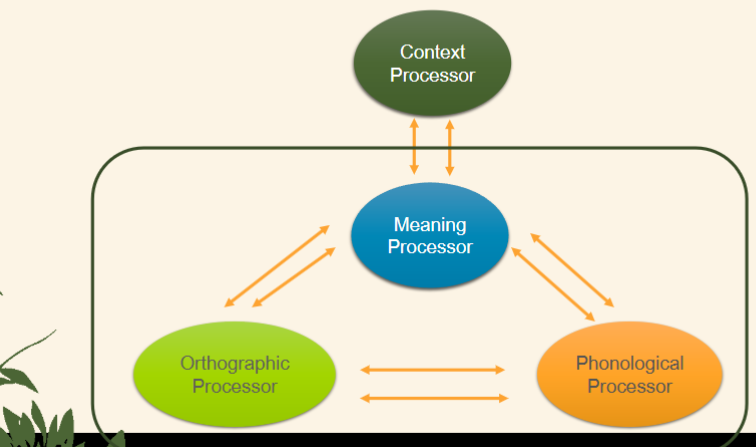
connectionist models of reading development
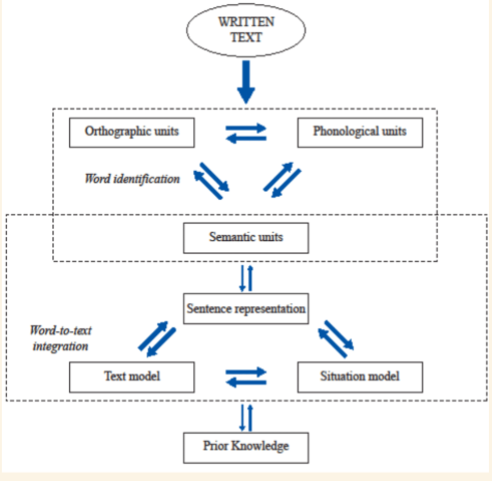
reading system framework
stages of reading development
prealphapetic , partial alphabetic, full alphabetic, consolidated
Prealphabetic stage of reading development
childrenrely on visually salient and contextual cues to identify words, do not use letter-soundcues
Partial alphabetic stage of reading development
children use letter names or sounds to read or write
they can't decode unfamiliar words
full alphabetic stage of reading development
children have learned phoneme-grapheme correspondences
they can analyze and form grapheme-phoneme connections to read and spell unfamiliar words
consolidated stage of reading development
children can read words by using larger consolidated spelling patterns (syllables or morphemes)
they can use larger chunks to decode and spell multisyllabic words
systematic Phonics instruction
Children are explictiy taught the grapheme-phoneme correspondences (GPCs) inaclear, sequential order, moves rom simple to more complex GPCs
explicit spelling instruction should include
spelling patterns , word origins, morphology
5 domains of language
Phonology, Lexicon, syntax, morphology, pragmatics
Syntax
systemic rules for combining words
prescriptive grammar: rules people think must be followed
Descriptive grammer: rules people actually use
Pragmatics
Use of language as a social tool.
includes understanding of register, turn taking, literal vs. non literal language
Regularitiy
Degree to which graphemes have the same pronounciation.
ex. B represents /b/ vs. C represents /k/ and /s/
Consistency
Degree to which letter patterns have the same pronounciation on different words
ex. INT in mint and pint
affriction
when /t/ is followed by /r/ or /yu/, sounds like /ch/
Frith Model of how children develop reading skill
logographic/pictorial stage: child’s brain photographs words and visually adjusts to the shape of the alphabet’s letters
alphabetic/phonological stage: brain begins to decode the letters (graphemes) into sounds (phonemes)
Orthographic stage: able to recognize words quickly and accurately
Chall Models of how children develop reading skills
prereading
initial reading and decoding
confirmation and fluency
redaing for learning the new
multiple viewpoints
construction and reconstruction
Bear et al.’s model of spelling development
emergent
Letter Name Alphabetic
Within word pattern
syllable juncture
derivational relations