O-Chem exam 4
 Call Kai
 Learn
Learn Practice Test
 Spaced Repetition
 Match
Match Flashcards
 Knowt Play
1/121

There's no tags or description
Looks like no tags are added yet.
Name | Mastery | Learn | Test | Matching | Spaced | Call with Kai |
|---|
No analytics yet
Send a link to your students to track their progress
122 Terms
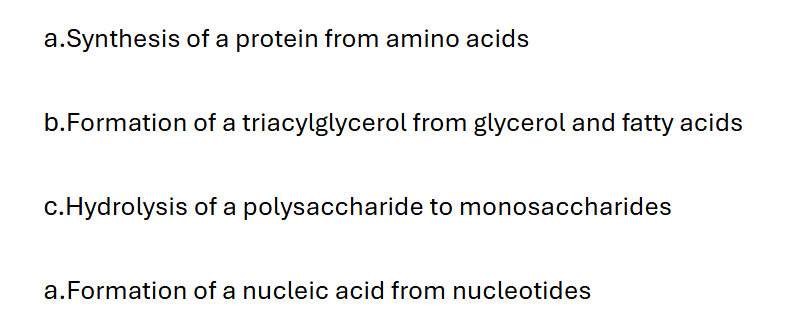
Classify each of the following chemical processes as anabolic or catabolic
a. Anabolic, b. Anabolic , c. Catabolic, d. Anabolic
What are the two types of metabolic reactions?
Anabolism and catabolism
What cellular organelle is responsible for the generation of most of the energy for the cell?
Mitochondrion
What intermediate molecule in metabolic reactions is responsible for producing energy in the human body?
ATP
Why is ATP the best energy source for human beings?
It has an intermediate value in free energy, and it undergoes slow hydrolysis in an aqueous environment
Which of the following structural descriptions for metabolic carboxylate ions that are derivatives of succinic acid is incorrect?
Fumarate contains a carbon–carbon double bond in a cis configuration
How many “strained” bonds are present in an ATP molecule?
Two
What are the stages of energy production in the order of occurrence?
Digestion, acetyl group formation, the citric acid cycle, and electron transport and oxidative phosphorylation
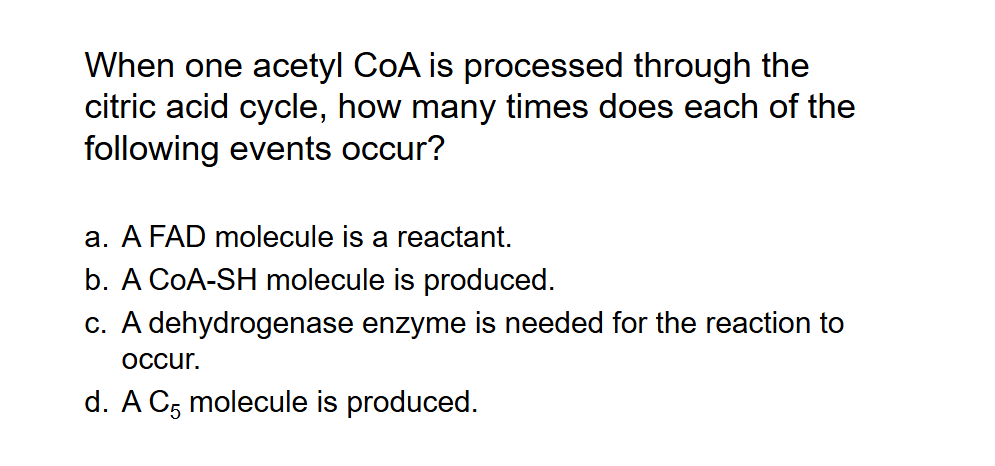
When one acetyl CoA is processed through the citric acid cycle, how many times does each of the following events occur?
A. One B. Two C. Four D. One
How many high-energy molecules are formed in one turn of the citric acid cycle?
3 NADH, 1 FADH2, and 1 GTP
Athletes have the ability to perform at high levels of activity because of their systems’ ability to produce large amounts of energy. How is this possible?
They have an increased number of mitochondria which are able to produce large quantities of ATP
Identify the functions of carbohydrates in the human body.
All the Above
Carbohydrates are classified as:
monosaccharides, disaccharides, oligosaccharides, and polysaccharides
What is the primary function of DNA?
Storage and transfer of genetic information
DNA and RNA are two types of nucleic acids found in
the cells of organisms. What is a nucleic acid?
An unbranched polymer containing monomer units called nucleotides
What is a nucleotide?
A three-subunit molecule containing a pentose sugar bonded to a nitrogen-containing
heterocyclic base and a phosphate group
The nucleotide AMP is found in
RNA molecules, but not DNA
What are the structural differences between RNA and DNA?
RNA contains the sugar ribose and heterocyclic bases adenine, cytosine, guanine, or uracil. DNA contains deoxyribose and the heterocyclic bases adenine, cytosine, guanine, or thymine
Predict the sequence of bases in the DNA strand
complementary to the single DNA strand shown below:
5′ A–A–T–G–C–A–G–C–T 3′
3′ T–T–A–C–G–T–C–G–A 5’
What is the complementary base in DNA?
Adenine–thymine
DNA contains the genetic information in a cell, so what does DNA replication refer to?
The process of producing exact replicates of DNA molecules
Where does the digestion of carbohydrates begin
mouth
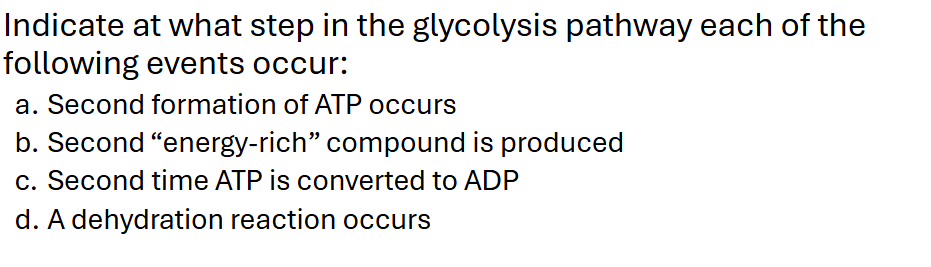
Indicate at what step in the glycolysis pathway each of the following events occur:
a. Step 10 b. Step 9 c. Step 3 d. Step 9
What statement best describes glycolysis?
A series of metabolic reactions to breakdown glucose into two pyruvate molecules, energy in the form of ATP, and NADH
Any given nucleotide in a nucleic acid contains
one sugar, one base, and one phosphate
The number of structural subunits present in a nucleoside and a nucleotide are, respectively
two and three
The number of different kinds of nucleotides present in any RNA molecule is
4
Which of the following are the three “single ring” bases that occur in nucleic acids?
cytosine, thymine, and uracil
The “backbone” of a nucleic acid molecule consists of an alternating sequence of
sugar and phosphate groups
35 percent of the bases in a certain DNA molecule are found to be A. What percent of the bases in this same molecule are G?
15%
Which of the following statements concerning the double helix structure present in DNA molecules is correct?
Base pairing between strands always involves one pyrimidine base and one purine base.
Replication of DNA produces two daughter DNA molecules in which
Each daughter molecule contains one parent strand and one newly synthesized strand.
In DNA replication the unwinding of the double helix
occurs at a single point along the length of the double helix
RNA molecules differ from DNA molecules in that they
are single stranded rather than double stranded
In a dinucleotide the phosphate linkage between nucleotide units involves
more than one correct response
In which of the following sets of nucleic acid “building blocks” are all members of the set possible components of a DNA molecule?
no correct response
Which of the following statements concerning genes and chromosomes is correct?
A gene is a segment of a DNA molecule that contains instructions for the synthesis of one or more proteins.
In a dinucleotide the phosphate linkage between nucleotide units involves
more than one correct response
Which of the following is a correct structural characteristic of a nucleotide?
More than one correct response
In DNA replication the two strands of the double helix separate, and each strand
serves as a template for the construction of its own complement
Which of the following sets of base composition data is consistent with the double helix nature of DNA molecules?
15% C and 15% G
The variable portion of a nucleic acid molecule is the sequence of bases attached to the nucleic acid “backbone
true
DNA nucleotides contain three subunits, and RNA nucleotides contain four subunits
False
Complementary base pairing in DNA involves the base combinations (A and T) and (G and C).
true
Nucleotides are related to nucleic acids in the same way that amino acids are related to proteins.
true
Which of the following statements about metabolism is correct?
Metabolism is the sum total of all the biochemical reactions that take place in a living organism.
Which of the following statements about mitochondria is correct?
Mitochondria are located within the cellular cytosol.
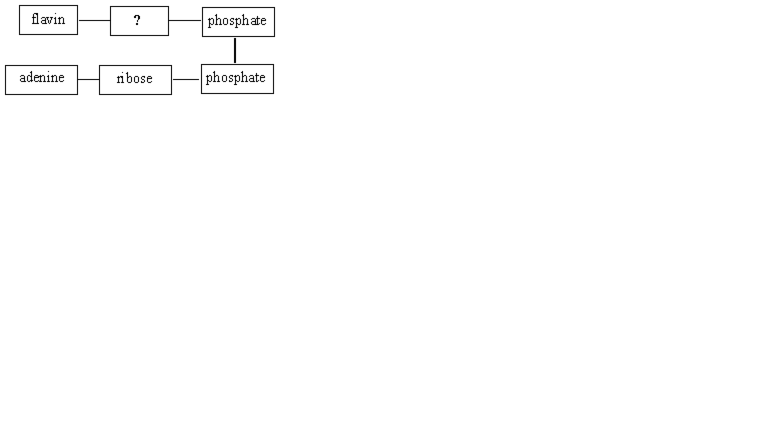
The missing structural subunit in the following diagram for flavin adenine dinucleotide is
ribose
The “fuel” for the citric acid cycle is
acetyl CoA
Which of the following is a correct general description of the reaction that occurs in the first step of the citric acid cycle?
C2 + C4 → C6
In which two steps of the citric acid cycle are molecules of carbon dioxide produced?
step 3 and 4
How many NADH and FADH2 molecules are produced, respectively, during one turn of the citric acid cycle?
one, three
Which of the following substances contains three or more high energy phosphate bonds?
ATP
Which of the following is a correct letter designation for the reduced form of a coenzyme?
FADH2
Which of the following are products of the citric acid cycle?
CO2 and NADH
In which of the following citric acid cycle reactions does the coenzyme FAD participate?
succinate → fumarate
Which of the following statements concerning citric acid cycle reactions is correct?
more than one correct response
FADH2 is the oxidized form of the coenzyme flavin adenine dinucleotide
false
Both ribosomes and mitochondria are examples of organelles
false
ATP, ADP, and AMP differ from each other in the number of adenine subunits present
False
Anabolic reactions usually require energy input in order to proceed
true
The primary site within the human body where carbohydrate digestion occurs is the
small intestine
Which of the following conversions is accomplished by the process of glycolysis?
glucose to pyruvate
The first two intermediates in the process of glycolysis are, respectively
glucose 6-phosphate and fructose 6-phosphate
How many total steps are there in the process of glycolysis?
ten
Accumulation of which of the following substances is the cause of stiff and sore muscles after vigorous exercise?
lactate
In which of the following pairs of nucleic acid bases are both members of the pair “single ring” bases?
T and U
In DNA replication the two strands of the double helix separate, and each strand
serves as a template for the construction of its own complement
The number of structural subunits present in a nucleoside and a nucleotide are, respectively
two and three
The “backbone” of a nucleic acid molecule consists of an alternating sequence of
sugar and phosphate groups
Replication of DNA produces two daughter DNA molecules in which
Each daughter molecule contains one parent strand and one newly synthesized strand
In which of the following sets of nucleic acid “building blocks” are all members of the set possible components of a DNA molecule?
no correct response
Nucleotides are related to nucleic acids in the same way that amino acids are related to proteins
true
The number of different kinds of nucleotides present in any RNA molecule is
four
In DNA replication the unwinding of the double helix
occurs at a single point along the length of the double helix
RNA molecules differ from DNA molecules in that they
are single stranded rather than double stranded
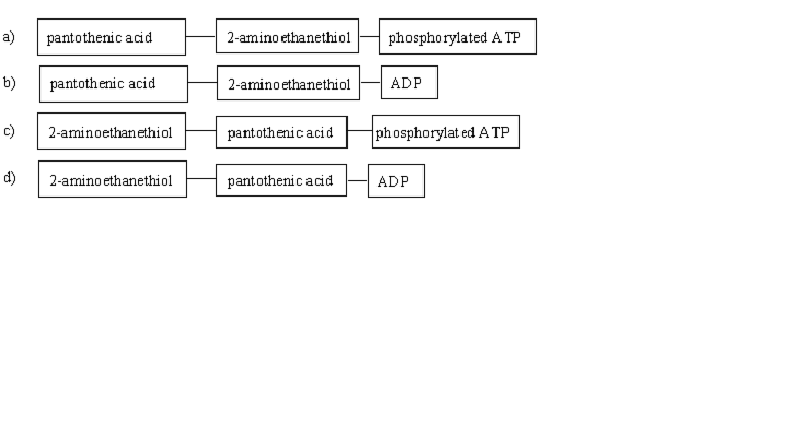
Which of the following diagrams gives the correct identities and arrangement of the structural subunits in coenzyme A?
c
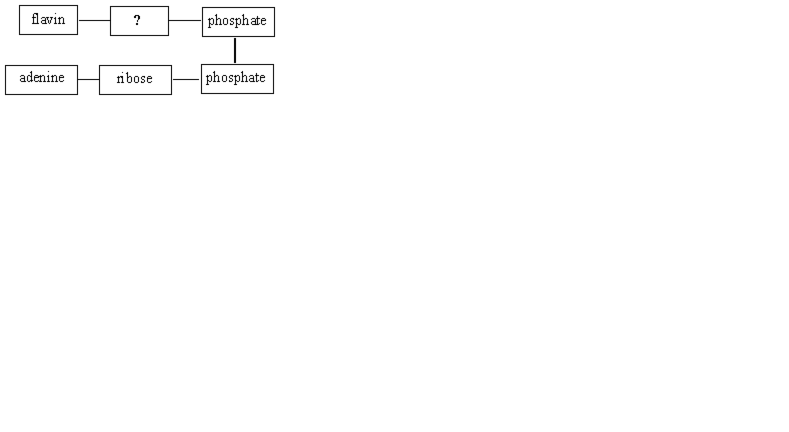
The missing structural subunit in the following diagram for flavin adenine dinucleotide is
ribitol
The correct notation for the reduced form of nicotinamide adenine dinucleotide is
NADH
In which of the following pairs of metabolic carboxylate ions are both members of the pair derivatives of succinic acid?
malate, fumarate
The “fuel” for the citric acid cycle is
acetyl CoA
Which of the following is a correct general description of the reaction that occurs in the first step of the citric acid cycle?
C2 + C4 → C6
Which of the following substances has two unsubstituted ribose molecules as structural subunits?
NAD+
Which of the following are products of the citric acid cycle?
CO2 and NADH
Which of the following statements about metabolism is correct?
Metabolism is the sum total of all the biochemical reactions that take place in a living organism.
How many NADH and FADH2 molecules are produced, respectively, during one turn of the citric acid cycle?
three, one
During digestion, triacylglycerols are converted by
lipases to _____ and _____.
monoacylglycerols; free fatty acids
Hydrolysis of triacylglycerols in adipose tissue is triggered by hormones that stimulate _____ production within adipose cells that stimulate lipases in these cells.
cyclic AMP (cAMP)
What is the fate of the glycerol that is produced during mobilization of triacylglycerols in adipose cells?
It is converted by a two-step process to dihydroxyacetone phosphate, which is an
intermediate in glycolysis and gluconeogenesis
What is the first step in the oxidation of a fatty acid?
It is activated by bonding to coenzyme A.
What is the net ATP production for a 16-carbon fatty acid?
106
When the lipid-carbohydrate metabolism is upset by certain body conditions, more acetyl CoA is produced that can be used in the citric acid cycle. This results in the production of _____ by a process known as _____
ketone bodies; ketogenesis
Lipogenesis occurs in the cell _____, where all intermediates are bound to _____, resulting in a fatty acid biosynthetic pathway where the fatty acid chain increases in length by _____ carbons per pathway cycle.
cytosol; ACP–SH; 2
dentify the statement that states the relationship between lipogenesis and citric acid intermediates?
The lipogenesis intermediates are four carbon monoacids, and the citric acid intermediates are four carbon diacids
Biosynthesis of cholesterol occurs in the _____.
liver
What is the product of lipid and carbohydrate metabolism that enters the citric acid cycle?
Acetyl CoA
Which of the following B-vitamin-containing coenzymes is needed in the reactions associated with the conversion of fatty acids to acetyl CoA?
FAD
Besides cholesterol being an important cell membrane component, what other function does cholesterol serve?
It is a precursor for various classes of steroid hormones.
A lipid is an organic compound found in living organisms that is:
insoluble in water and soluble in nonpolar organic solvents
A fatty acid is a naturally occurring _____ acid that nearly always contains an _____ number of carbon atoms with a carbon chain that is _____.
monocarboxylic; even; unbranched