Exam 4: Waves and Optics
 Call Kai
 Learn
Learn Practice Test
 Spaced Repetition
 Match
Match Flashcards
 Knowt Play
1/33

There's no tags or description
Looks like no tags are added yet.
Name | Mastery | Learn | Test | Matching | Spaced | Call with Kai |
|---|
No analytics yet
Send a link to your students to track their progress
34 Terms
SHM OF SPRINGS AND PENDULUMS
Oscillations of a Spring
If an object vibrates back and forth over the same path, each cycle taking the same amount of time, the motion is called ——
If the spring is hung vertically, the only change is in the —— position, which is at the point where the spring force equals the —— ——
Terminology
Displacement is measured from the —- point
Amplitude is the —— displacement from the equilibrium
If the equilibrium is not 0, you can use (max-min / 2)
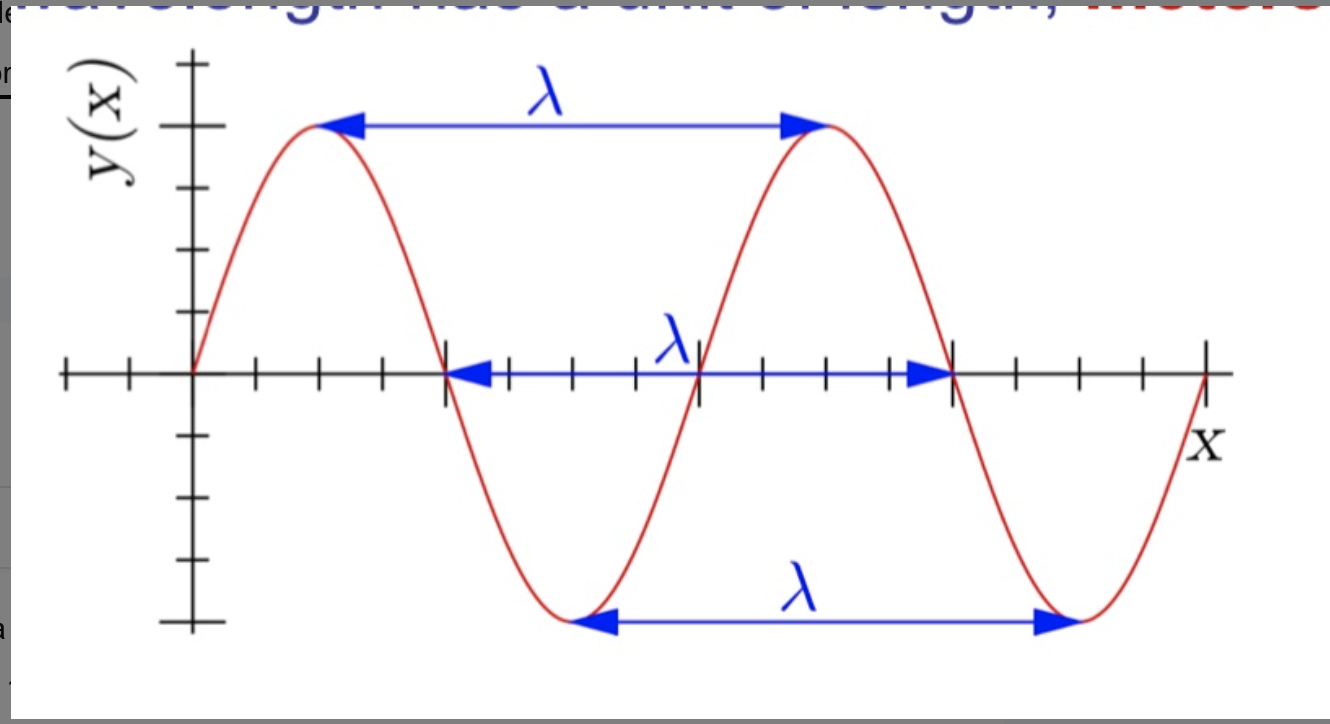
Wavelength is the distance between two consecutive corresponding points of the same phase on the wave (crest, trough)
Crest to crest
trough to trough
Equilibrium point to SECOND adjacent equilibrium point
Wave number: the number of wave cycles per unit distance (1/λ)
A cycle is a full to-and-fro motion
Period is the —- required to complete —- —-
Frequency: is the —- of cycles completed per —-
Angular Frequency: measures the rate of phase change in radians per second
ω = 2πf = √k/m so f = 1/2π√k/m
Pendulum has a different equation, one that relates length and gravity b/c it’s independent of mass
periodic
equilibrium, gravitational force
equilibrium
maximum
time one cycle
number second
Spring Force and Hooke’s Law
The force exerted by a spring depends on it's displacement, and if given by Hooke’s Law
Fs = -kx = ma
Negative sign means the restoring force acts in the direction opposite to the displacement
Force is —— constant so the acceleration is —- constant either, as both rely on ——-
not, not, displacement
Period and Frequency
The time between pulses/cycles is called the ——, and the number of pulses/cycles per unit time is the ——
period and frequency are ——
T = 1/f and f = 1/T
T unit = s; f unit = Hz
For a mass spring system, in terms of angular frequency we can also say that f = 1/2π√k/m, and therefore T = 2π√m/k
period frequency
reciprocal
Elastic (Spring) Potential Energy
Elastic force results from stretching or compressing an object
Elastic PE is the energy gained when —- is done to stretch a spring to a distance (x)
PEs = 1/2kx2
Simple harmonic motion occurs when the energy of the system repeatedly changes from —— energy to —— energy and back again
Energy added by doing work to stretch the spring is transformed back and forth between PE and KE
Total energy remains constant at all times
work
potential kinetic
Energy in the simple harmonic oscillator
If the mass is at its limits of its motion (maximum amplitude), the energy is all ——-
If the mass is at the equilibrium point, the energy is all ——-
We know what the PE is at each turning point/max amplitude, and this represents the system’s total energy:
E = 1/2kA2
Since E = PE + KE, we can say 1/2kx2 + 1/2mv2 = 1/2kA2 and we can use this to solve for the velocity
Remember, the total energy is constant, and the system is switching between all PE at max amplitude and all KE at equilibrium position
potential, kinetic
Simple Pendulum
As long as the cord is considered massless and the amplitude is small, the period does NOT depend on ——
T = 2π√L/g
Remember, period of a mass-spring system is T = 2π√m/k, but since pendulum period is NOT dependent on mass we replace with:
L = analog to mass
g = analog to k
Since T is reciprocal to f, we can say that f = 1/2π√g/L
Energy of a pendulum
At max amplitude, E = PE = mgh and KE = 0
At equilibrium position, E = KE = 1/2mv2 and PE = 0
mass
Damped Harmonic Motion
Harmonic motion with a —- or —- force
Amplitude ——- over time due to dissipative forces like friction or air resistance
If the dampening is small, we can treat is as an envelope that modifies the undamped oscillation
cos graph with — amplitude = dampening
frictional, drag, decreases, decreased
Forced Oscillations and Resonance
Forced vibrations occur when there is a period driving force
This force may or may not have the same period as the natural frequency of the system
However, if the frequency is the —— as the natural frequency, the amplitude can become very ——, this is called resonance
System will begin to oscillate on its own without a driving force in the presence of its resonant frequency
same, large
Summary: SHM
SHM is —— pattern
The restoring force is —- to the displacement for (for small displacements it obeys Hooke’s law)
The total energy is continually changing from —- to —- and back
Period is independent of ——- (lab topic)
Period is independent of —— in a pendulum (L/g), but NOT in mass-spring systems (m/k)
In SHM, acceleration is —- ——- because force is not constant (depends on displacement, so acceleration also depends on displacement)
sinusoidal
Potential
potential kinetic
amplitude
mass
not constant
Longitudinal Waves
Need a —- to propagate
Region of compression moves —-/—- to the medium
The displacement of the medium is along/parallel to the direction of the propagation of the wave
— waves are longitudinal waves
Consist of —— variations in the air
The diaphragm of a speaker oscillates back and forth producing regions of higher and lower pressure, and these regions propagate through the air as variations in air pressure and density, forming longitudinal sound waves
Transverse Waves
Displacement is —— to the direction of travel
Example: light waves, pulling a string, ripple over water
medium, along parallel sound
pressure
perpendicular
Intensity
The amplitude is air vibrations, what we hear is the intensity
The loudness of a sound is much more closely related to the log of the intensity
The intensity of a wave is the —— transported per unit time across a unit area with units of W/m2
Sound level is measured in decibels and defined as
dB = 10log(I/Io) where Io is the threshold of hearing, the quietest intensity a human ear can detect
Intensity of sound follows the —— —- law
I = 1/r2
So if you double the distance from the source of the sound, the intensity will be decreased by ¼
Intensity is equal to the —- ——
Log review
You can rearrange x = logy into y = 10x
energy
inverse square
squared amplitude
Velocity
Velocity can be related to wavelength and frequency with the equation v = λf
The velocity of a wave depends on properties of the medium where the wave propagates
The stiffer the medium the —- the sound travels through the medium
faster
Interference
A —- property of light, the process in which two or more waves combine
When two waves pass through the same region of space, they will interfere, and it can be destructive or constructive
Principle of superposition
When two or more waves combine the resulting disturbance or displacement is equal to the —— of the individual disturbances
Addition depends on the PHASE of the 2 waves
Types of interference
When two waves are exactly in-phase (0º) there is —— —- interference and the resulting amplitude is the sum of the two amplitudes (large)
When two waves are exactly out of phase (180º) there is —- —- interference and the two aves are cancelled out
When the two waves are partially out of phase there will be some —- interference and the resulting amplitude will be the difference between the two amplitudes (lower)
wave
sum
total constructive
total destructive
destructive
Standing Waves
Standing waves can be produced on a string with both ends fixed , and it’s a wave pattern that appears to stand still rather than traveling
Formed by the —- interference of 2 waves with the same —— and —— traveling in —- directions
It oscillates in place with formation of —- and ——
Nodes = result of total —— interference, —- amplitude
Antinodes = result of total —- interference, —- amplitude
The length of the medium that supports the standing wave must be an integer multiple of λ/2
The distance from one node to an adjacent node (or antinode to adjacent antinode) is EXACTLY —
Since the distance between nodes is exactly half a wavelength, the λ must be —— the length of the string
Depending on the number of λ/2 multiples that can be trapped in the length relates to the fundamental frequency of the 1st harmonic
Fundamental frequency is the frequency that creates — nodes and —- antinode
f = v/2L
The pitch of the sound depends on its ——-, and the loudness of the sound depends on its —— (—- —-) and ear sensitivity
constructive, frequency amplitude, opposite, nodes antinodes, destructive no, constructive maximum, λ/2, twice, 2, 1
frequency, intensity, squared amplitude
Doppler Effect
Occurs when a —— of sound is moving with respect to an ——
If the observer is moving with respect to the source, the λ remains the same, but the wave speed is different for the observer
A source moving toward an observer appears to have a —— frequency and a —— wavelength
A source moving away from an observer appears to have a —- frequency and a —— wavelength
source observer
higher, shorter
lower, longer
Beats and Beat Frequency
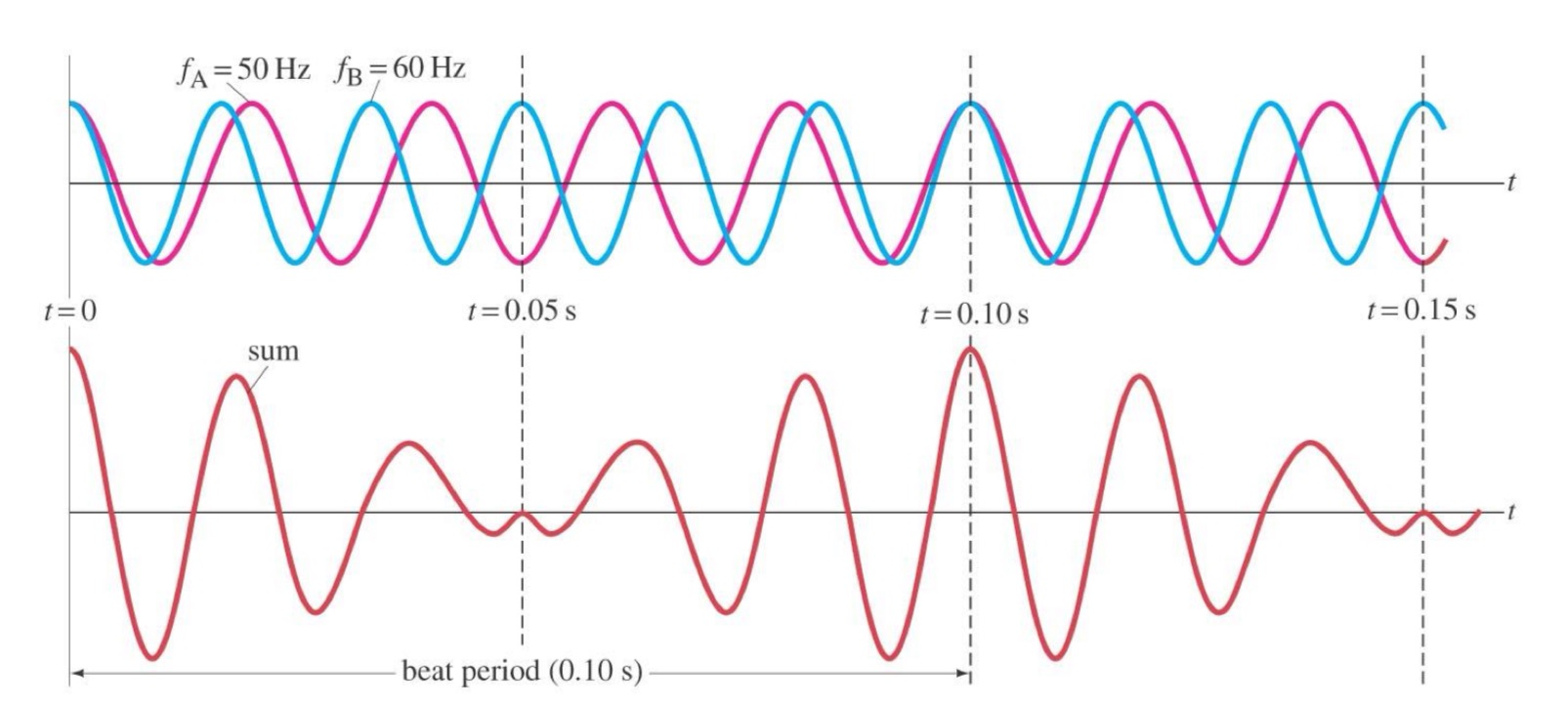
Waves can also interfere in time, causing a phenomenon called beats
Periodic fluctuation in sound loudness
When two sound waves of —— frequencies are played together, caused by —- and —— interference
Beats are the slow envelope around two waves that are relatively close in frequency
Beat frequency is the rate at which this pattern ——, calculated as the absolute difference between the two frequencies
fbeat = |f1 - f2|
Understanding the graph
The beat sum will be greatest/loudest when they are close to in-phase, and will be quietest when out of phase
When the peaks of both waves align, they add together to form a very tall wave (large amplitude)
When the peak of one wave aligns with the trough (low point) of the other, they cancel each other out, making a flat line (zero amplitude)
close, constructive destructive
repeats
Subtractive Color Mixing
The selective —— of light is a form of subtractive color mixing, some pigments absorb some wavelengths of light more than others
Process of creating colors by absorbing/subtracting specific wavelengths of light from white light, dyes, pigments, or filters, allowing only the ——, —- light to reach the eye
In color printing, the three primary pigments are cyan, yellow, and magenta
Examples
White light passed through a magenta filter will absorbs green but transmits and reflects red and blue
White light passed through a yellow filter will absorb blue but transmits and reflects green and red
White light passed through a cyan filter will absorb red but transmits and reflects green and blue
When light strikes an object some of the light undergoes specular reflection where all of the light is reflected as if by a ——, and the rest of the light will undergoes diffuse reflection and is reflected in —- ——
absorption, unabsorbed reflected
mirror, all directions
Additive Color Mixing
The process of —- different wavelengths of light in order to produce a response interpreted as a —— color
Combining three primary colors: blue, green, and red in different amounts can produce responses in our brains corresponding to the colors we are used to identifying
Red + green = yellow
Blue + green = cyan
Blue + red = magenta
Combing all three primary colors = white
mixing
different
Law of Reflection
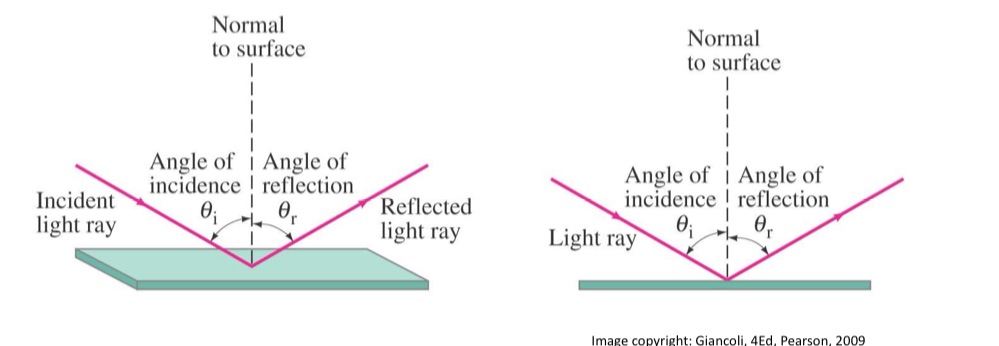
The angle of reflection that the ray makes with the normal to the surface of incidence —— the angle of incidence
Ø1 = Ø2
equals
Plane Mirrors
Diffuse Reflection
When light reflects from a rough surface, the law of reflection still holds, but the angle of ——- varies
With diffuse reflection, your eyes see reflected light at —- angles
Specular reflection (from a plane/flat mirror)
All light is reflected in the —— direction
Your eyes must be in the correct position to see the reflected image
Virtual Image
When we look in a plane mirror, the reflected image appears —— the mirror
As a result of the reflection from the mirror, we see a —— image, which we construct from the extension of the rays
The image is —-, —-, and the —- —- as the object
When doing flat mirror problems, if you are asked for angle of reflection or refraction you are ALWAYS comparing to the normal, NOT the mirror plane itself
incidence all
same
behind, virtual
virtual upright same size
Mirrors
Spherical mirrors can be either reflective on the inside surface (concave) or the outside surface (convex)
Concave
Reflects light from the —- surface
Parallel rays —- as they leave the mirror (opposite of lens)
Can magnify an image like a lens
Convex
Reflect light from —- surface
Parallel light rays —— as they leave the mirror (opposite of lens)
The image is ALWAYS ——-, ——, and —— (incident parallel rays seem to be coming from focal point behind the mirror)
inside, converge
outside, diverge, smaller, upright, virtual
Index of Refraction
Says how —— light travels through a —— with respect to its speed in a ——/—-
n = c/v where c = speed of light in a vacuum and v = speed of light in the medium
Smaller index of refraction = light travels ——
Part of Snell’s law, impacts the amount of bending of light when it moves from one medium to another, the amount of bending depends on the change of IOR between mediums
Index of refraction depends on ——
The air has the lowest IOR possible at ——-
This is when speed of light in a vacuum (c) is equal to the speed of light in the media … this is just air
There is no upper limit, but must be greater than 1.00
fast, medium, vacuum air
fast
wavelength
1.00
Dispersion
The index of refraction varies slightly depending on the —— of light
This is how prisms and water droplets create a —— from sunlight
Splitting of —— light into its constituent colors (like a rainbow) as they travel at different —— through a medium due to differences in IOR due to their differing wavelengths
wavelength
rainbows
white, speed
Law of Refraction
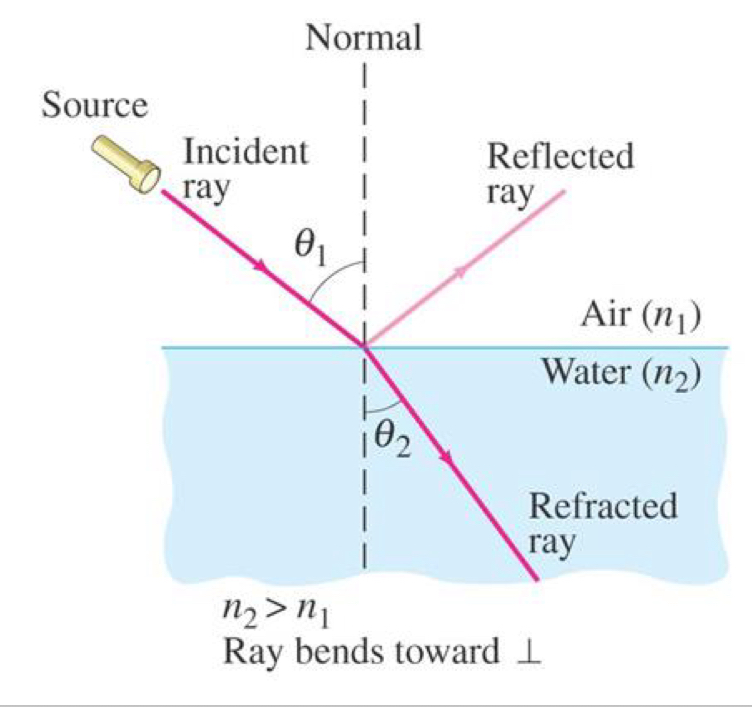
Light changes —— (—-) when crossing a boundary from one medium to another, this is called refraction
The angle the outgoing ray makes with the normal is called the angle of refraction
Remember, the normal is always perpendicular to the surface of the medium
SO angle of refraction is between the —- and the ——, NOT the —— boundary
direction bends
ray, normal , medium
Snell’s Law
Relates the indices of refraction of two media to the directions of ray propagation in terms of the angles to the —— surface
The medium with a higher IOR (—- speed of light) bends the ray —- to the normal plane (—- angle)
n1Ø1 = n2Ø2
normal
slower, closer, smaller
Total Internal Reflection
If light hits the plane of incidence at an angle higher than the —— angle when moving from a medium of high to low IOR, it can be totally internally reflected
Only happens when light travels from a medium of —— IOR to one of —— IOR
Øi > Øc = TIR
Øi = Øc then light travels at 90º along the medium boundary
Øc = sin-1(n1/n2)
This is how fiber optic cables work
critical, smaller
high low
Lenses
Convex/Converging
Light rays will ——- toward the optical axis
Incident parallel rays all —— pass through the —- ——
The distance from the center of the lens to the focal point is the —- ——
Focal length determines where the light rays will be focused and the image is formed
Has a —— focal length value
Concave/Diverging
Light rays will —— from the optical axis
Incident parallel rays all —— to be coming from the focal point
Has a —— focal length value
Thin lens equation
1/f = 1/di + 1/do
m = hi/ho = -di/do
Refractive/Optical Power
Measured in ——
Optical power is —— to focal length (P = 1/f)
converge, actually focal point, focal length, positive
diverge, appear, negative
diopters, reciprocal
Diffraction
Waves bend/diffract when passing through a small opening/—— or around small ——
The wave then spreads after passing through the slit
The wave properties of light are demonstrated by phenomena where light bends, spreads, or interferes with itself = diffraction
Slit properties
If the slit is small enough that it is comparable to the size of the wavelength of light, we will see diffraction/spreading
If the slit is too big, there will be no diffraction just simple parallel rays
Diffraction effect
Depends on the ratio of —— to —— ——- —— (λ/a)
Large ratio (small slit) = —- wave pattern
Small ratio (wide slit) = —- wave pattern
Basically, narrow slit = more spreading/diffraction
Diffraction Limit/Rayleigh Criterion
the wave nature of light limits ability to see —— objects
Criterion for the minimum resolvable detail
Imaging process if diffraction limited when the first diffraction minimum of the image of one source point coincides with the diffraction maximum of another
Why we can see bacteria but not viruses under optical microscope
slit, objects
wavelength, slit opening size
wide narrow
small
Single Slit Diffraction
The parallel rays will interfere at some points as they travel through the slit and onto the screen
Creates a broad central maxima bright band, with smaller bright spots alternating with dark spots
Where crest meets crest exactly in phase = —- interference = —— spot
Where crest meets trough exactly out of phase (shifting λ/2) = —— interference = —— spot
This results in a pattern of light and dark spots across the screen, with the
Equation: sinØdark = m(λ/a)
Calculates angle of a DARK SPOT
Where m = integer for each multiple of λ (central maxima m = 0, first dark spot m = 1)
Remember, sinø = x/L
constructive bright, destructive dark,
Double Slit Diffraction
When light passes through two slits, it makes two lights waves —- —- with each other
These two waves will interfere constructively or destructively depending on a phase difference (λ, λ/2, etc)
If two waves travel equal optical distances to the screen, they interfere ——- and a —- spot is seen
If two waves travel distances differing by one full λ, the two waves will ALSO interfere —— and a —- spot is seen
But if two waves trvel distances differing by λ/2 then the two waves interfere —— and a —- spot is produced
This results in an —— pattern of bright and dark spots = fringe pattern
NO central maxima!! Evenly sized and spaced dark and bright spots
Equation: sinØ = (mλ/d)
Calculates angle of a BRIGHT SPOT
d = distance between the two fringes, NOT the width of the slit like in the single slit equation
in phase
constructively bright
constructively bright
destructively dark
alternating
Spectroscopy
Study and interpretation of colors of the —— spectra
Atoms and molecules can be identified when they are in a thin gas through they characteristic emission lines
Analyzes a set of color —— or —— by a compound to identify it
electromagnetic
emitted absorbed
Scattering of Light
Redirection of light rays in random, different directions when hitting particles in a medium, causing effects like blue skies or red sunsets
The sky is blue due to scattering
Rayleigh Scattering: Intensity of incident light = 1/λ4
Ex. the scatter of λ = 400nm (blue) is 9x stronger than that of λ = 700nm (red)
So shorter wavelengths will be scattered ——, so blue light will scatter more than red light, and this is why the sky is seen as blue
It’s the atmosphere and molecules that allow the sky it look blue, without atmosphere there would be nothing to scatter the light and it would just be black like space
In the evening, the sun is so low on the horizon the blue light scatters so much it has be removed, so the only the —- scattered wavelengths/colors appear (longer λ: red, orange, yellow)
more
least
Phenomena that represent wave properties of light include ——, ——-, ——-, —— and ——
interference, diffraction, polarization dispersion, scattering
Reflection: bouncing back of light after it hits a surface, the angle of reflection that the ray makes with the normal to the surface of incidence equals the angle of incidence
Refraction: Light changes direction (bends) when crossing a boundary from one medium to another
Dispersion: change of IOR with wavelength of light, causes prisms and rain rainbows (splitting of white light into its constituent colors (like a rainbow) as they travel at different speeds through a medium)
Diffraction: bending, spreading of light waves when they encounter an obstacle, edge, or pass through a narrow opening
Scattering: redirection of light rays in different directions when hitting particles in a medium, causing effects like blue skies or red sunsets
ok