Psychology Chapter 10
 Call Kai
 Learn
Learn Practice Test
 Spaced Repetition
 Match
Match Flashcards
 Knowt Play
1/45

There's no tags or description
Looks like no tags are added yet.
Name | Mastery | Learn | Test | Matching | Spaced | Call with Kai |
|---|
No analytics yet
Send a link to your students to track their progress
46 Terms
Alfred Binet
A French psychologist who created IQ tests for French school children to determine which kids needed extra help.
He put the idea of Mental Age which is the age at which a child performs.
Ex. if you score the test as an 8 year old your mental age is an 8 year old regardless of your age
Intelligence
The ability to use one's mind to learn from experience and solve novel problems
IQ tests
Stands for Intelligence Quotient.
A standardized test used to asses a persons intellectual ability compared to others.
Test-retest reliability
Does a test taker obtain a similar score when they retake the test.
Internal reliability
Do the items in the test correlate with each other. If the test was split into 2 and they do good on both halves that’s high internal reliability.
Ex. the test is about depression first half is about depression so they should do good on the second half
Interjudge reliability
Do different test givers obtain similar scores when they give tests to the same people.
Face validity
Does the test subjectively look like it is measuring the right thing.
Ex. looking at the questions of a math test you would know its testing math skills
Content validity
Do the questions or test items relate to all aspects of the construct being measured.
Ex. a test on chapter 10 and 9 the test should cover both chapters and not a majority of one.
Criterion validity (predictive validity and concurrent validity)
Does the test correlate with something in the real world that it should correlate with.
Ex. if IQ test measures intelligence it should correlate with grades.
Predictive validity: Measuring one thing then assuming the future
Ex. Measuring IQ predicting they’ll have high grades in the future
Concurrent validity: Measuring both things at the same time
Ex. Making them take a IQ test and asking what their GPA is
Construct validity
The extent to which a test actually measures the psychological concept (construct) it is intended to measure.
Ex. the test should measure depression and not sadness and anxiety
Mental age
The age of which you are performing mentally.
Chronological age
The actual age from birth.
Ratio IQ
The method to calculating intelligence.
Mental Age/Chronical age x 100 = ratio IQ
Deviation IQ
A measure of intelligence that compares a persons performance to others of the same age group, based on how fair their score deviates from the average.
Ex. 100 + 15( (Person score - Average score) / Standard Dev.)
WAIS- Wechsler Adult Intelligence Scale (VCI- verbal comprehension index, WMI- working memory index, PRI- perceptual reasoning index, PSI- processing speed index)
The commonly used IQ test that measures different cognitive abilities in adults. The VCI and WMI are verbal IQ and PRI and PSI are performance IQ
Ex.
VCI: what do a fish and crow have in common
WMI: repeating following digits. 4586, 48579, 495849 etc
PRI: Understanding a sequence and figuring the missing piece
PSI: Checking if either the two symbols on the right matches with any on the left
Factor analysis
A method used to analyze how various items correlate together that measure underlying abilities or traits.
Ex. How much alcohol, parties, marijuana , black card do you own. 3 correlate but not the last one.
Charles Spearman
Proposed the theory of general intelligence (g factor) suggesting that a single general ability influences performances across all cognitive tasks. People who do well in one cognitive task tend to do well in others.
Two-factor theory of intelligence
Charles Spearman applied the factory analysis to mental tests and had a theory that intelligence is made up of a general ability (g factor) plus specific abilities (s factor)
g factor, general intelligence
A general mental ability that influences performance across all cognitive tasks.
If you are good at one type of thinking task you tend to be good at others as they are positively correlated. Overall intelligence
Involves math problems, vocabulary, spatial problems
s factors, specific intelligences
Specific skills for specific tasks. If two people have similar g factors they can still differ in specific areas. Like which specific areas you are bettor or worse in
Ex. student A is good at math but average in language skills. Student B is good at writing but weak in reasoning. The s factor is
Crystallized intelligence
How much information you know. Knowledge and skills gained through experience, education, and learning
Fluid intelligence
How good you are at solving new problem. The ability to solve new problems without relying on prior knowledge
Gardner’s 8 intelligences (linguistic, logical-mathematical, visuospatial, musical, bodily-kinesthetic, interpersonal, intrapersonal, naturalistic)
A theory that intelligence is made up of different independent abilities rather than a single general intelligence.
Linguistic intelligence: skill with language
Logical-mathematical intelligence: skill with logic and math
Visuospatial intelligence: skill with spatial tasks
Musical intelligence: skill with music
Bodily-kinesthetic intelligence: skill with body/movement
Inter-personal intelligence: skill with understanding others
Intra-personal intelligence: skill with understanding oneself
Naturalistic intelligence: skill with nature
Emotional intelligence
The ability to understand other people emotions, understand your own emotions, and control your emotions.
Heritability
A measure of how much variation in a behavioral trait within a population can be explained by genetic differences.
Height has high heritability in many populations, meaning genetic differences explain much of the variation in height between people
Caveats about heritability
Caveat means important limitations of how heritability should be understood.
Heritability explains how much genetics explains VARIATION in a trait. It is not about how much genetics determine the trait. It makes no sense to say “90% of my height is genetic.” Instead: “90% of height differences in a population are due to genetics”
Heritability is not about specific mechanism (or about HOW genes produce a
trait); the genes in question might produce a trait that elicits a response from
the environment. E.g. the genes might make the kid good looking, which in
turn makes people treat the kid better, which in turn makes the kid more
extraverted.Heritability can change depending on the environment. E.g. in poorer
countries, or poorer socio-economic conditions, heritability estimates will be
lower (because people aren’t reaching their genetic potential).
Shared environment
The environmental factors that siblings or people in the same family share. Making the siblings more similar.
Non-shared environment
The environment is not shared by siblings which makes the individual unique even within the same family. Which makes siblings different from each other.
Fraternal (dizygotic) twins
Twins formed from two different eggs fertilized by two different sperm cells, they share about 50% of their genes like regular siblings. Not genetically identical but can be same or different sex.
Identical (monozygotic) twins
Twins formed when one fertilized egg splits into two, they share 100% of their genes. Genetically identical and usually same sex.
Heritability of IQ
The extent to which genetic differences explain variation in IQ scores within a population. IQ has moderate to high heritability.
Neural efficiency and IQ
The idea that individuals with higher intelligence use their brains more efficiently, showing less brain activation when solving problems compared to lower IQ individuals.
Smarter brains = less effort for same task
Brain size and IQ
Brain size is moderately correlated with IQ scores but brain efficiency and structure are more important than size alone.
Flynn effect
Philosopher James Flynn observed an increase in average IQ scores over generations in many countries. That must be caused by something in the environment like better schooling as it cant be genetic change as it takes way longer.
Reaction range
The genetically determined range within which trait (like IQ) can develop, depending on environmental conditions. Genes set a range and environment determines where you fall within it
Poverty lowers intelligence
Chronic poverty is associated with lower cognitive performance due to environmental stressors such as poor nutrition, stress, and limited educational resources. Environment can suppress cognitive development. Not about genetics, but conditions
School raises intelligence
Access to schooling and education improves cognitive skills and IQ test performance by developing reasoning, knowledge, and problem-solving abilities. Education strengthens cognitive abilities. IQ can improve with learning opportunities
Gene-environment interactions
The idea that genetic potential and environmental influences work together to shape traits like intelligence.
Ex. A child with high genetic potential for intelligence may only reach it with good nutrition and education
Normal distribution
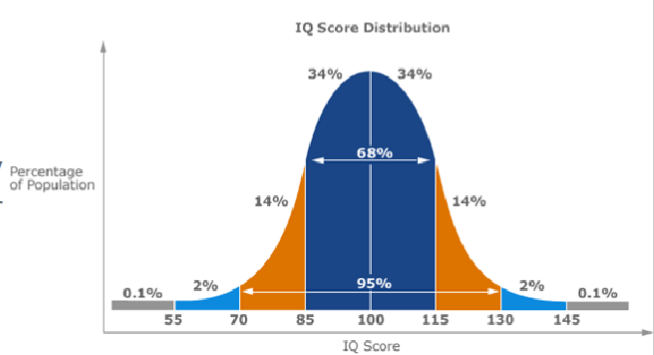
Intellectually gifted
Individual who have an IQ over 130 2% of the population have above average cognitive ability and faster learning and problem solving.
Intellectually disabled (mild, moderate, severe, profound)
A condition characterized by significantly below-average intellectual functioning and difficulties in everyday adaptive skills. 2% of population have IQ under 70
Mild: 50-70
Moderate: 35-50
Severe: 20-35
Profound: below 20
Down syndrome
A genetic condition caused by an extra copy of chromosome 21, leading to intellectual disability and characteristic physical features. Average IQ of down syndrome is 50
Ethnic group differences in IQ tests
Observed differences in average IQ scores between ethnic groups, which are strongly influenced by environmental factors such as education, socioeconomic status, and test bias.
Black: 90
White: 100
Asian: 105
Jewish: 107-115
Predictive bias
Occurs when a test predicts real-world outcomes (e.g., academic performance) differently for different groups, meaning the same test score does not correspond to the same level of performance across groups.
If two groups (e.g., African American and European American students) have the same IQ score but achieve the same college grades, then the IQ test is not predictively biased.
The test would only be predictively biased if the same IQ score predicted different academic performances for different groups.
Heritability WITHIN groups vs heritability BETWEEN groups
Within group: Genetic differences explain variation inside a group (e.g., within one population).
Ex. In a population of students in Canada, IQ differences between individuals are partly due to genetic differences.
Between group: Incorrect inference that differences between groups are genetic — this is not supported by heritability research.
Ex. Group A has lower IQ than Group B, therefore genes explain the difference this is incorrect. the explanation would be Differences between groups (e.g., socioeconomic, education, nutrition, test access) are mostly environmental
Sex differences in IQ tests
Research shows small or no average differences in overall IQ between males and females, but some differences in specific cognitive abilities.
Men are better at mental rotation, spatial navigation,
mathematical reasoning and throwing.
Women are better at object location memory, mathematical calculation, perceptual speed, verbal fluency, and fine-motor dexterity
differences are due to the fact that men were hunters and women were gatherers in our evolutionary past