neuro 3003 exam 3
 Call Kai
 Learn
Learn Practice Test
 Spaced Repetition
 Match
Match Flashcards
 Knowt Play
1/176

There's no tags or description
Looks like no tags are added yet.
Name | Mastery | Learn | Test | Matching | Spaced | Call with Kai |
|---|
No analytics yet
Send a link to your students to track their progress
177 Terms
Economic decision making
Reward maximization vs. risk minimization (MIN-MAX)
Utility
strength of preference for given outcome
Min-max
Based upon probabilities of outcome
People tend to be more sensitive to losses than to gains
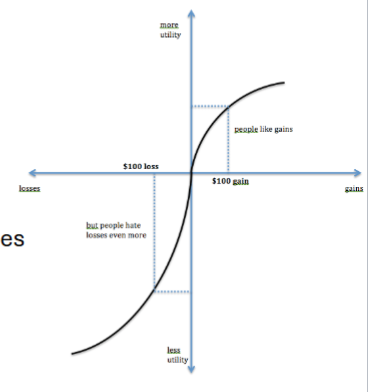
People tend to be more sensitive to losses than to gains
Gaining $100 vs losing $1000…
How to measure decision making in lab?
LETS GO GAMBLING!
Also looking at timing of decisions (marshmallow experiment)
Gambling Tasks: Two or four-armed bandit tasks
Participants select different levers, each has different reward values
Medial orbital frontal cortex
positively correlated with value gained from outcome (from the gambling)
The effects of time on decisions
Timing of expected reward influence decision
Tend to prefer small but immediate reward instead of a larger but more delayed reward
no self discipline…
vmPFC
value, empathy, morality
vmPFC & striatum
encode subjective values; emotional evaluation
OFC & striatum
modulate value of decision making
Dopamine in Decision making
Dopamine helps with learning faster
More dopamine = makes reward feel “better”, which strengths the association b/w the symbol and the gain
Less dopamine = weakens learning signal, making it harder for the brain to update the “utility” (usefulness) of a choice
Lateral PFC & parietal cortex
encodes relative desirability of choice selection, likelihood of reward for given choice (actual decision making)
Premotor cortex
motor planning
Motor cortex
executing motor movement associated with decision
Exploit
known opportunities/solutions (“if it ain't broke, don’t fix it”)
Explore
new and potentially better opportunities
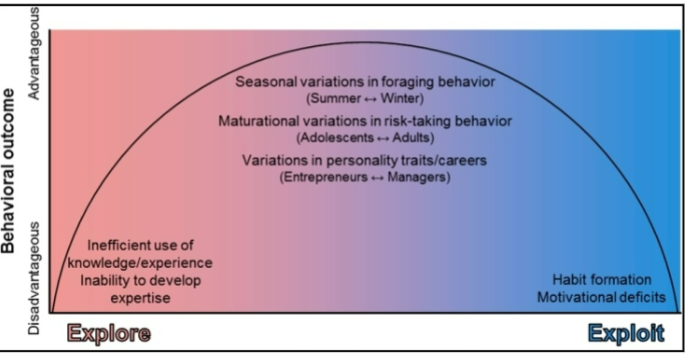
Explore pros and cons
Pros:
Map building
You can find better ways to get rewards you didn’t know existed
Adaptable
Cons:
Failure to learn
Wasting time
High risk
Exploit pros and cons
Pros:
Maximize reward with little effort
Low risk if its working
Cons:
Never know if there’s something better
Ur screwed if the environment changes
Exploration
hippocampus, striatum, dlPFC, dACC
Exploitation
vmPFC, vlPFC
Males (Explore/Exploit)
Tend to explore
Females (Explore/Exploit)
Tend to exploit
Striatum
Key for procedural memory (habits)
Anterior cingulate cortex (ACC)
salience
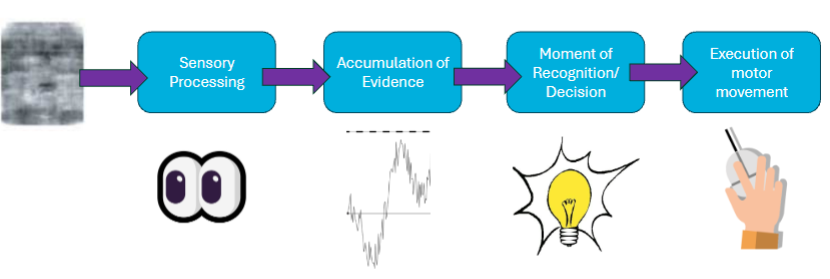
Drift Diffusion
Think of it like sitting back and gathering evidence before you make a choice
How we look at this in a lab
Patients in an fMRI were asked to press a button when they could identify the object
Saw 3 patterns of BOLD response
Sensory: primary and secondary sensory regions
Accumulation: dlPFC, IPS, IT
Moment of decision: preSMA, ACC, thalamus
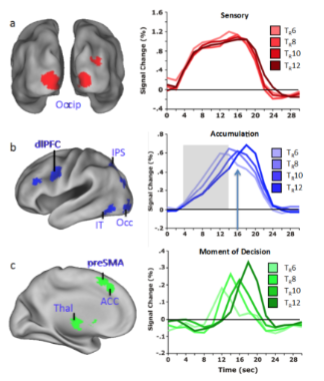
Drift Rate
average amount of evidence gained per unit of time
Central executive
planning, goal setting, attention, inhibiting inappropriate actions
dlPFC (abstract reasoning & logic), PPC, OFC (goals)
Salience
changes in stimuli
Dorsal anterior cingulate cortex, anterior insula, sensory & limbic regions
Default
Introspection & reflection
Posterior cingulate cortex, medial PFC
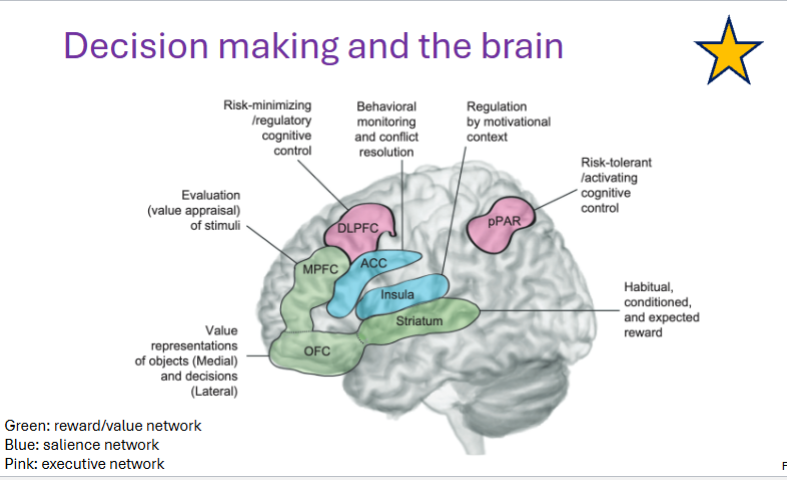
Dorsolateral Prefrontal Cortex
Important for executive functions
Abstract reasoning and logic
Ventromedial Prefrontal Cortex
Important for empathetic decision making
Cognitive evaluation of morality
Orbitofrontal Cortex
Important for forming associations with hedonic (good/pleasurable) experiences and other reinforcing signals
Critical for goal-directed behavior
Damage to the OFC
Lose ability to judge social value of their actions
More impulsive
Lack of focus
Salience network
regulates the other networks.
When it detects something important, it acts as a toggle: it shuts down the Default Mode Network (daydreaming) and activates the Central Executive Network (task-focus).
dorsal anterior cingulate cortex, anterior insula, sensory and limbic regions
Default mode or intrinsic network
Involved in internal or private considerations
• Most active during introspection and reflection
• Key brain regions: Posterior cingulate cortex, medial prefrontal cortex
Inattentional blindness
Failure to detect an unexpected (added) stimulus when attention is too focused on something else
Change blindness
Failure to detect a change in stimulus (e.g., object moving, appearing, or disappearing)
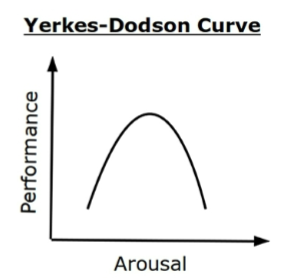
Yerkes-Dodson Law
"arousal" (stress, excitement, or alertness) impacts our ability to perform
Low arousal = low performance
too lazy to do anything
Optimal arousal = peak performance
Have enough norepinephrine to be focused
High arousal = low performance
Too stressed, panicked, or over-simulated
Locus Coeruleus (LC)
brain's "master switch."
The Signal: The LC releases Norepinephrine (NE), the chemical responsible for alertness and the "fight or flight" response.
The Reach: Notice how the blue lines spread from the LC to almost everywhere:
Neocortex: To sharpen focus and executive planning.
Amygdala: To heighten emotional awareness (fear/anxiety).
Thalamus: To open the "gates" for sensory information.
The Result: This widespread release shifts the entire brain into a state of high readiness
(Selective) attention
ability to focus awareness on one stimulus, thought, or action while ignoring other irrelevant stimuli, thoughts, and/or actions.
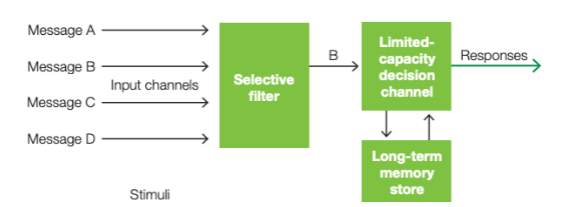
Informational Bottleneck
Selective attention is limited; perceptual processing has a small capacity
Context SWITCHING
Time and attentional cost to task or context switching; our attention becomes fragmented

NO context switching
Deep work or flow; when we do our best work

Overt attention
adjusting gaze to directly look at a target stimulus
Covert Attention
ability to perceive stimuli outside of fovea (peripheral vision)
Posner cueing tasks
covert attention is directed while your eyes stay at one point
Invalid: arrow pointing at opposite place
Neutral: double headed arrow
Valid: Arrow pointing at right place
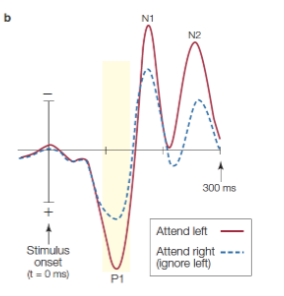
Brain activity higher when directly focusing on something
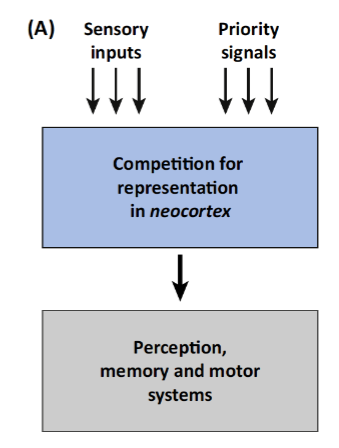
Attention as a Cause
attention is a physical "signal" that actively filters what you see
Ex: you choose to listen to something
Limited number of sensory signals reach the later stages of the processing:
LGN → V1 → higher order visual areas
Feedback from frontal & parietal cortex and superior colliculus in midbrain
Attention as an Effect
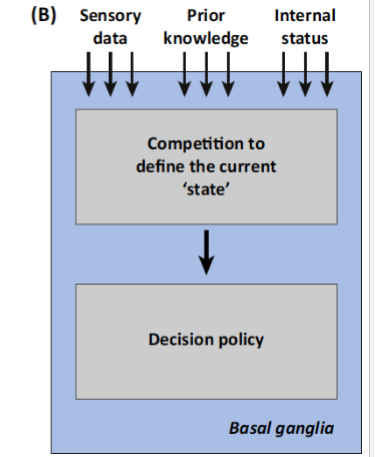
Attention is the result of your brain making a decision
The Mechanism: Your brain is always running a "competition" between different possibilities based on:
Value: What is most rewarding?
Needs: Am I hungry?
External World: Is that a loud noise?
Prior knowledge
The Winning Signal: Whichever goal or stimulus "wins" the competition in your motor and value circuits becomes what you are "attending" to.
First Order (FO) Thalamus
Relays raw sensory data from the outside world (Ex: a bright flash "grabs" your focus)
Higher Order (HO) Thalamus
Receives input from the cortex and sends it back to other cortical areas; your goals and expectations use the thalamus to filter out noise and highlight relevant data.
Superior Colliculus
Priority mapping
Damage = makes you spatially unaware
leads to decreased performance in an
attention task
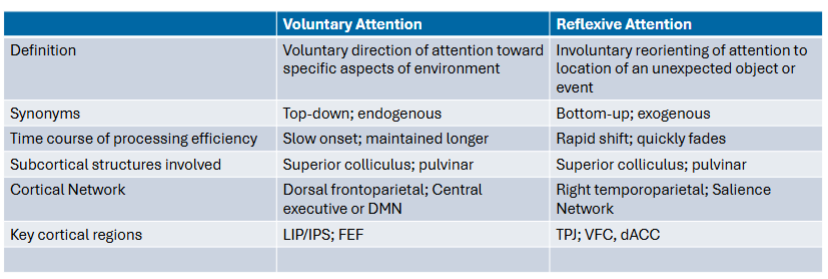
Goal-directed attention
Curiosity, motivation, focus
Endogenous (top-down)
Voluntary
Stimulus-driven attention
Reaction, fear. pop-up ads
Exogenous (bottom-up)
Reflexive
Visual attention pathway
Processing at the sensory level (subcortical and cortical levels)
Association areas
Executive function areas (planning and decision making)
Cortical salience network
Critical for monitoring and noting important changes and internal/external stimuli
Automatic grasp of attention based upon salient stimuli
Key regions: dorsal Anterior Cingulate Cortex, Anterior Insula, sensory and limbic regions
Dorsal frontoparietal network
Voluntary or endogenous control of attention aka Central Executive Network or dorsal network
Right temporoparietal network
Reflexive or exogenous capture of attention aka Salience Network or ventral network
Hemispatial Neglect
parietal lobe damage where people lose perception of one side
patients are not blind, but they lack the "mental searchlight" to acknowledge or process the left half of the world
Can’t copy left side of pictures, or eat the left side of their plate because they forget the left exists
Balint’s Syndrome
can’t switch attention easily due to Bilateral lesions of parietal lobe
Oculomotor apraxia: difficulty steering visual gaze (can’t pinpoint stuff)
Optic ataxia: unable to reach for objects using visual guidance
Simultagnosia: extreme restriction of attention; only seeing one object at a time
Learning
the process of acquiring new information
Memory
the ability to store & retrieve that information
Engram
memory trace, persistent change in the brain that reflects the storage of memory
Meadow vole males
Polygynous
Large home ranges
Good spatial abilities; larger hippocampus
Place cells
encode the position of the animal in space (hippocampus)
Grid cells
encode coordinates (location, distance, directionality) (entorhinal cortex)
London taxi drivers
Extensive mental map of streets
Repeated spatial learning
Bigger hippocampus
stages of memory
Encode —> Store —> Retrieve
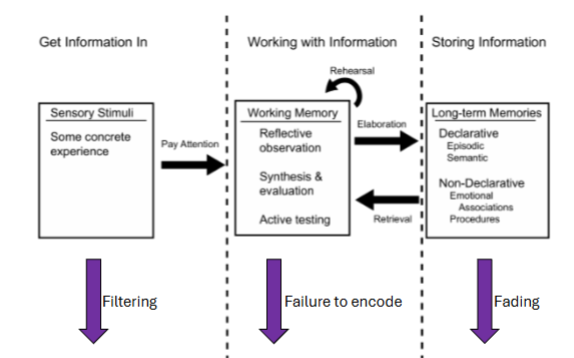
Working memory
Active maintenance of info in the limited, short-term memory
Depends upon a quick-learning memory store
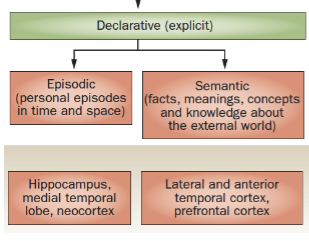
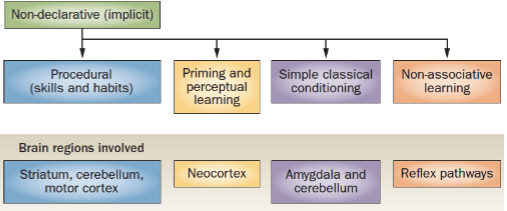
Process of converting STM or WM to LTM
Left frontal lobe active when try to retrieve info
Hippocampus active when retrieval successful
Working memory changes with age
Working memory stabilizes between 15 and 22
Stable WM until ~50
Linear decline thereafter
Younger adults show increased dlPFC activity with increased WM demands
older adults show increased dlPFC activity during WM maintenance - suggests lower efficiency
Sleep and memory consolidation
need sleep for memory formation (slow oscillation and fast spindle coupling)
The Fast-Learning Store: The Hippocampus
captures new information rapidly
fast and volatile" synaptic changes; It is highly plastic but has limited capacity
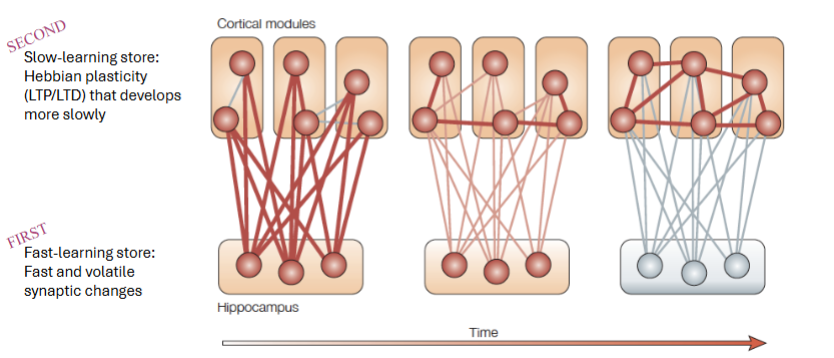
The Slow-Learning Store: The Neocortex
a long-term storage vault for stable, structured knowledge
Uses Hebbian plasticity (LTP/LTD) that develops over time. It requires many repetitions or sleep to "solidify" connections
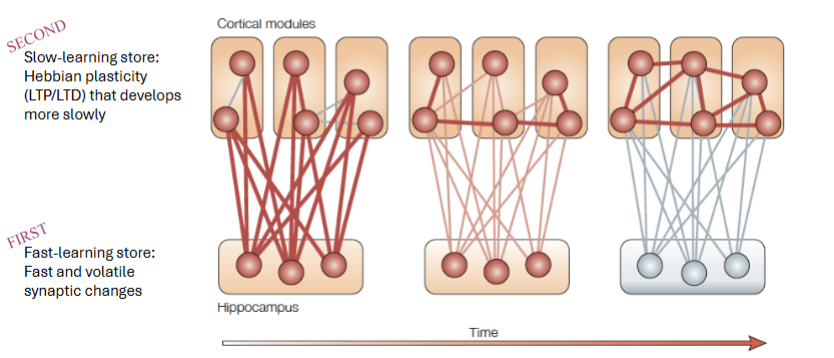
Systems Consolidation
Over time, the memory is "transferred" or "replayed" from the hippocampus to the cortex.
Hippocampal Independence: Eventually (last panel), the cortical modules are so well-integrated with each other that they no longer need the hippocampus to retrieve the memory
Stress
disturbance of homeostasis
Stressor
condition, agent, or other stimulus that causes stress (e.g., heat, cold, hunger, threat, anticipation)
Stress response
a suite of physiological and behavioral responses that help to re-establish homeostasis
Allostasis
The adaptive processes that maintain homeostasis through the production of mediators; achieving stability through change
Allostatic load
Refers to the wear and tear that results from either too much stress or inefficient management of allostasis
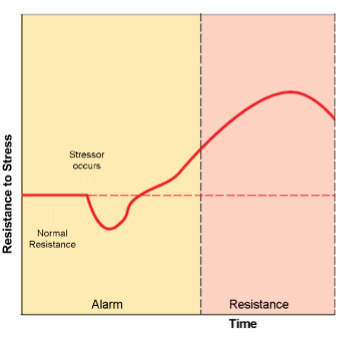
GAS - Stage 1: Alarm Reaction
many stressors involve only this stage
Mobilize resources – inhibit digestion, increase HR/BP/breathing
Heightened sensory acuity and memory
Activation of SNS and NE and E
Activation of HPA axis and release of cortisol
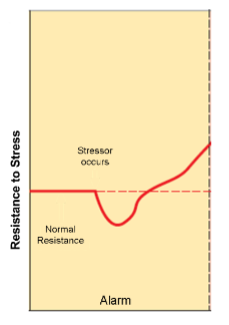
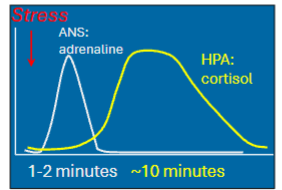
Stage 1: Alarm Reaction (SNS)
Earliest stage of Alarm Reaction mediated by the activation of SNS (Epinephrine and Norepinephrine)
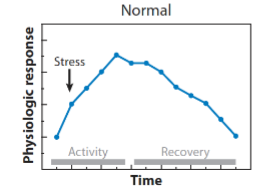
Stage 1: Alarm Reaction (HPA)
Next stage of Alarm Reaction mediated by the activation of HPA axis
ANS (fight or flight, more immediate, peaks first)
HPA: cortisol: slow wave, peaks at 10 minutes, “the brake”
ensures the body does not overreact and return systems to a stable state
Negative feedback loop
GAS - Stage 2: Resistance
Surge capacity: mental and physical resources to cope for a longer period of time
Increased cortisol synthesis, liver makes glucose for energy, increased lipid mobilization, muscle decreases protein synthesis
Increased Cortisol, energy usage - Just trying to cope for a hot minute
GAS - Stage 3: Exhaustion
After the mental and physical reserves are depleted
Fatigue rapidly, heart disease, reproductive disorders, stomach ulcers, hippocampal neuron death, immune suppression
Depleted/defeated - This is where the issues arise (heart disease, ulcers, neuron death
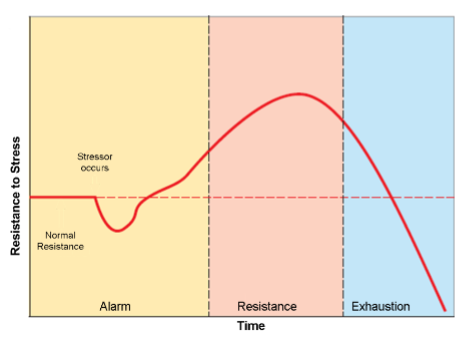
General Adaptation Syndrome
Not all stressors put us through all stages
Some stages can last longer for different stressors or for different people
Period of chronic, unabated stress (global pandemic, civil unrest, politics, war, global climate change, loss of job, grief, etc.)
Cortisol as a necessity
Increased attention to task
Increased glucose for brain function
Need to react quickly to dangerous stimuli
Some anxiety, increased alertness improves performance
Increased energy to combat stress
Anti-inflammatory action
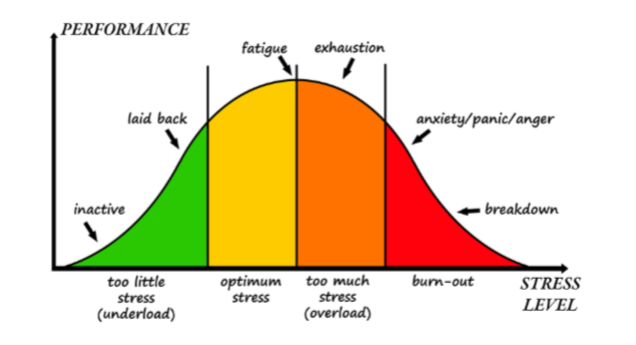
A little bit of stress as a good thing
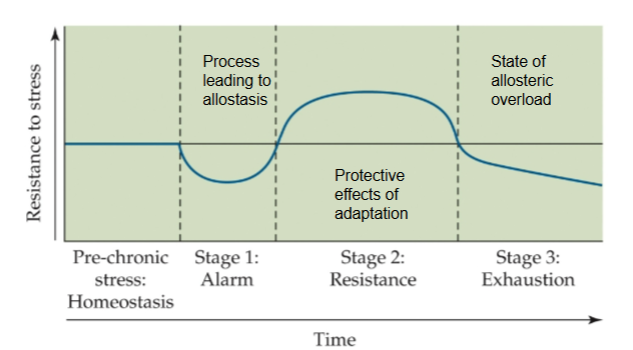
Allostasis & General Adaptation Syndrome
Different types of allostatic adaptations
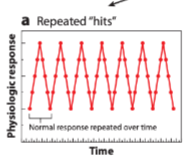
Repeated "Hits (Allostaic load)
occurs when a person faces multiple, closely-spaced stressors
The body never has enough time to fully recover between events, leading to a constant state of high physiological arousal
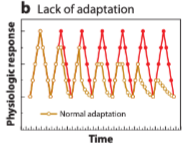
Lack of Adaptation (Allostaic load)
Normally, the body "gets used" to a repeated, non-threatening stressor (like public speaking)
In this case, the body fails to habituate, treating every single instance as a brand-new, high-level emergency