Lec 7 - Mudrocks
 Call Kai
 Learn
Learn Practice Test
 Spaced Repetition
 Match
Match Flashcards
 Knowt Play
1/48

There's no tags or description
Looks like no tags are added yet.
Name | Mastery | Learn | Test | Matching | Spaced | Call with Kai | Chat |
|---|
No analytics yet
Send a link to your students to track their progress
49 Terms
Mudrocks comprise of how much percent of sedimentary rocks
45%-55%
Main constituents of mudrocks
clay and quartz
what does the color of a mudrock tell you?
indicates whether the depositional environment is anoxic/oxygen-deficient or oxidizing
Describe fissility of mudrocks
fissile — shale
papery — varves
block — mudstone
Sedimentary structures in mudrocks
laminated, bedded, slumped, bioturbated, massive
Fissility
tendency to break into sheets
Lamination
caused by variation in grain size and/or changes in composition. Deposited in relatively short periods of time by turbidity currents OR develops over months or years
siltstones
similar texture to those found in fien sandstones
why are some mudrocks massive?
sediment-water flows have a high viscosity at time of deposition
bioturbation
mass sediment movement
dewatering
soil processes and root growth
color of mudrocks is a affected by?
mineralogy and geochemistry.
organic matter content
pyrite content
oxidation state of Fe
Dark gray to black mudrocks
increasing organic matter and pyrite
Red and purple mudrocks
presence of ferric oxic, hematite occuring chiefly as grain coatings and intergrowths with clay particles
green mudrock
made with ferrous iron w/in the lattices of illite and chlorite. No hematite, organic matter or iron sulfides. Green color may also develop from red mudrocks through the reduction of hematite by migrating pore waters.
olive and yellow mudrock
mixing of green minerals and organic matter
color mottling in different shades of gray mudrock
due to bioturbation
yellow/reds/browns mudrocks
can be pedogenic processes, espeically in lacustine and floodplain muds
what are clays
hydrous aluminous silicates with sheet and layered structures similar to mica (phyllosilicates)
how are clays classified
based on number and arrangement of tetrahedral and octahedral sheets in their basic structure
interlayer cations
substitution in the tetrahedral and octahedral sheets
presence of water
what are the building blocks of clay minerals
octahedral and tetrahedral layers
desccribe an aluminum octahedra
6 oxygen linked with aluminum that can be replaced or substituted by Fe or Mg
describe silica tetrahedra
3 oxygen atoms shared with adjacent tetrahedra, linked together to form a hexagonal network
what is a 1:1 phyllosilicate structure
simplest phyllosilicates result from bonding one tetrahedral layer to one octahedral layer.
name a clay with a phyllosilicate 1:1 structure
Kaolinite, dickite, nacrite, halloysite
Describe the Phyllosilicate structure 2:1
1 octahedral layer sandwhiched between two tetrahedral layers.
What happens to Montomorillonite in good drainage conditions
Mg will be leached and Kaolinite will form instead of montmorillonite
how do Smectites form
result from weathering and alteration of basic rocks
Nontronite results from
alteration of basaltic glass
Montmorillonite and beidellite result from
the alteration of volcanic ash to give bentonite clay deposits
how are other smectites formed? (Nontronite, biedellite, and saponite)
variable modes of substitution in the octahedral and tetrahedral layers
What is Illite?
most common clay mineral in sedimentary rocks. Has a 3 layer structure but Al3+ replaces Si4+ in the tetrahedral layer. This results in a deficit of charge which is balanced by K ions in interlayer positions.
describe Chlorite
has brucite in between layers, substitution by Fe2+ occurs which imparts the green color
How are mixed layers formed
interlayering of common clays
how does feldspar occur in clays
generally present in low concentrations due to low physical and chemical stability. May be preferentially preserved in muddy sediments because of low permeability.
are muscovite and biotite common in clays?
muscovite is common, biotite less common
How does calcite occur in mud
calcite occurs as skeletal debris or diagenetic calcite, dolomite, or siderite
Is organic matter common in mudrocks?
Yes, particularly black shales
what are the 3 origins of clay minerals
inheritance, neoformation, and transformation
inheritance
detrital and stable in their present location
neoformation
formed in situ and either have been precipitated from solution or formed from amorphous silicate material
transformation
clays are modified by ion exchange or cation rearrangement
where does clay mineral formation take place
weathering and soil environment
depositional environment
during diagenesis and into low-grade metamorphism
where does Kaolinite occur (>20%)
acid tropical soils where leaching is intensive. Dominant in low-latitude areas particularly off major rivers draining regions of tropical weathering
Montmorillonite >50%
Product of intermediate leaching and weathering. Common in temperate soils with good drainage and neutral pH, in poorly drained soils and in arid-zone soils which are highly alkaline.
Where does Illite (>40%) occur
where degree of leaching is limited. More common in ocean-floor muds of higher latitudes. Typically reaches the ocean via rivers and wind transport
where does chlorite occur (>20%)
intermediate leaching in temperate acid soils; also in soils in arid region where chemical processes are minimal
Montmorillonite are related to what systems?
MOR systems and volcanic oceanic islands.
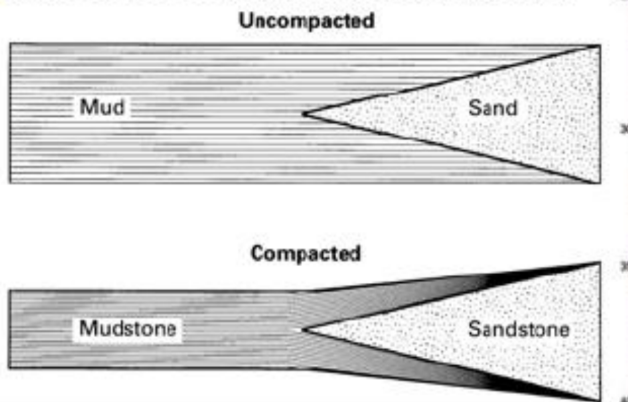
Compaction
expels water and reduces thickness of sediment by a factor of up to 10. Further compaction through water loss requires temperatures approaching 100oC at depths of 2-4km.
how do changes in clay mineralogy take place during diagenesis
rise in temperature and increase in burial depth.
differential compaction
sand and clay compact differently leading to complex outcrop patterns.