Study Guide Exam 3
 Call Kai
 Learn
Learn Practice Test
 Spaced Repetition
 Match
Match Flashcards
 Knowt Play
1/111

Earn XP
Description and Tags
Presidency, Congress, Interest groups
Name | Mastery | Learn | Test | Matching | Spaced | Call with Kai |
|---|
No analytics yet
Send a link to your students to track their progress
112 Terms
Where does the Constitution talk about the President?
Everything about the president is in Article 2 of the Constitution - the constitution does not say much about the president
Not a lot of express powers given to the president, its more implied powers or inherent powers
First words of article 2:
“The executive power shall be vested in the President of the United States of America”
Where does the constitution talk about the President and are most things in that part specific or general??
The powers in Article II are described as “general” because they have been interpreted broadly over time
Article II provides specific qualifications for choosing a president but it provides broad, general grants of power regarding how the president operates, leading to the expansion of presidential power throughout American History
what does Article II (Sections 1-4) say about the president?
The main section establishing the presidency, qualifications (35 years old, natural-born citizen, 14-year resident), the election process (Electoral College), the oath of office, and impeachment
what does Article II (Section 7) say about the president?
Details the President’s role in the legislative process, specifically the power to sign or veto bills passed by Congress
what are the requirements to be president? (3)
1) Be at least 35 years old
2) Need to be a Native citizen of the United States
3) You have to have lived in the United States for at least 14 years
what do we mean by saying the President is Chief of State?
or referred to as the Head of State, it means the symbolic or ceremonial leader of a country
this role is purely ceremonial
The president is Chief of State, the symbolic ceremonial leader of the country but also is in charge of all the mechanisms of government
When we think of the United States, we think about the President and who is the President
Chief of State is also referred as..?
the Head of State and the Head of Government
the president is also the Head of Government, the person that makes sure that the government is functioning
what do we mean by saying the President is Chief Executive?
is in charge of all the workings of the government, makes sure that the laws in this country are actually functioning
All the people working in the different departments help the President fulfill his role as Chief Executive
what are the things a President does as Chief Executive?
Manages the 15 executive departments
Issues Executive Orders (3 types)
Grants Executive Pardons(Presidential Pardons)
Nomination of Federal Judges
Appointing Ambassadors
what is nomination of Federal Judges?
president picks the judges to serve on on all of these courts
94 district courts
12 courts of appeal
supreme court
what is the Appointing of Ambassadors?
Ambassadors - run the embassy’s to that country
every country that the United States has diplomatic relationships with we have this thing in those country’s called an Embassy
ex: US embassy in Italy
what are Executive Pardons/Presidential Pardons?
A presidential pardon can free people convicted of crimes from jail terms, formally give them without expunging their criminal records, and restore certain rights-to vote, to bear arms, for example.
for pardons it has to be a federal crime
the Constitution says presidents can issue pardons to people
What are Executive Orders?
A rule or regulation which originates from the President that has the effect of law
its not a law, but it kind of has the effect of law
they have the force of law but only on the Executive branch
why and how do Executive Orders exist?
Executive Orders are not specifically mentioned in the Constitution. They exist due to the interpretation of Section 3 of Article II in the Constitution which states that the President must “take care that the laws be faithfully executed”
what does Section 3 of Article II in the Constitution state?
states that the President must “take care that the laws be faithfully executed”
what is one of the ways that the laws are faithfully executed?
is through the use of Executive Orders
All presidents have used Executive Orders to?
manage the executive branch and set policy
Presidents have turned to Executive Orders as a substitute for legislation
what types of Executive Orders are there?
1) Proclamations - They are often directed at citizens - not just government officials - and many of them call on them to take a specific action
Proclamations are mostly ceremonial in nature saying
ex: Presidential Proclamation 98 signed Nov 1, 2017 - Proclaims November to be National Military Families and Veterans Month. Lincoln freed slaves with Emancipation Proclamation
2) Memorandum - A type of Executive Order given to cabinet secretaries ordering them to do certain things. This could be as routine as preparing a report or as significant as drawing up regulations on wage and hour laws, firearms, or coal power plants
important things happen from memorandums
ex: Eisenhower used one to desegregate schools. Trump signed a memorandum to lower health insurance premiums by allowing customers to buy plans across state lines
3) National Security Directives - Generally operate like memoranda but in the area of national security
more specifically refined
ex: Obama used one to close down Gitmo. Bush used one to create the Department of Homeland Security
how many executive orders are there ?
3
1) Proclamations
2) Memorandum
3) National Security Directives
what are Proclamations?
They are often directed at citizens - not just government officials - and many of them call on them to take a specific action
Proclamations are mostly ceremonial in nature saying
ex: Presidential Proclamation 98 signed Nov 1, 2017 - Proclaims November to be National Military Families and Veterans Month. Lincoln freed slaves with Emancipation Proclamation
what are Memorandums?
A type of Executive Order given to cabinet secretaries ordering them to do certain things. This could be as routine as preparing a report or as significant as drawing up regulations on wage and hour laws, firearms, or coal power plants
important things happen from memorandums
ex: Eisenhower used one to desegregate schools. Trump signed a memorandum to lower health insurance premiums by allowing customers to buy plans across state lines
what are National Security Directives?
Generally operate like memoranda but in the area of national security
more specifically refined
ex: Obama used one to close down Gitmo. Bush used one to create the Department of Homeland Security
what are the 2 most important types of Executive Orders?
1) Memorandums
2) National Security Directives
How does the process of Executive Orders work?
1) President writes them
2) They get published in the Federal Register (a daily book/website which publishes all governmental rules and regulations)
in the next day or two they get published
3) 30 days after they appear in the Federal Register they become law
what is the Federal Register?
a daily book/website which publishes all governmental rules and regulations
What are the restrictions on Executive Orders?
they cannot be unconstitutional
incoming presidents can decide to continue or revoke any E.O of any previous president
they have the force of law but only on the Executive Branch
You cannot ask for federal funding in an E.O
what does the Constitution say about the President as Chief Legislator?
The Constitution is a little bit specific as to what the president should be doing in his role as Chief Legislator
The Constitution spells out 4 responsibilities of the president as Chief Legislator
1) State of the Union Address
2) Recommend Legislation - president can only suggest laws
3) Call Congress into Special Session
4) Veto an act of Congress
what is the purpose of the State of the Union Address?
it is a big deal, looks forward intended to give Congress an idea of what the presidents got in mind as far as things that he feels like issues, topics he feels they should be working on in the upcoming year
the entire important people who run government are there in one room at the same time
why would the President call Congress into Special Session?
During one of those periods where they are not in Washington and something happens the president can call them back in to address them
What are the ways a President can respond to a bill?
1) Sign the Bill - likes the bill, implement
2) Veto bill - doesn’t like any of it, does not become law
3) Ignore bill - the president does nothing, during most of the year when a president ignores a bill after 10 days the bill automatically becomes law
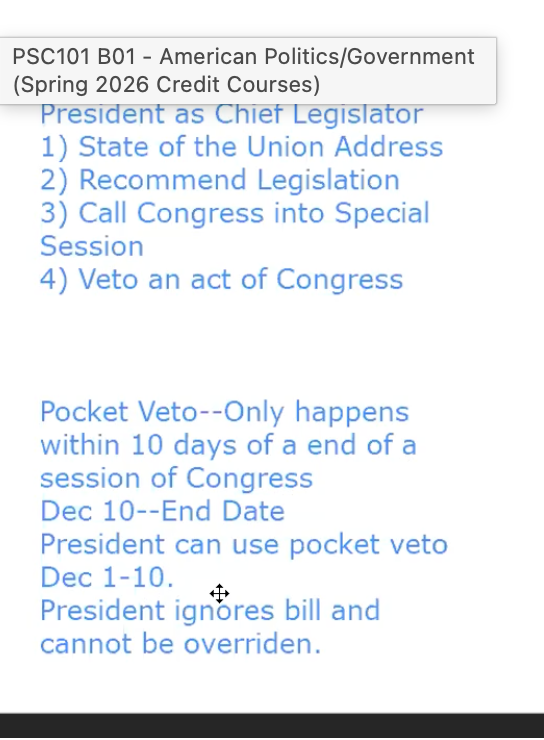
4) Pocket veto(at certain times of the year) - Only happens within 10 days of an end of a session of Congress. President can use pocket veto Dec 1-10. Ignores bill and dies
what is a pocket veto?
Only happens within 10 days of an end of a session of Congress.
Dec 10 - end date
President can use pocket veto Dec 1-10.
President ignores bill and cannot be overwritten by Congress
If the president gets a bill within 10 days of the end of the session of Congress he can ignore the bill and the bill dies
what is a line item veto?
Can the president go through a bill and cherry pick the things he likes and keep them, scratch out the things he doesn’t like and get rid of them? No, but presidents used to be able to do that. Known and called a line item veto
not constitutional
President has to determine, sign a bill or veto a bill in its entirety
is no longer in existence
what is executive privilege?
Is the right of the president to withhold information from those who claim a right of access to documents or to testimony by White House officials
congress is the watchdog over the other branches of government
congress goes to the president and would say we would like the emails and the president says “executive privilege”
does not work with criminal acts- if they’re investigating you cant save somebody
some presidents use executive privilege to exert power or hide wrongdoings(ex: Nixon - Watergate)
what is a signing statement?
A written proclamation issued by the president upon the signing of a bill into law
A signing statement is in essence presidents saying there is a part of this bill that I don’t like but i’m still going to enforce the bill in its entirety
Attach a signing statement to a bill - “i’m still going to enforce the parts of the bill that I don’t agree with”
How did George Bush treat signing statements than all the other presidents?
George Bush gets a bill before him and there is parts of a bill that he doesn't like but he still signs the bill into law but he attaches a signing statement saying that the parts of the bill he doesn’t like he is not going to enforce
first person to do that
What does it mean when we say the President is Commander in Chief?
President is in charge of army, navy, air force, marines
In charge of nuclear codes and nuclear weapons
As commander in chief, the president has the power to..?
order a military response to an emergency, such as foreign attack, without formal declaration of war
What was the intent of the Founding Fathers - Commander in Chief?
The founding fathers thought that war should be a shared power. Congress has the ability to declare war - express power given to them by the Constitution.
According to the Founding Fathers, the president should be in charge only when war has already been declared unless we are being invaded or unless there is a nuclear weapon attack upon the country
war should be a shared power - presidents have ignored this notion
what is the War Powers Act?
Intended to restore a constitutional balance between the President and Congress
Reason/Rationale: Presidents ignore Congress, they think Congress is going to leak information to the media and the media will let the world know and the intended target they’ll know
What are the main points of the War Powers Act? (4 main parts)
1) The President should consult Congress before any troop commitments “in every possible instance” - presidents have basically ignored
2) The President must inform Congress of his actions within 48 hours
3) The President must secure Congressional authorization after 60 days - At worst, if the president does something that Congress and the country doesn’t agree upon - 3 months later its over (90 days)
the 60 day window - the 60 day clock does not start until the president says it starts
Congress lets presidents get away with this because if the incident goes bad, Congress can say blame the president
4) If no authorization, he has 30 days to withdraw troops
the main parts of War Powers Act revolve around #3 and #4
what does it mean when we say the President is Chief Diplomat?
This means the president is in charge of Foreign Policy/Foreign Affairs
Not specifically given to him in the Constitution but Congress didn’t want it so President just took it up
Main things under Chief Diplomat:
treaties
executive agreements
what do you do as Chief Diplomat?
Travel the world
Meet leaders of other countries
Have engagements and make proposals that are accepted
Other people come into the U.S and foreign leaders come into the U.S (the president meets with them)
what is a treaty?
An agreement between the U.S and one or more other countries
involve really important things like military agreements or economic agreements
Constitutions says treaties have to be ratified by a two thirds vote in the Senate
what are executive agreements?
President can write executive agreements and basically its implemented almost automatically
initially they were not supposed to be dealing with important things
presidents try and use executive agreements to get the things that they want
what is the difference between a treaty and an executive agreement?
Executive agreements do not need the approval of Congress
what is the only thing Congress has ever done about executive agreements?
In 1972, they passed the Case Act
The president has to inform Congress of any executive agreements within 60 days of it being signed
what does it mean when we say the President is Manager of Prosperity?
The American People often judge a good and a bad president by whether or not he can divise a plan for a healthy and growing economy
something not specifically mentioned in the Constitution
when the economy is doing well, we give the president maybe too much credit
when the economy is doing poorly, we may put too much blame on the president
what is the job of the president as Manager of Prosperity?
presidents job - make sure the country is successful, the country is thriving economically
Four traits to describe a president - who are good or bad presidents?
active or passive - this pertains to a presidents approach towards the job - energy level
active president - workaholic, highly driven, ambitious
passive president - lazy, takes a lot of vacations, puts in minimum amount of work
positive or negative - this pertains to how the president feels about the job
positive president - enjoys the job, builds up his self esteem
negative president - he’s out of his element, bothersome, hates the job, enjoys it less
According to barber, all presidents are one of four types?
active positive - high self esteem, confident that they qualify for the job, productiveness, good working with people
active negative - compulsive, hard workers, ambitious, but anxious, suffer anxiety over their work, become secretive,
passive positive - compliant, enjoy being president but they feel overwhelmed, resort to delegating, easily manipulated, good personality
passive negative - withdrawn, annoyed to even be the president, low self esteem, doing the job out of sense of duty, avoid conflict
what is James David Barber’s theory on what makes a good or bad president?
Psychological model for determining good/bad presidents
James David Barber - The Presidential Character
this is a very simplistic way of looking at the president
criticism of this theory: you cant apply this to anyone who has not been elected.
Only applies to people who have accepted the positions and start doing the job
Barber says that a presidents personality shapes his behavior as president it shapes his behavior in office
Four traits to describe a president - who are good or bad presidents
active or passive - this pertains to a presidents approach towards the job - energy level
active president - workaholic, highly driven, ambitious
passive president - lazy, takes a lot of vacations, puts in minimum amount of work
positive or negative - this pertains to how the president feels about the job
positive president - enjoys the job, builds up his self esteem
negative president - he’s out of his element, bothersome, hates the job, enjoys it less
According to barber, all presidents are one of four types:
active positive - high self esteem, confident that they qualify for the job, productiveness, good working with people
active negative - compulsive, hard workers, ambitious, but anxious, suffer anxiety over their work, become secretive,
passive positive - compliant, enjoy being president but they feel overwhelmed, resort to delegating, easily manipulated, good personality
passive negative - withdrawn, annoyed to even be the president, low self esteem, doing the job out of sense of duty, avoid conflict
Judging a president is incredibly subjective in nature - the eyes of the beholder
on international affairs, economic management, pursuing equal justice for all, crisis leadership, vision and agenda settings
When we are judging presidents, the presidential scholars say that presidents have to have?
5 qualities that make up a good president
vision - clear understanding of where they want to lead the country, a perspective
pragmatism - flexible responses to changing conditions
consensus building - getting the national consensus, doing something that is popular in the U.S
charisma - capture and retain the affection of every average citizen
trustworthiness - credible among the people
What types does he consider to be a good or bad president?
he feels the active positives are the best type to handle the job - positive attitude toward work, tend to be eager and better able to take on new challenges
worst types of president are active negatives - tend to become dangerous because they don’t like their decisions to be challenged
what does Barber consider to be a good type of president?
he feels the active positives are the best type to handle the job - positive attitude toward work, tend to be eager and better able to take on new challenges
AP
what does Barber consider to be a bad type of president?
worst types of president are active negatives - tend to become dangerous because they don’t like their decisions to be challenged
AC
what does the Constitution say about the Vice President?
The only formal duty of the VP is to preside over the Senate and cast a vote in case of tie
the VP isn’t there when the senate is in session, he is only there when there is a tied vote
the constitution says that the VP can break the tie in a Senate vote
When does the VP take over?
Secession Process - Detailed in the 25th Amendment
Vice President takes over in cases of death, removal, resignation or disability
25th amendment says that the VP and the cabinet can get together to formally request the President to be removed
what are the roles and functions of the Vice President?
Role of the VP changes with each president
most VP fundraise and go to the ceremonial things that the president do not want to go to
Power of the Vice President began to change under Carter-Mondale and reached its high point with Dick Cheney
Dick Cheney most powerful VP - George Bush let him
what if something happens to the Vice President, what if there is a vacancy?
president picks someone new that has to be approved by Congress
what is an emolument?
salary, fee, or profit from office
What is the Emoluments Clause?
Part of the Constitution
The Founding fathers put this in to kind of make sure that the President didn’t abuse his job
The president is going to be paid a salary, the president should not use the position of the President to try and enhance his wealth or take some type of title from another country
It was a way to prevent sitting leaders from accepting foreign gifts or payments, in order to ensure complete neutrality from outside influence and to prevent even the appearance of corruption
The Emoluments Clause reads as?
“No Person holding any office of profit or trust under them [the United States], shall, without the consent of the congress, accept of any present, Emolument, Office, or Title, of any kind whatever, from any King, Prince, or Foreign State.”
where does the Constitution talk about Congress and are most things in that part specific or general?
Article 1 - all about Congress, more specific in regards to what Congress can do
provides a precise listing of Congressional powers
Article I of the Constitution grants several key powers to Congress, which include overseeing the budget and all financial matters, introducing legislation, confirming or rejecting judicial and executive nominations, and even declaring war.
“All legislative powers.. shall be invested in Congress.” - Article 1, Section 1
what does Article 1 and each of its sections in the Constitution explain about Congress?
Article I of the United States Constitution is the section that creates and defines Congress, spanning ten sections that detail the legislative branch's structure, powers, and duties. Specifically, Article I, Section 1 vests all legislative powers in a Congress consisting of a Senate and House of Representatives.
Article I, Section 1: Establishes the legislative power of the federal government.
Article I, Section 2: Details the House of Representatives.
Article I, Section 3: Details the Senate.
Article I, Section 8: Outlines the specific powers of Congress (e.g., taxing, declaring war).
Additionally, Article II, Section 3 mentions Congress regarding the State of the Union address and the president’s duty to report to them
who are the leaders of the 119th Congress - House of Representatives?
Speaker of the House - Mike Johnson Louisiana
Majority Leader - Steve scalise Louisiana
majority whip - tom emmer Minnesota
minority leader - hakim Jeffries New York
minority whip - Katherine clark Massachusetts
who is the speaker of the house?
Mike Johnson Louisiana
who is the majority leader of the house?
Steve scalise Louisiana
who is the majority whip in the house?
tom emmer Minnesota
who is the minority leader in the house?
hakim Jeffries New York
who is the minority whip in the house?
Katherine clark Massachusetts
who are the leaders of the 119th congress - senate?
majority leader - John thune - South Dakota
majority whip - John barasso - Wyoming
president pro tempore - chuck Grassley - iowa
minority leader - chuck Schumer - New York
minority whip - dick Durbin - Illinois
who is the majority leader in the senate?
John thune - South Dakota
who is the majority whip in the senate?
John barasso - Wyoming
who is the president pro tempore?
chuck Grassley - iowa
who is the minority leader in the senate?
chuck schumer - new York
who is the minority whip of the senate?
dick durbin - Illinois
which part of Congress is more reflective of the demographics of the country?
The House of Representatives is open to more minorities and women.
the senate consists predominantly of white people
what is an incumbent?
the person whose been elected is trying to get reelected and we call that person the incumbent
what are the advantages of being an incumbent?
1) Name Recognition - being in office for a number of years people will hear about you and know your name
2) Claim credit for bringing money back to your state or district - you can say that you are using the federal government to the advantage of your district or to your state
3) Positive evaluations from casework - if you are good at doing casework and resolving peoples problems, its almost like a job evaluation
4) Franking Privileges - the ability to send things through the mail for free (given to members of Congress)
5) Easier access to the media - press conferences/interviews are more likely to be granted to you
6) Easier to fundraise - there are requirements for members of congress, it’s easier if you have already been elected. If you have already been elected you might say this person will do me a favor in the future so I will donate to their campaign. Easier because you can influence congress and colleagues to do something
7) Experience in running a campaign - hire people who have experience in running a campaign, they know where to advertise and who to interview
8) Gerrymandered districts - the districts are drawn in a way that its almost impossible for your political party to not lose an election
who or what are some of the influences on the way members of Congress decide to vote?
There are 4 main sources of influence on members of Congress:
1) Party - specifically the leadership of the political party, a lot of these leaders want perfect party unity they don’t want no renegades voting against what they want. The renegades can be punished/penalized
2) Constituents - how their vote will be reacted to by the people that vote for them
3) Colleagues—logrolling: voting to support a colleague’s bill in return for a promise of future support. The smartest people in Congress can’t be experts on everything, they ask colleagues for help
4) Interest Groups - political groups that are powerful. members of interest groups sit down with legislators and write bills with them, insert language into bills that is going to benefit the interest groups. interest groups have a lot of money. interest groups have the power of money, the power of influence, play a big role - provide information to congressmen.
what is logrolling?
voting to support a colleague’s bill in return for a promise of future support
what are the functions of Congress?
1) Congress has the right to accept or deny nominations of the President to the Federal Courts or to head up any of the Cabinet departments or executive agencies
most of these important positions have to be approved by the Senate with the exception of one - the National security advisor
2) They have the right to determine the amount of money that can be used by the government. This is called the “power of the purse”
this is one of the more important functions of congress
every year congress has to pass a budget, the president can make suggestions to the budget but if they do not pass the budget technically the government cannot function
3) They have the right to remove the president
very difficult, need the majorities in both the house and the senate
4) It has the right to investigate activities within the executive branch and the executive agencies. This is called congressional oversight
congress are the “watch dogs” of the other branches of government
the oversight committee looks at things like have ethics violations been broken by a member of the cabinet, has someone been taking bribes, has someone committed crime
5) They have the right to make the laws of the land
most common occupation of a member of congress is lawyer
law making is part of their job
they get a lot of help with making laws with interest groups
6) Congress acts as the branch of government which deals with all the complaints and grievances of individual citizens. This is called casework
what is considered to be the most important or primary function of Congress?
Resolve political differences and signal the existence of a consensus for policy action
congress resolves differences, come to compromise, form coalitions
To do this, political parties must form a coalition to support any piece of legislation. This means getting support from as many members of their own party as well as the opposition
this is clumsy and time consuming process - law making in general
made lawmaking complicated to prevent bad laws from passing (bicameral legislature)
what is the difference between a Trustee, Instructed Delegate, and a Politico?
these terms refer to how we expect our members of Congress to act after they get elected
Trustee - a member of Congress who listens to the opinions of their constituents but is then trusted to use their own and best judgement to make a final decision
a trustee is someone who is basically saying I know what’s best for you, I know more about it than you, so trust me i’m going to vote on your behalf
Instructed Delegate - is a member of Congress who votes the way their constituents wants them to vote regardless of their own opinion
if you are going to be a true instructed delegate for every decision and choice that you have to make in Congress you basically have to ask the people who voted you into office how you should vote
Politico - someone who acts either as a trustee or an instructed delegate depending on the situation, law, issue
In regard to things we are not so concerned about they will act as a trustee
in regard to things that affect us more directly they will be more of a instructed delegate
the concept of a politico is more idealistic
most members of congress are going to act as a trustee
what is a trustee?
a member of Congress who listens to the opinions of their constituents but is then trusted to use their own and best judgement to make a final decision
a trustee is someone who is basically saying I know what’s best for you, I know more about it than you, so trust me i’m going to vote on your behalf
what is a instructed delegate?
is a member of Congress who votes the way their constituents wants them to vote regardless of their own opinion
if you are going to be a true instructed delegate for every decision and choice that you have to make in Congress you basically have to ask the people who voted you into office how you should vote
what is a politico?
someone who acts either as a trustee or an instructed delegate depending on the situation, law, issue
In regard to things we are not so concerned about they will act as a trustee
in regard to things that affect us more directly they will be more of a instructed delegate
the concept of a politico is more idealistic
most members of congress are going to act as a trustee
what are the primary responsibilities of the Speaker of the House?
Presides over the House when they are in session - determines who may or may not speak on the floor of the House
Makes sure the party backed legislation runs smoothly through the house and gets voted on by the entire house of representatives
good effective speaker will use persuasion, it is key to being a good speaker of the house, hold on to members of your own majority party and from the minority party
In charge of Committee assignments
Speaker of the House decides who will sit on what committee
The speaker of the house has two chief assistants, who are they?
the majority leader and the majority whip
majority leader - second in command
majority whip -
what are the primary responsibilities of the majority leader and majority whip?
House - The majority leader is next highest-ranking officer below the speaker
helps decide what legislation is going to be debated
House - The majority whip is the vote counter - goes around and gives a progress report to the other two leaders as to who is in and who is not in with regards to the vote on a specific issue
Senate Majority leader and Senate Majority Whip - organize the business of the Senate
senate majority leader has enough power to block bills
tasks: propose legislation, move it forward, block things from being moved forward
what is the role of the House - The majority leader ?
is next highest-ranking officer below the speaker
helps decide what legislation is going to be debated
what is the role of the House - The majority whip?
is the vote counter - goes around and gives a progress report to the other two leaders as to who is in and who is not in with regards to the vote on a specific issue
what is the role of the Senate Majority leader and Senate Majority Whip?
organize the business of the Senate
senate majority leader has enough power to block bills
tasks: propose legislation, move it forward, block things from being moved forward
what are the various types of committees in Congress and what are the differences between them?
1) Standing Committees—Most important and permanent. 16 in the House and 20 in the Senate. They have full authority to recommend legislation. These committees are further divided into subcommittees.
2) Select or Special Committees—These are temporary committees created to deal with specific issues, and they are supposed to disband when their work is done. They have limited functions and responsibilities. They do not have authority to recommend legislation.
3) Joint Committees—These are committees comprised of both members of the House and Senate. They are permanent committees that have no authority to recommend legislation. There are four of them with the most important one called the Joint Economic Committee.
what is a standing committee?
Most important and permanent. 16 in the House and 20 in the Senate. They have full authority to recommend legislation. These committees are further divided into subcommittees.
They can move a bill forward or prevent a bill from moving forward
Ex of standing committees – agriculture, appropriations
Standing committees are broken down into even more specific topics called subcommittees
what is a select or special committee?
These are temporary committees created to deal with specific issues, and they are supposed to disband when their work is done. They have limited functions and responsibilities. They do not have authority to recommend legislation.
Not as important as standing committees, not many important responsibilities
Ex of select committees: human rights, climate crisis
Do not have the responsibility to move legislation forward
what is a joint committee?
These are committees comprised of both members of the House and Senate. They are permanent committees that have no authority to recommend legislation. There are four of them with the most important one called the Joint Economic Committee.
The Joint Economic Committee every year does a report on the economy of the U.S and presents the report to the president to see what directions should he move
what is congressional oversight?
the right to investigate activities within the executive branch and the executive agencies
congress are the “watch dogs” of the other branches of government
the oversight committee looks at things like have ethics violations been broken by a member of the cabinet, has someone been taking bribes, has someone committed crime
what is congressional casework?
Congress acts as the branch of government which deals with all the complaints and grievances of individual citizens
subcommittee is the first place where..?
a bill is going to be looked at