biochem lecture 12 regulation of glucose metabolism & polysaccharides as storage molecules
 Call Kai
 Learn
Learn Practice Test
 Spaced Repetition
 Match
Match Flashcards
 Knowt Play
1/15

There's no tags or description
Looks like no tags are added yet.
Name | Mastery | Learn | Test | Matching | Spaced | Call with Kai |
|---|
No analytics yet
Send a link to your students to track their progress
16 Terms
Where are the regulatory steps of glycolysis clustered around?
The irreversible steps
What is feedback inhibition?
There is enough product, so stop making it
What is feed-forward activation?
There is enough substrates, so make product
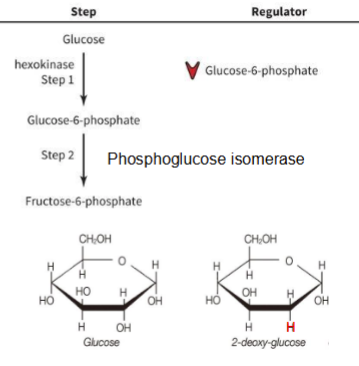
How is hexokinase regulated?
Hexokinase is inhibited by its product (classic feedback inhibition)
2-deoxyglucose (2-DG) can be phosphorylated by HK to make 2-DG-phosphate (2-DGp), but 2-DGp cannot be converted by phosphoglucose isomerase, making it a competitive inhibitor
Excess 2-DG starves cells by blocking more glucose from being phosphorylated
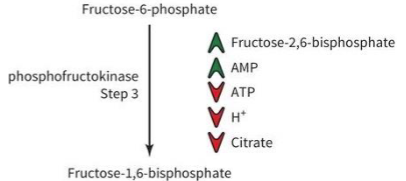
What are the mechanisms of PFK regulation?
Cells low on ATP → Adenosine monophosphate (AMP) activates glycolysis
High levels of ATP → block glycolysis
H+ build up means too much lactate → muscles “shuts down” (fatigue)
Citrate build up means too much ATP → block glycolysis
Most PFK regulators work allosterically
What is fructose-2,6-biphosphate (F-2,6-BP) and how does it work as a regulator?
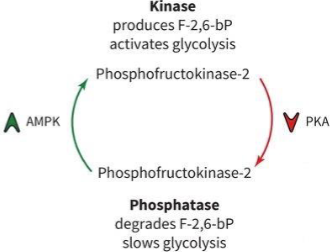
F-2,6-BP is a strong PFK allosteric activator that is produced by another isoform of PFK called PFK-2
Lots of F-6-P leads to the production of F-2,6-BP, which activates PFK to increase rate (feed-forward activation)
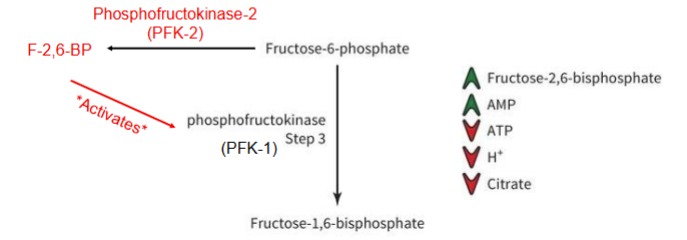
How does PFK-2 regulation work?
AMP-activated protein kinase (AMPK) senses high levels of AMP and turns on the kinase activity of PFK-2, which then makes F-2,6-BP from F-6-P to increase glycolysis
Protein kinase A (PKA) inactivates PFK-2 kinase and activates PFK-2 phosphatase function to convert F-2,6-BP to F-1,6-P to slow glycolysis
How does pyruvate kinase (PK) regulation work?
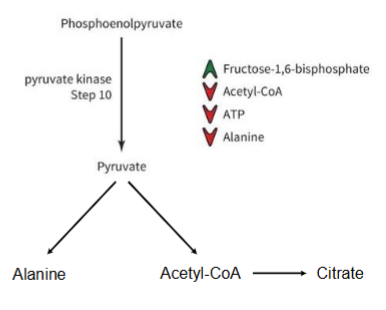
If there are more reagents, F-1,6-BP does feed-forward activation
If too much ATP, shut down energy production
Acetyl-CoA and alanine (downstream products) build up → slow down reaction
Why regulate multiple enzymes?
Glucose is a primary point of entry for carbon at most cells and this carbon is used in almost everything
How is glucose stored?
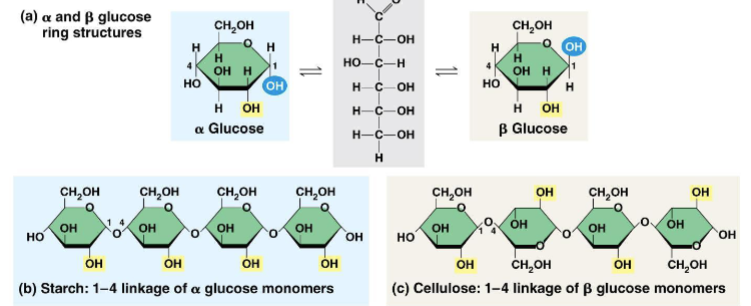
Plants and animals store glucose in more stable polymers
Glucose and other sugars on their own are called monosaccharides
Sugars are stored as polysaccharides
What is glycogen?
A type of polysaccharide that animals make
Branching polymer
~75% in muscle tissues and 25% in the liver → MOST tissues cannot create glycogen
Cannot be transported, must be metabolized where it’s made
Muscle never shares liberated glucose, but liver does
What happens in the glycogen synthesis pathway?
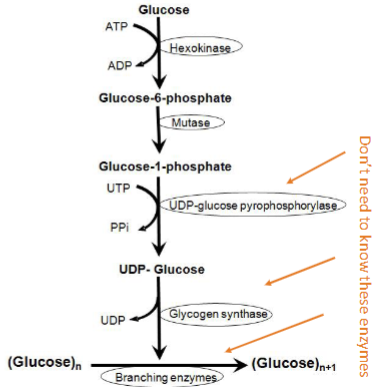
Glucose-6-P (G6P) is converted to glucose-1-P (G1P) by phosphoglucomutase
G1P is attached to a UDP to facilitate addition to growing chain
UDP is lost during chain addition
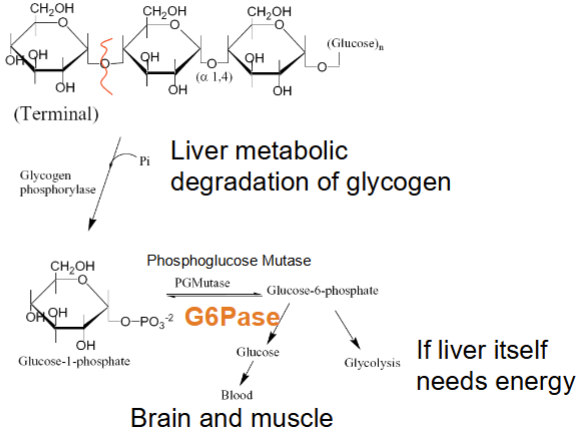
What is the breakdown process in glycogen metabolism (liver metabolic degradation of glycogen)?
Glycogen phosphorylase uses inorganic phosphate (Pi) to convert glycogen to G1P
Phosphoglucomutase (PGM) moves the phosphate group from C1 to C6, turning G1P to G6P
Energy can go to the liver itself (glycolysis if liver itself needs energy) or to the brain and muscles (G6Pase removes phosphate from G6P, allowing glucose to exit the liver)
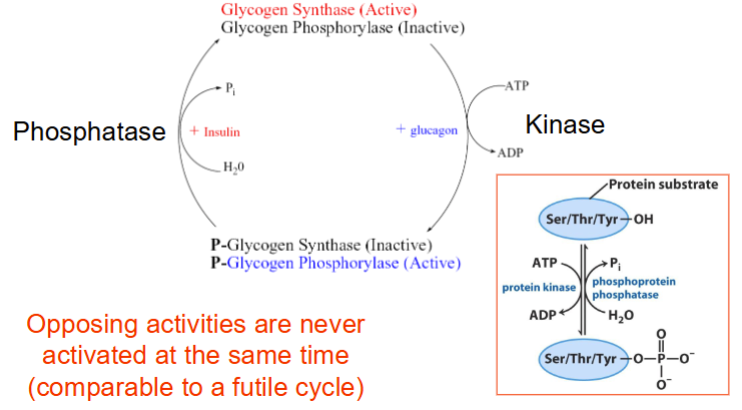
What is reciprocal control in glycogen metabolism?
Regulation via phosphorylation/de-phosphorylation
When blood sugar high: Insulin activates phosphatase (removes phosphate groups). This turns on synthase (builds glycogen for storage) and turns off phosphorylase (breaks down glycogen for energy). Energy is stored.
When energy needed: Glucagon activates kinase (adds phosphate groups). This turns off synthase and turns on phosphorylase. Energy is released into the blood.
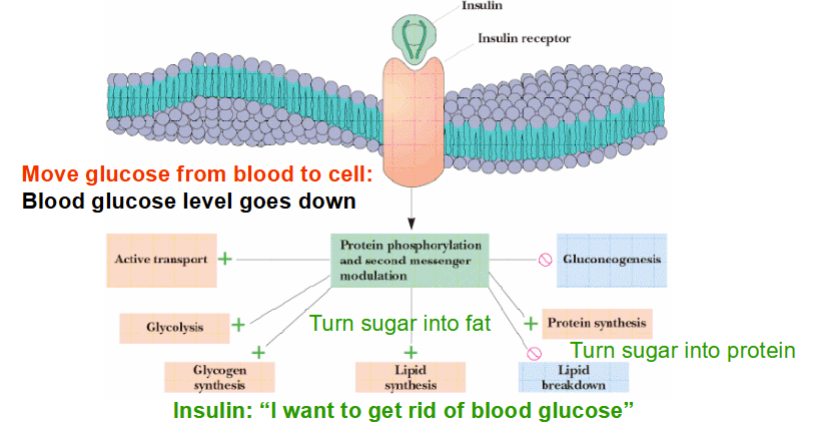
What does hormone signaling do?
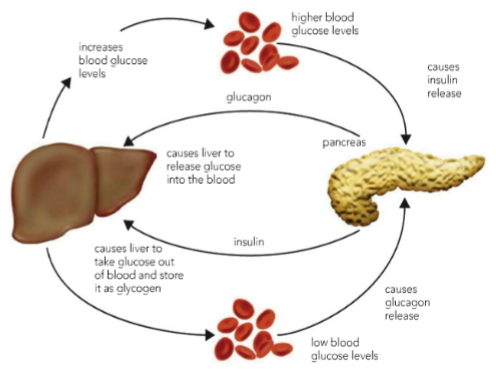
Regulate glucose levels
Dysregulation drives disease: type 1 diabetes caused by lack of insulin production, which drives elevated blood glucose
What does insulin do?
Move glucose from the blood to the cell, causing blood glucose levels to decrease