#1 Ch.10 Patient Assessment
 Call Kai
 Learn
Learn Practice Test
 Spaced Repetition
 Match
Match Flashcards
 Knowt Play
1/12

Earn XP
Name | Mastery | Learn | Test | Matching | Spaced | Call with Kai |
|---|
No analytics yet
Send a link to your students to track their progress
13 Terms
AVPU
Alert, Verbal, Painful, Unresponsive
SAMPLE
Signs/Symptoms, Allergy, Medication, Past medical history, Last oral intake, Events leading up to the incident
What is it called when a patient refuses to go to the hospital?
Patient refuse transport (PRT)
The patient exhibits a significant deviation from their baseline behavior or cognition. What term describes this?
Altered mental status (AMS)
Vital Sign Norms
Heart rate/ Pulse rate (hr/pr): 60-100
Respiratory rate (rr): 12-20
Blood pressure (bp): 120/80
SpO2 (saturation peripheral oxygen): 94-99%
ETCO2 (end tidal CO2): 35-45
Temperature: 97°F-99°F
SpO2
Peripheral oxygen saturation or “SpO2” represents the percentage of hemoglobin in your blood that is carrying oxygen.
Hemoglobin
A protein whose main function is to facilitate the transportation of oxygen in red blood cells and assists in the return transport of carbon dioxide.
ETCO2
End-tidal carbon dioxide (ETCO2) is the level of carbon dioxide that is released at the end of an exhaled breath.
What is the top number on a blood pressure reading?
Systolic, representing the pressure in your arteries when your heart contracts and pumps blood out.
What is the bottom number on a blood pressure reading?
Diastolic, representing the pressure in your arteries when your heart is at rest and refilling with blood between beats.
Radial pulse
located on the lateral (thumb) side of the wrist
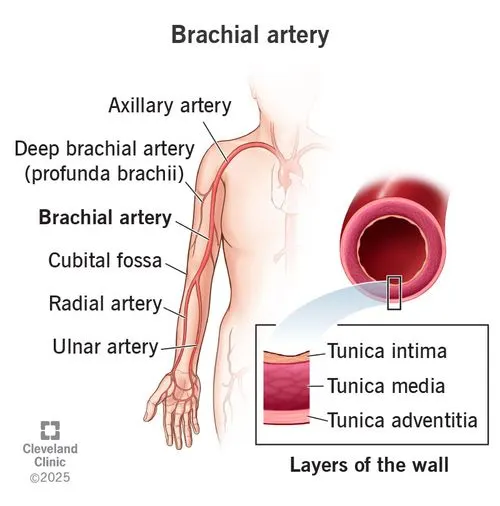
Brachial pulse
the brachial artery, a major blood vessel located on the inner side of the upper arm.
Carotid pulse