MATHS - PURE
 Call Kai
 Learn
Learn Practice Test
 Spaced Repetition
 Match
Match Flashcards
 Knowt Play
1/24

There's no tags or description
Looks like no tags are added yet.
Name | Mastery | Learn | Test | Matching | Spaced | Call with Kai |
|---|
No analytics yet
Send a link to your students to track their progress
25 Terms
What is the cosine rule
a2=b2+c2−2bccos(A) - for finding a side
rearrange for finding an angle
what are the special limits for differentiation by first principles that you are expected to know
h→0limhsin(h)=1
h→0limhcos(h)−1=0
How would you find out if a curve is convex, concave or has a point of inflection
Concave ~ \frac{d^2y}{dx^2}<0
Convex ~ \frac{d^2y}{dx^2}>0
Point of inflection ~ dx2d2y=0
How would you find out if a curve has two roots, one real root (repeated roots) or no real roots
Two real roots ~ b^2-4ac>0
One real root (repeated roots) ~ b2−4ac=0
No real roots ~ b^2-4ac<0
How would you find out if a curve is increasing, decreasing or stationary
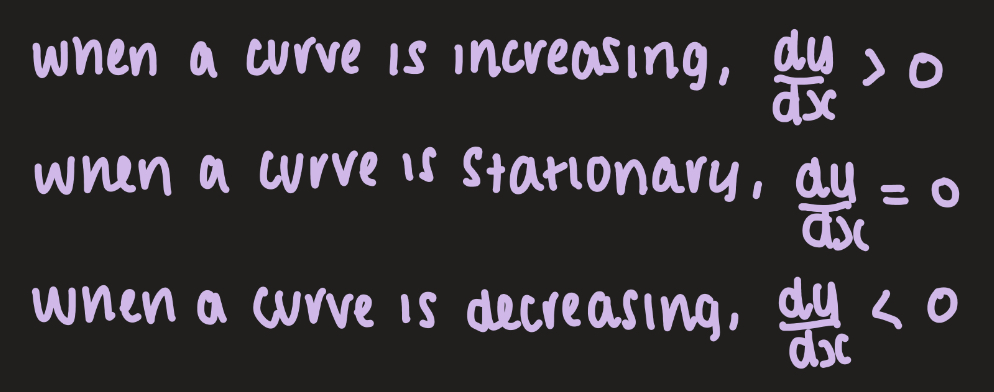
How would you convert degrees into radians and radians into degrees
360° = 2π radians
180° =π radians
Radians into degrees ~ divide byπ —> x180
Degrees to radians ~ divide by 180 —> xπ
What are all the pythagorean identities
sin2x+cos2x=1
sec2x=1+tan2x
cosec2x=1+cot2x
How would you work out the nth term of an arithmetic sequence
Un=a+(n−1)d
a is the first term
d is the common difference
What is the Newton-Raphson formula
Used for finding the roots of a function
Formula = xn−f′(x)f(x)
What is the formula for parametric integration $$\int_{t}^{t}y\cdot\frac{\differentialD x}{\differentialD t}dt
\int_{t}^{t}y\frac{\differentialD x}{\differentialD t}dt
What is the formula for finding the nth term of a geometric sequence
Un=arn−1
a is the first term
r is the common ratio
What is the general formula for exponential growth
y=Aekt
What is the general formula for exponential decay
y=Ae−kt
What is the simplified version of the tan double angle formula
tan(2x)=1−tan2x2tanx
How would you find a unit vector of a given vector
Divide by it’s magnitude
e.g. if the vector is a, the unit vector would be ∣a∣a
What is the trapezium rule (in word form)
Width of strip / 2 [1st height + 2(sum of middle heights) + last height]
What are the simplified versions of the cos(2A) double angle formula
cos2A−sin2A
1−2sin2A
How do you decide what to make as your “U” for integration by parts?
Logarithms
Algebra
Trigonometry
Exponentials
What is ln x integrated?
xln(x) - x
how do you find the area of a sector in degrees and radians?
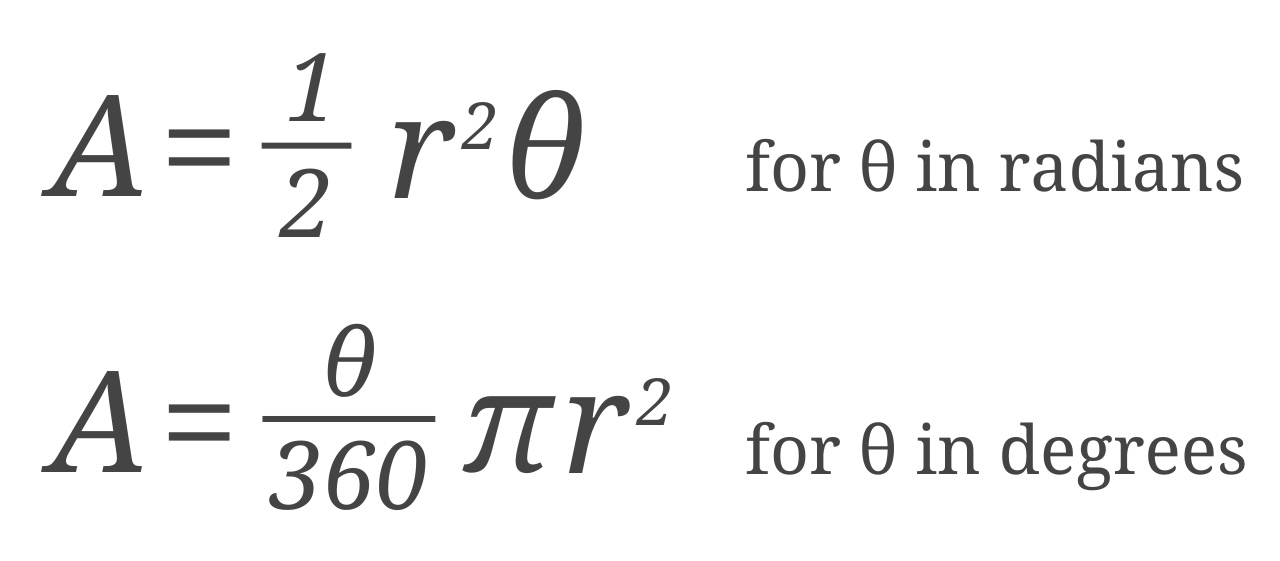
Why can’t you do the inverse of a many to one function?
Because it would become a one to many function (which is not a function)
because each input must only have one output
What is 2x differentiated and integrated?
Differentiated = 2xln2
Integrated =ln22x
What is domain and range?
Domain = used as the “inputs” - range depends on the domain - x values
Range = y values
What do the numbers in the number system mean?
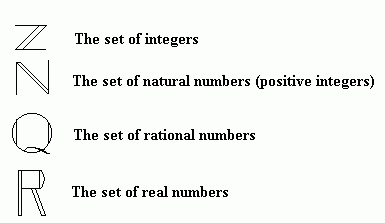
How do you find the domain of the inverse of a function?
The range of the original function