2electricity & Magnetism exam questions
 Call Kai
 Learn
Learn Practice Test
 Spaced Repetition
 Match
Match Flashcards
 Knowt Play
1/3

There's no tags or description
Looks like no tags are added yet.
Name | Mastery | Learn | Test | Matching | Spaced | Call with Kai |
|---|
No analytics yet
Send a link to your students to track their progress
4 Terms
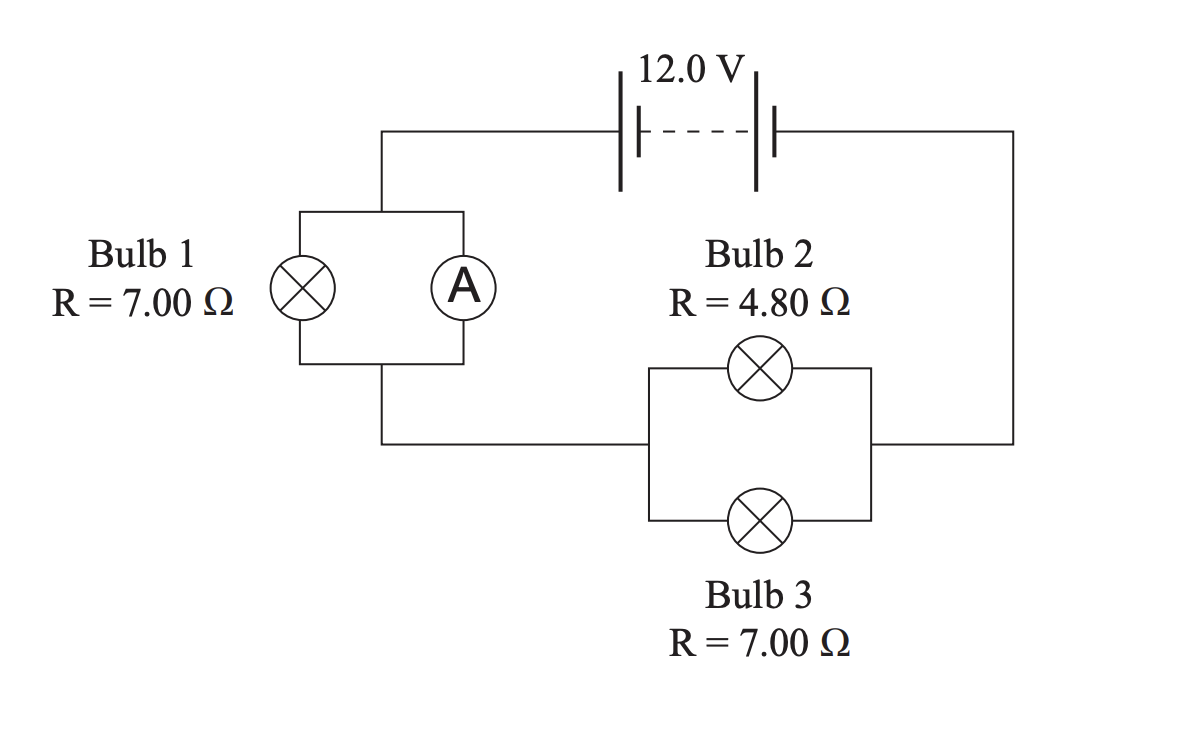
An ideal ammeter (with negligible resistance) is added to the previous circuit as shown below. Discuss the effect adding the ammeter has on the current, the voltage, and hence the brightness of each bulb.
When the ammeter is added in parallel with bulb 1, it creates a additional pathway for the electrons to flow through, as the ammeter has negliable resistance, this creates a short circuit for bulb 1. The current takes the path of least resistance through the ammeter instead of through the 7.00 Ω bulb, so bulb 1 will not light on, 0V. This change would lower the resistance of the circuit (Rt = 2.85 ohms from 9.85 ohms), and would hence increase the total current( I = V/R = 4.2A from 1.22A), Voltage across bulb 2 and 3 is now higher too. Bulbs 2 and 3 are still in parallel, so the full 12 V from the battery is now across the parallel branch containing Bulb 2 and Bulb 3 (increasing from 3.74 V previously). With a larger voltage and more current flowing through each branch, both Bulb 2 and Bulb 3 become brighter as P= IV.
a
c
b
c
c
c