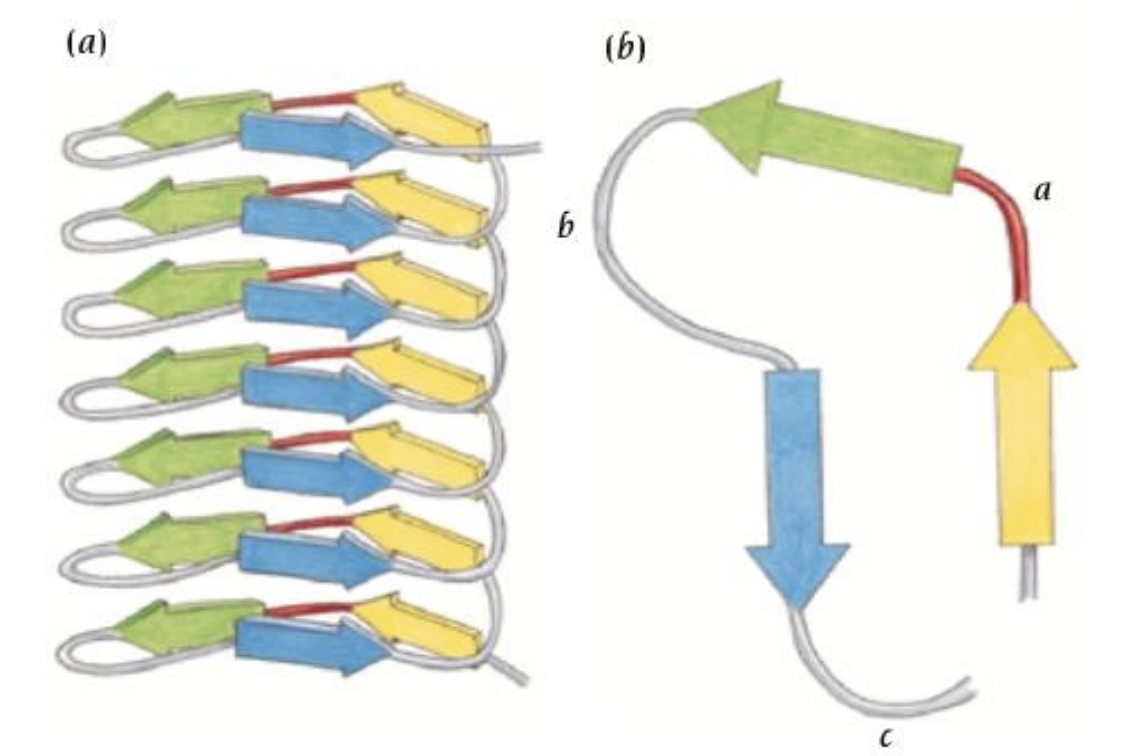
Folding motifs

0.0(0)
Studied by 0 people
call kaiCall Kai
learnLearn
examPractice Test
spaced repetitionSpaced Repetition
heart puzzleMatch
flashcardsFlashcards
GameKnowt Play
Card Sorting

1/7

encourage image

There's no tags or description

Looks like no tags are added yet.

Last updated 3:45 PM on 6/6/26
Name
Mastery
Learn
Test
Matching
Spaced
Call with Kai

No analytics yet

Send a link to your students to track their progress

8 Terms

1
New cards

Alpha proteins

  • Four helix bundle: 4 α-helices packed together, can be parallel (cytochrome c) or antiparallel (HGF); highly hydrophobic to stabilise the bundle, using the “ridges-into-groove” model

  • Globin fold: 8 α-helices (A-H) arranged in a specific 3D orientation to form a hydrophobic pocket to hold a prosthetic group (like Heme) for active sites.

    • Example: Myoglobin is one globin fold, whilst Haemoglobin is 4 globin folds
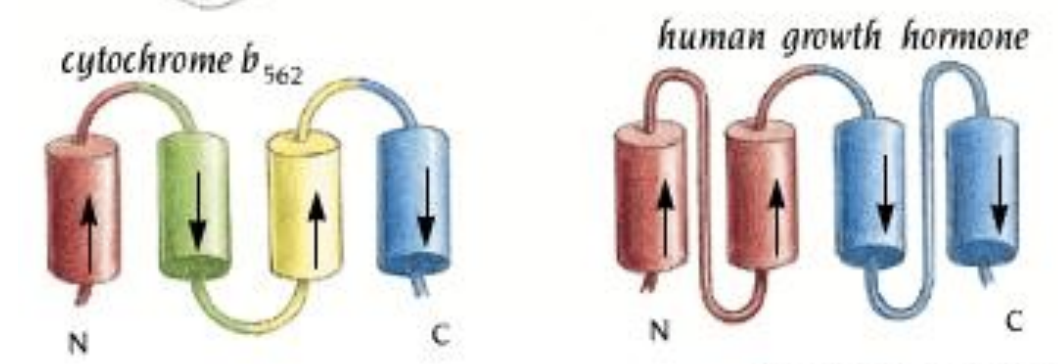
<ul><li><p><strong><u>Four helix bundle</u></strong>: 4 α-helices packed together, can be parallel (cytochrome c) or antiparallel (HGF); highly hydrophobic to stabilise the bundle, using the “ridges-into-groove” model</p></li><li><p><strong><u>Globin fold</u></strong>: 8 α-helices (A-H) arranged in a specific 3D orientation to form a hydrophobic pocket to hold a prosthetic group (like Heme) for active sites. </p><ul><li><p>Example: Myoglobin is one globin fold, whilst Haemoglobin is 4 globin folds</p></li></ul></li></ul><p></p>
2
New cards

Alpha/beta proteins

  • TIM barrel: min. 200 residues, 8 parallel β-strands forma central twisted barrel (core) surrounded by 8 α-helices on the periphery, forming a barrel-like shape; active site is at the C-terminal end of the β-strands (the top of the barrel)

  • Rossman fold: 6 central, twisted β-sheets with α-helices on both sides. Has a “switch point” where the strand order reverses, creating a crevice where the active site is; classic motif for nucleotide binding
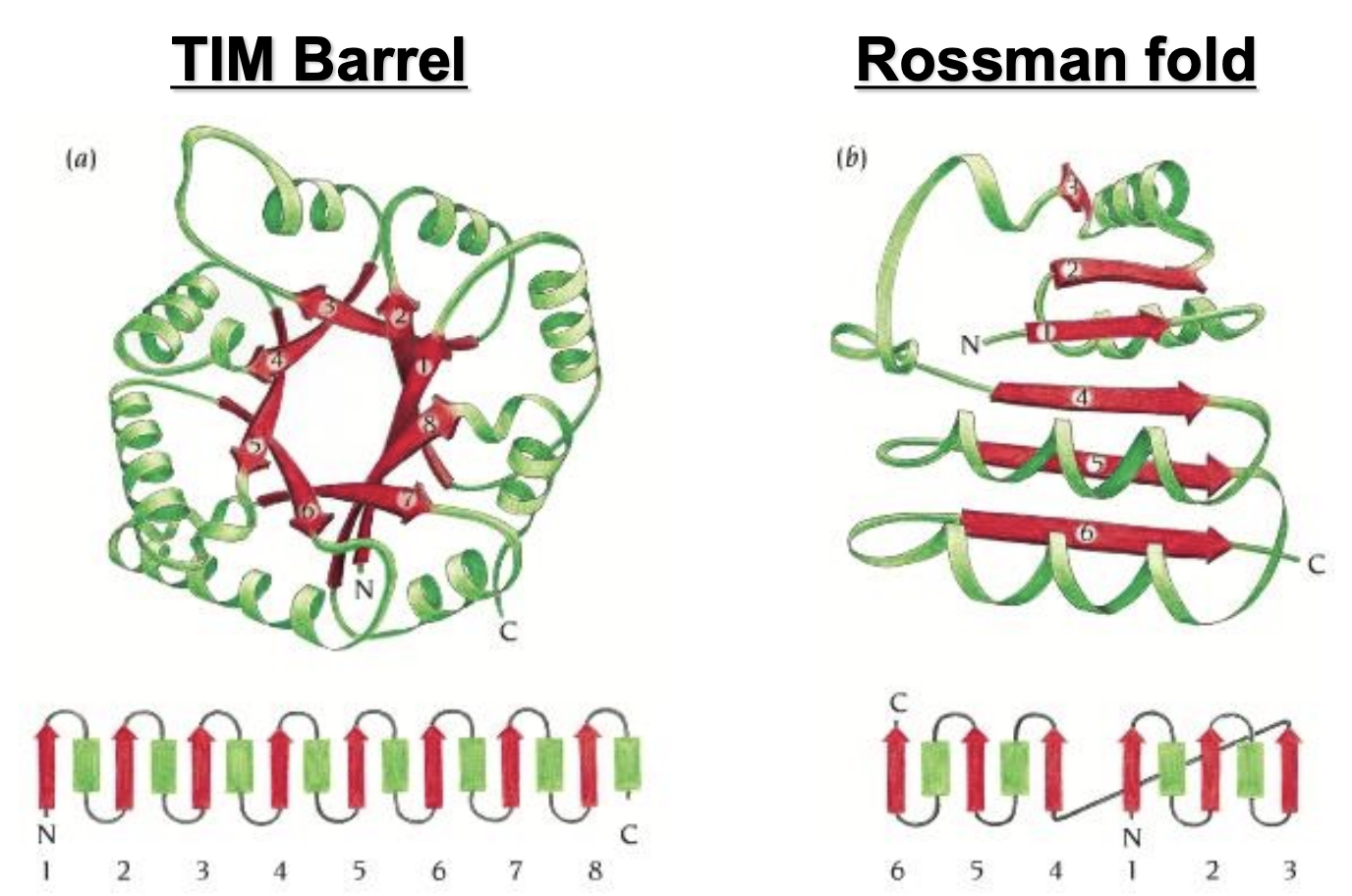
<p></p><ul><li><p><strong><u>TIM barrel</u></strong>: min. 200 residues, 8 parallel β-strands forma central twisted barrel (core) surrounded by 8 α-helices on the periphery, forming a barrel-like shape; active site is at the C-terminal end of the β-strands (the top of the barrel)</p></li><li><p><strong><u>Rossman fold</u></strong>: 6 central, twisted β-sheets with α-helices on both sides. Has a “switch point” where the strand order reverses, creating a crevice where the active site is; classic motif for nucleotide binding </p></li></ul><p></p>
3
New cards

Beta proteins

  • Greek key barrel: strands oriented in a specific “folded over” topology

  • Up-and-down barrel: simple antiparallel strands connected by loops
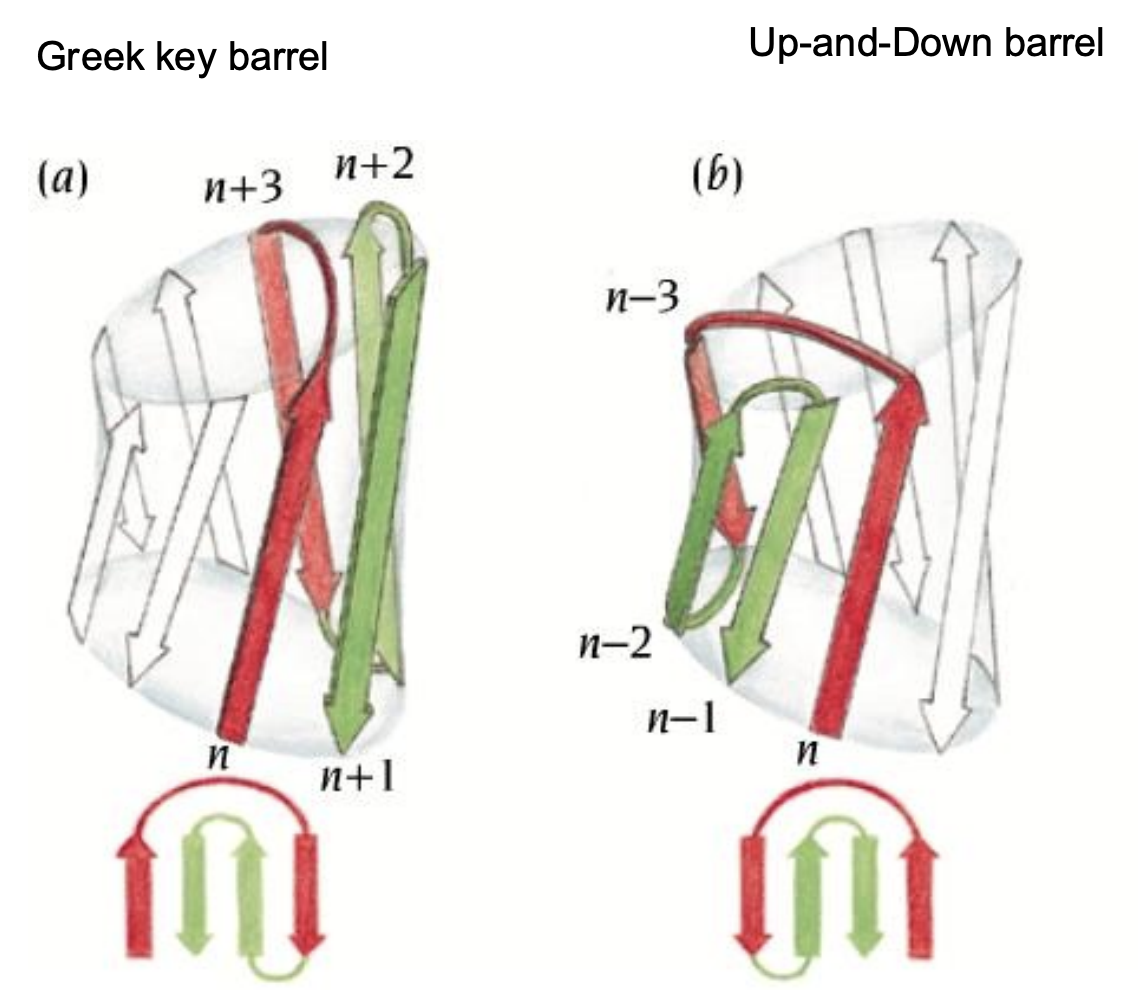
<ul><li><p><strong>Greek key barrel</strong>: strands oriented in a specific “folded over” topology</p></li><li><p><strong>Up-and-down barrel</strong>: simple antiparallel strands connected by loops</p></li></ul><p></p>
4
New cards

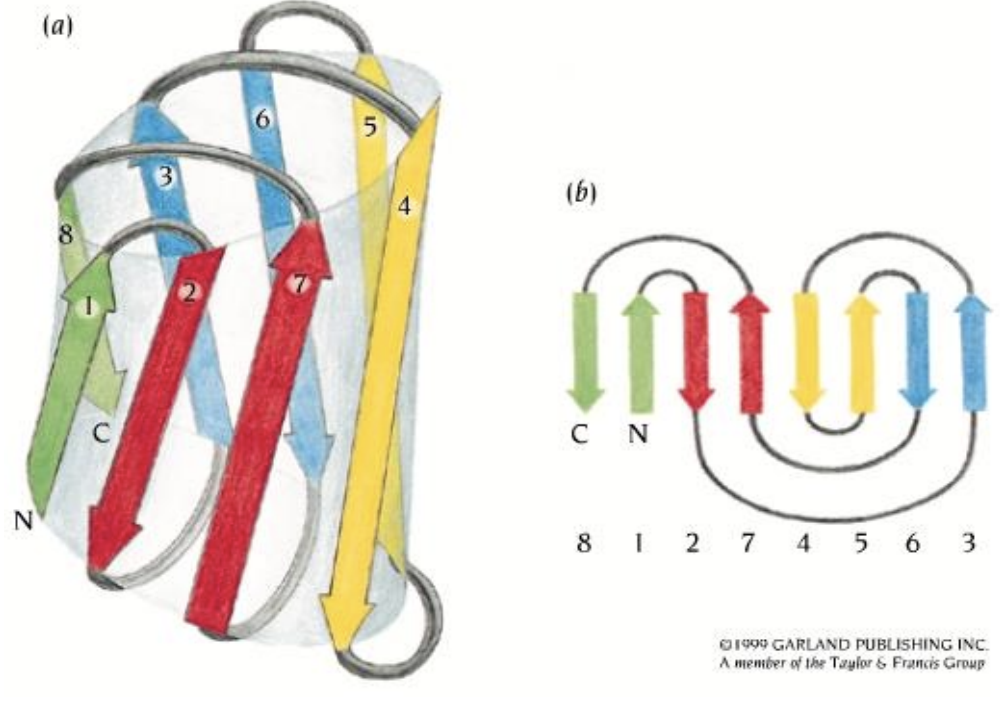
What is the Jelly roll barrel?

A beta protein motif.

  • “Wrapped” version of Greek key, where the N- & C-terminals always end up close
<p>A beta protein motif. </p><ul><li><p>“Wrapped” version of Greek key, where the N- &amp; C-terminals always end up close</p></li></ul><p></p>
5
New cards

What is immunoglobulin fold?

A beta protein motif.

  • Two antiparallel β-sheets packed against each other (like a sandwich); Y-shaped, the loop at the tips are the antigen-binding sites

6
New cards

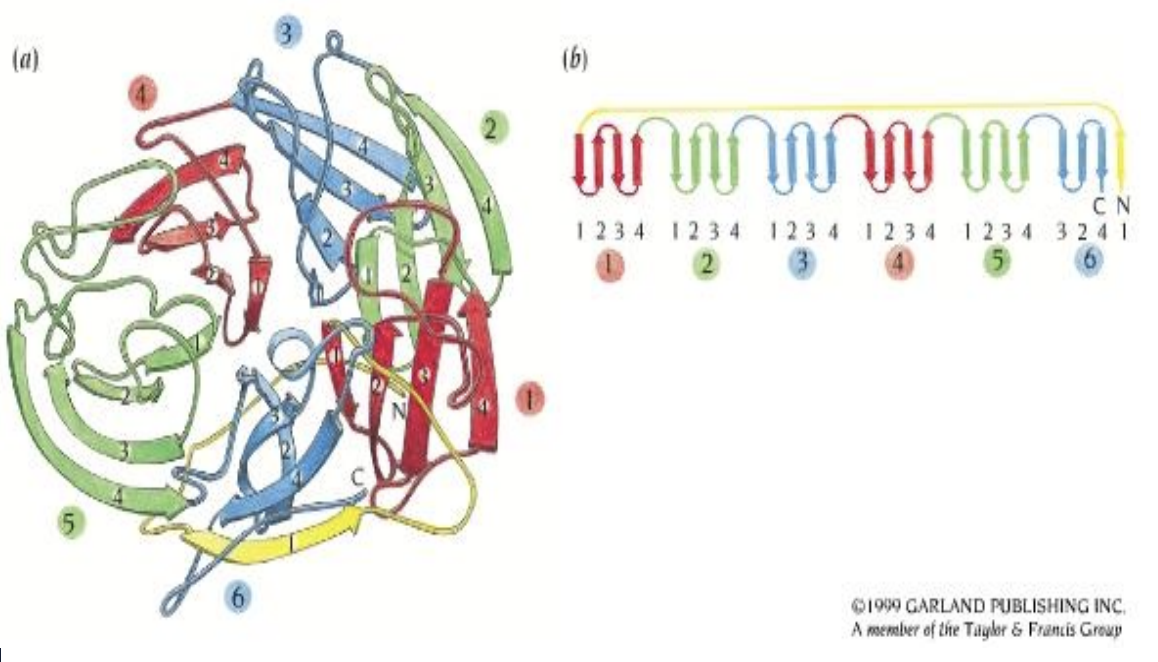
What is β-propeller motif?

A beta protein motif.

  • Sheets arranged like the blades of a fan around a central axis
<p>A beta protein motif.</p><ul><li><p>Sheets arranged like the blades of a fan around a central axis</p></li></ul><p></p>
7
New cards

What is parallel β-helix?

A beta protein motif.

  • Strands wind in a helical fashion to form a triangular prism

  • “Toblerone” motif

<p>A beta protein motif.</p><ul><li><p>Strands wind in a helical fashion to form a triangular prism</p></li><li><p>“Toblerone” motif</p></li></ul><p></p>
8
New cards

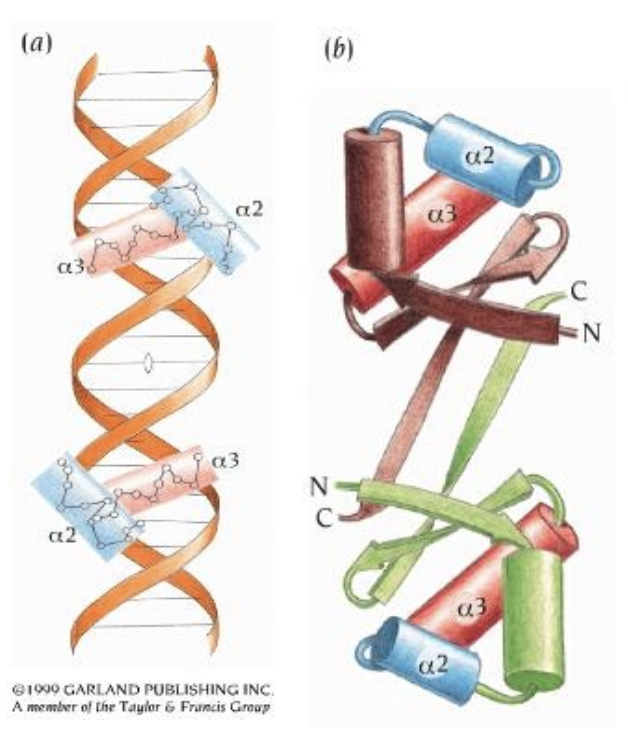
What is a DNA binding protein motif?

Helix-turn-helix

  • Two α-helices connected by a short “turn” of amino acids

  • One of the helices fits into the major groove of the DNA

  • Most DNA-binding proteins function as dimers
<p><strong>Helix-turn-helix</strong></p><ul><li><p>Two α-helices connected by a short “turn” of amino acids</p></li><li><p>One of the helices fits into the major groove of the DNA</p></li><li><p>Most DNA-binding proteins function as dimers</p></li></ul><p></p>