psych 1101 module 41 social influence
 Call Kai
 Learn
Learn Practice Test
 Spaced Repetition
 Match
Match Flashcards
 Knowt Play
1/25

There's no tags or description
Looks like no tags are added yet.
Name | Mastery | Learn | Test | Matching | Spaced | Call with Kai |
|---|
No analytics yet
Send a link to your students to track their progress
26 Terms
norms
understood rules for accepted and expected behavior, prescribe “proper” behavior
conformity
complying with social behavior
social contagion
Behavior is influenced by social contagion. If one of us yawns, laughs, coughs, scratches, stares at the sky, or checks our phone, others in our group will often do the same
Chameleon effect
We human chameleons also take on the emotional tones of those around us—their expressions, postures, inflections—and even their grammar
This natural mimicry enables us to empathize—to feel what others are feeling
Mood linkage > sharing of moods
positive ratings generate more positive ratings—a phenomenon called positive herding
Suggestibility and mimicry can lead to tragedy
conformity
adjusting our behavior or thinking to coincide with a group standard
Asch’s conformity test
Asch found, but they have revealed that we are more likely to conform when we
are made to feel incompetent or insecure.
are in a group with at least three people.
are in a group in which everyone else agrees. (If just one other person disagrees, the odds of our disagreeing greatly increase.)
admire the group’s status and attractiveness.
have not made a prior commitment to any response.
know that others in the group will observe our behavior.
are from a culture that strongly encourages respect for social standards.
Conform to avoid rejection or to gain social approval
normative social influence
influence resulting from a person’s desire to gain approval or avoid disapproval, we need to belong
dynamic norm
to how norms are changing, such as toward eating less meat, consuming less sugary drinks, or supporting gay rights
informative social influence
influence resulting from a person’s willingness to accept others’ opinions about reality
conformity can be bad
leading people to agree with falsehoods or go along with bullying. Or it can be good—leading people to give more generously after observing others’ generosity
lower conformity in
individualist cultures
Milgram’s shock test
When Milgram actually conducted the experiment, he was astonished. More than 60 percent complied fully—right up to the last switch
though perhaps by then the participants had reduced their cognitive dissonance—the discomfort they felt when their actions conflicted with their attitude
Obedience was highest when the person giving the orders was close at hand and was perceived to be a legitimate authority figure, the authority figure was supported by a powerful or prestigious institution, the victim was depersonalized or at a distance, even in another room, and there were no role models for defiance.
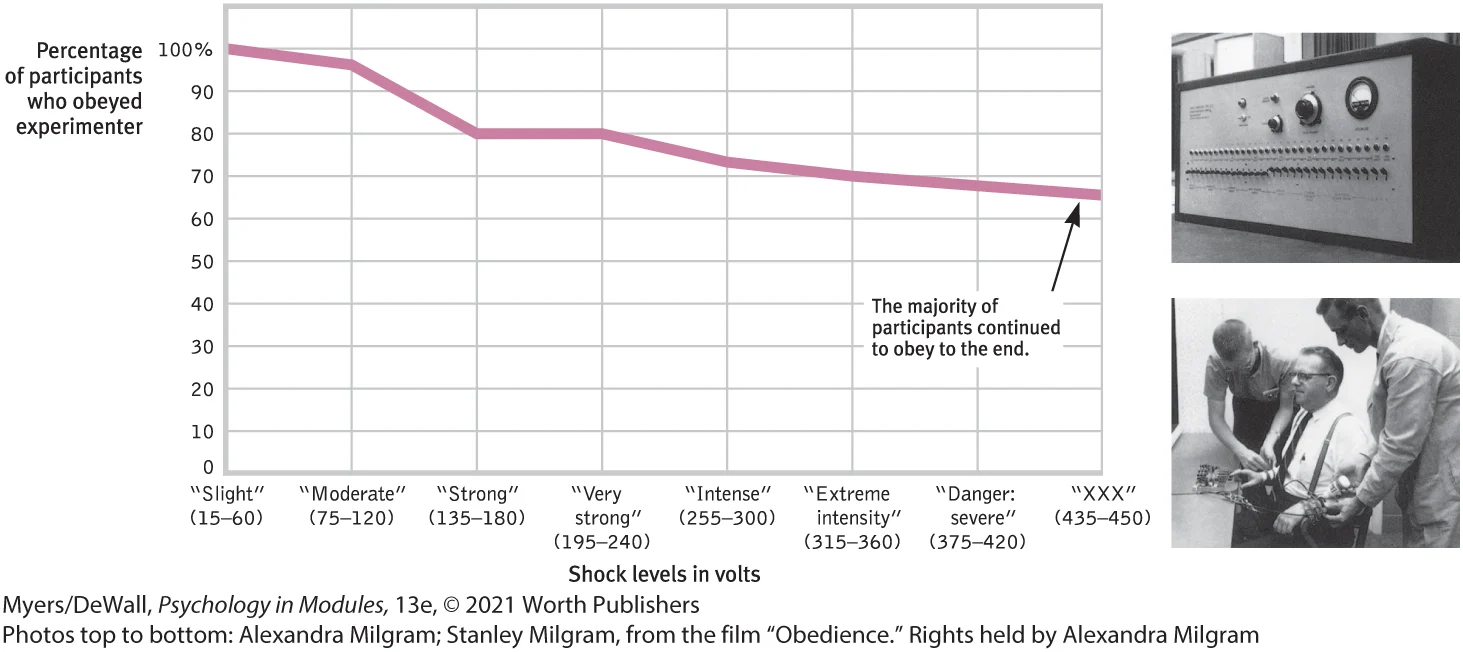
lessons from the conformity and obedience studies
Their moral sense warned them not to harm another, yet it also prompted them to obey the experimenter and to be a good research participant. With kindness and obedience on a collision course, obedience usually won.
Using foot in the door technique to ease in
What have social psychologists learned about the power of the individual? Social control (the power of the situation) and personal control (the power of the individual) interact
The power of one or two individuals to sway majorities is minority influence, influential if you hold position
social facilitation example
The presence of others strengthens our most likely response—the correct one on an easy task, an incorrect one on a difficult task > Because when others observe us, we become aroused, and this arousal amplifies our reaction
Example is home team affect > hat you do well, you are likely to do even better in front of an audience, especially a friendly audience. What you normally find difficult may seem all but impossible when you are being watched.
Crowding triggers arousal > ex comedians
Fish reeling example > reel faster if someone next to you doing task faster
social facilitation
in the presence of others, improved performance on simple or well-learned tasks, and worsened performance on difficult tasks.
social loafing example
Tight rope example > blindfolded students “to pull as hard as [they] can” on a rope. When they fooled the students into believing three others were also pulling behind them, students exerted only 82 percent as much effort as when they knew they were pulling alone
When people act as part of a group they may feel less accountable, view individual contributions as dispensable, overestimate their own contributions, and free ride on others' efforts
social loafing
the tendency for people in a group to exert less effort when pooling their efforts toward attaining a common goal than when individually accountable.
deindividuation
the loss of self-awareness and self-restraint occurring in group situations that foster arousal and anonymity.
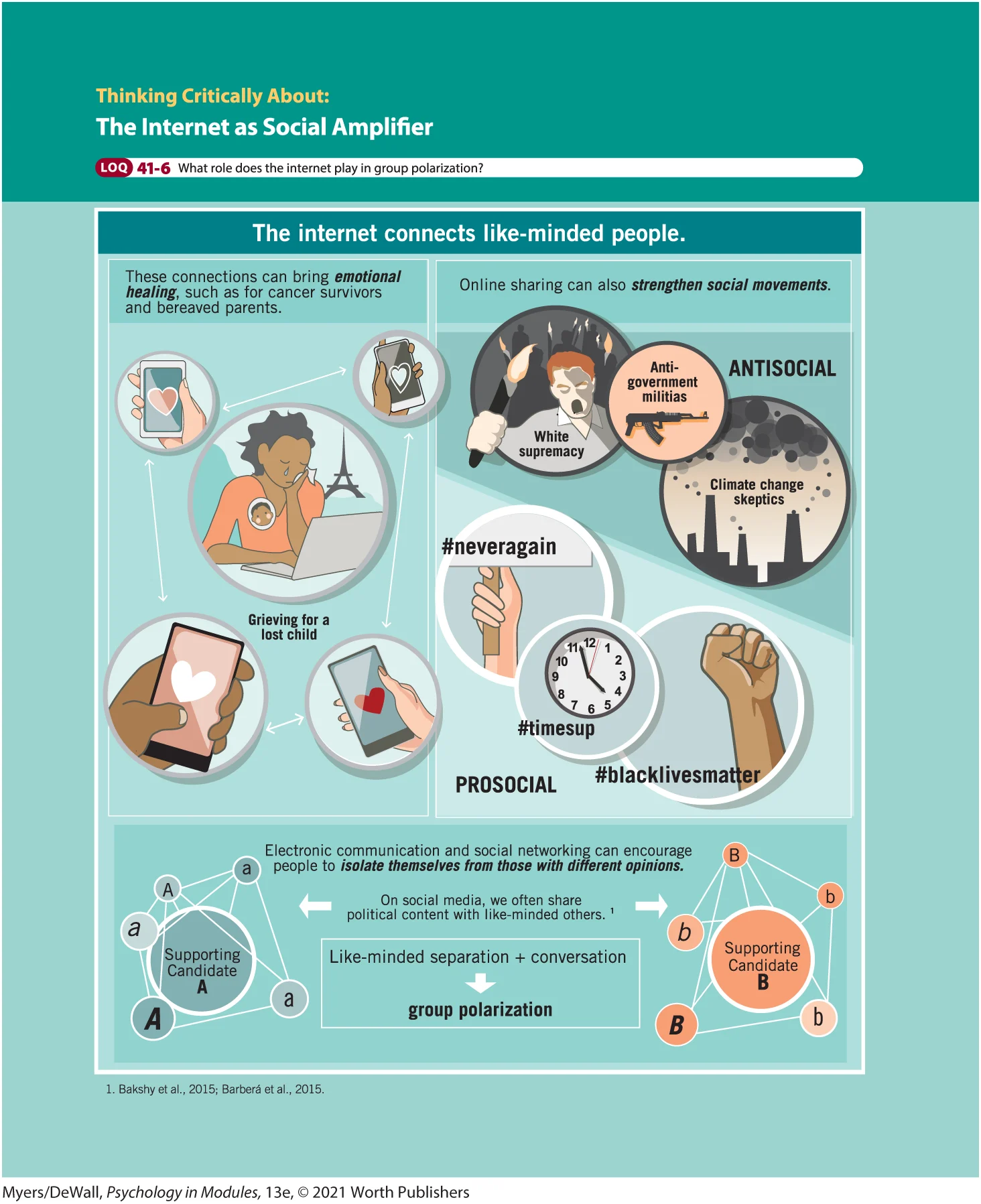
Deindividuation thrives in many settings. Internet anonymity enables people to feed and freely express their anger, sometimes with bullying and hate speech and online trolls
Research also shows that interacting with others can similarly have both bad and good effects.
social facilitation
social context > individual being observed
psychological effect of others’ presence > increased arousal
behavioral effect > amplified dominant behavior, such as doing better what one does well, or doing worse what is difficult
social loafing
social context > group project
psychological effect of others’ presence > diminished feelings of responsibility when not individually accountable
behavior effect > decreased effort
deindividuation
social context > group setting that fosters arousal and anonymity
psychological effect of others’ presence > reduced self awareness
behavioral effect > lowered self restraint
group polarization
the enhancement of a group’s prevailing inclinations through discussion within the group.
A powerful principle helps us understand this increasing polarization:
The beliefs and attitudes we bring to a group grow stronger as we discuss them with like-minded others.
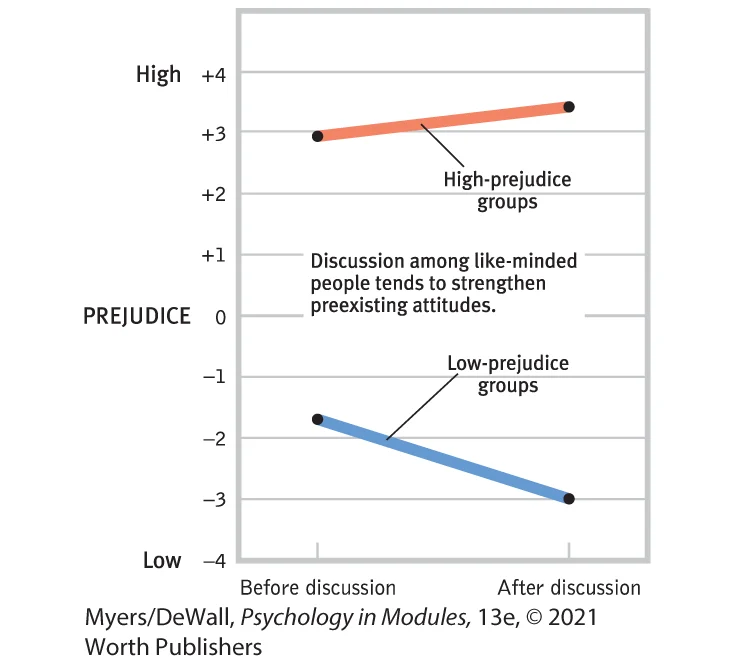
pictures!
Social psychologist Irving Janis (1982) studied the decision-making process leading to the ill-fated invasion. He discovered that
the soaring morale of the recently elected president and his advisers fostered undue confident
groupthink
the mode of thinking that occurs when the desire for harmony in a decision-making group overrides a realistic appraisal of alternatives.
Later studies showed that groupthink
fed by overconfidence, conformity, self-justification, and group polarization—contributed to other fiascos as well
Despite the dangers of groupthink, two heads are often better than one. Great minds often don’t think alike