Ch 7: Physical and Cognitive Development in Early Childhood
 Call Kai
 Learn
Learn Practice Test
 Spaced Repetition
 Match
Match Flashcards
 Knowt Play
1/70

There's no tags or description
Looks like no tags are added yet.
Name | Mastery | Learn | Test | Matching | Spaced | Call with Kai |
|---|
No analytics yet
Send a link to your students to track their progress
71 Terms
height and weight
avg growth is 2.5 inches and 5-10 pounds per year during early childhood
growth patterns vary individually
the two most important contributors:
ethnic origins
nutrition
growth hormone deficiency
absence of growth hormone produced by the pituitary gland to stimulate the body to grow
true or false. the brain reaches 95% of adult volume by 6 years
true. brain growth is slow during early childhood
myelination
nerve cells are covered and insulated w/ a layer of fat cells
this increases speed and efficiency
true or false most preschool children are more active than they will ever be at any later period in the life span
true
Gross motor skills require an effort to stay upright and move around
Simple movements, like hopping, jumping, and running at age 3
Athletic movements at home and school at age 4
Adventurous, hair-raising stunts in gyms and on playground equipment at age 5
fine motor skills
still clumsy at 3 years
improved fine motor coordination at 4 years
body coordination by 5 years
perceptual development
age 4-5: detection of boundaries between letters
by first grade, children can focus the eyes and sustain attention effectively on close-up objects.
recommended sleep
10-13 hours each night without interruption
problems include narcolepsy, insomnia, and nightmares
Sleep problems are linked with negative outcomes:
Attention problems
Worse school readiness profiles
Being overweight
Attention deficit hyperactivity disorder (ADHD)
more daily screen time is associated with a decrease in sleep time.
true or false. eating behaviors are influenced at school.
false. eating behaviors are strongly influenced by caregivers’ behavior
what are categories for obesity, overweight, and at risk for being overweight are determined
body mass index (BMI)
what country has the second highest rate of childhood obesity
USA
Obesity prevention guidelines, daily, for young children:
Five or more servings of fruits and vegetables
Two hours or less of screen time
Minimum of one hour of physical activity
Zero sugar-sweetened beverages
Malnutrition in young children from low-income families:
Eleven million preschool children are experiencing malnutrition
One common nutritional problem is iron deficiency anemia.
In 2019 in the United States, the leading causes of death in young children were
accidents (unintentional injuries)
homicide
congenital malformations
deformations and chromosomal abnormalities
cancer
true or false. children in poverty are not at risk for accidents, death, and asthma.
false. Children in poverty have higher rates of accidents, death, and asthma than do children from higher-income families.
true or false. children exposed to tobacco smoke are more likely to smoke.
false. Children exposed to tobacco smoke in the home are more likely to develop asthma and high blood pressure.
Individual characteristics that enhance a young child’s safety
social skills and emotion regulation
impulse control
use of personal protection
family/home characteristics that enhance a young child’s safety
child management and parenting skills
parent protective behaviors
home safety equipment.
school/peer characteristics that enhance a young child’s safety
home/school partnerships
absence of playground hazards
injury prevention and safety promotion policies/programs
community characteristics that enhance a young child’s safety
positive activities for families
active surveillance of hazards
effective prevention policies
state of illness and health of the world’s children
Devastating effects on the health of young children occur in countries with high poverty rates
A dramatic increase in deaths has resulted from HIV/AIDS, especially in poor countries.
preoperational stage
piaget’s second stage, 2-7 years of age
children represent the world w/ words, images, and drawings
they form stable concepts and begin to reason
children do not yet perform operations; reversible mental actions that allow them to do mentally what they formerly did physically
piaget’s preoperational stage: symbolic function substage
the child gains the ability to mentally represent an object that is not present
between 2 and 4 years of age
children’s thought is still limited by egocentrism and animism
egocentrism: the inability to distinguish between one’s own perspective and someone else’s
animism: the belief that inanimate objects have lifelike qualities and are capable of action
piaget’s preoperational stage: intuitive though substage
children use primitive reasoning and want to know the answers to many questions
4 - 7 years of age
piaget’s preoperational stage: centration and the limits of preoperational thought
centration: a centering of attention on one characteristic to the exclusion of all others
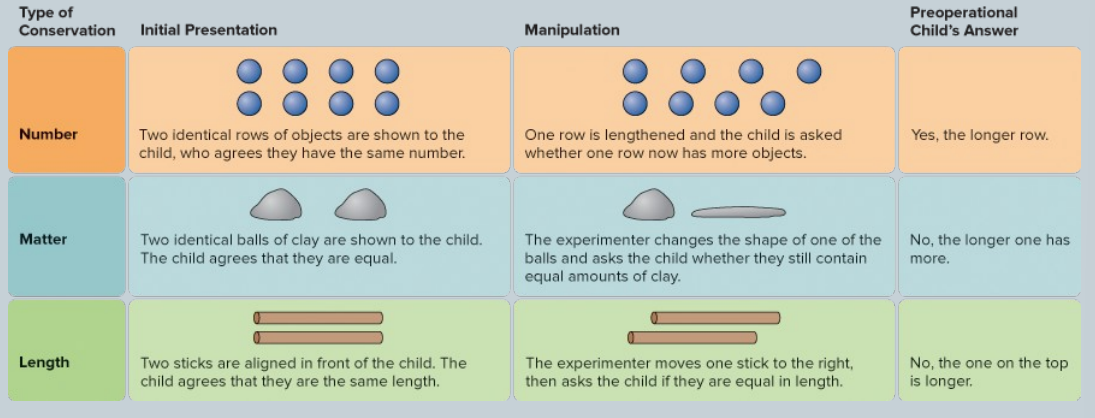
conversation: the awareness that altering an object or substance’s appearance does not change its basic properties
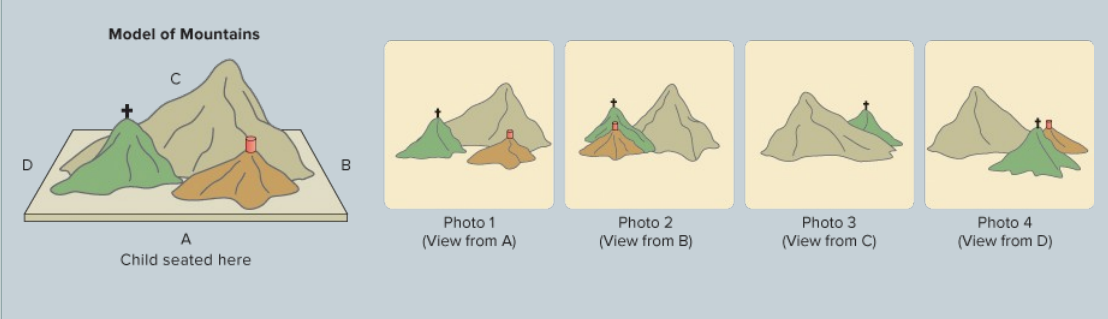
the three mountains task
View 1 shows the child’s perspective from where they are sitting. View 2 is an example of one of the photographs the child would be shown, along with other photographs taken from different perspectives. It shows what the mountains look like to a person sitting at spot B. When asked what a view of the mountains looks like from position B, the preoperational child selects a photograph taken from location A, the child’s view at the time. A child who thinks in a preoperational way cannot take the perspective of a person sitting at another spot.
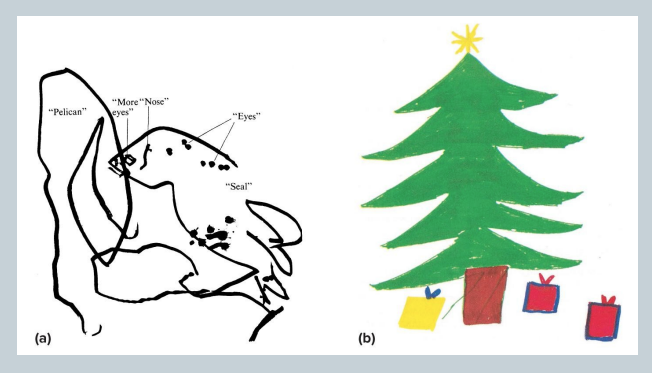
the symbolic drawings of young children
(a) A 3½-year-old's symbolic drawing. Halfway into his drawing, the 3½-year-old artist said it was a “pelican kissing a seal.”
(b) This 11-year-old’s drawing is neater and more realistic but also less inventive.
piaget’s conservation task
The beaker test is a well-known Piagetian test to determine whether a child can think operationally— that is, can mentally reverse actions and show conservation of the substance.
(a) Two identical beakers are presented to the child. Then the experimenter pours the liquid from B into C, which is taller and thinner than A or B.
(b) The child is asked if these beakers (A and C) have the same amount of liquid. The preoperational child says “no.” When asked to point to the beaker that has more liquid, the preoperational child points to the tall, thin beaker.

some dimensions of conservation:
number, matter, and length
vygotsky'‘s theory
children think and understand primarily through social interaction
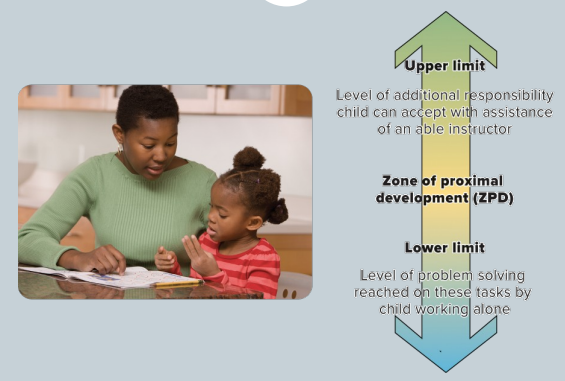
zone of proximal development (ZPD): the range of tasks too difficult for the child alone but that can be learned w/ guidance
linked closely to scaffolding: changing the level of support and instruction provided
as competence increases, less guidance is given
vygotsky’s zone of proximal development
Vygotsky’s zone of proximal development has a lower limit and an upper limit. Tasks in the ZPD are too difficult for the child to perform alone. They require assistance from an adult or a more-skilled child. As children experience the verbal instruction or demonstration, they organize the information in their existing mental structures so that they can eventually perform the skill or task alone.
vygotsky'‘s theory: language and thought
children use speech to communicate socially and to help them solve tasks
young children also use language to plan, guide, and monitor their behavior
private speech refers to this use of language for self-regulation
when they gain the skill to act w/o verbalizing, they have internalized their egocentric speech in the form of inner speech
private speech plays a positive role in development
vygotsky'‘s theory: teaching strategies
assess the child’s ZPD
Use the child’s ZPD in teaching
Use more-skilled peers as teachers
Place instruction in a meaningful context
Transform the classroom with Vygotskian ideas
evaluating vygtosky’s theory
takes a social constructivist approach: an approach that emphasizes the social contexts of learning and asserts that knowledge is mutually built and constructed
criticisms:
not specific enough about age-related changes
does not adequately describe how changes in socioemotional capabilities contribute to cognitive development
overemphasized the role of language in thinking
vygotsky’s theory vs paiget’s theories
attention
The ability to focus mental resources on select information improves significantly in the preschool years
executive attention
a good predictor or self-regulation, involves:
action planning
allocating attention to goals
error detection and compensation
monitoring progress on tasks
dealing with novel or difficult circumstances.
sustained attention
focused and extended engagement with an object, task, event, or other aspect of the environment
also called vigilance
attention is still deficient in at least two ways
salient versus relevant dimensions
planfulness
children are better able to understand their environment, they can sustain attention for longer periods
advances in comprehension and language development are particularly significant
memory
The retention of information over time is central to cognitive development
short-term memory
individuals can retain information up to 30 seconds with no rehearsal
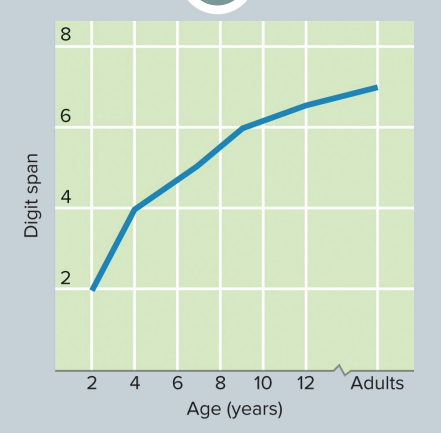
The memory-span task assesses short-term memory using a short list of stimuli—usually digits—presented at a rapid pace, after which subjects are asked to repeat the list
Short-term memory increases during early childhood
development changes in memory span
In one study, from 2 to 7 years of age children’s memory span increased from two digits to five digits (Dempster, 1981). Between 7 and 13 years of age, memory span had increased on average only another two digits to seven digits.
How accurate are young children’s long-term memories?
there are age differences in children’s susceptibility to suggestion
There are individual differences in susceptibility
Interviewing techniques can produce substantial distortions in children’s reports about highly salient events.
The accuracy of eyewitness testimony is dependent on type, number, and intensity of the suggestive techniques experienced.
autobiographical memory
Autobiographical memory involves memory of significant events and experiences in one’s life
In some areas (remembering a story, a song, or interesting event or experience), young children have been shown to have reasonably good memories
executive function
consists of higher-level cognitive processes linked to the development of the brain’s prefrontal cortex.
in early childhood, involves developmental advances in:
cognitive inhibition
cognitive flexibility
goal setting
delay of gratification
Mischel and colleagues’ studies using the “marshmallow experiment” linked delay of gratification in preschool with later academic success, coping, and competence
theory of mind
awareness of one’s own mental processes and the mental process of others
from 18 months to 3 years, children begin to understand three mental states
perceptions
emotions
desires
from 3-5 years, they come to understand false beliefs
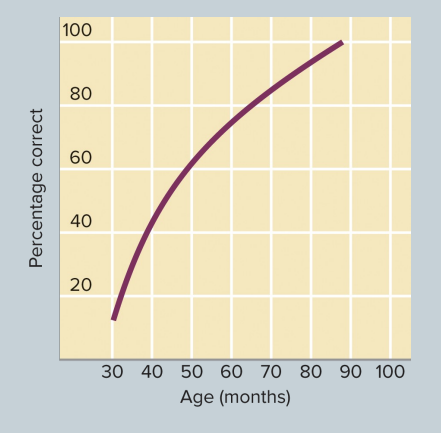
developmental changes in false-belief performance
the child’s understanding that a person may have a false belief that contradicts reality—dramatically increases.
from 2 ½ years of age through the middle of the elementary school years. In a summary of the results of many studies, 2 ½ year-olds gave incorrect responses about 80 percent of the time (Wellman, Cross, & Watson, 2001). At 3 years, 8 months, they were correct about 50 percent of the time, and after that, they gave increasingly correct responses.
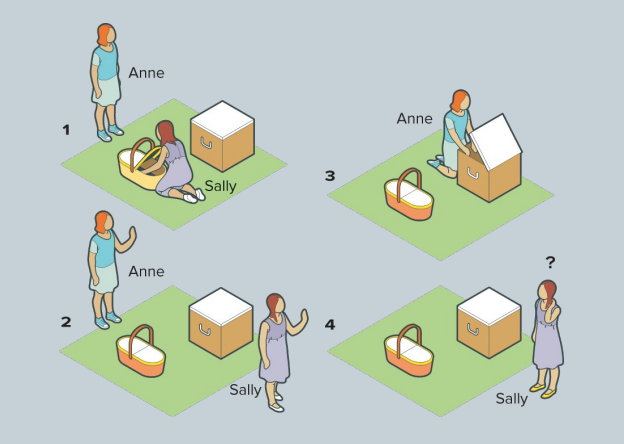
the sally and anne false-belief task
In the false-belief task, the skit above in which Sally has a basket and Anne has a box is shown to children. Sally places a toy in her basket and then leaves. While Sally is gone and can’t watch, Anne removes the toy from Sally’s basket and places it in her box. Sally then comes back, and the children are asked where they think Sally will look for her toy. Children are said to “pass” the false-belief task if they understand that Sally looks in her basket first before realizing the toy isn’t there.
At 5 to 7 years, children develop a deepening appreciation of the mind itself rather than just mental states
They can see the mind as an active constructor of knowledge
They realize the same event can be open to multiple interpretations.
Individual differences and factors that influence theory of mind:
Executive function and prefrontal cortex functioning
Language development
Socioeconomic status
children w/ autism have difficulty developing a theory of mind
ambiguous line drawing
In one study, children saw an ambiguous line drawing—a drawing that could be seen as either a duck or a rabbit. One puppet told the child she believed the drawing was a duck, while another puppet told the child he believed the drawing was a rabbit. Before the age of 7, children said that there was one right answer and that it was not okay for the two puppets to have different opinions

During the preschool years, most children become:
sensitive to the sounds of spoken words
capable of producing all the sounds of their language.
As they move beyond two-word utterances, they demonstrate a knowledge of morphology rules
plural and possessive forms of nouns
appropriate verb endings
prepositions, articles, and forms of to be
stimuli in berko’s study of young children’s understanding of morphological rules
In Jean Berko’s (19 58) study, young children were presented cards, such as this one with a “wug” on it. Then the children were asked to supply the missing word; in supplying the missing word, they had to say it correctly, too. “Wugs” is the correct response here. Berko, J. (19 58). The child’s learning of English morphology. Word, 14, 154. Copyright 19 58 by Jean Berko Gleason. All rights reserved. Used with permission.

fast mapping
a process in which young children learn the connection between a word and its referent quickly, only after limited exposure
Six key principles describe young children’s vocabulary development:
Children learn the words they hear most often
Children learn words for things and events that interest them
Children learn words better in responsive and interactive contexts than in passive contexts
Children learn words best in contexts that are meaningful
Children learn words best when they access clear information about word meaning
Children learn words best when grammar and vocabulary are considered
advancdes in pragmatics
Children learn culturally specific rules of conversation and adapt their speech in different settings
As they get older, they become increasingly able to talk about things that are not here and not now
Around 4 to 5 years of age, they learn to change their speech style to suit the situation
Early precursors of literacy and academic success include:
language skills
phonological and syntactic knowledge
letter identification
conceptual knowledge of print conventions and functions.
Strategies for using books:
Use books to initiate conversation
Use what and why questions
Encourage children to ask questions about stories
Choose some books that play with language
child-centered kindergarten
emphasizes education of the whole child and concern for their physical, cognitive, and socioemotional development
Experimenting, exploring, discovering, trying out, restructuring, speaking, and listening
montessori approach
children are given freedom and spontaneity in choosing activities
Fosters independence and cognitive skills
Critics suggest it deemphasizes verbal interaction, restricts imaginative play, and may not allow for creativity and for a variety of learning styles
developmentally appropriate practice (DAP): focuses on the typical developmental patterns of children and the uniqueness of each child
age appropriateness and individual appropriateness
the emphasis is on the process of learning
generalizing about DAP is challenging b/c it is an evolving concept, and individual programs vary
recent changes give more attention to sociocultural factors, the teacher’s involvement, and to what degree academic skills should be emphasized.
project head start
a compensatory program designed to provide children from low-income families the opportunity to acquire the skills and experiences important for success in school
not all created equal
improved parenting engagement and skills are linked to children’s success
Evaluations support the positive influence of quality early childhood programs
In terms of both the cognitive and social worlds of disadvantaged young children
curriculum controversy
academic approaches pressure young children to achieve, don’t provide chances to actively construct knowledge, and don’t focus on cognitive and socioemotional development.
universal preschool education
Critics of the idea argue, it is more important to improve preschool education for disadvantaged children