Lec 8: Tertiary Structure, Protein Folding, Quaternary Structure
 Call Kai
 Learn
Learn Practice Test
 Spaced Repetition
 Match
Match Flashcards
 Knowt Play
1/3

There's no tags or description
Looks like no tags are added yet.
Name | Mastery | Learn | Test | Matching | Spaced | Call with Kai |
|---|
No analytics yet
Send a link to your students to track their progress
4 Terms
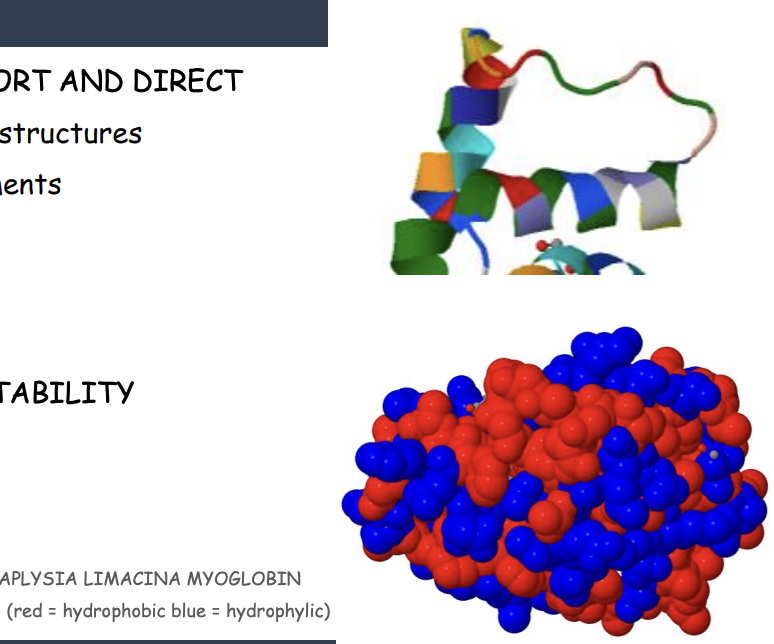
Tertiary Structure
DEFINITION: The complete three-dimensional arrangement of all atoms in a single polypeptide chain
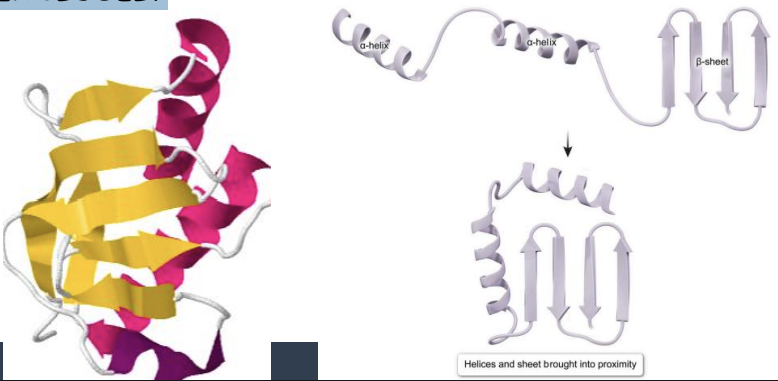
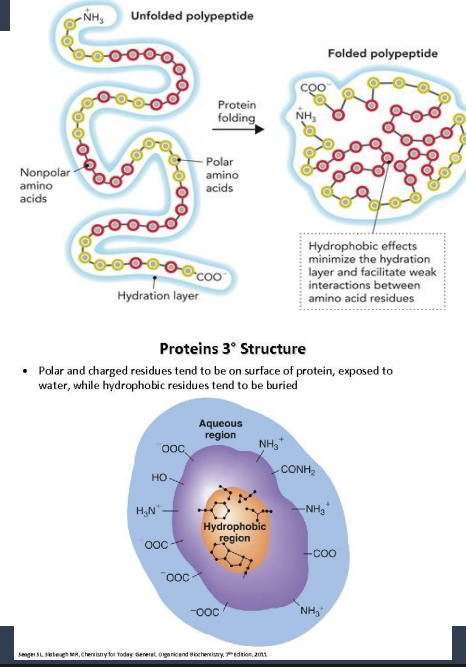
5 Key Features of tertiary structure
1. HELICES AND SHEETS PACK TOGETHER CLOSELY
Minimize empty space
Maximize van der Waals contacts
2. CONNECTING SEGMENTS ARE SHORT AND DIRECT
Loops and turns connect secondary structures
Minimize chain length between elements
3. PROTEINS FOLD TO MAXIMIZE STABILITY
Driven by thermodynamics
Native state is the energy minimum
4. HYDROPHOBIC RESIDUES BURIED IN CORE
Nonpolar side chains cluster inside
Drives the hydrophobic effect
5. HYDROPHILIC RESIDUES ON SURFACE
Polar and charged groups face solvent
Enable solubility and interactions
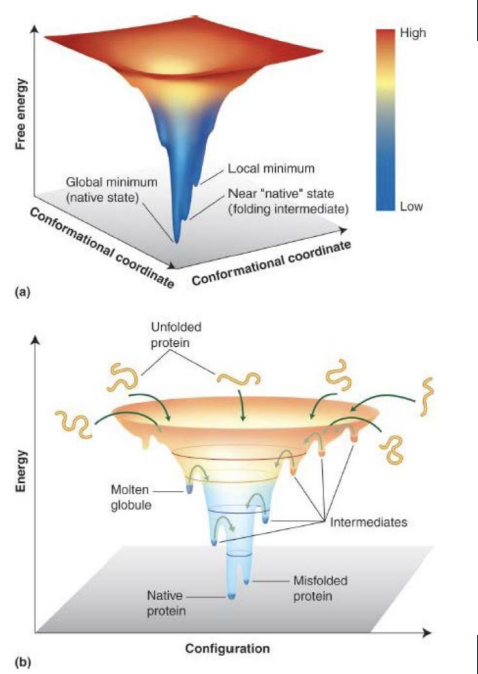
The Thermodynamics of Protein Folding
describe: unfolded state, folded state, folding funnel and Net ΔG (what does it allow)
high or low entropy, shape?
UNFOLDED STATE:
High entropy (many conformations); High energy; Exposed hydrophobic residues
FOLDED STATE:
Low entropy (single conformation); Lower energy; Buried hydrophobic residues
THE FOLDING FUNNEL:
Wide at top: many unfolded conformations
Narrow at bottom: single native state
Proteins "roll downhill" to native state
NET ΔG: -20 to -40 kJ/mol -> Small but significant; Allows flexibility and regulation
hi