1.5 Population Size and Ecosystems
 Call Kai
 Learn
Learn Practice Test
 Spaced Repetition
 Match
Match Flashcards
 Knowt Play
1/59

There's no tags or description
Looks like no tags are added yet.
Name | Mastery | Learn | Test | Matching | Spaced | Call with Kai |
|---|
No analytics yet
Send a link to your students to track their progress
60 Terms
Animal population growth curve
LAG
period of adaptation to the environment, few animals are initially present so growth is slow.
EXPONENTIAL
population doubles per unit time as resources are plentiful and no limiting factors
STATIONARY
population growth slows due to competition
reproduction rate = death rate
carrying capacity is reached
(DEATH)
death rate > birth rate
occurs due to a population crash (plants eaten)
natural disaster or new disease
Bacterial/Yeast population growth curve
LAG
rate of cell division is slow so population growth is slow
enzymes are being synthesised
EXPONENTIAL
population doubles in a unit time
cells divide at their maximum rate (binary fission/budding)
no limiting factors
STATIONARY
cells dying at the same rate as they are being produced
limiting factors - nutrients running out
DEATH
cell death > rate of cell production
build up of toxic waste (ethanol - yeast, lactic acid - bacteria)
What is INTRAspecific competition?
Competition within the SAME species. Limits population size and is important in natural selection
What is INTERspecific competition?
Competition between individuals of DIFFERENT species. Two species cannot occupy the same niche in a specific habitat. The more the niche overlaps, the more competition there is.
What do plants compete for?
light
water
mineral ions
space
What do animals compete for?
food and water
shelter
space
reproductive partners
What is the definition of carrying capacity?
The maximum population size that can be sustained over a period of time in a particular habitat.
What is the definition of environmental resistance?
Factors which slow down population growth.
What factors contribute to environmental resistance?
BACTERIAL CULTURE
nutrients - glucose/C source
space
pH
build up of toxic waste
ANIMAL/PLANTS
biotic factors —>
predators
intraspecific competition
parasitism/disease
abiotic factors —>
light intensity
temperature
water
minerals
accumulation of toxic waste
What is the definition of a density dependent factor and what are examples?
Density dependent factor — BIOTIC
A biotic factor is LIVING
disease/parasitism
accumulation of toxic waste
food availability
predation
availability of territory/shelter
What is the definition of a density independent factor and what are examples?
Density independent factor — ABIOTIC
An abiotic factor is NON-LIVING
soil pH
light availability
mineral availability
temperature
water
What is photosynthetic efficiency (PE)?
Definition, unit, equation and value.
PE is a measure of how well a plant is able to capture light energy.
Unit: %
Value: 1-2%
Equation: GPP ÷ quantity of light energy falling on the plant x 100
What is gross primary productivity (GPP)?
Definition, unit, equation and value.
GPP is the rate of production of chemical energy by photosynthesis in a given area in a specific time period.
Unit: KJ m-2 year-1
Value: 0.2% of energy from sun hitting earth
Equation: NPP + respiration
What is net primary productivity (NPP)?
Definition, unit, equation and value.
NPP represents the potential food available to primary consumers.
Unit: KJ m-2 year-1
Value: 0.1% of energy from sun hitting earth
Equation: GPP - respiration
What is primary productivity?
GPP
What is secondary productivity?
The rate at which consumers accumulate energy in their cells or tissues.
Why is energy transfer between plants and herbivores very inefficient?
Cellulose is difficult to digest.
More energy is left in herbivore faeces than in carnivore.
Lots of energy is used during the digestive process.
Why is energy transfer between herbivores and carnivores more efficient?
Because they are able to digest their high protein diets more easily.
10% of the energy ends up as herbivore biomass
20% of the energy can be transferred from herbivore to carnivore
Photoautotroph definition
Uses light energy to make complex organic molecules.
Chemoautotroph definition
Uses chemical energy to make complex organic molecule
What do the arrows in a food chain show?
The direction of energy flow.
What happens to energy in the food chain?
energy used in respiration, egestion, excretion. not all will pass to the next trophic level
not all tissue is eaten
energy required for:
active transport
muscle contraction
cell division
maintaining body temperature
What is the definition of succession?
The change in structure and composition of species in a community over time.
What is primary succession?
Succession that occurs in a habitat that has never been colonised before. (bare rock, volcanic soil)
Pioneer species stage of succession.
first plants to colonise a new habitat, highly adapted to very harsh conditions (extremeophiles)
LICHENS - slow growing symbiotic relationship between fungi and algae able to tolerate total desiccation and low nutrients
algae photosynthesise
fungal hyphae grip rock and trap soil fragments
MOSS - able to root into the first soil formed by decomposing lichen and total desiccation, could not survive on bare rock alone
Grassland community stage of succession.
decomposing moss and lichen establish soil sufficient for the roots of herbaceous plants
seeds are blown by the wind into the habitat, establishing grassland
Shrub stage of succession
heather, perennial
they outcompete the grasses by blocking sunlight from reaching them
Climax community stage of succession
forest dominated by trees, wild variety of plants and animals
the final stage of succession where the species composition is relatively stable.
the community reaches EQUILIBRIUM
Changes noticeable over time during primary succession
1) SOIL
increase in depth
increase in minerals (nitrates + phosphates)
Humus - increase in water content
2) increase in BIODIVERSITY
increase in no. of different species
increase in niches
increase in food and shelter
3) increase in BIOMASS
4) increase in STABILITY
What is secondary succession?
Repopulation of an area that has been previously colonised due to the habitat being disturbed or damage.
Happens in less time than primary succession:
Soil, seeds/roots, humus ALREADY PRESENT
Why is secondary succession a lot faster than primary succession?
already an existing seed bank in the soil
root systems, stumps and other plant parts can rapidly regenerate
fertility + structure of soil has been modified which makes it more suitable for growth and colonisation
Which factors affect secondary succession?
MIGRATION
vital
arrival of spores, seeds and animals
INTERSPECIFIC COMPETITION
occurs at all stages
how they progress
FACILITATION
invasion of later species depends on conditions created by earlier colonists
increases competitive ability of species which are then able to displace them.
What are pyramids of NUMBER?
The number of organisms at each trophic level shown as a graph with each level forming a horizontal bar over the previous one.
What are pyramids of BIOMASS?
Created to overcome the problem of inverted pyramids of number.
Biomass is used at each trophic level instead (Kg/m2)
DRY MASS is used (dehydrated in oven until no change in mass)
UNETHICAL —> kills organisms
May also be inverted due to differences in PRODUCTIVITY
How are minerals released from dead organisms to be used again?
Detritivores and decomposers break down the remains and waste products of organisms and the minerals return to the soil for plants to take up again.
Saprotrophs feed by secreting enzymes onto matter to digest it, freeing some enzymes in the process.
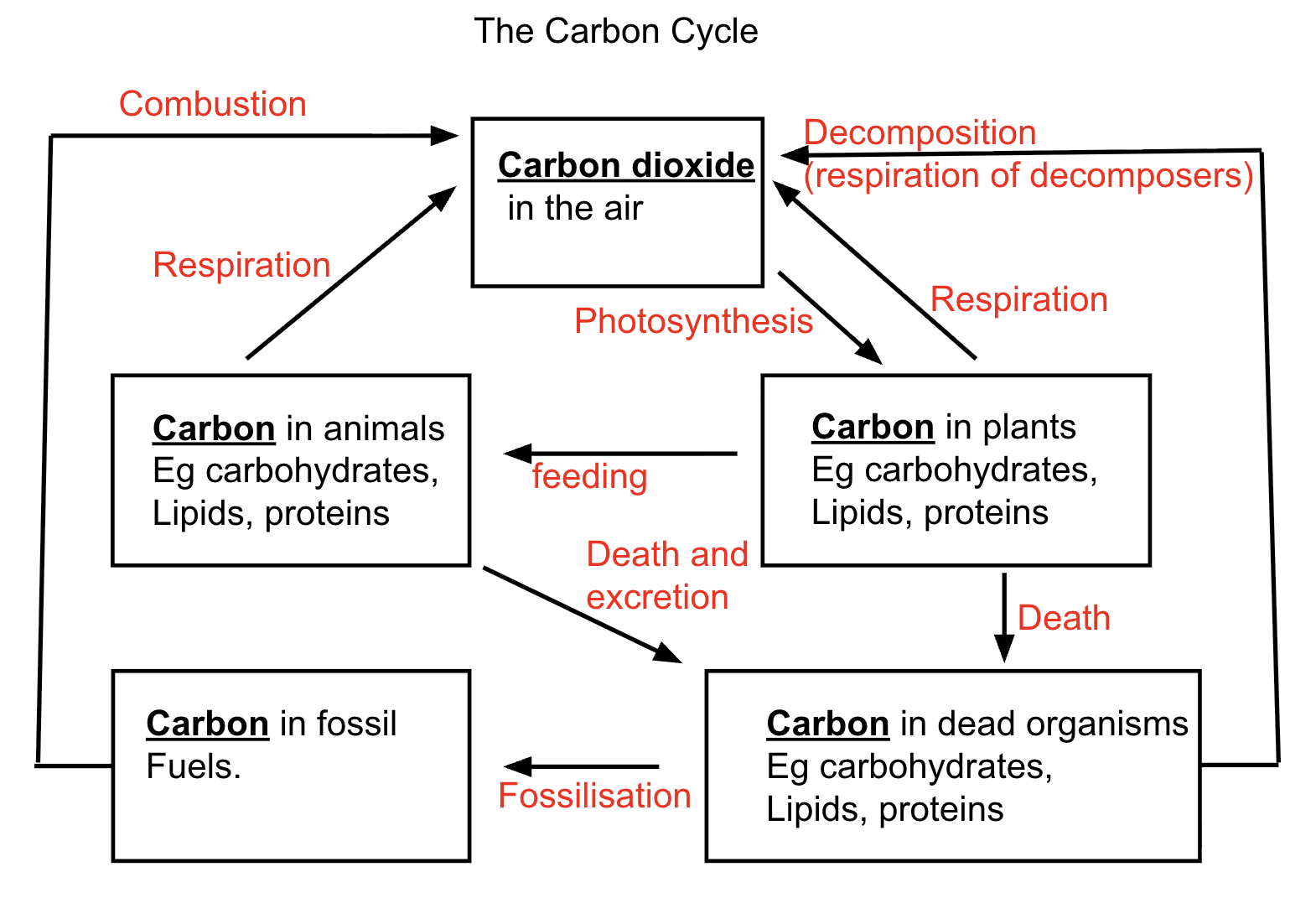
What are the 5 key processes in the carbon cycle?
Photosynthesis (from atmosphere and stores in oceans0
Respiration (co2 returned to carbon stores in air and oceans)
Decomposition (co2 released from dead organisms
Fossilisation (formation of fossil fuels from dead organisms (NOT DECAYED) and formation of limestone from skeletons)
Combustion
Draw the carbon cycle
What is the process of the greenhouse effect?
UV radiation from the sun reaches Earth, not all of this reaches as some is reflected back to space
Radiation that reaches the surface is absorbed and re-emitted as IR
This radiation is absorbed by greenhouse gases and warms the Earth.
A rise in co2 has caused an increase in this effect
Causes of the greenhouse effect
burning of fossil fuels
deforestation
methane increase (rice crops, cattle, rotting material in landfill sites)
CFCs more active as a greenhouse gas
Consequences of the greenhouse effect
melting of polar icecaps and thermal expansion of water, leading to flooding and coastal erosion
increased frequency of natural disaster climates
climate change having serious effects on food production
habitat changes
What is a carbon footprint and where can they be from?
A carbon footprint is the total amount of carbon dioxide attributable to the actions of an individual in the course of one year.
DIRECT emission → home and transport
INDIRECT emission → goods and services consumed
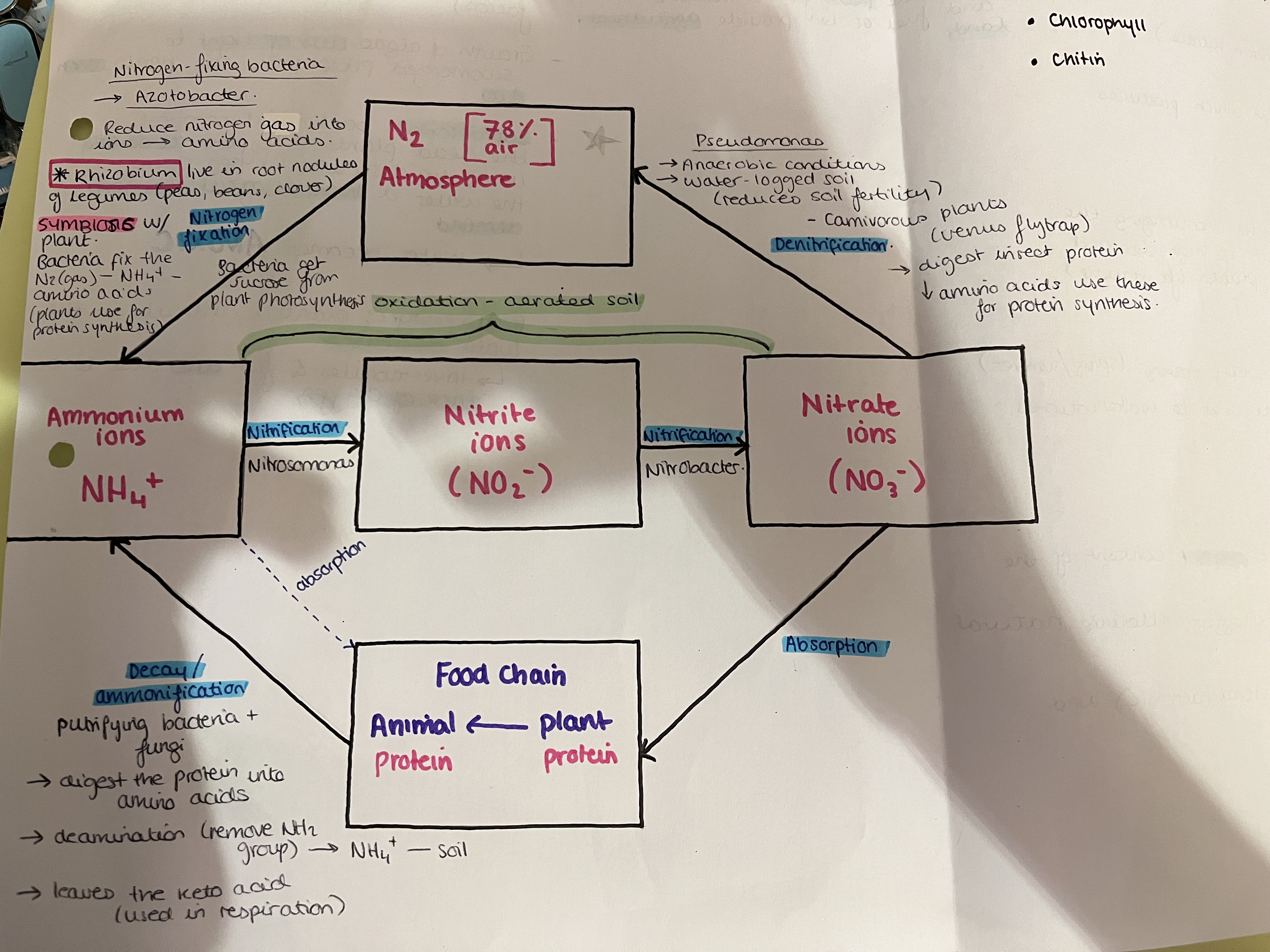
Draw the nitrogen cycle
What is the main principle of the nitrogen cycle?
Shows the flow of organic and inorganic nitrogen within an ecosystem. Nitrogen is converted between nitrogenous compounds and atmospheric nitrogen.
What are the 4 processes in the N cycle?
Nitrogen fixation
Ammonification
Nitrification
De-nitrification
What is nitrogen fixation?
The process that converts atmospheric nitrogen gas into compounds e.g. ammonium/nitrates by combining the nitrogen with hydrogen or oxygen
ACHIEVED BY:
lightning
Haber process
Nitrogen fixing bacteria
How does nitrogen fixation occur via lightning?
enormous energy of lightning breaks N2 apart and enables the nitrogen atoms to combine with oxygen, forming nitrogen oxides.
These dissolve in rain water, forming nitrate ions
How does nitrogen fixation occur via the Haber process?
Under high pressure and temperature, with the use of a catalyst, atmospheric nitrogen and hydrogen are combined to form ammonia or ammonium ions
How does nitrogen fixation occur via bacteria? (AZOTOBACTER)
Free living bacteria in the soil (azotobacter)
Convert nitrogen gas from soil air spaces into ammonium using nitrogenase
Nitrogen gas is reduced to ammonium ions, bacteria use these to make amino acids, but release excess into the soil.
SOME plants can absorb these
Why is there a problem with azotobacter?
They require aerobic conditions for respiration but N fixing is reduction which oxygen inhibits
however, these bacteria have very fast metabolic rates so use up O2 quickly so nitrogenase isn’t inhibited
How does nitrogen fixation occur via N fixing bacteria (rhizobium)
these have a symbiotic relationship with leguminous plants as they live in root nodules
inside the nodules, these bacteria also reduce nitrogen gas to ammonium ions using the enzyme nitrogenase
How do both organisms benefit from rhizobium?
bacteria makes ammonium ions, which are then combined with keto acids (carbs provided by host plants) to make their own amino acids
any excess ammonium ions made by the bacteria enter the phloem of the plant and are used to make amino acids
Why are root nodules of legumes pink? Why is this needed?
Due to the presence of leg-haemoglobin
the leg-haemoglobin has a high affinity for oxygen, so binds to it and keeps the o2 pp low inside the root nodules
the bacteria carry out aerobic respiration but the oxygen would inhibit nitrogen fixation (reduction)
What is the process of ammonification?
Bacteria and fungi secrete protease which hydrolyse proteins in dead and decaying organic matter to amino acids.
They also secrete deaminase, which deaminate the amino acids to produce ammonia. These are then reduced to ammonium ions.
What is the process of nitrification?
Carried out by nitrifying bacteria.
Ammonium ions are converted to nitrite ions by nitrosomonas
Nitrite ions are converted to nitrate ions by nitrobacter (oxidation)
What is the process of denitrification?
Nitrates are lost from ecosystems and converted back to nitrogen gas by denitrifying bacteria such as pseudomonas (reduction)
bad in farming as they are anaerobic so are a particular problem in waterlogged soil which lack oxygen
Why do plants/animals need nitrogen?
amino acid synthesis
nucleotide synthesis (DNA/RNA, ATP)
Chlorophyll
Chitin
Human negative impact on the nitrogen cycle
organic + inorganic fertilisers can lead to eutrophication
adding fertilisers reduces biodiversity
Bogs destroyed to provide peat
Human positive impact on nitrogen cycle
Improve nitrogen circulation:
draining land to reduce anaerobic conditions (installing drainage systems to reduce waterlogging)
planting fields of legumes to encourage nitrogen fixation
ploughing fields to improve soil aeration and encourage aerobic conditions
Why is eutrophication bad?
nitrates in fertilisers are leached out into waterbodies due to rain
causes algal bloom
algae growth cuts off light to submerged photosynthesising plants which die
saprotrophic bacteria decompose the dead plants and respire aerobically
this gives water a high biological oxygen demand and it becomes ANOXIC
biodiversity of plants and animals decreases in water
they die due to lack of o2
How to calculate degrees of freedom?
N1 + N2 - 2