Lecture 13: Germ Cells, Meiosis, and Fertilization
 Call Kai
 Learn
Learn Practice Test
 Spaced Repetition
 Match
Match Flashcards
 Knowt Play
1/56

There's no tags or description
Looks like no tags are added yet.
Name | Mastery | Learn | Test | Matching | Spaced | Call with Kai |
|---|
No analytics yet
Send a link to your students to track their progress
57 Terms
terminally differentiated
highly specialized
post-mitotic
examples of terminally differentiated cells
neurons, egg, sperm
Early embryonic stages
zygote → blastula → gastrula
totipotent → pluripotent → multipotent
totipotent cells
gametes (sperm and egg)
zygote
Why is the egg special?
doesn’t give rise to other cells unless combine genetic material with sperm
What does the egg have a lot of?
cytoplasm
proteins, machinery, and mRNAs
The egg is _____ differentiated
terminally
it reprograms the sperm cell nucleus to produce the totipotent zyote
Experimental Demonstration of the Reprogramming Capacity of Egg Cells
John Gurdon
Can take a tadpole gut epithelial cell (specialized) or a cultured adult skin cell (differentiated), remove the nucleus and transfer it to eggs treated with UV radiation (DNA contents of egg cell destroyed), and a normal tadpole will develop
The contents of the egg can reprogram somatic nuclei
DNA can only come from the nucleus you injected into the egg
No sperm cell was used, so no fertilization occurred
Genetic cloning
primordial germ cells
produce germ cells (sperm and oocytes)
set aside early during development
Germline is ____
immortal
A totipotent zygote can give rise to all cells, including more primordial germ cells, and so on
Primordial Germ Cells are ___
diplod
need the sperm and oocytes to be haploid so meiosis occurs
Development of the germline
1) specification
2) migration to gonad
3) proliferation, expansion
4) differentiation into eggs or sperm
meiosis
What organisms specify PGCs by induction
mice, humans, some reptiles
PGCs specification through induction
Receive cues from the environment to become PGCs
What happens after PGCs are specified?
Then they migrate to the developing gonad to make testes or ovaries
The development of gonads tells PGCs to differentiate into oocytes or sperm
What organisms specify PGCs by preformation (autonomous, intrinsic)
Drosophila, C.elegans, Xenopus, zebrafish
PGCs specification through preformation
germ plasm is asymmetrically inherited to give rise to primordial germ cells
it becomes localized to give rise to PGCs
What is germ plasm in simple terms?
Germ plasm is the hereditary, genetic material contained within germ cells
Maternally inherited
What is germ plasm in more detail terms
Maternally derived proteins and RNA deposited in the oocyte that promote germline fate
Highly concentrated and phase-separated RNA and protein condensates
Contains components that protect RNA and proteins from degradation
Contains transcriptional and translational repressors to keep somatic genes silenced
Don’t start transcribing the genome immediately in the zygote phase
Maintains expression of totipotency genes
Asymmetrically inherited into a subset of cells that will become germline progenitors
Want to keep PGC from differentiating into something else
Does the germ plasm keep the somatic genes on or silenced?
silenced
Germ cell specification by induction details
no germ plasm in the oocyte
BMP and WNT signals from one tissue signal to induce PGC fate in the adjacent tissue
Activates expression of germ cell genes
Maintains expression of totipotency genes
Represses somatic genes
Are germ cells made from the gonad?
No, they travel there
PGCs are specified, set aside, and then travel to the gonads
in gonads, they differentiate into eggs or sperm
Germ cell differentiation
In mammals, germ cells undergo sexual differentiation dependent on the gonad environment
Sex-specific gonad differentiation
If the Y chromosome is present, then Sry is made, which initiates the testes pathway
SRY is a transcription factor that leads to transcription of Sox9, which is another transcription factor that promotes testis formation and also leads to a pathway that inhibits β-catenin and the formation of ovaries
If you have a PGC that’s XX and ends up in a gonad that forms testes, what will happen
it will form sperm
spermatogenesis (making sperm)
Meiosis is initiated continuously in a mitotically dividing stem cell population
Four haploid gametes are produced per meiosis
Meiosis is completed in days or weeks
Meiosis and differentiation proceed continuously without cell cycle arrest
Differentiation of gametes occurs while haploid, after meiosis ends
Sex chromosomes are excluded from recombination and transcription during the first meiotic prophase
Mitosis expands the progenitor population
Type A spermatogonia divide mitotically to maintain the stem cell pool and create Type B spermatogonia
Incomplete cytokinesis
During divisions, the developing cells remain connected by cytoplasmic bridges, allowing them to share gene products and develop synchronously
PGCs colonize the gonad to form testes and make sperm
Sperm cells contribute centrioles and DNA, but no cytoplasm, to the oocyte
Meiosis begins in puberty
In spermatogenesis, meiosis is initiated _____
continuously in a mitotically dividing stem cell population
How many haploid cells produced per meiosis (Spermatogenesis)?
4 haploid gametes
How long does it take to complete meiosis (spermatogenesis)
days or weeks
Meiosis and differentiation proceed _____ (Spermatogenesis)
continuously without cell cycle arrest
Differentiation of gametes occurs while _____ (spermatogenesis)
haploid, after meiosis ends
sex chromosomes are ____ from recombination and transcription during Prophase 1 (Spermatogenesis)
excluded
_____ expands the _____ population (Spermatogenesis)
mitosis, progenitor
Type A spermatogonia divide mitotically to maintain the stem cell pool and create Type B spermatogonia
Type A spermatogonia divide ____
mitotically to maintain the stem cell pool and create Type B spermatogonia
Cytokinesis is ______ (spermatogonia)
incomplete
During divisions, the developing cells remain connected by cytoplasmic bridges, allowing them to share gene products and develop synchronously
PGCs colonize the ____ to form testes and make sperm
gonads
When does meiosis begin in males
puberty
Oogenesis
Early embryonic specification of PGCs
Mitosis with incomplete cytokinesis generates cysts
Bridges form communication between cells
Beginning of meiosis 1, oocytes stalled
When divisions happen, sister cells put their cytoplasmic content into one oocyte, while the 3 others die
Damaged materials are discarded in apoptotic sister cells for quality control
Process ensures quality over quantity
On the way to the developing gonads, PGCs undergo
active mitotic division
____ with _____ cytokinesis generates ______ (oogenesis)
mitosis, incomplete, cysts
Bridges form communication between cells
when are oocytes stalled 1st
meiosis 1
How many times is meiosis initiated in oocytes?
once in a finite population of cells
how many functional gametes produced per meiosis
1, other 3 polar bodies are destroyed
How long does it take to complete meiosis in oocytes?
completion of meiosis is delayed for months or years
when does differentiation of gametes occur (oocytes)
while diploid in first meiotic prophase
All chromosomes exhibit equivalent transcription and recombination during meiosis prophase for oogenesis or spermatogenesis?
spermatogenesis
end of meiosis 1, cells are
haploid (n)
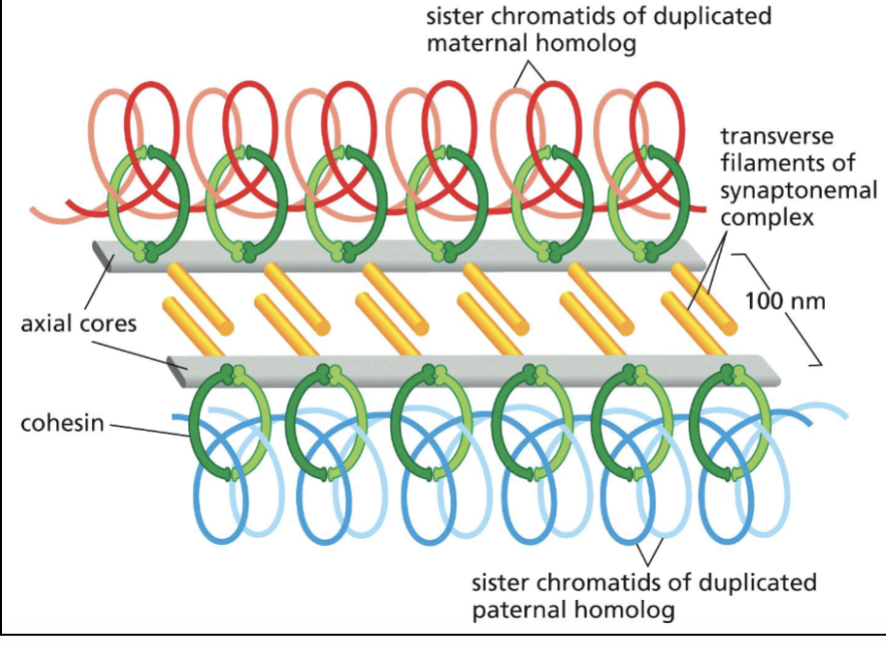
synaptonemal complex
a meiosis-specific, zipper-like protein structure that bridges paired homologous chromosomes
Cohesin interacts with axial cores of the synaptonemal complex
Cohesin holds the sister chromatids together
The synaptonemal complex allows sister chromatids to be held close together
Stages of Prophase I
1) Leptotene
2) Zygotene
3) pachytene
3) diplotene
4) Diakinesis
Leptotene
Chromosomes begin to condense into visible, thin threads
The maternal and paternal sister chromatids start to align
Zygotene
Homologous chromosomes pair up in a process called synapsis
The synaptonemal complex begins to assemble between them, acting like a zipper to hold the homologs together
Pachytene
The synaptonemal complex is fully formed, and the paired chromosomes are called a bivalent (or tetrad)
This is the stage where crossing occurs between non-sister chromatids
Diplotene
Synaptonemal complex disassembles
The homologous chromosomes begin to separate
Diakinesis
The homologs are completely unzipped
How to visualize what’s going on during Prophase 1
electron or immunofluorescence (cohesin) microscopy
What does 3d structures illumination microscopy do?
can show the paired lateral elements of the synaptonemal complex for meiotic chromosomes at pachytene
After the synaptonemal complex has disassembled during diplotene, the homologs are held together by
chiasmata