BIOL 200 Week 7-9
 Call Kai
 Learn
Learn Practice Test
 Spaced Repetition
 Match
Match Flashcards
 Knowt Play
1/113

There's no tags or description
Looks like no tags are added yet.
Name | Mastery | Learn | Test | Matching | Spaced | Call with Kai |
|---|
No analytics yet
Send a link to your students to track their progress
114 Terms
Supergroups of Animals / Animal-LIke Taxa
Alveolata, Rhizaria, Opistokonta (multicellular), Excavata
Animal Rooted Tree Order
Protists, Basal Phyla, Protostomes, Deuterostomes
What was the paradigm shift in the animal rooted tree?
Multicellularity: gave rise to the basal phyla
How many times did multicellularity occur? In tree of life? In animal phylogeny?
once in animals, many in tree of life
What did multicellularity allow for in animals?
larger size, increased mobility, better access to resources, specialization
What groups are in the Basal Phyla
Porifera (Sponges), Cnidarians, Ctenophora
What are the protostome lineages? What distinguishes them?
Lophotrochozoa and Ecdysozoa. Distinguished by different patterns of development.
Cephalic / Caudal
Head / Tail
Dorsal / Ventral
Dorsal: Back, Ventral: Belly
Proximal / Distal
Proximal: Closer structure, Distal: further structure
Superior / Inferior
Superior: above in respect, Inferior: below in respect
What are the Basic Tissue Types
Epithelial, Connective, Muscle, Nervous
What is included in epithelial tissue?
Skin, linings of digestive tract, blood vessels, etc.
What are the two forms of epithelial tissue?
Simple and Stratified
What types of simple epithelial tissue is there?
Simple squamous: flatenned and tightly bound layer of single cells (lining of blood vessels, endothelium)
Simple Cuboidal
Simple Columnar: digestive tract lining
What types of stratified epithelial tissue are there?
Stratified squamous: flat cells at top with bottom columnar, high in keratin and waterproof
Stratified cuboidal
Pseudostratified columnar: one layer, but with irregular shape and nuclei
Connective tissue, what is it and what is included?
cells embedded in a matrix that functions in supports, binding, transport, or immunity.
Includes loose fibrous connective tissue (dermis, fibroblast, collagen, elastic fibers, matrix), hyaline cartilage, bone, adipose tissue
Muscle Tissue what is it and what is included
Elongated cells with contractile proteins for movement. Includes skeletal (common), cardiac (striated), smooth (non striated)
What are the ten organ systems?
Integumentary, Skeletal, Muscular, Digestive, Circulatory, Respiratory, Nervous, Endocrine, Excretory, Reproductive
Integumentary includes
skin and hair, feathers, scales
Skeletal includes
external and internal hardened parts. Bones, cartilage, hair, feathers, scales, teeth, beak. Can be made of bone, cartilage, chitin, keratin
What are the two muscular components?
Somatic (Striated): support body wall, tail and appendages
Visceral: smooth muscles with gut, striated muscles with branchial/gill arches
Types of blood vessels
Arteries, Veins, Capillaries, Lymphatic
Respiratory system in aquatic vs terrestrial organisms
-gills and lungs evolved separately from digestive tract
-gills came from lateral slits in anterior region of digestive tract
-lungs came from primitive fishes, from foregut outpouching of digestive tract
-modern fishes had lungs become swim bladder, terrestrial animals kept lungs
What are the patterns of organization
Asymmetry (no plane to bisect into mirror images)
Radial Symmetry (infinite planes to bisect)
—> Biradial: two planes two divide (ctenophores/ comb jellies)
—> Pentaradial: 5 planes to bisect (due to arms)
Bilateral Symmetry (one plane called median plane divide into left and right)
What are the patterns of organization
Unicellular, Diploblastic, Triploblastic
Describe Diploblastic Organization
Has two embryonic cell layers: Ectoderm and Endoderm
Endoderm: lining of digestive cavity, digestive tissues
Ectoderm: epidermis and nervous system
Looks like ball of cells: endoderm —> mesoglea (non-cellular) —> ectoderm
Occurs in some basal phyla
Mesoglea
gelatinous, non-cellular, jelly-like substance found between the ectoderm and endoderm in cnidarians (jellyfish, corals) and ctenophores
Describe Triploblastic Organization
Three embryonic cell layers: ectoderm, mesoderm, endoderm
Ectoderm: epidermis, nervous tissue
Mesoderm: bulk of body tissues
Endoderm: gastrodermis, gut lining
Contains body cavity called coelom
In protosomes and deuterostomes
What is the coelom? What patterns can it be
A true coelom is an internal body cavity completely surrounded by mesoderm.
Acoelomate pattern: lacking the fluid filled cavity
Pseudocoelomate pattern: not fully mesodermal lining, could be between mesoderm and endoderm
Coelomate: has mesentary which is a thin membrane that joins digestive tract to walls
What is a protostome and what characterizes it?
One of two main groups of animals (sister to deuterostomes).
Spiral cleavage (specific to lophotrozoans) as development
—> has 3 divisions after fertilization with 2, 4, 8 cells and unaligned layers
—> Blastopore develops into mouth
—> Shizocoelous coelom (not universal)
—> Trochopore larva (have or had in past), only protostomes have
What characterizes deuterostomes
Radial Cleavage: 8 cells arranged into two layers, complementary
Blastopore develops into anus
Enterocoelous coelom
No trochophore larva
What are the three Eras?
Mesozoic, Cenozoic, Paleozoic
What are the four supergroups of animal-like protists
Alveolata, Amoebozoa, Excavata, Rhizaria
Protists are non-monophyletic
Unrooted, don’t know order of evolution
What is the significance of paleozoic time period to animal life?
Around 540 mya, contained the Cambrian explosion of animal phyla (all current groups present at this time)
However, animal like protists well before this
What was the most sever mass extinction?
The Permian
80% and 70% of terrestrial life went extinct.
Due to volcanic event, its atmosphere and climate impact
Describe generally the evolution of protists
They can be traced back 1.5 bya with fossils
All groups were present by Cambrian period
They are polyphyletic
Some species are animal like and plant like (Euglenoids flagella and photosynthesis)
Protozoa group meaning first animal
What are the generalized features of animal like protists
Unicellular, but complex with membrane bound system (nucleus, mito, membrane, lysosomes)
Contain pellicle: proteinaceous zone of cell interior to inside plasma membrane, that provides rigid
Supported by contractile vacuoles: keep internal state in narrow limits by expelling excess water
What are the asexual forms of reproduction in animal-like protists?
Binary fission (divide along long or perpendicular axis)
Schizogony (multiple mitosis of nucleus before cell division - mutlinucleate)
Budding (unequal cell division)
Describe animal-like protists relation to sexual reproduction
Variable among taxa
Haploid individuals produce gametes in zygotic meiosis
Amoebas do not sexually reproduces
Ciliates have complex form with macro and micronucleus
What defines the Excavata Protozoan Group
Named for excavated feeding groove
Some plant like (phytoflagellated) some animal like (zooflagellated) flagella
Important primary producers
Several are pathogenic
Describe the important pathogenic excavata species
Giardia intestinalis: waterborne disease, infecting small intestine
Trichomonas vaginalis: sti where men are asymptomatic
What defines the amoebozoan group
Amoeboid shape that moves with pseudopodia (extensions of cell that body flows into)
Lack pellicle
Phagocytosis for food
Do not sexually reproduce
What are some characteristic amoebozoan species
Naegleria fowleri causes encephalitis
Acanthamoeba causes keratitis
Entamoeba hisolyca results in amoebic dysentery and has no mitochondria
Describe the rhizarians (TSAR Clade)
They are amoeboid, but not sister to amoebozoa
Some have filopodia or axopodia (specialized pseudopodia)
Includes Foraminifera: secrete calcium carbonate, making white cliffs of dover and abundant since Cambrian
Describe the alveolata group
Highly variable with three groups: Dinoflagellates, Ciliates, Apicomplexans
Have or had plastids (phytoflagellates)
have stacked vesicles (alveoli) below plasma membrane
What are dinoflagellates
alveolates
marine
biflagellated
bloom = red tides
Describe ciliates
Alveolates such as paramecium
Cilia for moving and feeding
Cytostome mouth
Freshwater and marine
Free living meaning less disease relations
Fixed by rigid pellicle
Asexual: transverse fission (perpendicular)
Sexual: conjugation with dimorphic macro and micro nuclei
Describe apicomplexans
They are alveolates which are intracellular parasites
Have ring shaped apical complex
No cilia or flagella (internal parasites)
Include: plasmodium, cryptosporidium, toxoplasma
What disease is plasmodium related to, and what does its life history look like?
Related to malaria
Sporogony: asexual spores generated in mosquito who can transmit sporozoites to humans
Schizogony phase: spores in liver undergo Exoerythrocytic cycle where cells divide without division and then rupture into blood cells
Gametogony phase: in blood gametes are produced in the Erythrocytic cycle that mosquito can bite
When mosquito bites, gametes fertilize and meiosis occurs to make spores
What are the common features of Metazoans / Basal Animal Phyla
Multicellular animals
Presence of monoflagellated cells
Mitotic aster apparatus
Cell junctions
Proteins for movement and other functions (protists didn’t have this extent)
Monophyletic
What are the selective advantages of multicellularity
Larger, complexity, resource efficiency, less prone to be eaten, greater motility
How does multicellularity change what it means to be an individual
Multicellular organisms can undergo apoptosis:
—> stripping down of parts
—> supports early embryonic development
—> apoptosis when replication errors to prevent cancer
Multicellular organisms have division of cell types and functions:
—> reproduction in gametic cells
—> somatic cells seem to be against evolution, but are just a greater part of multicellular organisms (shifting of roles)
Porifera - Pore bearer refers to what species
Sponges
What are the for important cell types of Porifera
Pinacocytes: flattened pavement of integument
Porocytes: are the characteristic cells of poriferans, connect outside water to inside
Choanocytes: embedded in body wall and extending into cavity
Mesenchyme: unspecialized cells
What supporting structures are in Porifera
Spicules, which provide evidence for skeletal system
Made of various materials dependent on species
Needle like are glass like silicon, while varied structures are proteinaceous
hard = skeletal elements
has no tissues or organs
How do the choanocytes function in Porifera
the collar contains a flagella which moves with water current
water drawn in through pores with negative pressure
passing water contains particulates that get stuck on collar and move into cell and vacuole
water leaves through osculum of sponge
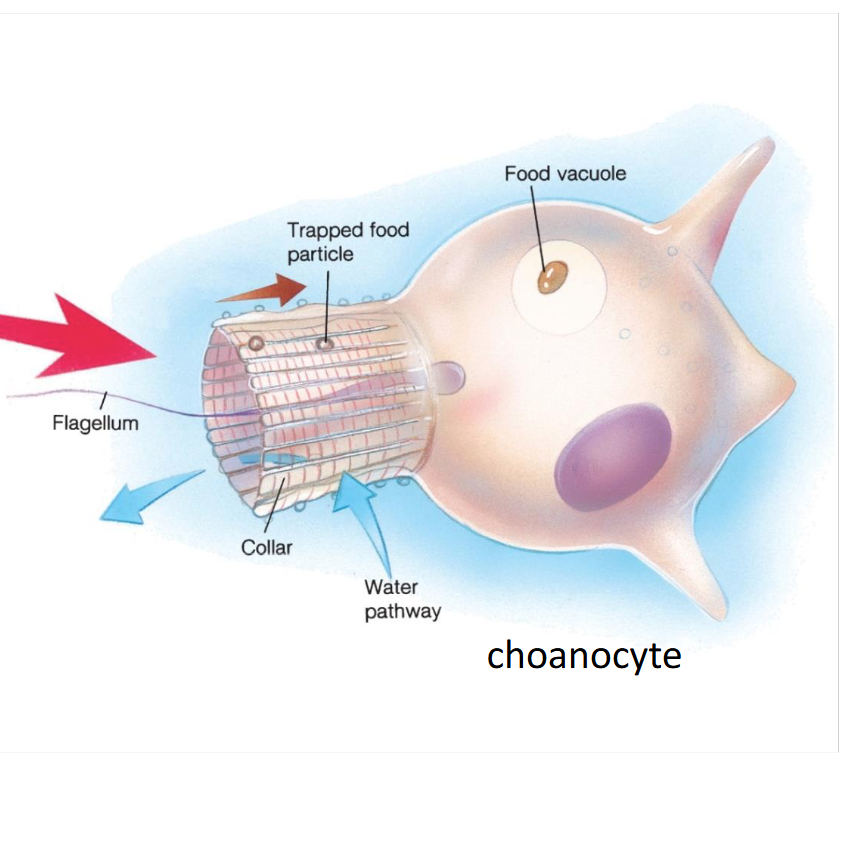
Describe the basic body form of Poriferans
Have little cellular specialization
Contains interior spongocoel which is the primary cavity
Pinacocytes line exterior, with porocytes embedded and open into cavity
Choanocytes in body wall stick out into spongoecoel
Water is constantly filtered through
What ecological roles do Porifera serve
Water filtration for clear water in coral reefs
Food for reef fishes
Describe the variation of sponge body forms
Walls can fold to increase chambers
Ascon, Sycon, Leucon with increasing folding
Leucon loses spongocoel
Describe reproduction of sponges
Asexual reproduction:
—> common in freshwater
—> gemmule structures allow for overwintering (released before winter and contain amoeba until released in spring)
Sexual reproduction:
—> monoecious and asynchronous
—> choanocytes produce gametes
—> planktonic larva: in water column briefly before settling
Outline the diversity of sponges
~9000 spp
four groups differentiated by spicule characteristics
wall complexity not phylogenetically informative
What species are part of the Cnidara phylum?
Hydra, jellyfish, anemone, coral
What are shared characteristics of cnidaria
Radial or biradial symmetry
Diploblastic tissue organization
Gastrovascular cavity
Nerve net
Cnidocyte cells
Describe the Diploblastic development of Cnidaria
Ectoderm gives rise to epidermis with:
-epitheliomuscular cells that can contract (most)
-cnidocytes
Endoderm gives rise to gastrodermis (ciliated and moves water)
Describe the Life Cycle of Cnidarians
Alternation of Generation between polyp and medusa stages
Polyp: sedentary, structural body column with large cavity and mouth at apical part, asexual budding into medusa
Medusa: free swimming, flipped and shortened column to polyp (bell shape), mouth downward with tentacles, sexual (dioecious) with gametes released into water
Zygote developes into ciliated larva called planula
Describe the structure and function of Cnidocytes
Functions: capturing prey, defense, motility, competition
Structure:
nematocyst is inner stinging part, inverts to produce tube and string
operculum plate covers inner,
cnidocil is trigger
may have barbs, be sticky, or other methods of function
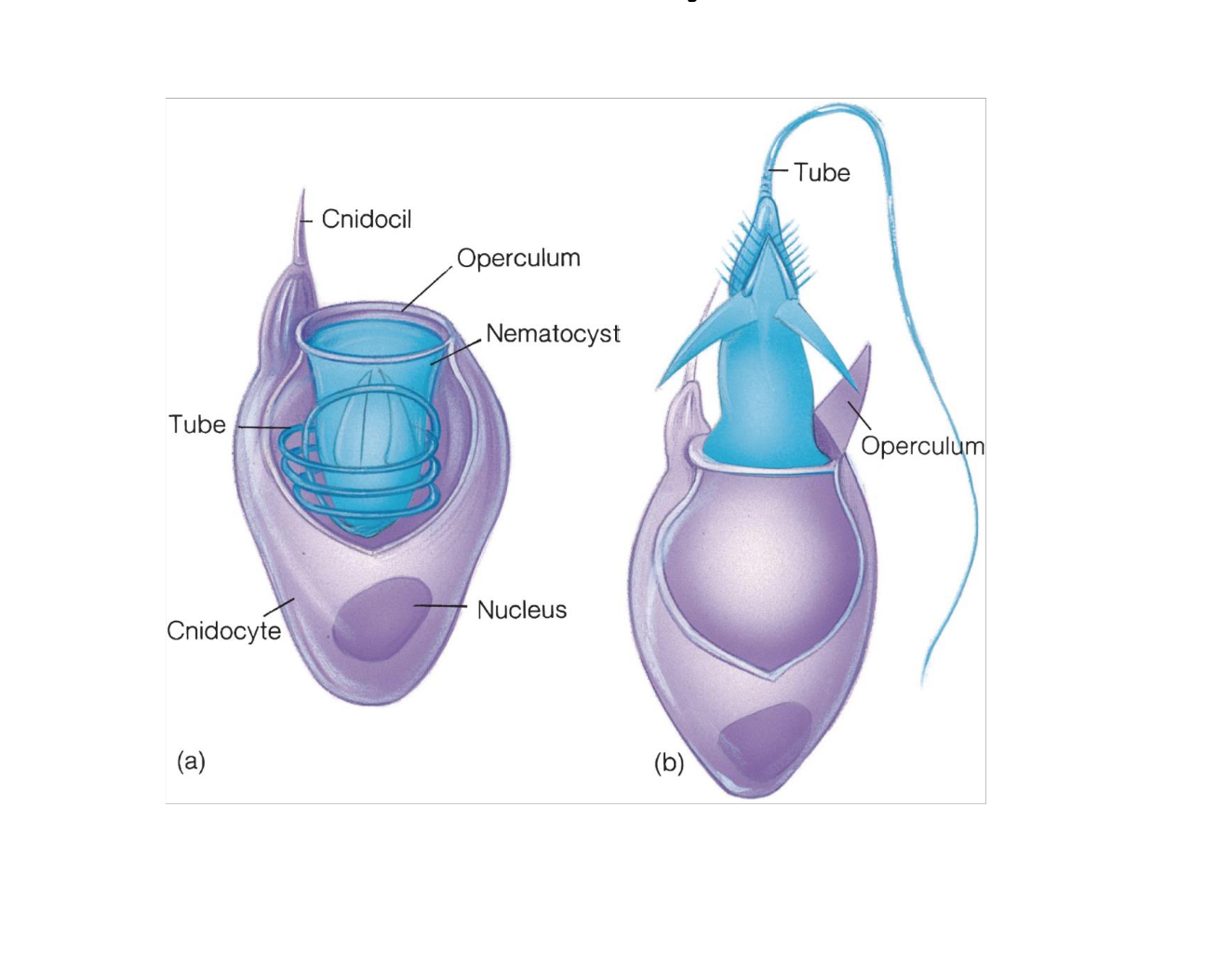
Describe the hydrostatic skeleton present in Cnidarians
pressure on walls make turgid structure that muscles counterract
provides support, functions in movement
not hard like bone, cavity can be filled with water,
outline the diversity of Cnidaria
Hydrozoans: small, common, marine, colonial polyps (some feeding, some reproductive)
Scyphozoa: marine, true jellyfish, medusa dominant, dioecious
Cubozoa: box jellyfish, toxic (predation or defense), tentacles in four corners
Anthozoa: marine, polyp only, gastrovascular cavity divided by mesenteries (with gonads, cnidocytes), symbiotic with zooxanthellae, external radial symmetry, internal biradial, include anemones
Describe the characteristics of Ctenophora or Comb Jellies
diploblastic (have muscles so maybe triplo)
biradial
mesoglia is cellular with muscle cells
gastrovascular cavity with anal opening
nerve net
monoecious with external fertilization
Describe the structure of a Ctenophore / Comb Jelly
Has eight comb rows along body walls with cilia
Colloblast cells on tentacles are sticky to catch prey
Paired tentacles = biradial
What are the characteristic features of Lophotrochozoa
Trochophore Larva: characteristic shape, cilia at apex and anus, complete digestive system (two orifice, anterior/posterior with tube)
Lophophore: feeding organ, trunk with ring at top, with ciliated tentacles, mouth at top of column that loops back up to anus
If either is present = lophotrochozoans, neither doesn’t mean either way
Is there are characteristic feature of the Phylum Platyhelminthes? Describe common characteristics of Platyhelminthes
Platyhelminthes or Flatworms have no universal features and are not monophyletic
Common features:
worm with flat body
acoelomate; instead filled with mesodermal parenchyma
bilateral symmetry; some cephalization (anterior)
organ system level organization (first group), cnidarians only had hints of netlike nerves and skeletal elements
incomplete gut
protonephridia excretion
nervous system: anterior ganglia, longitudinal ventral nerve cords
monoecious
What groups or classes are within Platyhelminthes
Turbellaria (planarians)
Trematoda (flukes)
Monogenea (monogenetic flukes, ectoparasites)
Cestoidea (tape worms)
Describe characteristic features of Turbellaria / Planarians
Polyphyletic
Free-living flatworms: benthic, marine, freshwater, few terrestrial
Mobile: circular and longitudinal muscle fibers, cilia on ventral surface
Predatory
Dorsal/ventral flattening —> compressed body form
Describe anatomy of Turbellaria / planarians
digestive system: single opening with protruding pharynx, three lobes (anterior two posterior), diverticula pouches extend laterally
thin epidermis
circular muscles: extend to become thinner
longitudinal muscles: shorten length
parenchymal tissue unspecialized
parenchymal muscle support thinner
ventral nerve cords
Describe gut morphology of Turbellaria
variable from tube to complex branching
branching of diverticula increases cell coverage, which provides alternative to blood vessels
Describe excretion of Turbellaria
Through protonephridia unit
Long tubules around periphery, flame cell at cap, cilia of flame cell push down fluid which is filtered for nutrients and excreted
Describe nervous system of turbellaria
pair of ventral nerve cords
some have netlike nerves extending into peripher, which coalesce into ganglia // others branch with segmental patterns where commissures connect nerve cords
consists of sensory and motor neurons
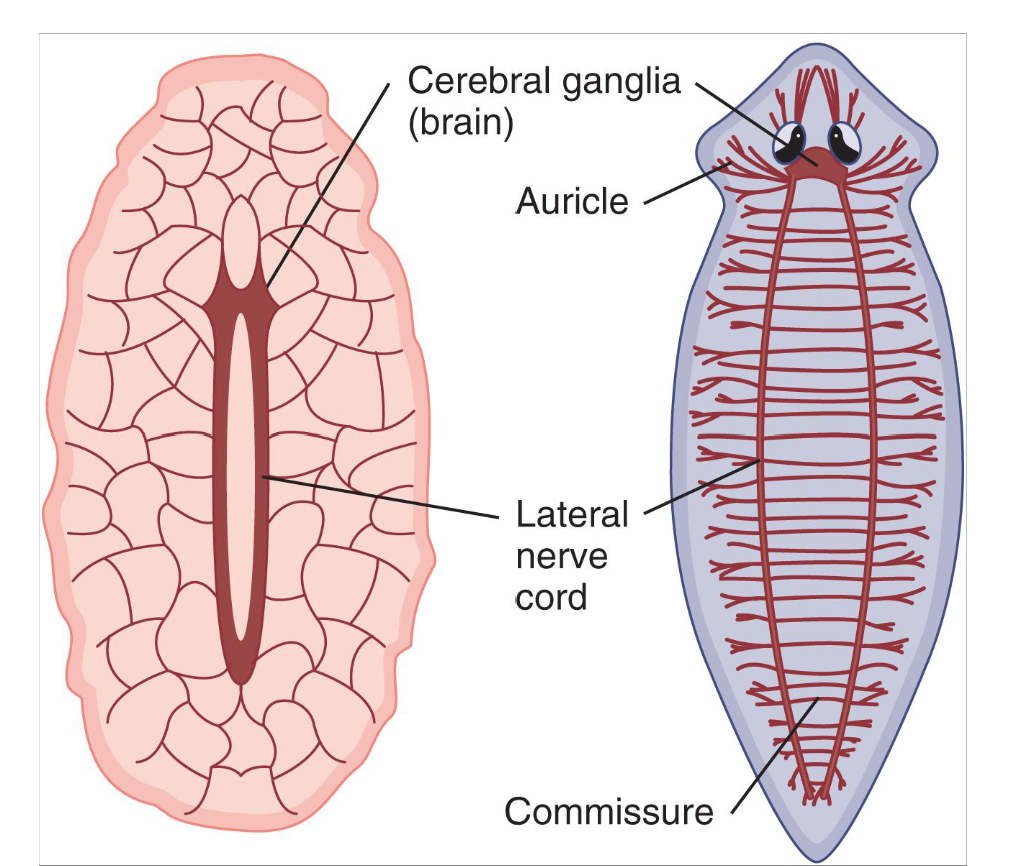
Describe reproduction in Turbellaria
most complex system in planarians
monoecious
copulatory sac receives sperm: stored and sent into oviducts
eggs deposited outside in cocoon
vitellaria in eggs for nutrients
mostly non larval development
also asexual: transverse fission
What are trematodes
Trematodes are parasitic flukes, usually associated with the bile duct of digestive system and target vertebrates
They are flattened and wide like a whales tail
Most diverse of platyhelminthes, two subclasses Digenea (two host) and Aspidogastrea (one host)
Complex life-histories
Describe trematode internal anatomy
simple except reproductive system, dispense most of anatomy
host provides living setting
almost exclusively sexual
eggs into host digestive tract
digestive structure: mouth and two long ceca tubes
What is the tegument of trematodes and its structure?
the outer covering or skin that serves as defense
it is syncytial: a multinucleated structure due to cell fission
Outer tegument: glycocalyx: maintains contact with bile duct and extends cytoplasmic bodies below basement membrane
Inner tegument: basement membrane (thin sheet support)
Describe a life history of a common Liver Fluke
Produces fertilized eggs in host
Eggs in water develop into larva
Cilia of larva find host (snail), form sporocyst and redia that produce hundreds of embryonic cells
Cercaria larva are motile, enter water to find second intermediate host (Plant)
Consumption of plants repeats process
What are monogenea
include parasites of fish which burrow into skin or gills of animals
What are cestoidea
Tapeworms (highly specialized gut parasites)L
-target vertebraes and intestines
-simple anatomy: secondary evolution trend as ancestors more complicated
-intermediate hosts, usually one
Describe the structures of Cestoidea
Anteior: Scolex (attaches to inner lining of digestive track with hooks)
Neck narrows
Posterior: divided proglottid (maturation away from neck) is a reproductive structure, can reproduce with other tapeworms
Gravid ploglottid: matured, sac of fertilized eggs, voided through host feces until next host
beef Tapeworm: No digestive system; rudimentary nervous and excretory system
“male and female reproductive system on wheels”
Describe the lifecycle of a Beef Tapeworm
Using scolex to attach to intestine, tapeworm sexually reproduces
proglottid breaks off and is eliminated
cow ingests eggs which hatch in oncosphere (thorned and burrows into through digestive tract to circulatory system)
Embeds in muscle and becomes inactive cyst
Human eats beef with cyst —> activates
Describe generalized traits of mollusks (and what they include)
Soft bodies
includes snails, bivalves, octopus, squids, etc.
triploblastic, coelomate
morphologically variable, united with:
Body form: muscular head-foot (ventral), visceral mass (dorsal),
Mantle (inside shell) and mantle cavity
Radula (chitinous): rasping for mouth
Trochophore larva (many)
Open circulatory system (except cephalopods): blood not in vessels, direct cell contact
What are the three important classes of Molluscs
Gastropods, Bivalves, Cephalopods
Describe the generalized anatomy of Molluscs
Ventral muscular head-foot with overlying visceral mass
Cephalization, with head like structure at anterior
Skeletal shell element
Mantle iand mantle cavity
Outline the structure of the shell/mantle/mantle cavity, with Ex: Bivalve
Top Shell: periostracum (protein outer layer), prismatic layer (mineralized), nacreous layer (smooth inside, protein, CaCO3)
Mantle: lined by epithelium, thick at shell tip (shell gland), lay down materials (grow shell),
—> pearl forms between nacreous layer and epithelium when irritant gets trapped
Mantle cavity: between mantle and head foot, water can circulate, contract walls for ventilation of water or air,
—> may contain gills
—> release nitrogenous (nephridium) and digestive (anus) wastes from anus into cavity
—> releasing reproductive products
Describe the radula structure of molluscs and function
Radula is within diverticula of radula sac
It can protrude, wrapping around cartilage
scraping algae or biofilms
associated with mouth, but not homologous to teeth
What species are gastropods
Snail, slugs, limpets
Describe gastropods characteristics
Aquatic (both marine and freshwater) and terrestrial
Intermediate host for parasites
~65,000 spp.
Describe torsion of gastropods
While ancestors only had larvae, modern have torsion twisting
Larval form visceral mass twists 180 counterclockwise
Results in: cavity superior to head, gills above head, anus feeding into area above head
Hypothesized as protecting head which can withdraw into cavity
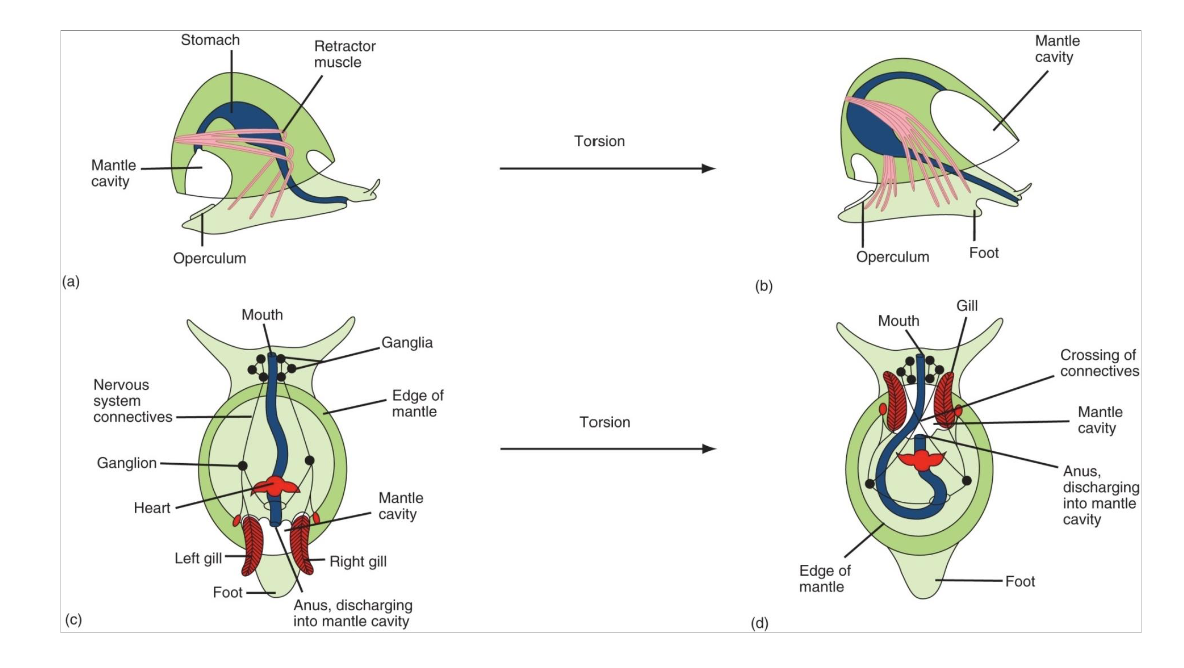
Describe respiration of gastropods
Aquatic: gill structures in mantle cavity
Land: mantle cavity highly vascularized (like lung)
Open nephrostome / pneumostome allow air or water in
Describe the coiling shell of gastropods
Right or left handed based on species
Assymetrical
Protection, hydration
Constrains space: one nephridium, one atrium, one lung
Describe reproduction in Gastropods
Most lay eggs
Some dioecious, broadcast spawners
Monoecious: copulation and mutual sperm exchange, protandrous or protogynous
Some live bearing (viviparous)
Marine forms have trochophore larvae —→ veliger larvae
Describe three examples of Gastropods
Banff Spring Snail: survive hot temperatures, at risk
Cone Snails: decorated, radula with harpoon and toxins to immobilize and consume fish
Nudibranchs: live in coral reefs