Big Chemistry
 Call Kai
 Learn
Learn Practice Test
 Spaced Repetition
 Match
Match Flashcards
 Knowt Play
1/76

There's no tags or description
Looks like no tags are added yet.
Name | Mastery | Learn | Test | Matching | Spaced | Call with Kai |
|---|
No analytics yet
Send a link to your students to track their progress
77 Terms
Subatomic particles
neutron= neutral, electron= negative, proton= positive
Atomic number
the number of protons (used to order elements in the periodic table)
Atomic mass
The number of protons and neutrons, Atomic mass is called "mass" rather than just a count (mass number) because it represents the actual weighted average mass. Electrons are not included because they barely have any weight at all( so if there is a decimal on the mass its probably just the electrons). Rounded as normal
Valence shell?
Outermost shell
If the nucleus is further from the shell…
it can hold more electrons
How many electrons can we put in the 3rd shell, up to element 20
ONLY 8
After element 20 on the periodic table, what is the max capacity of each shell’s formula?
2n2
Closer to the nucleus =
lower energy
In further electron shells
Attraction between +ve nucleus and -ve electrons becomes weaker
Why do sometimes, elements in the same group have similar properties?
Due to their electron configuration, and the fact that they have the same number of electrons in their valence shell
What happens as u move down group 1?
The atoms become larger and the outer electron shell goes further and further away from the nucleus( atomic radius increases).
Also attraction between the nucleus and electrons become weaker.
They become more reactive since the atomic radius increases as the size gets larger.
How can the number of valence electrons be found?
The number of valence electrons can be found by counting the groups and skipping groups 3-12 (transition metals)
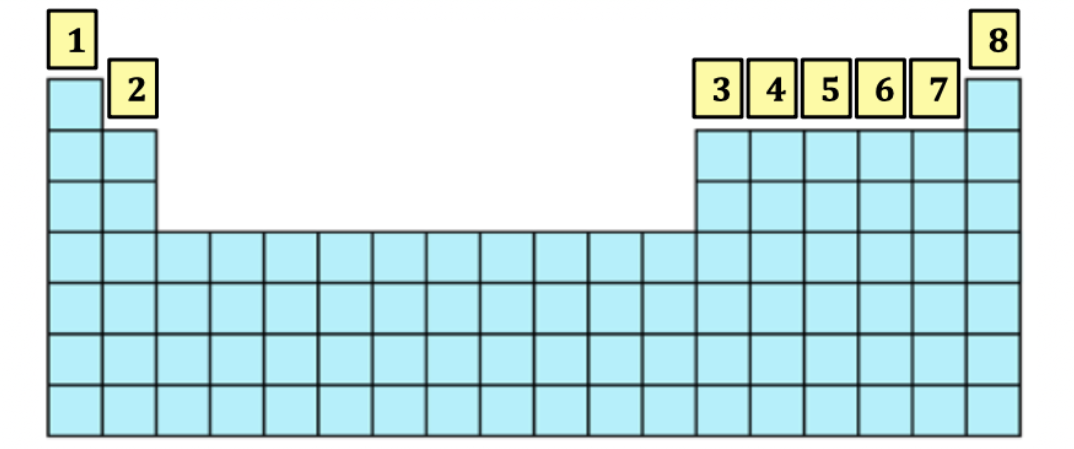
What are the different groups of metals on the periodic table?
Alkali metals, alkaline earth metals, transition metals, other metals, rare earth lanthanide metals, rare earth actinide metals
Alkali metals
Group 1 (excludes hydrogen) - meaning 1 valence electron - and a charge of +1
Highly reactive
uncharacteristically low melting point because — Alkali metals have low melting points because they only have one valence electron per atom to contribute to metallic bonding, resulting in a weak "sea of electrons".
Reacts violently with water to form a base and H2
As u move down the alkali metals they become more reactive ; Alkali metals (Group 1) become more reactive as you move down the periodic table because their atoms get larger, and so does the atomic radius, making it easier to lose their single outer electron
Are very soft
Alkaline earth metals
In group 2, so Two electrons in outer shell, 2+ charge
Very reactive, but not as reactive as group 1. As group 1 has lower ionization energy as a result of having only one valence electron.
Low melting points
soft
As u move down alkaline earth metals = reactivity is increased
React violently with water to form a base and H2(g)
Ionization energy
The energy required to remove an electron is called ionization energy.
Metalloids
found in between metals and non-metals
properties are a combination of both metals and non-metals
non-metals
Found in groups 14-18
Large range of melting and boiling points
Are all gases at room temperature except bromine
Have a high amount of valence electrons (except noble gases)
metals electrons
Low number of electrons
Halogens
group 17 — thus 7 valence electrons, and a charge of -1
halogens react with metals to create salts
Melting Point and Boiling Point increase as you go down the group
Reactivity decreases as u go down the group
How does atomic mass increase, and why?
moving down each group
moving right across each period
As you move down a group or to the right across a period, the atomic number increases. This means you are constantly adding protons and neutrons to the nucleus. Because protons and neutrons make up virtually all of an atom's mass, the atomic mass steadily goes up.
How does atomic radius increase?
moving down each group
moving left across each period
Reactivity?
the tendency of an atom or molecule to undergo a chemical reaction
how does reactivity of metals increase?
moving down each group
left across each period
reactivity of non-metals
moving right across each group,
up across each period
ionization energy
increase going right across each period
going up a group
what is electronegativity?
Measure of how strongly an atom’s nucleus is attached to its electrons
electronegativity
increases moving right each group and up each period.
What is an ionic bond?
ionic bond is a type intramolecular force : chemical bonds that hold atoms together within a compound. Ionic bonds are the electrostatic attraction experienced between oppositely charged ions. They typically form between a metal (cation) and a nonmetal (anion), due to electron transfer, but they can also form between nonmetals if polyatomic ions are involved.
Ion
any atom or molecule that has a net electrical charge
BREAK
What are polyatomic ions?
Polyatomic ions are covalently bonded groups of two or more atoms that act as a single unit and carry a net positive or negative charge
electrostatic interactions:
the attractive or repulsive force between charged particles or objects, include electrostatic attractions and repulsions
anion vs cation
cation = positive net charge
anion = negative net charge
Is ionic bonding directional?
NO, IT IS NOT DIRECTIONAL, ANS and acts between many surrounding ions in the lattice.
as the valence shells increase
electrostatic attraction significantly decreases
Ionic bonds process
One atom loses electrons → becomes a positive ion (cation)
Another atom gains those electrons → becomes a negative ion (anion)
The opposite charges attract → forming a strong electrostatic attraction (the ionic bond)
Lattice structure
Ionic compounds contain many cations and anions bonded together in a large structure called a lattice
The total charge of lattice structures is 0
Crystal formation
.
𖢻 Almost all Ionic compounds have a crystal structure, which means that the ions are arranged in a regular repeating three-dimensional arrangement of ions.
𖢻 A crystal forms when ions arrange into a repeating lattice as a molten ionic compound cools or as water evaporates from a solution.
𖢻 The exact arrangement of ions in a crystal varies according to the size and ratio of the ions.
𖢻 Factors that affect the size and regularity of the crystals include:: Rate of cooling, Rate of evaporation, Concentration of the solution and Purity of the solute
what state are ionic compounds in at room temperature?
solid
why are ionic compounds brittle?
Ionic compounds are brittle because, when external force is applied to them, the charged ions (cations and anions) shift and therefore align with like ions.
This causes them to repel each other, and the repulsion causing the compound to shatter.
why do ionic compounds have high melting points?
High melting points in the ionic bonding model result from the strong electrostatic force by oppositely charged ions.
To melt an ionic compound, a large amount of energy is needed to overcome the strong electrostatic attractions within the lattice and allow ions to move freely.
As mentioned before, this means they are solid at room temperature.
why are many Ionic compounds are soluble in water
Water can break apart the ionic lattice because the positive cations and negative anions are attracted to the partial charges within the water molecules.
Strong attractions between water molecules and ions pull the ions away from the lattice.
This allows water to surround the individual ions during dissolving.
Conduction of electricity in an aqueous solution
Substances that conduct electricity have free moving, charged particles. When the charged ions are dissolved in water they can move to conduct electricity.
They are conductive when in molten form
Molten ionic compounds can conduct electricity because they have free, mobile, charged ions. Due to the property being a solid, the compound cannot conduct electricity due to the ions positioned in a fixed lattice. When heated, the thermal/kinetic energy loosens the bonds between the charged particles, creating mobile charged particles needed for conductivity and turning the compound into a liquid form.
How do u name ionic compounds?
Name the cation first, followed by the anion.
If the metal is a transition metal, indicate its charge (oxidation state) using Roman numerals in brackets after the metal name.
iron(III) chloride
copper(II) sulfate
Monatomic nonmetal anions change their suffix to “-ide.”
Examples:
chlorine → chloride
oxygen → oxide
Polyatomic ions keep their ion names unchanged.
Examples:
nitrate
sulfate
carbonate
indicator for polyatomic vs monatomic ionic compounds
monatomic ions end with : -ide ( so the nonmetal ends with ide, because it is named last) ( and the cation is named first which usually is the metal because the metal is the one losing the electrons)
polyatomic ions end with other stuff ( its got a list)
Metallic bond
Describing the electrostatic attraction between the metal ions arranged in a lattice structure, and the free floating electrons (term ‘sea of delocalised electrons’ frequently used ) around them. Metallic bonds are a type of intramolecular force: the powerful chemical bonds that hold atoms together within a compound. Metallic bonding is a type of strong chemical bond that occurs in pure metals and alloys
How do metallic bonding work?
The vast majority of metal atoms only have a few electrons in their valence shells; so they always become cations since they lose their valence shell electrons to obtain a stable valence shell.
Metal atoms lose electrons during bonding because they have low electronegativity and low ionization energy. This means their outermost valence electrons are only weakly held by the nucleus, and it requires less energy for a metal atom to shed these few electrons than it does to pull in six or seven more to fill its outer shell.
This creates a strong lattice structure bound together by metal cations and a sea of delocalised electrons.
Properties of pure metals
malleable and soft
High melting and boiling points
conductive of heat and electricity
Lustre/ shine
What is an alloy?
Alloys are a mixture of two or more elements where one element is a metal, combined via metallic bonding.
why do alloys have different properties than pure metals
because of their structure there are a lot of like ‘bumps’ in the structure since there a different sized atoms in it, and they dont fit perfectly into the lattice. Which changes some of the properties.
Covalent bonding
A covalent bond is a chemical bond formed when two atoms share pairs of electrons in order to achieve a stable electron configuration.
Covalent bonding USUALLY occurs between two nonmetals. Since non-metals usually do not have many electron in their valence shell rather than losing or gaining electrons, atoms now share an electron pair.
This shared electron is called an electron pair.
what are molecules
Molecule: Molecules are defined by discrete, finite groups of atoms held together by covalent bonds
simple molecular substances
A simple molecule has multiple atoms covalently bonded together. These covalent bonds between atoms are very strong.
A simple molecular structure is made of small, separate molecules. However, the forces of attraction between separate molecules are weak, and so simple molecules are easily separated from each other.
Giant covalent structures
These are giant lattices where atoms are covalently bonded in a continuous network.
strong covalent bonds throughout the entire lattice/network. there are essentially no separate molecules
Macromolecules / polymers
Very large molecules made from repeating units (monomers).
Examples:
polyethylene,
proteins,
DNA.
States of matter
If (s) is written as a subscript of a FORMULA , It means the formula is a solid.
If (aq) is written as a subscript of a FORMULA , It means the formula is a aqueous.
If (l) is written as a subscript of a FORMULA, It means the formula is a liquid.
If (g) is written as a subscript of a FORMULA , It means the formula is a gas.
what is a chemical reaction?
A chemical reaction occurs when two or more substances come together to form a new substance. Unlike a mixture where it can be separated.
Indicators of a chemical reaction:
Colour change
Temperature change
Precipitate formed (solid)
Bubbles
New smell
how is energy needed in every chemical reaction
Energy is absorbed to break chemical bonds in reactants, and
Energy is released when new bonds form in products.
Basically — Energy is needed to begin the process of breaking the bonds between atoms in the reactants. This then allows the atom to rearrange and form new bonds in the products — thereby releasing new energy.
Chemical changes?
Break and rearrange atomic bonds (using energy) to create new substances.
Physical changes?
Alter the form or state of matter without changing its structure. E.g water and salt mixed and can be separated
What are reactants and products?
The original substances are called the reactants. The new substances that are formed during a chemical reaction are called the products.
The law of conservation and mass:
In a chemical reaction, matter is maintained.
As all matter is made of atoms, the total mass of the reactants is the same as the total mass of the products.
—> This means that in a chemical reaction, the atoms don’t go anywhere; they simply rearrange themselves.
This is why we have to balance equations - these show the atoms are rearranged, but remain a part of the equation.
Combination/ Synthesis Reaction
Two reactants are combined to form one product
General formula: A+B —> AB
Decomposition Reaction
One reactant is broken down into two (or more) products
AB —> A + B
Single Displacement Reaction
A type of reaction in which a more reactive element reacts to displace a less reactive element in a compound.
General Formula: A + BC —> AC + B
How can this happen?
A more reactive metal can replace a less reactive metal. Metals can also replace hydrogen if the metal is more reactive than hydrogen.
For halogens :
A more reactive halogen can replace a less reactive halogen
Double displacement reaction
Two compounds exchange cations in order to form different compounds
Usually occurs in aqueous solutions
Double displacement reactions can either be precipitation or neutralisation reactions
Aqueous solution
A substance dissolved in water
Precipitate
⋆🦪 Precipitate: A precipitate is an insoluble solid product formed from the mixing of two aqueous solutions.
Precipitation reaction:
When solutions containing dissolved ions (aqueous) are mixed together, the ions are able to come into contact with each other.
Then, from the new solution, oppositely charged ions attract.
Basically - The cations and anions of one solution is able to make compounds with the cations and anions of the other solution (provided enough forces of attraction exist)
In some cases, the attraction is strong enough to form ionic bonds and a new ionic compound.
These compounds may be insoluble and form a precipitate (new ionic compound).
Chemical reactions in which precipitates are formed are called precipitate reactions
Precipitation reactions involve an EXCHANGE of IONS in the solution. So it is a double displacement reaction.
AB + CD —> AD +BC
Energy component: In a precipitation reaction, energy is absorbed to separate ions from water molecules, and energy is released when ions form a solid ionic lattice in the precipitate.
Holistically, ions that are soluble in water, when mixed together can form a precipitate, through a double displacement reaction,
Combustion reactions:
A combustion reaction is an exothermic reaction where a fuel (usually a hydrocarbon) reacts with oxygen at high temperature, releasing energy as heat, light and an oxide compound.
Fuel + Oxygen = Oxide compound
Characteristics:
Exothermic: Releases significant amount of energy in the form of heat light.
Oxygen: REQUIRED as a reactant
Fuel types: commonly involves hydrocarbons (CH) to produce carbon dioxide and water. BUT combustion reactions do not always produce carbon dioxide and water since:
💧 Hydrogen combusts in the presence of oxygen gas to produce water:
💧BUT, Some metals, like Magnesium, burns in the presence of oxygen to produce metal oxide:
acids:
are corrosive, they react with solid substances
All acids have hydrogen
lower number on the pH scale = more acidic = more Hydrogen
bases:
𝜗ৎ can be caustic (eg. sodium hydroxide)
caustic: any highly alkaline or acidic substance capable of corroding or irreversibly destroying organic tissue (such as skin and eyes) through a chemical reaction
𝜗ৎ Are called alkalis if can be dissolved in water
higher number on pH scale = higher alkalinity of bases
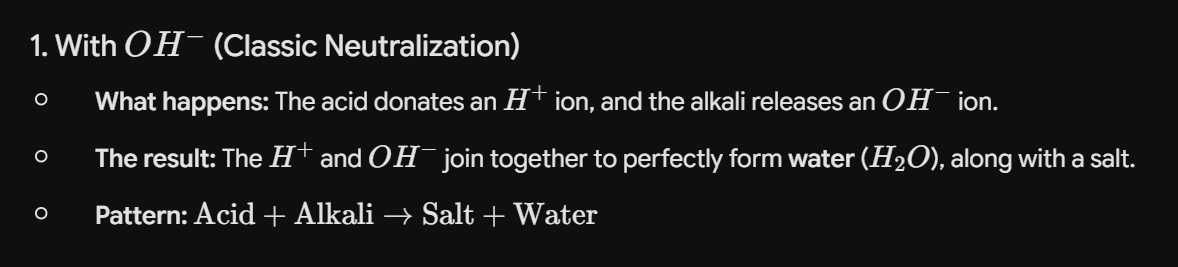
neutralisation reactions
Occurs between acid and base (MOST usually metal base)
acid + metal oxide = salt + water
acid + metal hydroxide = salt + water
acid + metal carbonate = salt + water + carbon dioxide gas
acid + metal hydrogen carbonate = salt + water + carbon dioxide gas
IS A DOUBLE DISPLACEMENT REACTION