Human Resources Review
 Call Kai
 Learn
Learn Practice Test
 Spaced Repetition
 Match
Match Flashcards
 Knowt Play
1/42

There's no tags or description
Looks like no tags are added yet.
Name | Mastery | Learn | Test | Matching | Spaced | Call with Kai |
|---|
No analytics yet
Send a link to your students to track their progress
43 Terms
ADEA
age discrimination in employment act of 1967
age discrimination in employment act of 1967
job applicants and workers cannot be discriminated against based on their age.
This act protects applicants and workers age 40 and older from job discrimination.
Exceptions to this law would include instances where age is determined to be a bona fide occupational qualification (BFOQ).
bona fide occupational qualification (BFOQ)
a narrow legal exception allowing employers to base hiring decisions on religion, sex, or national origin if reasonably necessary to normal business operations.
It is a defense against discrimination claims, typically applying to authenticity (e.g., actor), safety (e.g., pilot age), or privacy (e.g., locker room attendant)
ADA
Americans with disabilities act of 1990
Americans with Disabilities Act of 1990 (ADA)
a law that offers protection from prejudice in employment for individuals documented as having a disability
centralized authority
when the major decision-making power lies with a group of executives from the main office or company headquarters
delegation
occurs when a senior level employee assigns specific tasks to a junior level employee
the subordinate becomes responsible and accountable for the task
Doctrine of Corporate Negligence
a law that states that hospitals can be held liable for the competence, or incompetence, of their staff
downsizing
the planned elimination of positions in an organization
employee assistance program
program that provides services to employees who are experiencing personal and/or work-related issues that may impact their job performance
EEO
equal employment opportunity act
Equal Employment Opportunity Act (EEO)
a subsequent amendment that strengthened Title VII of the Civil Rights Act, creating the EEOC enforcement body and extending protections to public employees
a federal law regulating hiring and firing of individuals based on race, color, religion, sex (including pregnancy, sexual orientation, and gender identity), national origin, age (40 or older), disability, or genetic information
equal pay act of 1963
a law that states men and women must be compensated the same if they are performing equivalent work
FLSA
Fair Labor Standards Act of 1938
Fair Labor Standards Act (FLSA) of 1938
addresses the requirements for minimum wage, overtime, equal pay and child labor for employees of companies involved in business whether it is regional, national, federal or foreign
FMLA
Family and Medical Leave Act of 1993
Family and Medical Leave Act (FMLA) of 1993
a federal law directing employers to provide unpaid leave to staff who have personal or family health issues
flextime
a flexible, alternative work schedule that allows employees to choose their start and end times
halo effect
a form of bias in which a positive impression or experience in one area leads to a positive judgement overall
ex: a supervisor may assign high performance ratings to an employee based solely on the fact that they like the employee
HRM
Human Resource Management
Human Resource Management (HRM)
An approach to management, comprising staffing, retention, development, adjustment, and managing change
HR strategy
The decisions, processes, and choices organizations make regarding how they manage their people
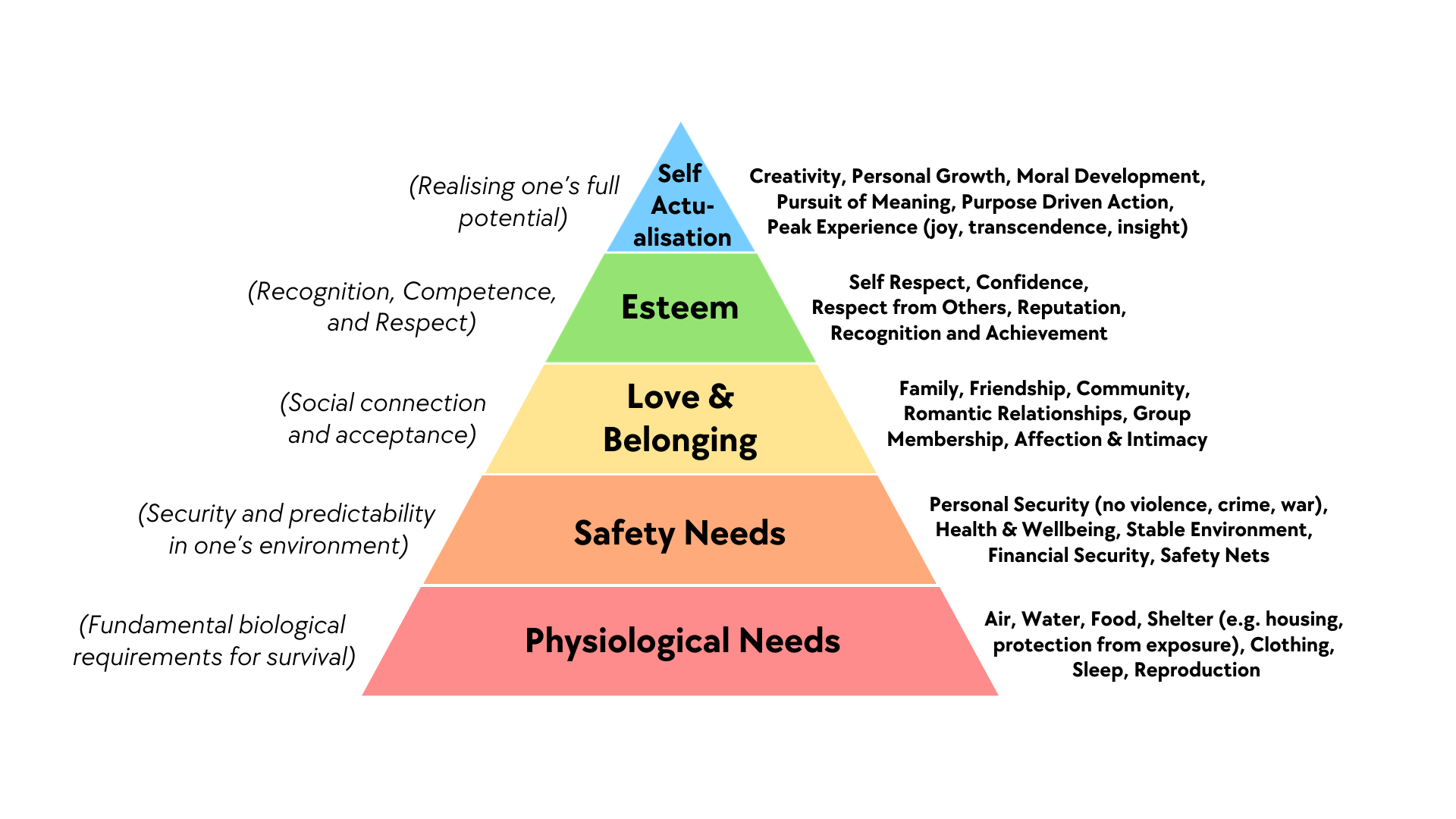
Maslow’s Hierarchy of Needs
A theory of human motivation showing the general progression of pursuits as:
1. Physiological needs
2. Safety needs
3. Love and belongingness needs
4. Esteem needs
5. Self-actualization needs
OSHA
Occupational Safety and Health Act
Occupational Safety and Health Act (OSHA)
A federal law that requires employers to develop and implement whatever is necessary to ensure a safe and healthy place of employment
Productivity
A measure of the output of goods and services relative to the input of labor, material, and equipment
Profit
The income remaining after total costs are deducted from total revenue
progressive discipline
When utilizing progressive discipline, minimum penalties would be applied first before moving to severe penalties.
For example, an employee would first receive an oral warning and then a written warning before being suspended.
retention
Initiatives taken by management to keep employees from leaving.
For example, ensuring harmonious working relations between employees and managers; and maintaining a safe, healthy work environment
restructuring
The process of changing an organization by selling or buying companies or lines of business, or by laying off employees
right sizing
The process of restructuring an organization so it can make a profit more efficiently.
Organizations will usually right size their business by reducing their workforce, reorganizing upper management, cutting costs, and changing job roles
ROI
return on investment
Return On Investment (ROI)
A measure of the gain/loss generated on an investment relative to the amount of money invested
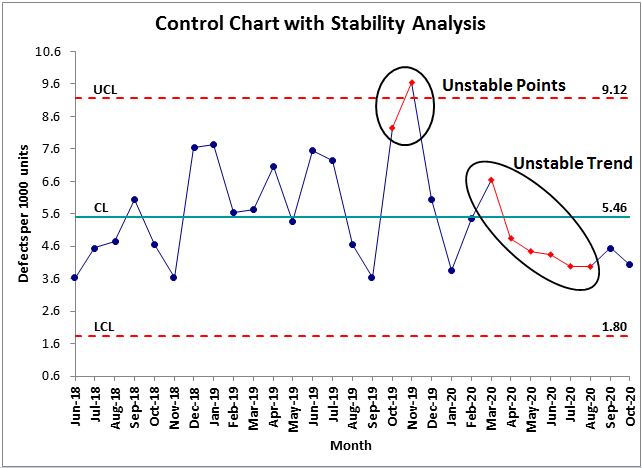
run or process control chart
Run or process control chart is a report that includes a graphic that displays data over time and provides an excellent visualization of quality and quantity trends
service units
volume of work
span of control
The average number of employees a manager can supervise effectively
Specialization of Labor/Division of Labor
divides large, labor-intensive duties or tasks into sub-elements which can be done effectively by a different group of workers.
staffing
The managerial activities of identifying work requirements within an organization; determining the numbers of people and the skills mix necessary to do the work
Title VII of the Civil Rights Act
The portion of the law that states hiring and compensation cannot be based on an individual’s race, color, religion, sex, national origin, or whether they are a member of a protected class.
usability
The interface between people/employees and technology, usually measured in terms of efficiency (time to complete a task), effectiveness (error rate), and user satisfaction
unity of command
A management principle that no subordinate in an organization should report to more than one boss
Wage and hour laws
Regulate and oversee how much staff is paid (wages) and how the amount they are paid is calculated (hour)
include determinations of overtime, vacation, and other paid time off (PTO)
Work simplification
An approach to determine how to accomplish a task with less effort in less time or at a lower cost while maintaining or improving the quality of the outcome.