Lecture 10 - Absolute
 Call Kai
 Learn
Learn Practice Test
 Spaced Repetition
 Match
Match Flashcards
 Knowt Play
1/30

There's no tags or description
Looks like no tags are added yet.
Name | Mastery | Learn | Test | Matching | Spaced | Call with Kai |
|---|
No analytics yet
Send a link to your students to track their progress
31 Terms
What is the balancing act with static perimetry?
test time versus accuracy
1. separation of degrees (spacing/location)
2. threshold (1-4 dB)
uses algorithms to optimize
Why does static perimetry continuously repeat apply spots ~15° temporally?
blind spot located
test for accuracy (gaze tracking and trigger happy patients)
What is static perimetry the best at detecting?
1. small changes in threshold
2. central changes
What is kinetic perimetry the best at detecting?
1. small changes in spatial extent of a defect
2. peripheral changes
3. remaining vision in advanced disease
What are the common uses of static perimetry?
1. glaucoma
2. macular disease
3. visual ability testing
What are the common uses of kinetic perimetry?
1. neuro-ophthalmological conditions
2. peripheral retinal diseases
3. low vision
What is the background luminance of visual field testing?
close to ambient lighting conditions
should in a lighting range where Weber's law holds: small changes in retinal illumination have an equal effect on background and stimulus luminance (constant Weber's fraction)
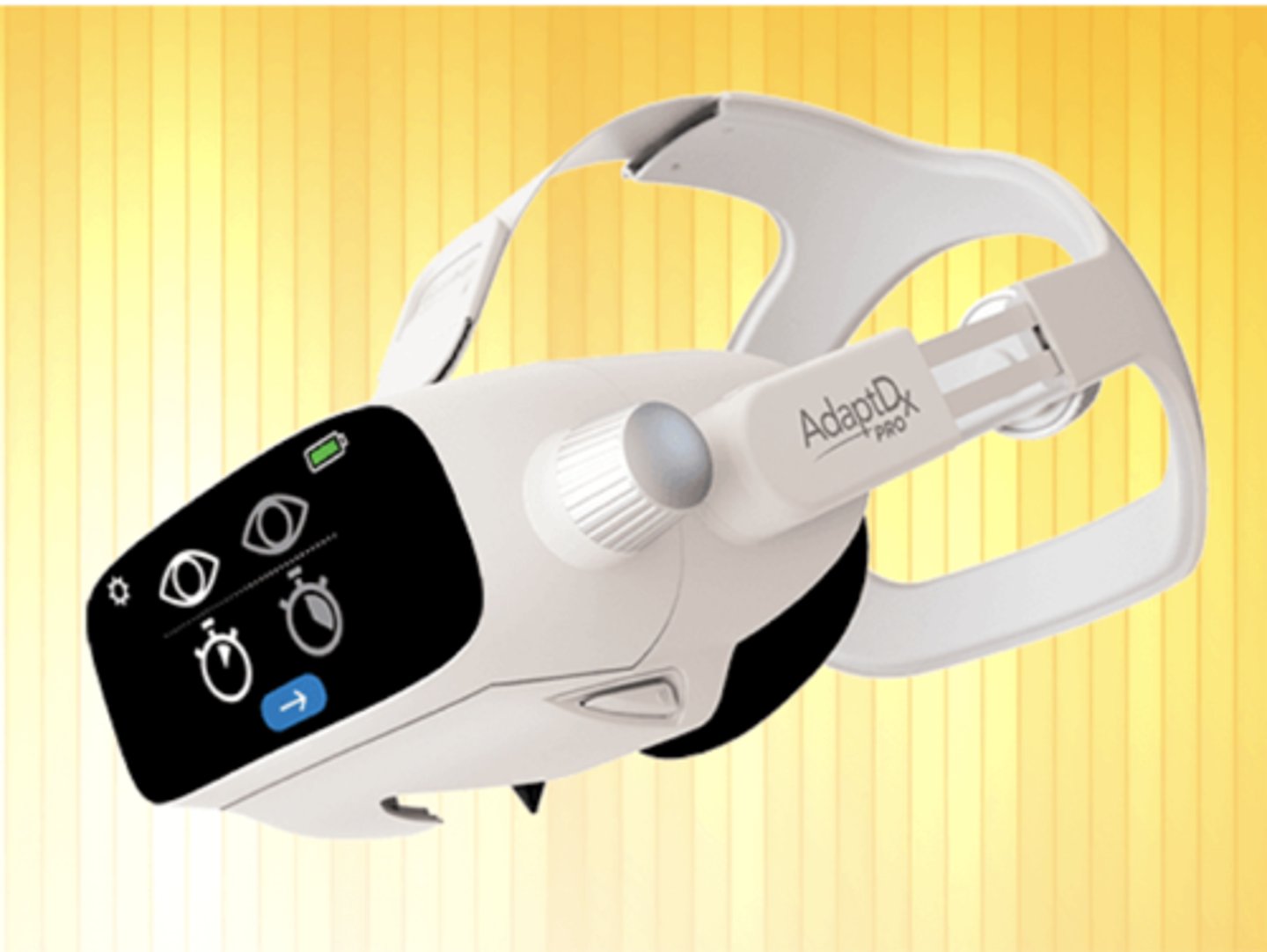
What is the next generation of dark adaptation testing?
AdaptDx Pro - head-mounted test system, virtual technician provides the patient instructions through the test
How do visual threshold change with scotopic conditions?
detect dimmer light with rod-based vision
threshold is lower (sensitivity is higher), saturate at higher light levels
How do visual threshold change with photopic conditions?
better resolution with cone-based vision
cones recover quicker from bleaching, much more saturation - Weber's fraction lower, acuity is better
Outside of the eye, can rods detect one photon?
yes
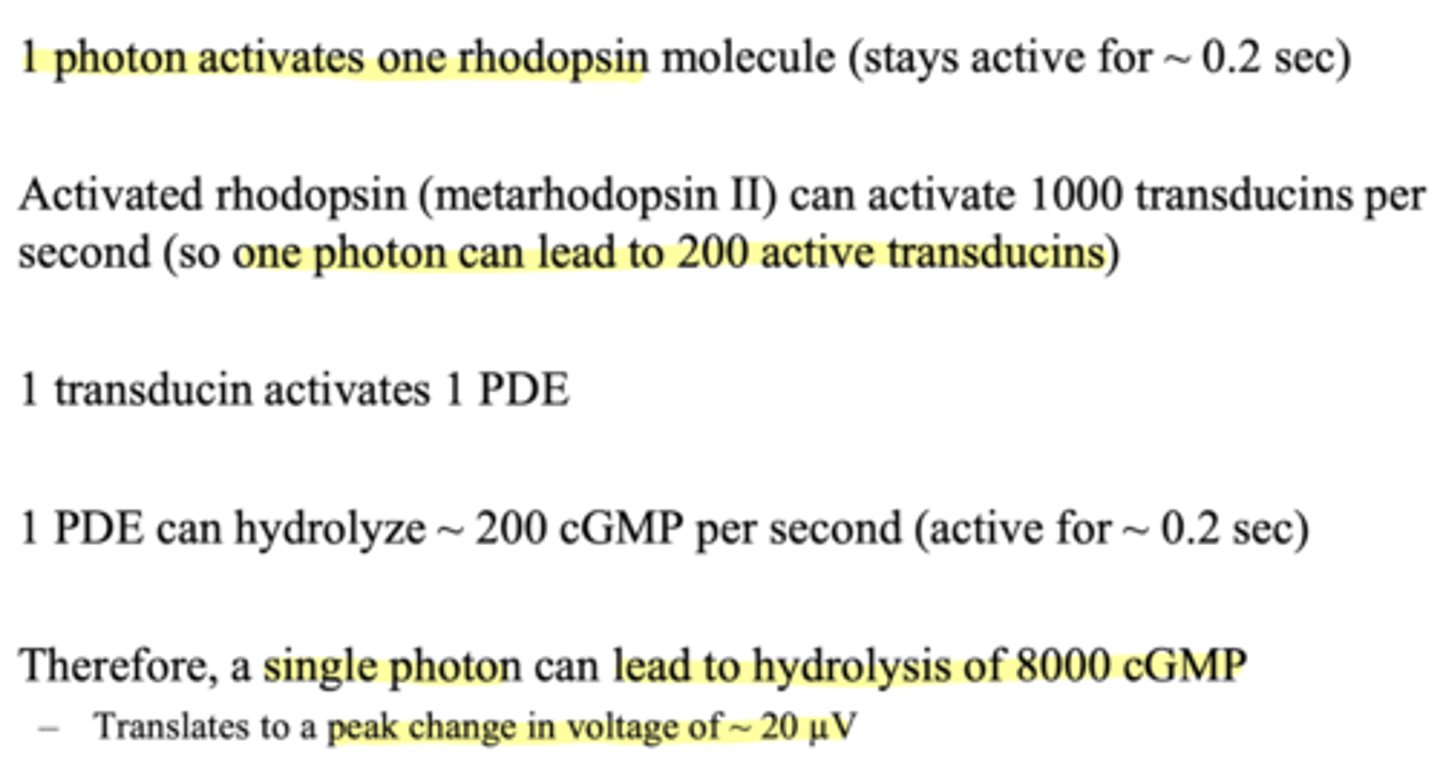
Can a human subject detect a flash of light that contains one photon?
no - only about 10% of the photons in original light flash are absorbed by rods
50% of photons in a light flash would get back to the retina (absorbed by cornea, lens, vitreous, etc.), another 40% would pass through (not absorbed) or are absorbed by cones not rods
Assuming only one photon was absorbed by the rod - can we detect that?
no, problem is noise
noise due to spontaneous isomerization of 11-cis retinal to all-trans retinal
roughly happens every 2 minutes in a single rod (120 million rods)
What is the Stiles-Crawford effect?
light entering an adult cone directly, via the center of the pupil, is more likely to be absorbed, and looks brighter
vice versa
light entering a cone at an angle, via the edge of the pupil, is less likely to be absorbed and looks dimmer
Why does peripheral entering light look dimmer? And why is this an advantage?
not completely absorbed by the outer segment
helps with aberrations
What are some reasons why rods are more sensitive than cones?
1. Stiles-Crawford effect (peripheral cones)
2. cones are noisier
3. less signal amplification in cones
4. voltage response to 1 photon in cone only 1/10 of rod
5. rods exhibit better spatial and temporal summation
What is spatial summation?
adding together of responses that occur in different photoreceptors
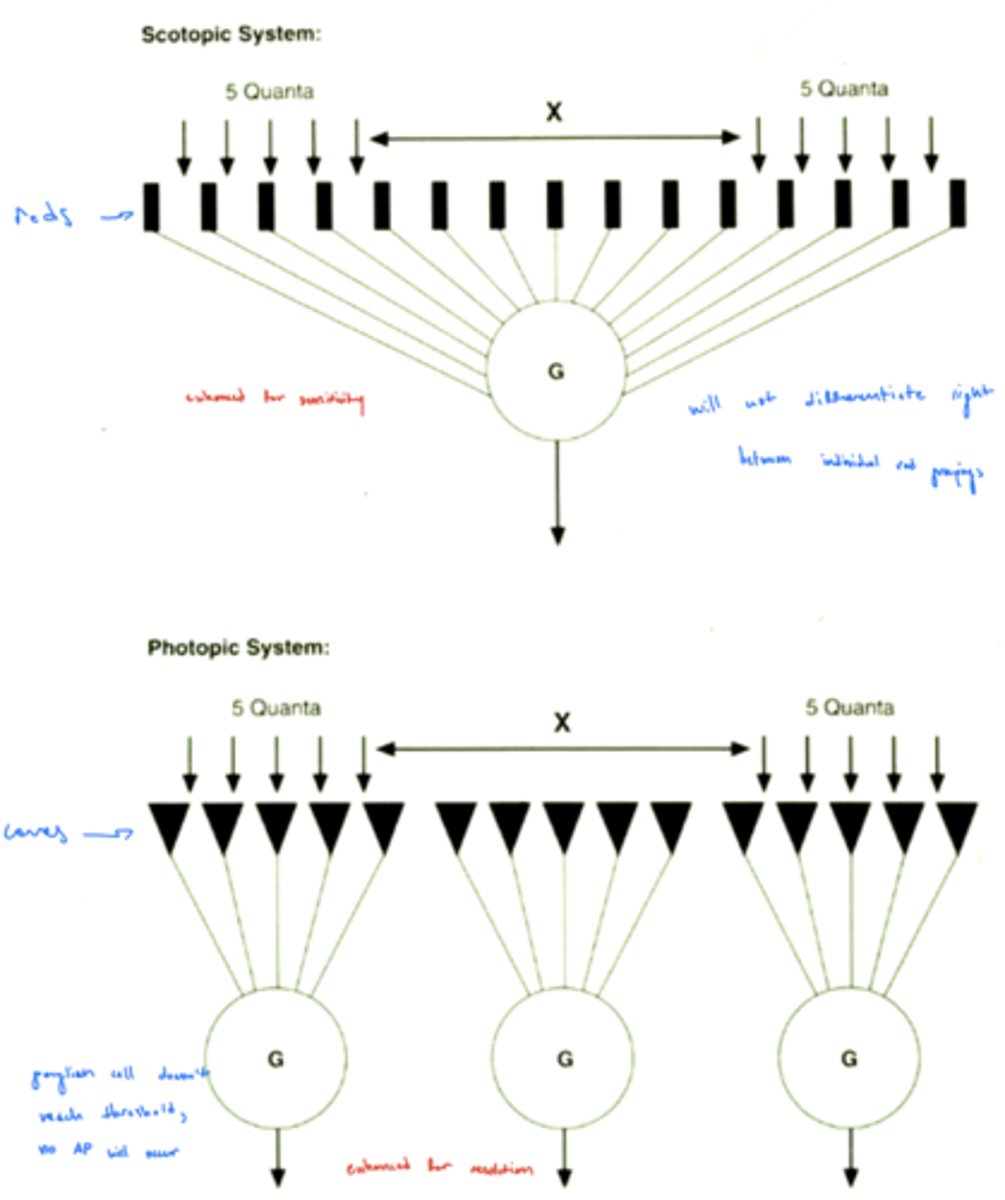
Which photoreceptor is better at spatial summation? Why?
rods
easier for the rod to absorb 10 quanta (needed to reach threshold) over its larger area
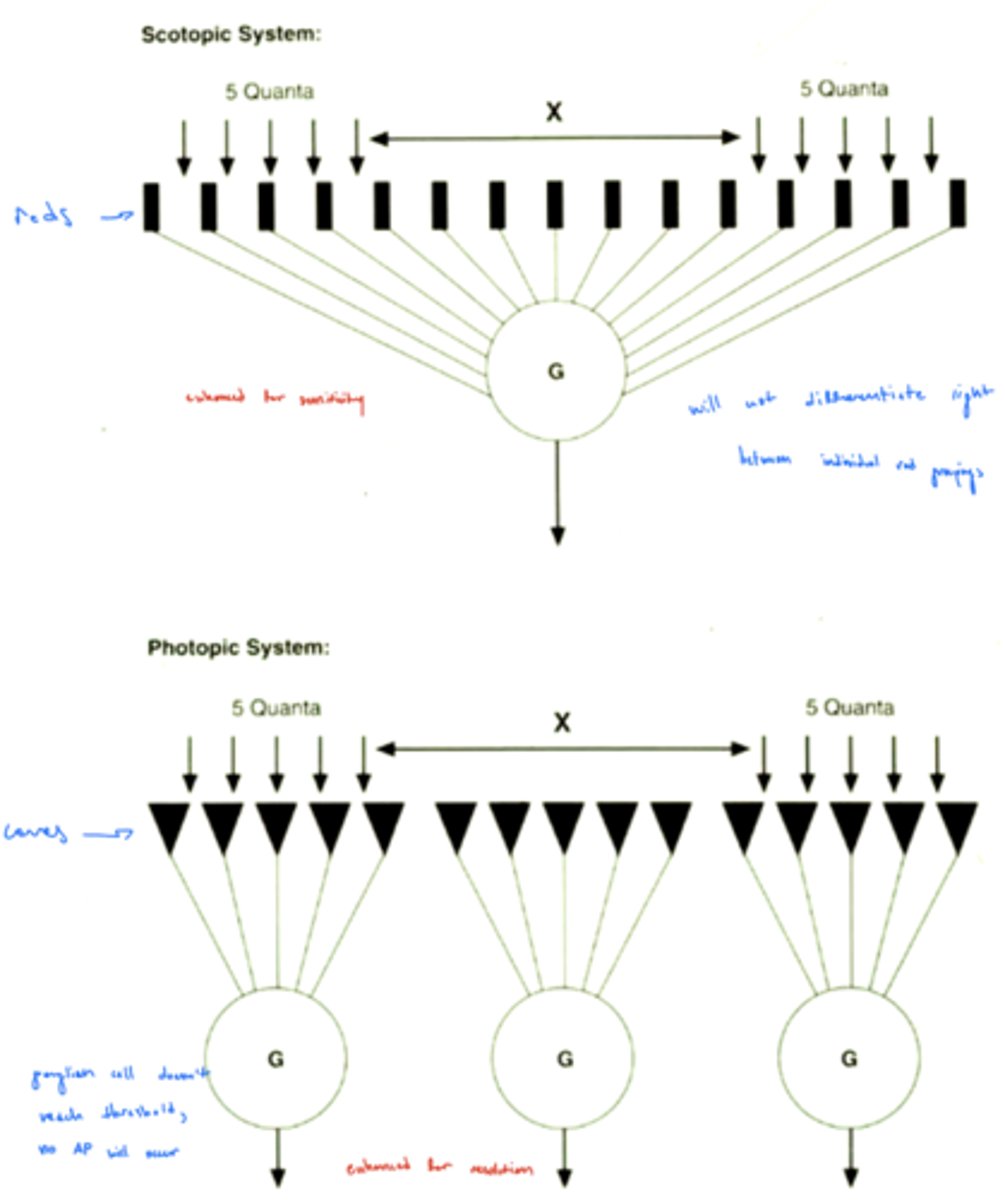
What is Ricco's Law?
threshold is independent of spot size if quanta in spot remain constant
english - small lights need 10 quanta to be seen (reach threshold), larger lights need >10 quanta to be seen
for a light that is 2x width of critical diameter, light would have to contain twice the photon number
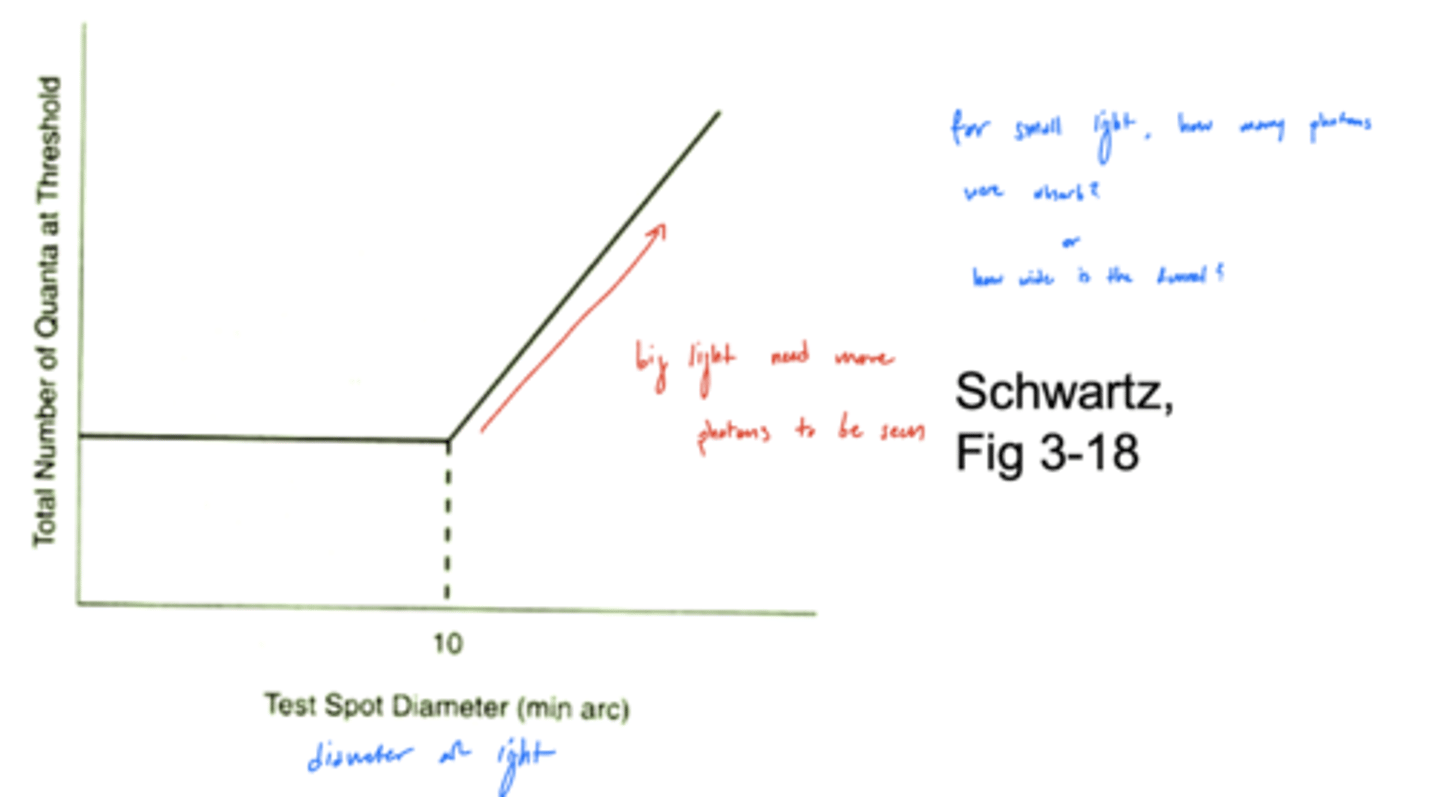
What is the test light size required for rods to see a stimulus?
10 mins of arc
What is temporal summation?
adding together of events that occur at slightly different times
Which photoreceptor has better temporal summation?
rods - sum up more information over time than cones
less resolution therefore!
Which stimulus will a rod see?
threshold - 10 luminance
temporal summation threshold - 100 msecs
1. two 5 luminance lights across 120 msecs
2. two 5 luminance lights across 80 msecs
2. two 5 luminance lights across 80 msecs
why? - add lights together, under 100 msec summation threshold
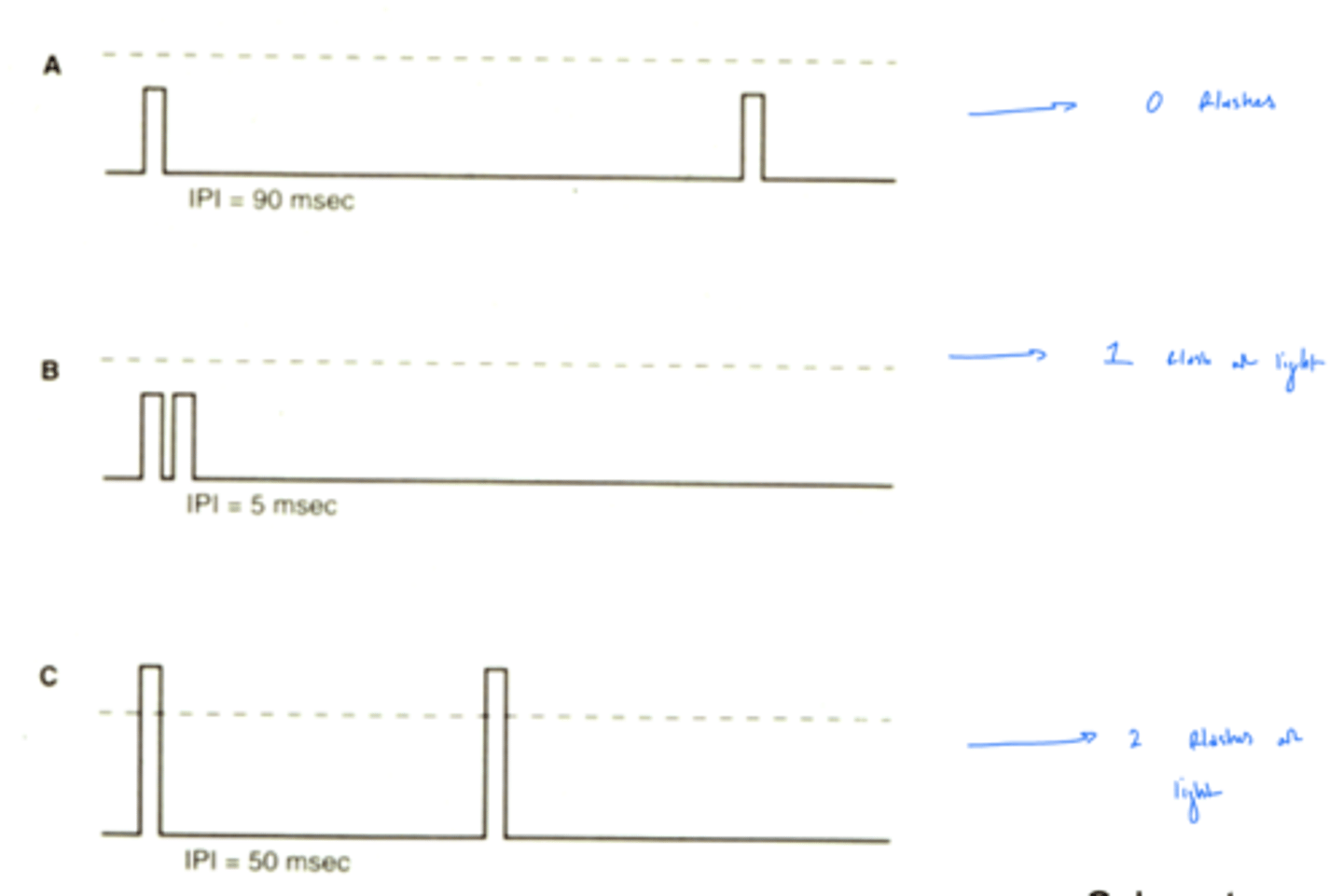
How many lights will a rod see?
threshold - 10 luminance
temporal summation threshold - 100 msecs
two 5 luminance lights 5 msecs apart
rod will see one light whether or not they're above or below (have to add up above threshold) threshold
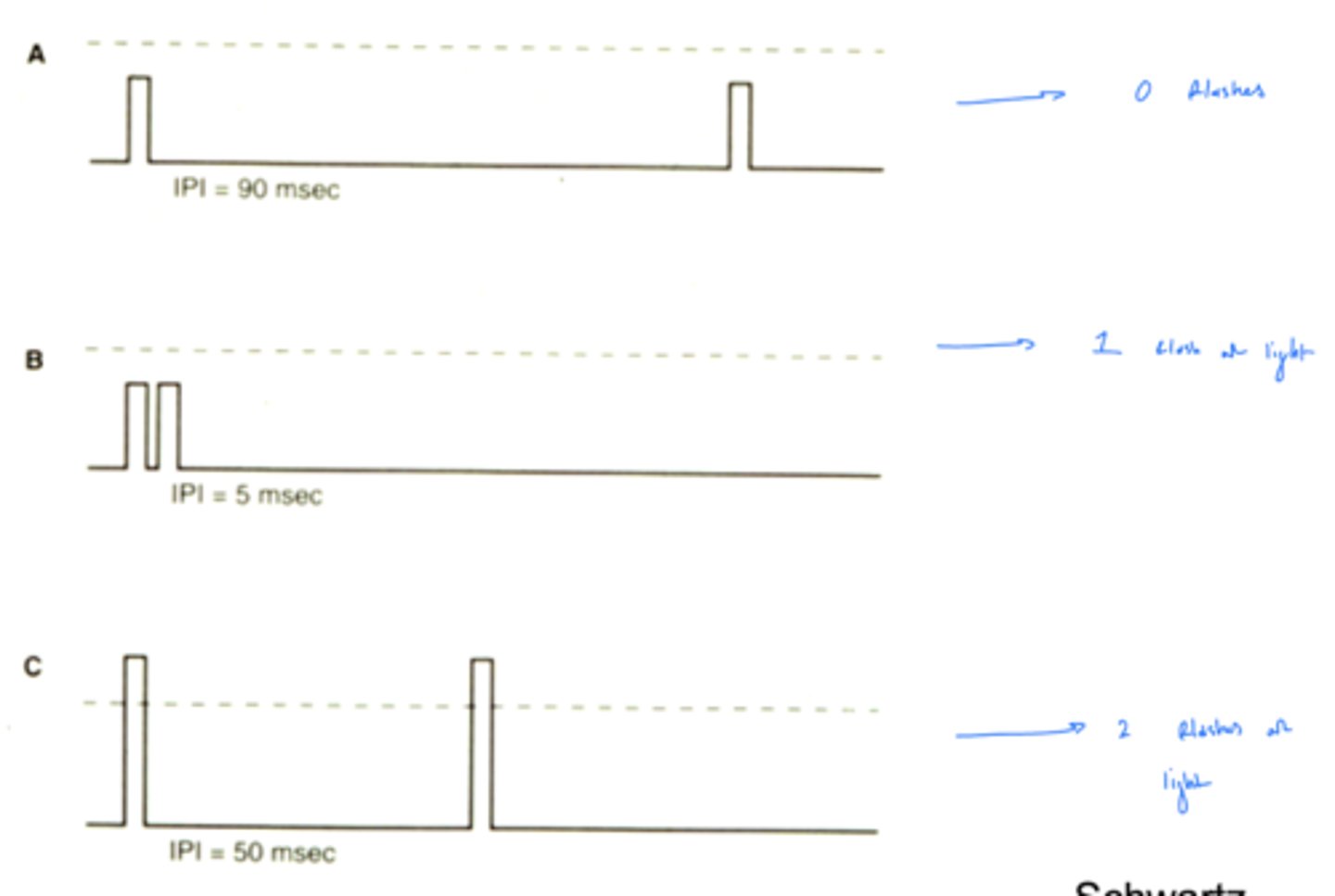
How many lights will a rod see?
threshold - 10 luminance
temporal summation threshold - 100 msecs
two 10 luminance lights 120 msecs apart
two lights
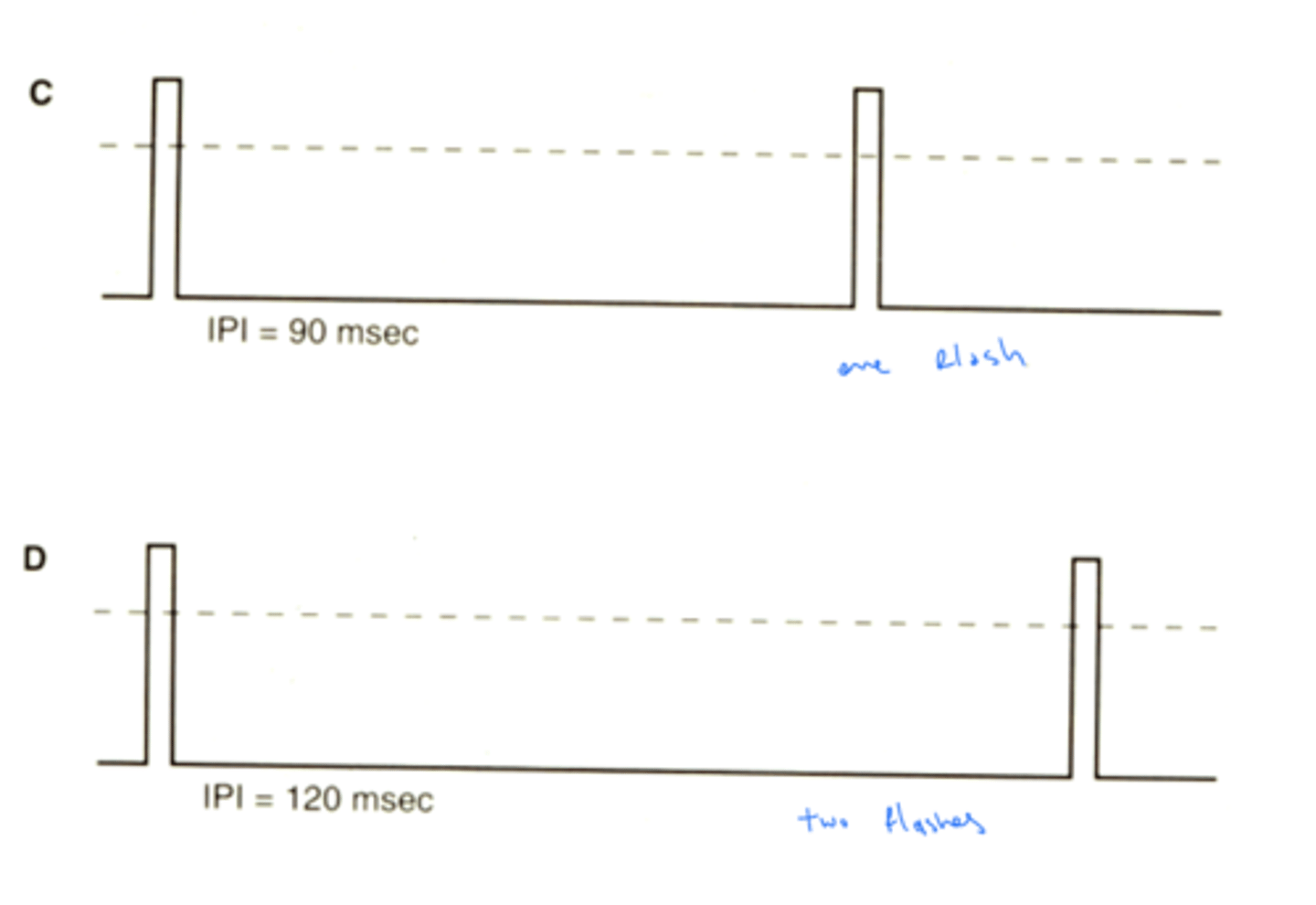
What is the critical duration for rods?
100 ms
What is the critical duration for cones?
10 ms
What is Bloch's law?
up to the critical time duration, as long as the threshold number of quanta are delivered during this period, it does not matter how they are delivered
english - if the light(s) reach threshold within the critical duration, one light will be seen
if multiple lights outside the critical duration (assuming reach threshold), multiple lights will be seen
What were the conclusions of Hecht et al.?
1 photon was enough to induce a response
100:10:1 rule
100 photons on cornea
10 photons on retina
1 photon minimum number of photon a rod can signal for
What are the absolute threshold for small, brief flashes at scotopic conditions and photopic conditions?
scotopic - 100 photons
photopic - 600 photons
ratio of 6
What are the absolute threshold for large, long flashes at scotopic conditions and photopic conditions?
scotopic - 10^-4 trolands
photopic - 10^-1 trolands
ratio of 1000
rods see 1000 times better dimmer than cones