bio p3
 Call Kai
 Learn
Learn Practice Test
 Spaced Repetition
 Match
Match Flashcards
 Knowt Play
1/16

There's no tags or description
Looks like no tags are added yet.
Name | Mastery | Learn | Test | Matching | Spaced | Call with Kai |
|---|
No analytics yet
Send a link to your students to track their progress
17 Terms
how to calculate the initial rate of reaction
measure mass/volume qs thing broken down at intervals over time
why initial rates determined for comparison
rate slows down as (q spesific substance) is used up
so rates can not be compared
describe how to make dilution out of given values
description of method (1) • calculation of dilution factor / use of C1V1=C2V2 to calculate sucrose solution volume as 2 (cm3) (1) • stating the volume of sucrose solution and calcium ion solution to be used to make 10cm3 (1)
vitamin c concentration formula
mass of vitamin C to decolourise 1cm³ of DCPIP = 10 mg × volume of vitamin C used
concentration = mass/volume
how to meassure zone of inhibition
place dish on {gridded / graph} paper (1) • count squares (1)
biodiverity
the {number of different / variety of} species (of living organisms) in an area / stated area (1)
• the genetic differences within species of living organisms (1)
describe how to modify to allow sd to be obtained
experiment repeated (1)
under the same conditions / described (1)
why eg ph is kept the same
because it might affect {(pollen grain) germination / enzymes (involved in germination)} (1)
• it is (thought to be) the optimum for {(pollen grain) germination / enzymes (involved in pollen germination)} (1)
protein test
ddition of {biuret reagent / base and copper sulfate} (1) purple colour (1)
why initial rate of reaction is better
{the rate of the reaction slows down / gelatine is used up (over time)} (1)
so rates can be validly compared / compared only if they are all initial rates (1
how to calculare initioal rate of reaction 2021 oct
measure transparency of film over time (1) plot transparency against time (1) calculate (initial rate from) gradient of straight part o
bond between amino acids and how broken
peptide bonds broken by hydrolosis
vitamin c q
because (antioxidants / vitamin C) reduce (the quantity of) free radicals (1) • that cause damage to {cells / tissues / blood vessels / endothelium} (1) • reducing {plaque / atheroma} formation (1)
how to make a solution remoing phosphates from the given thhe given table 2
remove potassium hydrogen phosphate (1) - NOT PHOSPHATE IONS
• replace potassium removed / add extra of named salt to adjust balance (1)
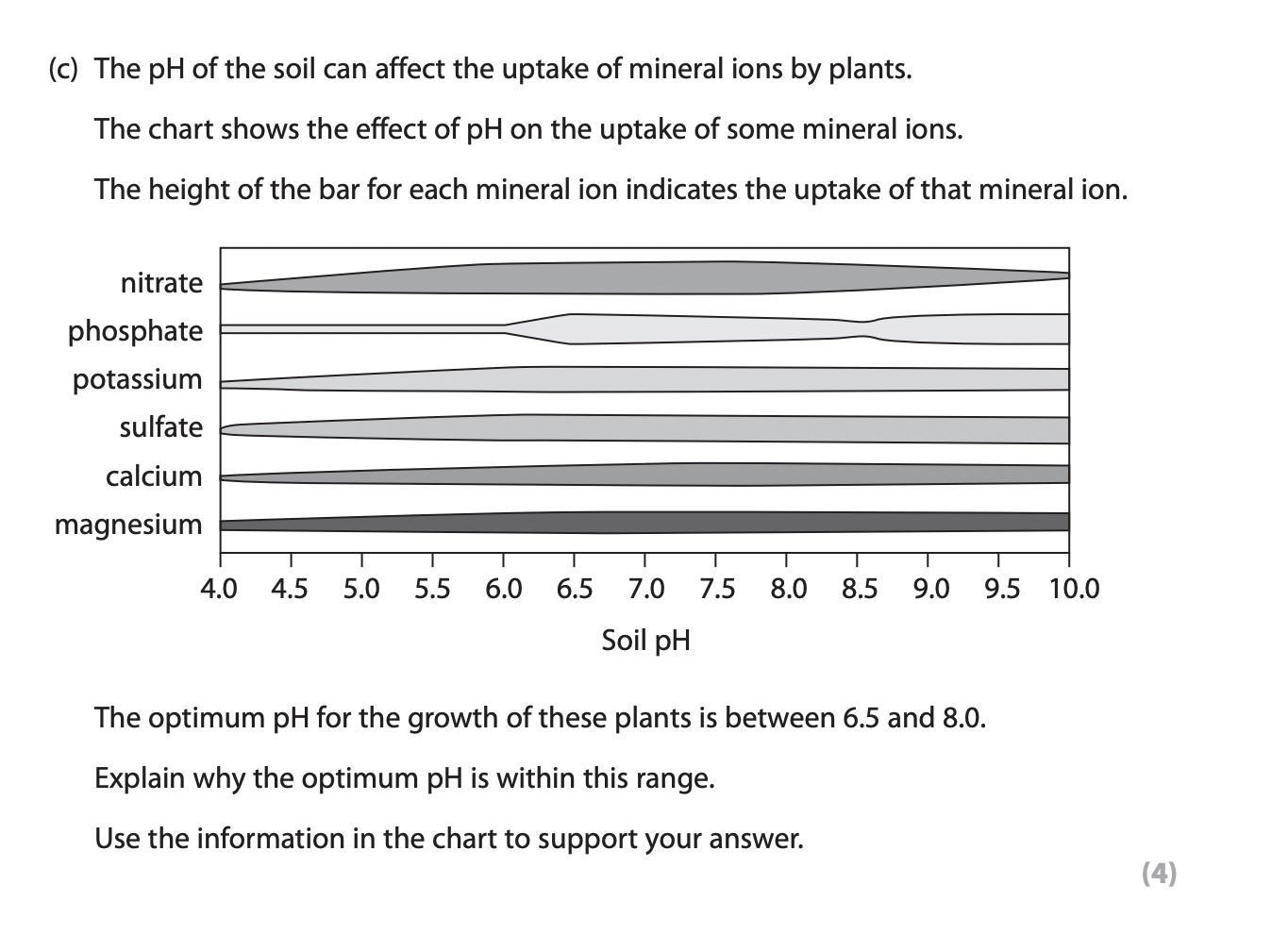
because this is the highest (uptake) of all mineral ions • {below 6.5 / at 8.0-8.5} phosphate in short supply / {above 8.0 / below 5.5} nitrate in short supply (1) • needed for appropriate {substance /process} (1) • pH {above / below} this range will denature enzymes (1)
how to use pipete accuratly
take readings at the (bottom of the) meniscus (1) • hold the pipette at eye level when taking the readings
Explain two safety precautions that must be taken when preparing bacterial plates.
{aseptic technique / description of aseptic technique} to avoid contamination of {cultures with other bacteria / ourselves with bacteria (which could be pathogenic)} (1)
• {leave the lid loose / only partially seal lid} (of Petri dish onto base) so that {conditions are aerobic / anaerobic bacteria (which could be pathogenic) do not grow} (1)
• growing bacteria at temperatures {slightly below 37°C / no higher than 35°C / body temperature} to decrease growth of pathogenic bacteria