Biomechanics Lecture 6 (Angular kinetics)
 Call Kai
 Learn
Learn Practice Test
 Spaced Repetition
 Match
Match Flashcards
 Knowt Play
1/12

There's no tags or description
Looks like no tags are added yet.
Name | Mastery | Learn | Test | Matching | Spaced | Call with Kai |
|---|
No analytics yet
Send a link to your students to track their progress
13 Terms
what is moment of inertia
Inertial property for rotating bodies, represents resistance to angular acceleration, based on both mass and the distance the radius of gyration
Moment of Inertia equation
I = m x k^2
radius of gyration
distance from the axis of rotation to a point, used as the mass distribution for calculating moment of inertia, distribution of forces above the axis of rotation
Angular Momentum
Quantity of angular MOTION possessed by a body, measured as the product of moment of inertia x angular velocity
Angular momentum equation
H = I x w OR H = Mk^2w
only difference with angular momentum is that you are accounting for the
radius of gyration
principle of conservation of angular momentum
the total angular momentum of a given system remains constant in the absence of external torques (H1 = H2)
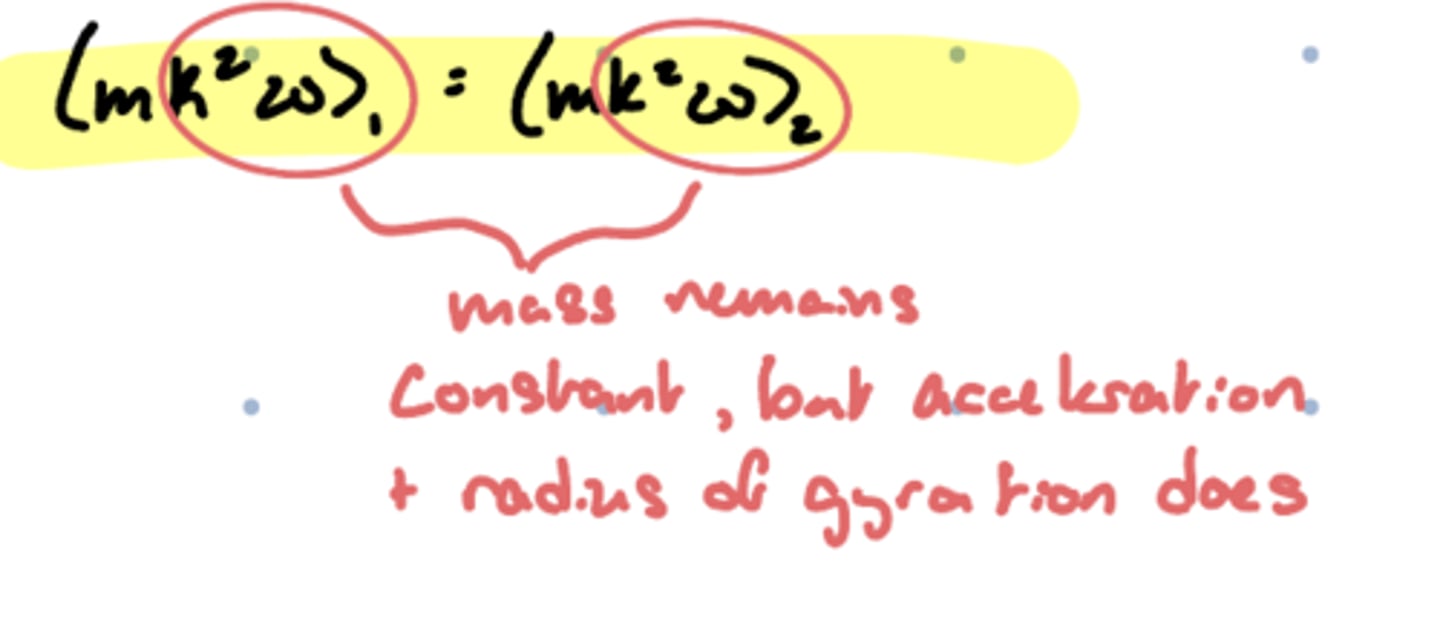
what produces change in angular momentum?
angular impulse (Tt)
angular impulse (Tt) is
the product of torque and the time interval over which the torque acts
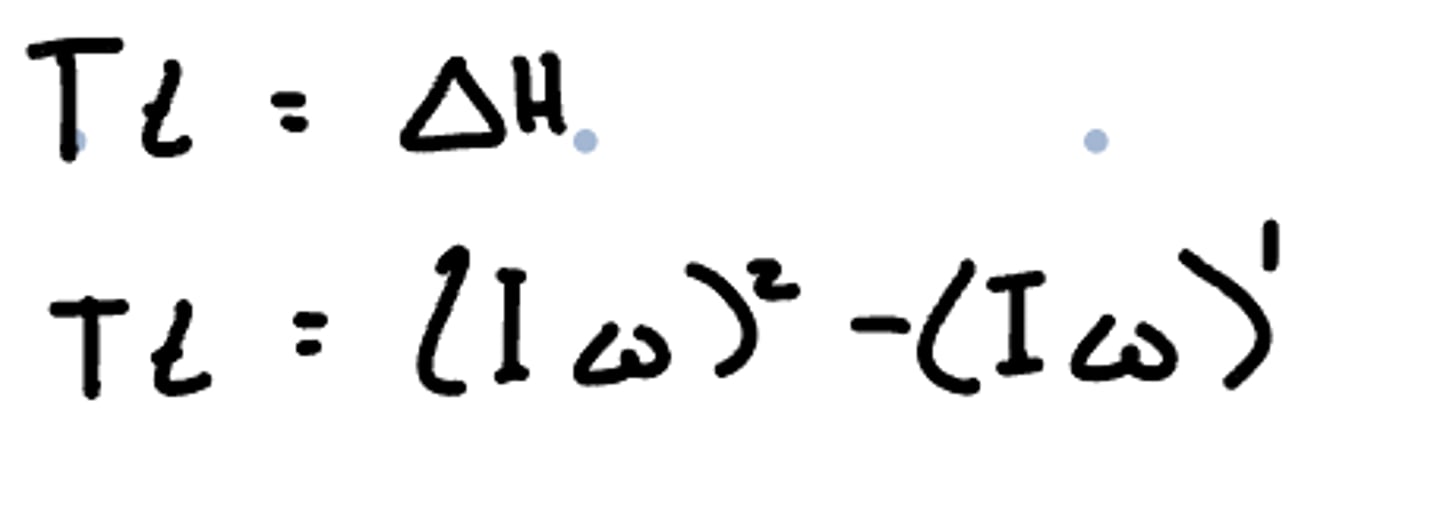
torque is the angular equivalent of force so...
force x time = impulse
Torque x time = angular impulse
Angular law of inertia
a rotating body will maintain a state of rest or constant rotational motion unless acted on by an external torque that changes the state
Angular law of acceleration
a net torque causes angular acceleration of a body that is: of a magnitude proportional to the torque, in the direction of the torque, inversely proportional to the body's moment of inertia
angular acceleration equation
T = Ia or mk^2