1904 EXPH: Chapter 5 Energy Expenditure
 Call Kai
 Learn
Learn Practice Test
 Spaced Repetition
 Match
Match Flashcards
 Knowt Play
1/30

There's no tags or description
Looks like no tags are added yet.
Name | Mastery | Learn | Test | Matching | Spaced | Call with Kai |
|---|
No analytics yet
Send a link to your students to track their progress
31 Terms
metabolic rate
is the rate of energy use by the body
basal metabolic rate (BMR)
rate of energy expenditure at rest
in supine position
thermoneutral environment
after 8hr sleep
measuring energy expenditure: direct calorimetry
heat production increase with energy production
can be measured in a calorimeter
water flow through walls
body temperature increases water temperature
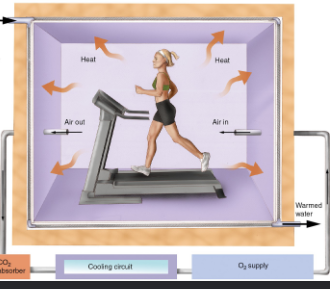
measuring energy expenditure: direct calorimetry Pro/Con
Pro: good for RESTING metabolic measurements
Con: expensive, heat added by exercise equipment, measurement errors created by sweat, neither practical not accurate for EXERCISE
measuring energy expenditure: indirect calorimetry
estimates total body energy expenditure based on O2 used and CO2 produced
measures respiratory gas concentrations
measuring energy expenditure: indirect calorimetry Pro/Con
Pro: accurate
Con: not comfortable, expensive, time consuming, required trained personnel, participant risk due to maximal exertion
POP QUIZ- what is VO2max
the highest rate of O2 consumption attainable during maximal or exhaustive exercise
fitness can be measured by the vol of O2 consumed while exercising
DONE AT YOUR MAX CAPACITY
measuring energy expenditure: O2 and CO2 measurements
VO2: vol of O2 consumed per minute
Rate of O2 consumption
Vol of Inspired O2 - Vol of expired O2
VCO2: vol of CO2 produced per minute
Rate of CO2 production
Vol of expired CO2 - Vol of inspired CO2
measuring energy expenditure: respiratory exchange ratio
O2 usage during metabolism depends on the type of fuel being oxidized
more carbon atoms in molecule = more O2 needed
Glucose (C6H12O6) < Palmitic Acid (sat fatty acid) (C16H32O2)
Respiratory exchange ratio
ratio between rates of CO2 production and O2 consumption
RER=VCO2/VO2
POP QUIZ: What fuel are you mainly using at your VO2max?
use RER as the variable to tell you
RER <1
fat metabolism
aerobic threshold
low intensity
RER= 0.85
fat and glucose metabolism
aerobic-anaerobic transition
moderate intensity
RER>1
glucose metabolism
anaerobic threshold
high intensity
exercise intensity and fuel selection
Low intensity exercise (<30% VO2 max)
Fats are primary fuel during prolonged low intensity exercise
High intensity exercise (>70% VO2 max)
CarboH (glucose) are primary fuel
“Crossover concept”
describes the shifts from Fat to CHO metabolism as exercise intensity increases
RER for fat (C6H32O2+ 23 O2→16 CO2 + 16 H2O
RER= VCO2/VO2 = 16 CO2 / 23 O2 = 0.70
RER for CarboH (glucose) (C6H12O6 + 6 O2→ 6 CO2 + 6 H2O)
RER= VCO2/VO2 = 6CO2/6O2 = 1.00
energy expenditure during aerobic exercise
point at which O2 consumption doesn’t increase with further increase intensity
the primary criterion is a plateau in VO2
best single measurements of cardiorespiratory fitness
more training allows athlete to compete at higher percentage of VO2max
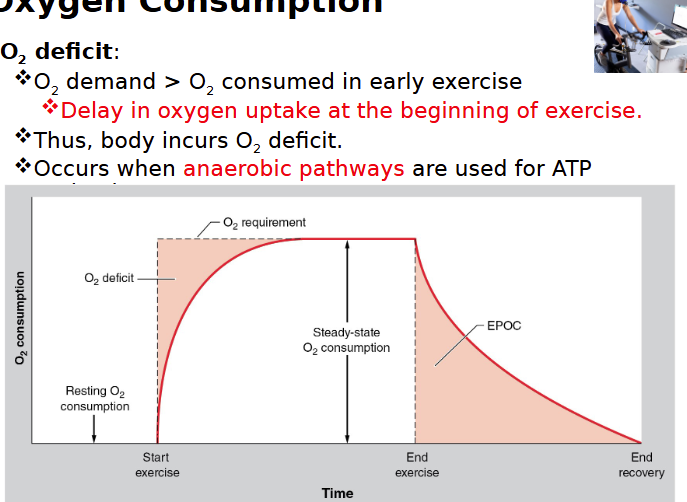
oxygen consumption: O2 deficit
O2 demand > O2 consumption in early exercise
delay in oxygen uptake at the beginning of exercise
thus, body incurs O2 deficit
occurs when anaerobic pathways are used for ATP
(@ ANAEROBIC PATHWAY) → not enough Oxy at early exercise!
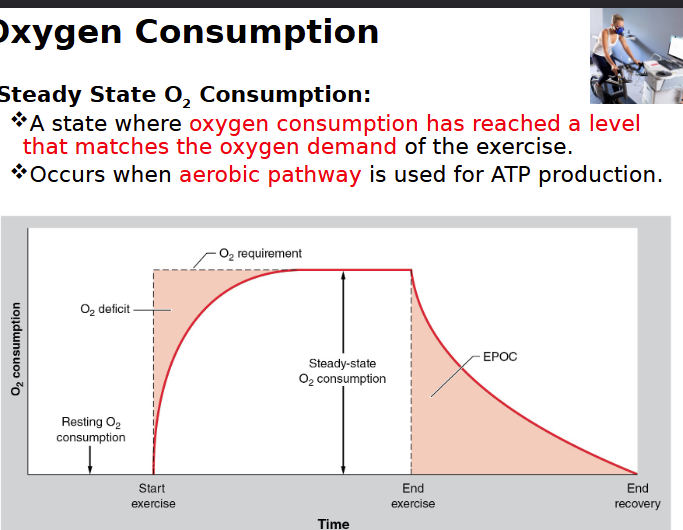
oxygen consumption: steady state O2 consumption
a state where oxygen consumption has reached a level that MATCHES the oxygen demand of the exercise
occurs when aerobic pathway is used for ATP production
meet w plateu
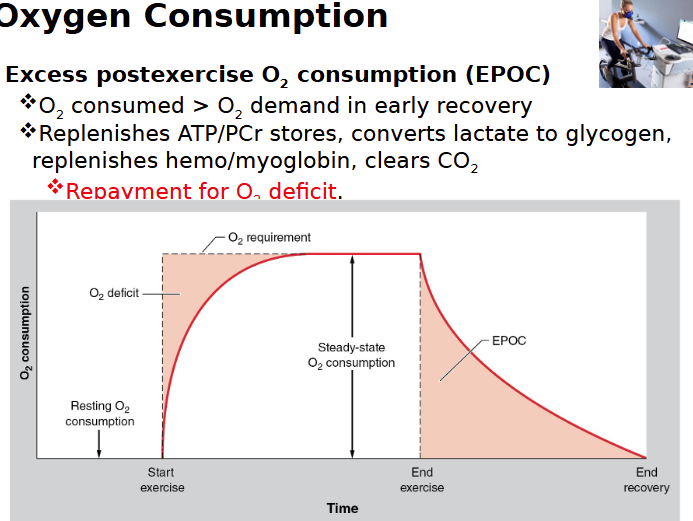
oxygen consumption: excess postexercise O2 consumption (EPOC)
O2 consumed > O2 demand in early recovery
replenishes ATP/PCr stores, coverts lactate to glycogen, replenishes hemo/myoglobin, clears CO2
REPAYMENT FOR O2 deficit, all oxy not provided at the start of exercise will be provided at end
EPOC notes
excess postexercise O2 consumption
EPOC →all oxy that not provided at early exercise will provide at the end of exercise
(replenish everything) → recovery portion of VO2 max
if larger oxy deficit = larger EPOC
if smaller oxy deficit = smaller EPOC
true or false: smaller EPOC in athlete
true, athlete more efficient transmit quick to aerobic and spend less time in APCr and glycolic = smaller oxy = smaller EPOC
true or false: smaller O2 deficit in athlete
true, athlete have smaller O2 deficit bc they transition to aerobic faster due to more capillaries and mitochondria
oxygen consumption: LESS LACTATE PRODUCATION AT THE BEGINNING OF EXERCISE
less lactate at early exercise
better developed aerobic bioenergetic capacity due to:
cardiovascular adaption (more capillaries)
muscular adaptions (greater mitochondria vol)
energy expenditure during maximal aerobic exercise
absolute VO2 max expressed in L/min
relative VO2 max normalized for body weight
ml O2 * kg -1 * min^-1 (mili per kg per min)
more accurate comparison for different body size/ BW
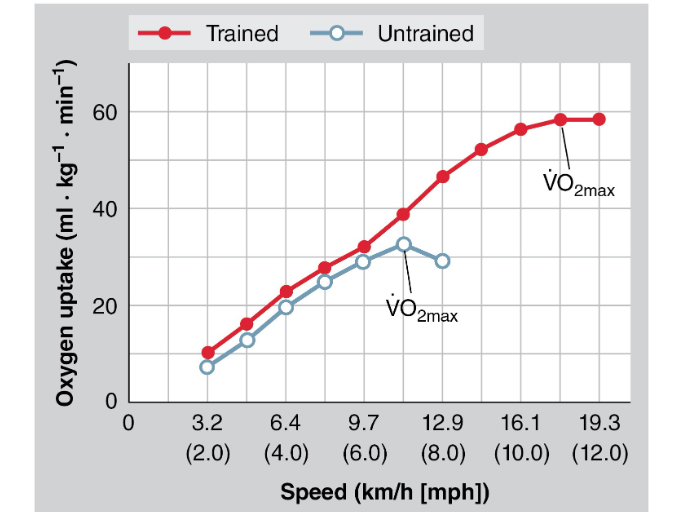
oxygen uptake: trained vs untrained
untrained: reach VO2 max faster
train: reach VO2 slower due to more capillaries + mitochondria (staying longer induration)
what is lactate
produced at glycolic system (2)
if no oxy, produced lactate through lactate dehydrogenase
can be used for: oxidized in mitochondria, can be transmitted to lactate shuttle to be oxidized, lactate can convert into glucose → gluconeogenesis
anaerobic energy expenditure: lactate threshold
lactate threshold: point at which blood lactate accumulation increases markedly → while exercise, accumulation blood lactate, point where it significantly increases (LT)
lactate production rate > lactate clearance rate
(LPR >LCR) → body not able to clear lactate at same speed that produce which marks the increase
higher lactate threshold = better endurance performance
for two athletes with same VO2max higher lactate threshold predicts better performance.
energy expenditure: successful endurance athletes
high VO2 max
high lactate threshold (as % VO2 max)
high percentage of Type I muscle fibers (aerobic cell respiration)
(type 1 more successful bc it’s a aerobic cell respiration)
energy expenditure during maximal aerobic exercise notes
plateau→ the true VO2 max
EPOC→ O2 consumed > O2 demand in early recovery
(EPOC restores ATPCr , lactate →glycogen (gluconeogenesis), body temp CO2 recovery
O2 deficient→ O2 demand > O2 consumption at early exercise. (Anaerobic pathway for ATP
when start of exercise, muscle demand oxy