A&P Digestive System Week of 4.20
 Call Kai
 Learn
Learn Practice Test
 Spaced Repetition
 Match
Match Flashcards
 Knowt Play
1/73

There's no tags or description
Looks like no tags are added yet.
Name | Mastery | Learn | Test | Matching | Spaced | Call with Kai |
|---|
No analytics yet
Send a link to your students to track their progress
74 Terms
What are the monomer products of starch and glycogen digestion?
Monosaccharides.
What are the macro moles that we need to digest into their monomers and subunits?
Starch and glycogen into monosaccharides
Protein break them down into large - short peptides - amino acids
Triglycerides - break down into glycerols and 3 fatty acids
Nucleic acids - break dna and rna down into nucleotides
What are the final breakdown products of protein digestion?
Amino acids.
Where does digestion happen?
mouth, stomach, small intestine (gastrointestinal tract)
What is the gastrointestinal tract?
a long tube that extends from the mouth to the anus. Lumen contained inside (where the food goes) and has accessory glands and structures associated with it?
What are the types of digestion?
Mechanical and chemical digestion
What is mechanical digestion?
Physically breaking down food into smaller pieces
What is the primary benefit of mechanical digestion?
It increases the surface area of food, making chemical digestion more efficient.
What is chemical digestion?
The chemicals in food being broken down by enzymes (now you are actually changing the chemistry of the thing, ex breaking down carbohydrates into smaller sub units)
What is absorption?
Taking digested food into the blood stream
What is propulsion?
Moving the food through the system, (swallowing and peralstasis)
What happens in the mouth
Begins mechanical digestion (because you are chewing), Begins chemical digestion (break down starch here), Monitor food quality (taste), Prepare food for swallowing, Teeth, salivary glands, and tongue, Some but not much absorption (ex aspirin and alcohol
What are the incisors?
front teeth, chisel structures important for cutting (initial mechanical digestion)
What are cuspids (canines)?
3rd from middle
What are premolars?
broad crowns with rounded cusps used to grind or crush. Two teeth after cuspids on each side
What are molars?
3 teeth after premolars More involved with the chewing and breaking up of food into smaller pieces
What are the three types of salivary glands in the mouth?
Sublingual, submandibular, and parotid glands.
Where are sublingual glands?
under the tongue
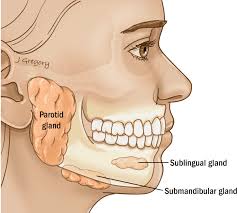
Where are submandibular glands?
below the mandible on each side
What is the parotid?
sitting on top of masseur?
What do the salivary glands do?
They produce amylase in the saliva, water moistens food so you can taste it
What is the function of salivary amylase?
It is an enzyme that begins the chemical digestion of starch.
What is the tongue?
A large skeletal muscle that allows for speech, and forms food into a bolus. It also has taste buds and two lingual glands -- lingual lipase and mucus
What is the purpose of the mucus on the tongue?
to help hold food bolus together
What is a bolus?
A chunk of food formed by the tongue to be swallowed.
What are the three regions of the pharynx?
Nasopharynx, oropharynx, and laryngopharynx.
Where is the nasopharynx?
Behind nasal cavity
Where is the oropharynx?
Behind oral cavity
Where is the laryngopharynx?
behind larynx
What are the three phases of the swallowing reflex (deglutition)
Voluntary, Pharyngeal Phase, Esophageal Phase
What is the voluntary phase of the swallowing reflex?
your tongue pushes to food towards the back of the mouth and as your tongue does this, it closes off the oral cavity
What is the pharyngeal phase?
involuntary, controlled by the medulla, soft palate pushed up the block nasal cavity, larynx comes up to meet the glottis, the epiglottis closes over the glottis and swallowing begins
What is the esophageal phase of the swallowing reflex?
peristalsis moving the food down the esophagus to the stomach
What is peristalsis?
wave-like muscle contractions moving the food down the esophagus into the stomach
What is the esophagus?
Tube that gets from the pharynx to the stomach
What is the function of the lower esophageal sphincter?
It stays closed to prevent heartburn by keeping stomach contents from entering the esophagus.
What is the stomach?
A muscular sac that digests proteins, breaks down food, and mixes it with digestive juices
What happens in mechanical digestion in the stomach?
Formation of chyme(food mixed with digestive juices in the stomach), Sphincters control flow,Lower esophageal sphincter keeps it from going of, Pyloric sphincter opens to allow small amounts of chyme into the small intestine and then closes up again, lingual lipase beecomes active and breaks down lipids
What is chyme?
Food mixed with digestive juices in the stomach.
What are the two sphincters in the stomach?
lower esophageal sphincter and pyloric sphincter
What is the function of the pyloric sphincter?
Opens to allow small amount of chyme into the small intestine and then closes up again
What is the function of the garlic pits?
To produce mucus, and Important because it will line the surface of the stomach and protect the stomach from its own gastric juices which are really acidic
What happens in the gastric gland?
Stomach produces gastic juice, Pepsinogen converted to pepsin (break down proteins) by HCL (produced by stomach) (super acidic)
Intrinsic factor - protein that helps you get vitamin B12 out of your food and absorb in into small intestine
What converts pepsinogen into active pepsin?
Hydrochloric acid (HCl).
What is the role of intrinsic factor?
It is a protein that helps the body absorb vitamin B12 in the small intestine.
What is gastrin?
hormone produced in the stomach and triggers glands to release gastric juice
What are the three sections of the small intestine?
Duodenum, jejunum, and ileum.
What is the duodenum?
first part of the small intestine, feeds into the next region of the stomach called the jejunum
What is the jejunum?
Middle section of the small intestine.
What is the ileum?
Final part of the small intestine, will dump stuff from the large intestine
What are the three thing that help the small intestine be involved in chemical and mechanical digestion?
Pancreas, liver, and gall bladder
Where does most absorption of nutrients happen?
small intestine
What are the carbohydrate enzymes in the small intestine?
Maltase, sucrase, lactase
What is the protein enzyme in the small intestine?
peptidases
what are the nucleic acid enzymes in the small intestine?
Nucleosides, phosphates
What are the three important pieces (with descriptions) of absorption in the small intestine?
Circular folds, which have villi (finger like extensions to increase surface area of SI) and micro villi (more extensions)
What are the three structural features that increase the surface area of the small intestine?
Circular folds, villi, and microvilli.
What is segmentation in the small intestine?
Alternating smooth muscle contractions that mix food bolus/chyme with digestive juices in mechanical digestion of the small intestine
What is the migrating motility complex?
Peristalsis over short sections, pushing food down just a little bit further through the small intestine to large intestines
What is pancreatic juice?
roduced in the pancreas, flows through pancreatic duct, and flows to inside lining of small intestine and duodenum
What are the protein enzymes in the pancreas (non active state until duodenum)
Trypsin, chymotrypsin, carboxpeptidase
What is the function of pancreatic amylase?
will break down starch
what is the function of pancreatic lipase?
will break down lipids
What is the function of pancreatic nuclease?
Will break down nucleic acid
What is the function of sodium bicarbonate in pancreatic juice?
It neutralizes the acidity of chyme coming from the stomach because enzymes don't work well in acid
What is the function of the liver?
Regulates blood glucose levels, Makes lipoproteins → aid transport in the blood, Removes toxins, Produces bile
What is the function of the gallbladder?
stores and concentrates bile, produces Cholecystokinin hormomone
What hormone triggers the gallbladder to release bile?
Cholecystokinin (CCK).
What is the function of Cholecystokinin
hormone produced in the small intestine, small intestine produced this when fats enter the small intestine, this triggers the gall bladder to contract, and releases bile into the small intestine
What is the primary function of bile?
To emulsify fats.
What are the main functions of the large intestine?
Absorbing water, hosting bacteria that produce vitamins, and storing/eliminating feces.
List the parts of the colon in order of flow.
Cecum, ascending colon, transverse colon, descending colon, and sigmoid colon.
Where does lingual lipase become active?
In the stomach.