STATS One-way within-subjects (repeated measures) ANOVA
 Call Kai
 Learn
Learn Practice Test
 Spaced Repetition
 Match
Match Flashcards
 Knowt Play
1/12

There's no tags or description
Looks like no tags are added yet.
Name | Mastery | Learn | Test | Matching | Spaced | Call with Kai |
|---|
No analytics yet
Send a link to your students to track their progress
13 Terms
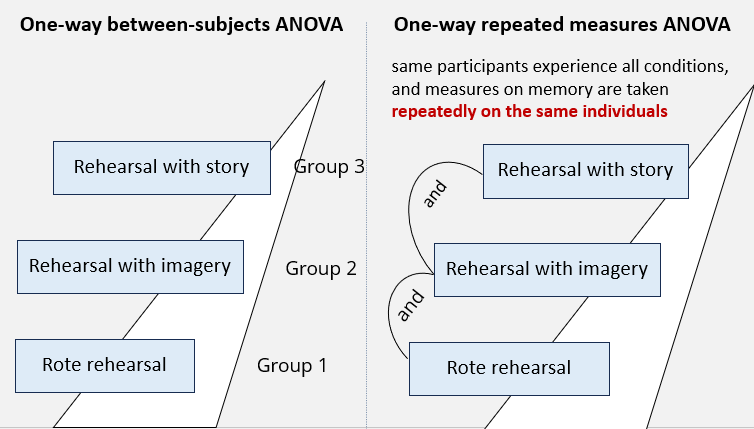
Difference between between-subjects ANOVA and within-subjects ANOVA
Between-subjects design
Each participant appears under only one level/condition
One IV
Within-subjects design
Same participants appear in ALL conditions
One IV
Evaluation of Between-subjects (independent groups) ANOVA
PROS:
Simplicity
CONS:
Large variability from person to person: there could be one participant that is really eager than the other
Requires large sample sizes for power
Evaluation of One-way within-subjects (repeated measures) ANOVA
PROS:
More economical - fewer cases
Controls for individual differences
Providing relatively accurate estimates - accurate detecting the effect of the conditions or treatments being tested
CONS:
Carryover effects - exposure to treatment at one time influences responses to another
Practice effect
Fatigue effect
3 Assumptions for one-way within-subjects (repeated measures ANOVA)
Levels of measurement - DV is continuous
Normality of residuals - Residuals are normally distributed close to the reference line on a QQ plot
Assumption of sphericity
Sphericity
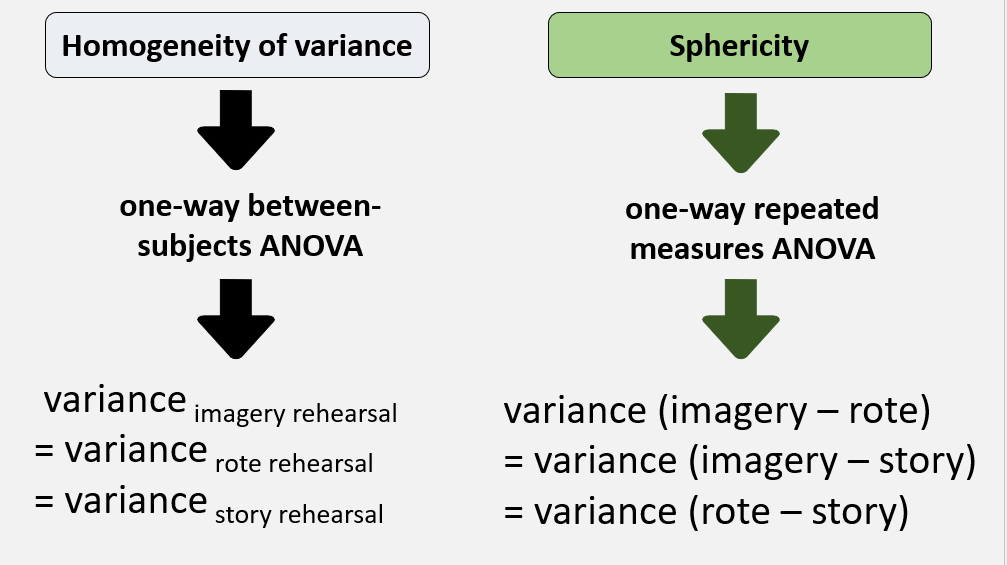
Variance of differences between any two conditions must be the same as the variance of the differences between any other two conditions
Variance of the differences between Rote rehearsal and Story rehearsal
=
Variance of the differences between Rote rehearsal and Imagery rehearsal
=
Variance of the differences between Story rehearsal and Imagery rehearsal
Instead of looking at the 3 groups seperately (homogeneity of variance), sphericity looks at the variances with each pair making sure its equal
Uses Mauchly’s test
Mauchly’s test for Sphericity and its violations
W statistic = .xx, p = .xx
If p < .05, the assumption of sphericity is violated
If p > .05, the assumption of sphericity is satisfied
Without sphericity, we are in danger of making Type II errors → the test therefore loses statistical power → test is less sensitive to detecting true differences
Sphericity correction if the assumption is violated
Greenhouse-Geisser (GG) correction or Huynh-Felt correction (HF)
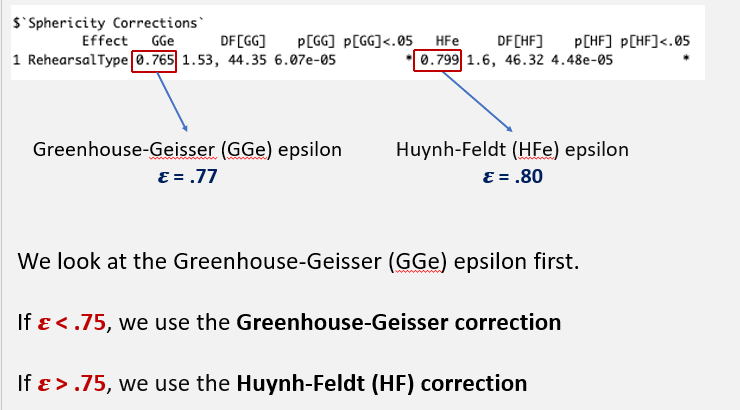
Epsilon (𝜺) : sphericity estimate → under GGe or HFe in R
Measures how far the data is from the ideal sphericity
Ranges between 0 and 1 (1 = no violation of sphericity)
Look at the Greenhouse-Geisser (GGe) epsilon first
If 𝜺 < .75, we use the Greenhouse-Geisser correction
If 𝜺 > .75, we use the Huynh-Feldt (HF) correction
Therefore, if sphericity is violated, only report the scores AFTER the sphericity correction
What is the post hoc test for one-way within-subjects ANOVA?
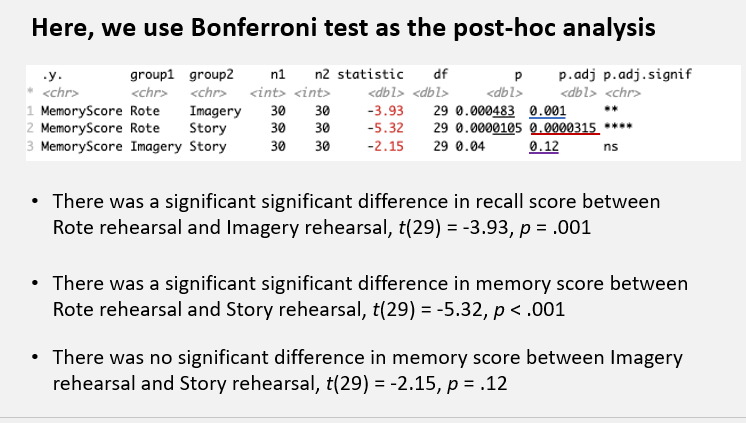
Bonferroni method
t(df) = statisticx.xx, p = p.adj.xxx
What do you do after the post-hoc analysis for one-way within-subjects ANOVA?
You already have the generalised effect size for the overall ANOVA (ηG2 generalised eta squared), you also need to calculate the effect size (Cohen’s d) for each of the pairwise comparison
Write-up
We conducted a one-way repeated measures ANOVA to test the effect of rehearsal types on memory performance.
Mauchly’s test of sphericity revealed a violation of sphericity (p = .006). A one-way repeated measures ANOVA with a Huynh-Fedlt correction suggested a significant effect of rehearsal types on memory performance, F(1.6, 46.32) = 14.57, p < .001, , ηG2 = .14.
Bonferroni-adjusted pairwise comparisons showed that students using the rote rehearsal strategy had significantly lower memory performance compared to those using the imagery rehearsal strategy (t(29) = -3.93, p = .001, d = -.72) and those using the story rehearsal strategy (t(29) = -5.32, p < .001, d = -.97). However, there was no significant difference between the imagery and story rehearsal strategies (t(29) = -2.15, p = .12, d = -.39).
When do you omit the 0 before a decimal point in a write up?
If the number can exceed 1, you keep the 0 (F-value, pairwise comparisons)
If the number cannot exceed 1, omit the 0 (correlations, epsilons, effect sizes, p values)
Note: for zeros after decimal points, always include trailing zeros even after 1 significant figure (to ensure that it is 2 significant figures)
How do you know the direction of a pairwise comparison?
If the cohen’s d is positive (positive effsize), then group 1 has a higher mean than group 2
If the cohen’s d is negative (negative effsize), then group 1 has a lower mean than group 2
If sphericity is violated, which results do you include/exclude?
Use the corrections degrees of freedom and p-value
Keep the original F-value and generalised effect size