Language and Semantic Knowledge Systems
 Call Kai
 Learn
Learn Practice Test
 Spaced Repetition
 Match
Match Flashcards
 Knowt Play
1/71

There's no tags or description
Looks like no tags are added yet.
Name | Mastery | Learn | Test | Matching | Spaced | Call with Kai |
|---|
No analytics yet
Send a link to your students to track their progress
72 Terms
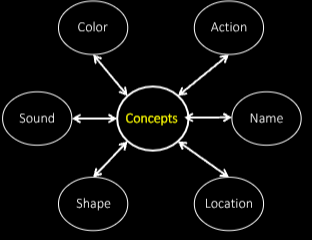
What is a concept?
Perceptually-grounded symbols, conjunction of perceptual, motor etc reps involved in experiences with instances of the concept
What is family resemblance?
Concept categories are structured around similarity (perceptual-motor or amodal)
BUT features are probabilistic, not necessary/sufficient
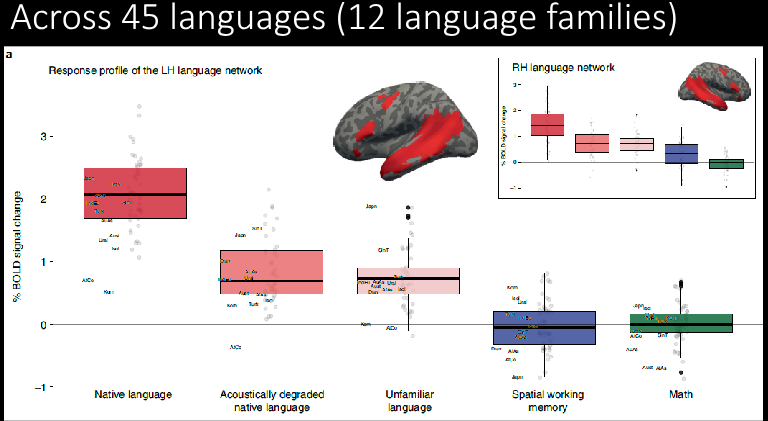
How was Malik-Moraleda’s (2022) study into universal attributes of language conducted (design)?
Language localizers
English localizer: reading sentences vs. nonwords.
Native-language localizer (critical task):
Listening to short passages from Alice in Wonderland in:
Their native language
An acoustically degraded version (speech-like but unintelligible)
An unfamiliar foreign language
Non-linguistic control tasks
Spatial working memory task
Arithmetic (math) task
Naturalistic cognition
Listening to a coherent story in the native language
Resting-state scan
Properties tested:
Topography – location in frontal, temporal, and parietal cortex
Left-hemisphere lateralization
Functional integration – strong correlations among language regions
Functional selectivity – stronger responses to language than to non-linguistic tasks
What were the findings of Malik-Moraleda’s (2022) study into universal attributes of language?
The neural architecture supporting language is universal, despite dramatic surface-level differences between languages
Universal features:
Consistent anatomical location
Predominant left lateralization
Strong internal functional connectivity
Selectivity for linguistic processing
These properties likely reflect shared biological constraints shaped by evolution
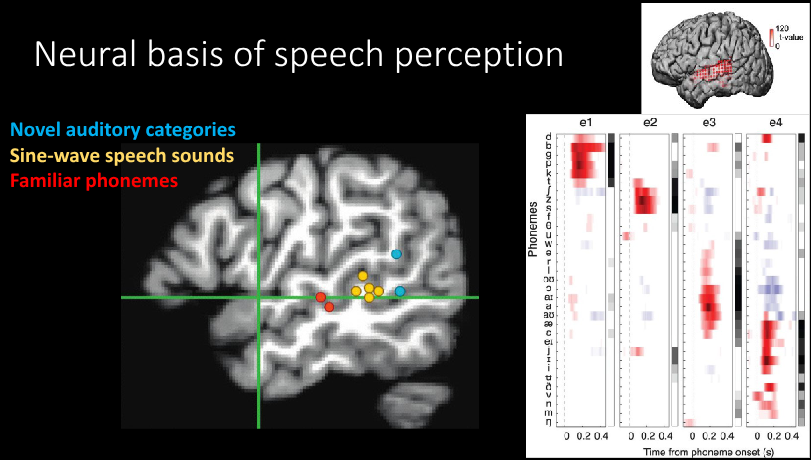
Neural basis of speech perception (diagrams)
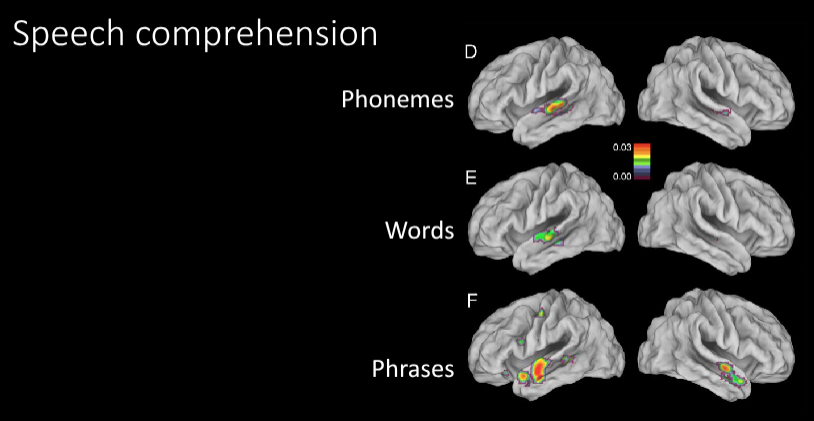
Speech comprehension (diagrams)
How are semantic features distributed?
Across modality-specific systems
Visual features → ventral temporal cortex
Auditory features → temporal cortex
Motor features → frontoparietal cortex
What does recognition involve?
Convergence
What is semantic cognition? What does it involve?
Brain's ability to acquire knowledge across a lifetime, store meanings of words/objects/people/events, generalise that knowledge to new situations, flexibly use meaning to guide (non)verbal behaviour
Divergence or pattern completion
Hub + spokes → hub in anterior temporal lobes
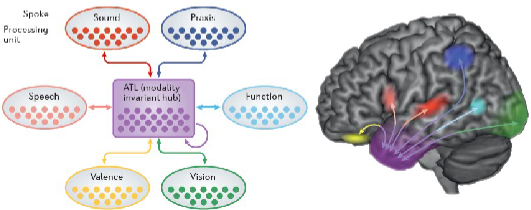
What does semantic representation involve?
The hub-and-spoke model
Concepts are built from spokes (modality-specific systems e.g vision, emotion, lang) + hub (transmodal region that integrates info across modalities)
What is the semantic hub?
Located in the anterior temporal lobes (ATL), bilaterally
Integrating modality-specific reps/multimodal features
Allows generalization across contexts (e.g. knowing that dogs bark even if you’ve never seen this dog)
Supports abstraction beyond surface similarity
Enables category membership judgments
Applies to objects, actions, + abstract words
Ultimate convergence zone
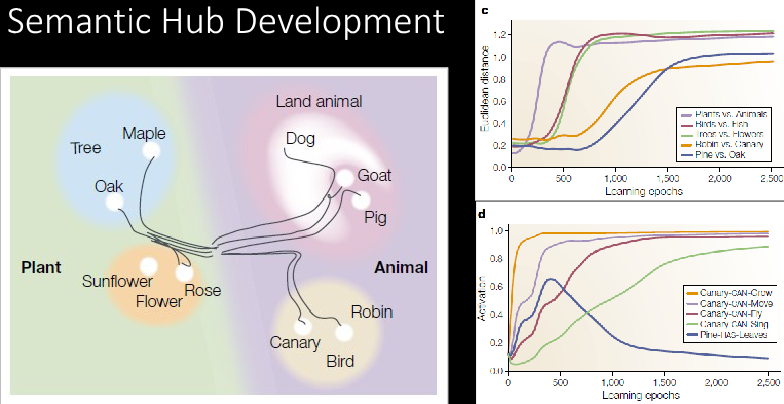
What is key evidence for the semantic hub?
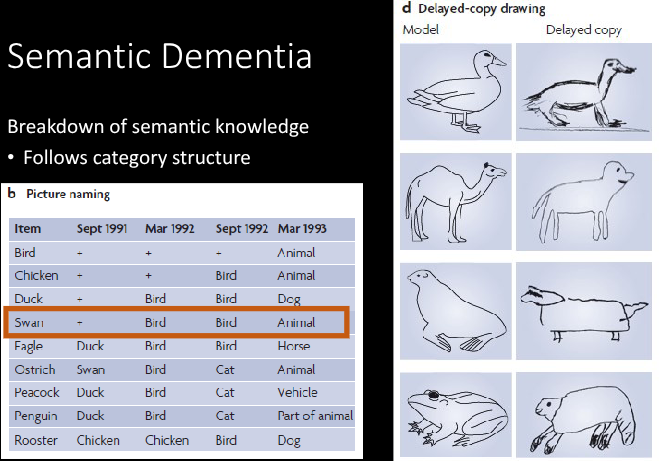
Semantic dementia
Neurodegenerative disorder
Follows category structure → progressive loss of specific info whilst retaining general info (breakdown of semantic knowledge)
Starts in anterior temporal lobe
Patients show impairment across all concept types, effects driven by familiarity, typicality + specificity, highly consistent deficits across tasks + modalities
fMRI (with distortion correction): ATL activates for meaning across modalities
TMS: disrupting ATL slows semantic processing across domains
Electrocorticography: ATL shows early semantic coding (~200 ms)
Computational models: hub damage reproduces SD-like patterns
What does semantic cognition support?
Understanding language
Recognizing objects
Making inferences (e.g. what objects are for)
Using tools appropriately
What does semantic cognition depend on?
The controlled cognition framework:
Semantic rep system
Semantic control system
What is the semantic representation system?
Stores conceptual knowledge
Builds abstract, generalisable concepts from experience
What is the semantic control system?
Regulates how semantic knowledge is accessed/used
Shapes meaning according to task, context + goals
What does semantic control enable us to do?
Focus on task-relevant meanings
Suppress dominant but irrelevant associations
Retrieve weak or unusual meanings
Adapt meaning to context
E.g. using a knife differently (cutting, spreading, scooping)
What does semantic control rely on?
A distributed network
Ventral and inferior prefrontal cortex (vPFC / IFG)
Posterior middle temporal gyrus (pMTG)
Intraparietal sulcus (IPS)
Pre-SMA and anterior cingulate cortex
What is semantic aphasia?
Damage: prefrontal and/or temporoparietal regions
Problem: failure to control semantic activation
Errors: inconsistent, context-dependent
Cueing: helps a lot
Strong susceptibility to distraction and interference
What is semantic dementia?
Damage: ATL hub
Problem: loss of representations
Errors: consistent, frequency-sensitive
Cueing: does not help
Double dissociation supports separate systems for rep + control
How do computational models relate to semantic control?
Show that a separate control system is necessary to preserve generalisation + allow flexible, task-specific behaviour
If task context is mixed directly into semantic reps then concepts fail to generalise properly
Representation = stable structure
Control = flexible modulation
What are some other semantic contributors?
IFG: semantic control + conflict resolution
Angular gyrus: integrative semantic functions
Posterior MTG: lexical semantic reps
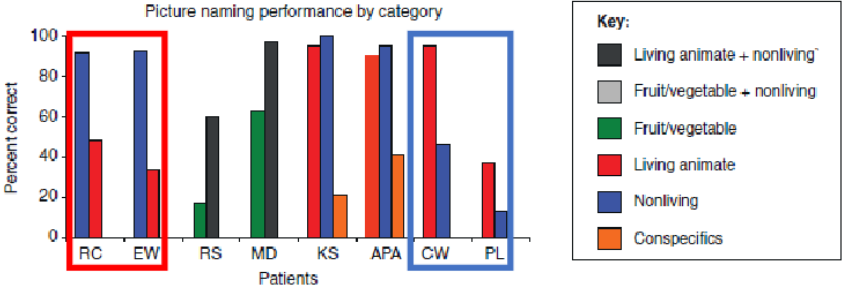
What are category-specific semantic deficits?
Semantic deficits following stroke can affect some categories more than others
Could be due to different feature types: sensory-functional distinction
Animals + fruit: defined more by sensory knowledge (colour, shape, four legs, etc.)
Inanimate objects (e.g. tools): defined more by their functions + associated actions
Converging evidence: gemstones + musical instruments tend to be impaired with living things (sensory) but body parts tend to be impaired with nonliving things (functional)
Explains why some patients have general semantic loss (e.g. semantic dementia) + others show category-specific deficits (e.g. tools vs animals)
Hub damage → category-general impairment
Spoke damage → category-specific impairment
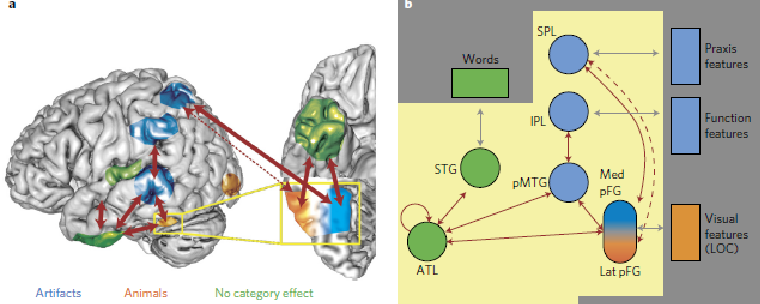
What is there a double dissociation for?
Living things + nonliving things
What does sentence comprehension rely on?
Left-lateralised distributed network
What are the components of the left-lateralised distributed network involved in sentence comprehension?
Posterior MTG
Posterior IFG (Broca’s area)
ATL
Temporoparietal junction/AG
Phonological loop
What is the function of the posterior MTG?
Accesses morphosyntactic features
Reps grammatical category alternatives
What is the function of the posterior IFG (Broca’s area)?
Top-down selection
Resolves ambiguity
Possibly supports sequencing or control
Theoretically controversial due to mixed lesion evidence
What is the function of the ATL?
Combinatorial parsing
Compositional semantic integration
What is the function of the temporoparietal junction/AG?
Participant role assignment (“who did what to whom”)
What is the function of the phonological loop?
Supports comprehension of complex sentences
Not strictly necessary in all cases
What is involved in sentence production?
Less understood
Agrammatism is heterogeneous, not a single syndrome
Lesions vary widely across patients
fMRI suggests shared grammatical resources for comprehension + production
Posterior MTG + IFG likely contribute to both
Unresolved precise functional roles
What does perception of spoken language involve?
Early auditory processing
Spectrotemporal analysis in STG
Phonological processing
Hemispheric differences
Outline the process of auditory processing
Cochlea → brainstem → thalamus → primary auditory cortex (Heschl’s gyrus)
What does phonological processing involve?
Posterior STG + STS form a phonological network
Hierarchical processing from simple sounds to word forms
Representations are distributed, not localized to single spots
Describe the differences between hemispheres
LH → rapid temporal processing (phonemes)
RH → slower temporal integration (syllables, prosody)
In perception of spoken language, what occurs after phonological recognition?
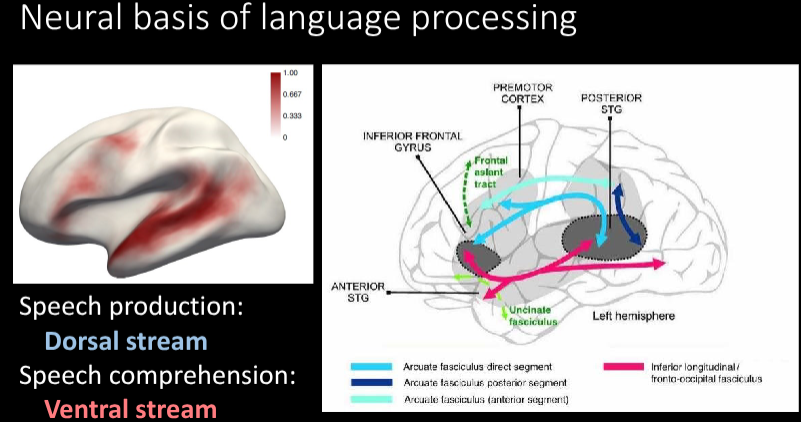
Processing splits in 2 → dual-stream model
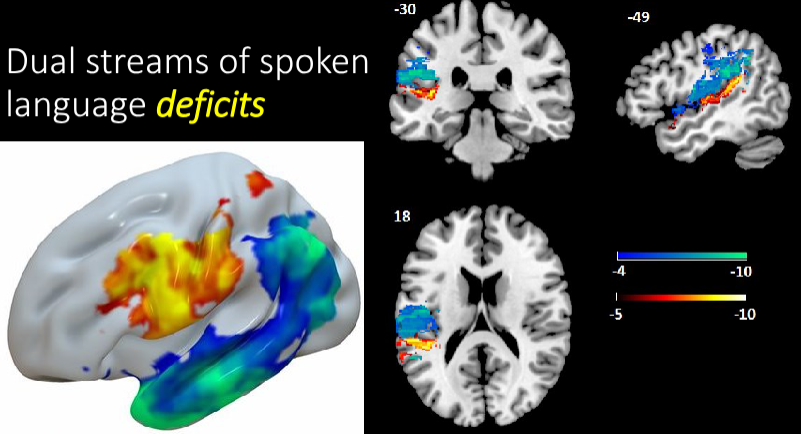
What is are the dual streams of spoken language?
Speech production: dorsal stream (inferior parietal and frontal)
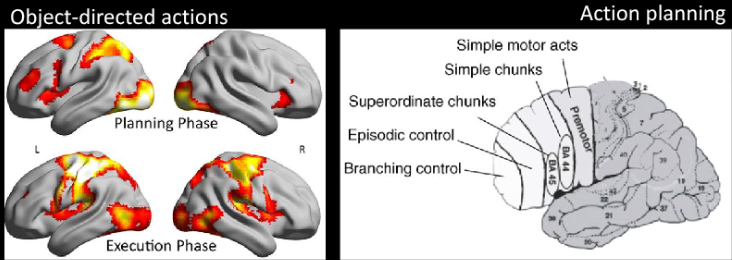
Related to skilled action (dorso-ventral visual stream) + action planning
Speech comprehension: ventral stream (superior temporal)
What is the dorsal stream?
Sound → action
Area Spt → frontal articulatory regions
Supports repetition, verbal short-term memory, speech learning
Strongly left-lateralized
What is the ventral stream?
Sound → meaning
Posterior MTG → anterior temporal lobe (ATL)
Supports lexical–semantic processing
Bilateral but left-dominant
Dual streams of spoken language deficits (diagrams)
How does motor involvement relate to perception of spoken language?
Exists but is modulatory, not essential + remains debated
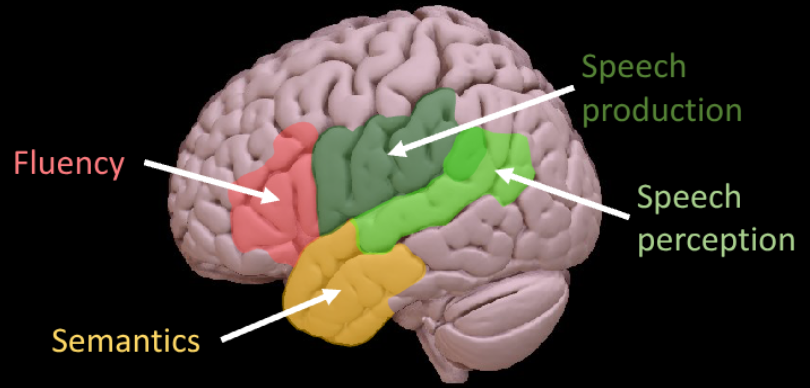
Language sub-systems (diagram)
What does spoken language production involve?
Conceptual selection
Morphosyntactic processing
Phonological encoding
Syllabification and articulatory planning
Motor execution
What does conceptual selection involve?
Meaning selected, strongly involving the ATL
IFG contributes control + selection
What does morphosyntactic processing involve?
Likely involves mid/posterior MTG
What does phonological encoding involve?
Posterior STG/STS retrieves phoneme sequences
Debate over single vs dual phonological lexicons
What does syllabification and articulatory planning involve?
Posterior IFG + anterior insula
Frequent syllables may be stored as motor “chunks”
What does articulatory planning involve?
Segment-level deficits
Ghost → ‘goath’
Phoneme distortions
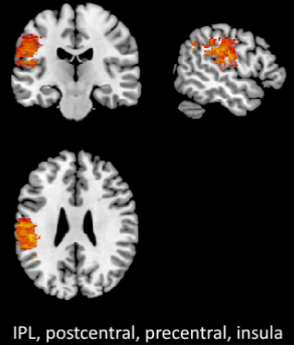
What does sentence planning involve?
Sentence-level deficits
Global fluency + informativeness
Mean length of utterances
Words in sentences
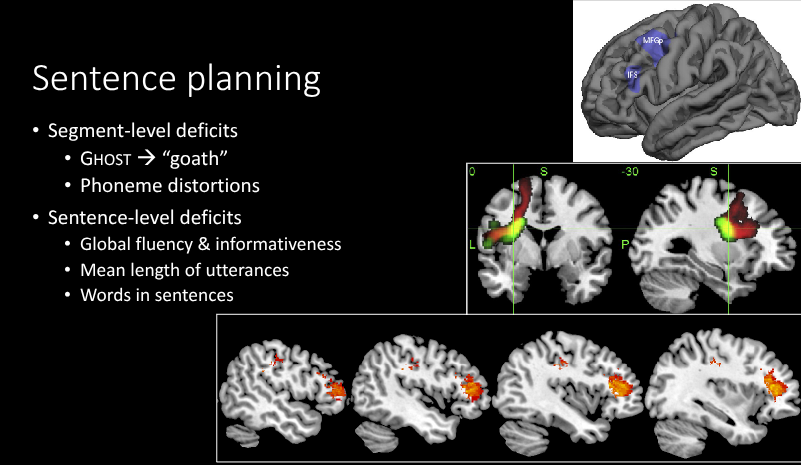
Sentence planning as action planning (diagrams)
What does motor execution involve?
Ventral precentral gyrus (somatotopic vocal tract map)
What is the function of the auditory feedback loop?
Compares expected vs actual sound
What is the function of the somatosensory feedback loop?
Monitors vocal tract sensations
Allows rapid, unconscious correction
What does reading involve?
A central visual processing hierarchy
Visual cortex → occipitotemporal regions → visual word form area (VWFA)
What are the properties of the visual word form area?
Invariant to size, font, case, position
Prefers real words over pseudowords
Script-general (alphabetic, logographic, Braille)
Develops through learning (not evolution)
What occurs after VWFA recognition?
Phonology accessed via perisylvian speech circuits
Semantics accessed via inferior temporal and ATL systems
How are regular and irregular words read?
Regular → sublexically
Irregular → may rely more on semantics (controversial)
What does writing involve?
Orthographic retrieval
Graphemic buffer
Allographic conversion
Graphomotor planning
What is orthographic retrieval?
Abstract grapheme strings accessed in the VWFA
What is a graphemic buffer?
Maintains letter identities + order
Controlled by posterior IFG
What is allographic conversion?
Abstract letters → specific forms
What is graphomotor planning?
Stroke sequences for handwriting
Frontoparietal motor regions
How does typing relate to writing?
Uses related but distinct mechanisms
What aspect of the brain does language primarily rely on? How is this area organised?
Cerebral cortex
Organised by:
Lobes (frontal, temporal, parietal, occipital, insula)
Gyri and sulci
Cytoarchitectonic regions (e.g. Brodmann areas)
What does language depend on?
Large-scale distributed networks → don’t work in isolation
Communicate via white-matter pathways
Broca’s area (left IFG) + temporal lobe regions are highlighted as major hubs → BUT always as parts of wider circuits (not standalone “modules”)
How are brain mapping methods used?
Converging evidence across methods (as no single method is sufficient)
What are the different brain mapping methods?
Hemodynamic imaging (PET, fMRI)
Lesion studies (neuropsychology)
Transcranial magnetic stimulation (TMS)
Electrophysiology (EEG, MEG, intracranial recordings)
Evaluate hemodynamic imaging
Good spatial resolution
BUT poor temporal resolution, correlational
Evaluate lesion studies
Provide causal evidence
Reveal dissociations between language components
Have improved due to better imaging and testing methods
Evaluate TMS
Temporarily disrupts or facilitates specific regions
High temporal + spatial precision
BUT limited to surface cortex
Evaluate electrophysiology
Excellent temporal resolution
Closer to neural firing
BUT often limited in spatial precision or availability