2.4 national income
 Call Kai
 Learn
Learn Practice Test
 Spaced Repetition
 Match
Match Flashcards
 Knowt Play
1/27

There's no tags or description
Looks like no tags are added yet.
Name | Mastery | Learn | Test | Matching | Spaced | Call with Kai |
|---|
No analytics yet
Send a link to your students to track their progress
28 Terms
what is the circular flow of income
flow of goods and service between households and firms and their corresponding payments in money terms
what are the key components in the circular flow of income
Households: Provide factors of production (labour, land, capital) to firms and receive wages, rent, and profits in return.
Firms: Produce goods and services, paying households for their factors of production and receiving revenue from selling products.
Government: Collects taxes from households and firms, and spends on public services and welfare.
Financial Sector: Facilitates saving and investment by households and firms.
Foreign Sector: Engages in trade with the domestic economy through exports and imports.
what are the flows in the circular flow of income
Flows in the Model:
Real Flow: Movement of goods and services (e.g., labor, products).
Money Flow: Movement of money (e.g., wages, consumer spending).
Money flows in one direction, good/services/factors of production flow in the other direction
what are the leakages in the circular flow of income
Leakages and Injections:
Leakages: Savings, taxes, and imports, which remove money from the circular flow.
Withdrawals or leakages are where money is removed from the economy:
taxes (T)
savings (S)
imports (M)\
what is income
Income:
Refers to the flow of money received, typically measured over a period (e.g., monthly or annually).
Sources include wages, rent, interest, and profits.
Example: A teacher's annual salary is a form of income.
what is wealth
Wealth:
Refers to the stock of assets owned at a given point in time - can be used to generate income.
Includes physical assets (real estate, cars) and financial assets (stocks, bonds).
Example: Ownership of a house and shares in a company represent wealth.
what are injections in the circular flow of income
Injections are monetary additions to the economy:
government spending (G),
investment (I)
exports (X)
consumer spending (C)
how does leakages/injections affect the circular flow of income
If injections exceed withdrawals, then the circular flow of income will expand. And so national income will rise.
If leakages exceed injections, then the circular flow of income will shrink. And so national income will fall.
In an equilibrium, injections must be equal to withdrawals and so the national income remains the same.
how can injections/withdrawals be used to analyse macroeconomic impacts
You can use this model to analyse the macroeconomic impact of an event.
E.g. if the government decides upon expansionary fiscal policy and increases government spending, this raises injections. If injections exceed withdrawals, the circular flow of income will expand and national income will rise.
E.g. if there is uncertainty (low animal spirits), say, because of the risk of a break up of the European Union (EU), then consumers will save more (savings is a leakage) and firms will invest less (investment is an injection). If leakages exceed injections, the circular flow of income will shrink and national income will too.
what is the equilibrium of real national output
The equilibrium position of national output is where the AD and AS curves intersect. If either AS or AD are shifted, then the equilibrium position will change.
The size of this change will depend on the size of the shift and the elasticity of the curve which has not moved i.e. the elasticity of AS if AD has moved.
what causes the fiscal multiplier effect
The fiscal multiplier effect occurs when an initial injection into the economy causes a bigger final increase in national income.
what is the multiplier ratio
The multiplier ratio is the ratio of change in real income to the injection that created the change.
The multiplier ratio quantifies the total change in national income resulting from an initial change in spending.
It demonstrates how initial spending generates further income and consumption, leading to a multiplied effect on the overall economy.
how do you calculate the multiplier if you have actual data
multiplier (k) = change in real gdp (y) / change in injections (j)
what is the positive multiplier effect
Positive multiplier effect:
Initial Spending: An initial increase in spending (e.g., government investment, export demand) injects money into the economy.
Income Generation: This spending becomes income for households and firms, who then spend a portion of this income.
Secondary Spending: The subsequent spending generates additional income for others, continuing the cycle.
Diminishing Returns: Each round of spending is smaller due to withdrawals (savings, taxes, imports), eventually tapering off.
Bigger final increase: Even though each round of spending gets smaller, the successive rounds of spending means final increase in national income is much larger than the initial injection
The multiplier effect can be a key driver of economic growth, as it can lead to increases in overall output, employment, and incomes.
what is the negative multiplier effect
Negative multiplier effect:
The multiplier effect can also work in reverse. If the government cut spending, some public sector workers may lose their jobs. This will cause an initial fall in national income. However, with higher unemployment, the unemployed workers will also spend less leading to lower demand elsewhere in the economy.
The negative multiplier effect occurs when an initial withdrawal of spending from the economy leads to knock-on effects and a bigger final fall in real GDP.
It could be a decrease in injections.
Fall in consumer spending
Fall in investment
Fall in exports
Fall in government spending.
Or it could be an increase in withdrawals from the circular flow. It could include:
Tax - reducing disposable income
Imports - spending flows abroad
Save - household income saved rather than spent.
what is the effect of the multiplier effect displayed on a diagram
two shifts in total, one smaller and one larger
what are examples of the multiplier effect
Examples:
Government spending on infrastructure, such as roads and bridges, which can create jobs and increase demand for goods and services.
Tax cuts can also have a multiplier effect if they lead to increased consumer spending and business investment.
Finally, increases in government transfer payments, such as social security or welfare benefits, can increase household incomes and lead to higher levels of consumption spending.
Covid example:
The spread of the Coronavirus is causing many negative economic effects.
A decline in travel - leading to falling revenue for airlines and travel companies.
A decline in trade and firms running out of spare parts
A fall in confidence causing a decrease in travel and a decrease in investment.
These effects all cause a fall in demand and lower economic growth. However, they can be exacerbated by a negative multiplier effect which affects people not directly linked to the virus.
For example, airline companies may have to lay off staff. People working at Heathrow or for airline companies lose their jobs and therefore there will a fall in consumer spending in these areas. Leading to further falls in demand elsewhere in the economy. If there is a fall in global trade, all firms connected to trade and travel will see a fall in demand.
what is the marginal propensity to consume (MPC)
The proportion of additional income that is spent
what is the marginal propensity to save (MPS)
The proportion of additional income that is saved
what is the marginal propensity to tax (MPT)
The proportion of additional income that is paid in tax
what is the marginal propensity to import (MPM)
The proportion of additional income that is spent on imports
what is the Marginal propensity to withdraw (MPW)
The increase in leakages following an increase in income MPW=MPS+MPT+MPM
how do marginal propensities affect the multiplier
A higher MPC directly leads to a larger multiplier effect, meaning that an initial injection of spending will have a greater impact on overall economic output due to increased recirculation of income within the economy
Conversely, a higher MPS results in a smaller multiplier as more income is saved and not spent immediately.
The multiplier is dependent on MPC and so can change all the time. MPC depends on a range of factors; any factor that affects consumption (as a component of AD) will affect the MPC, for example a change in interest rates will affect the MPC.
● The higher the MPC, the bigger the multiplier as this means more money of income is spent so more money is transferred through the circular flow and less is withdrawn.
● The other marginal propensities show how much of a change is income is withdrawn from the economy i.e. how much is not spent. An increase in any of these will decrease the MPC. A change in tax will affect MPC (ceteris paribus) as it will increase the MPT. Any factor other than income that affects imports, for example the quality of imported goods, will affect MPM and therefore MPC.
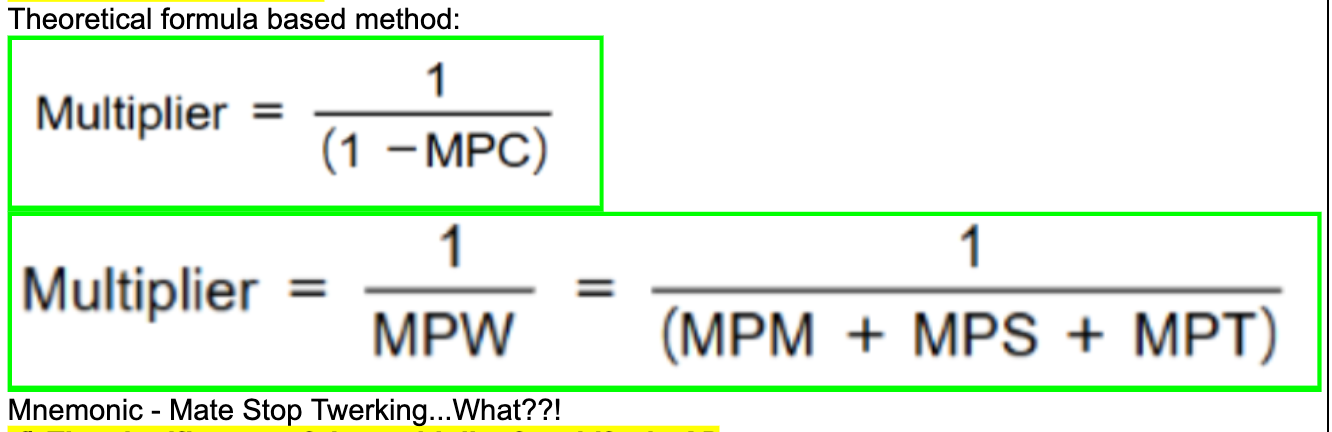
what is the formula for the multiplier
multiplier = 1/MPM + MPS + MPT or 1/MPW (MATE STOP TWERKING…WHAT?)
the marginal propensity to consume (MPC)
the marginal propensity to save (MPS)
the marginal propensity to tax (MPT)
the marginal propensity to import (MPM)
1/(1-MPC) and 1/MPW, where MPW=MPS+MPT+MPM
why does the effect of the multiplier depend on location on the curve/spare capacity
The multiplier leads to an increase in AD higher than the original increase but for it to have the desired effect, there must be sufficient spare capacity in the economy (i.e. it cannot be at full output) for extra output to be produced.
If the AS is perfectly inelastic, like on the classical LRAS curve, then the only impact of the multiplier will be to increase price; it will not affect output in the long run, although it will in the short run. The more elastic the curve, the smaller the effect on price but the bigger the effect on output.
Therefore, as with any increase in AD, the effect of the multiplier depends on the shape of the AS curve and whether it is short run or long run. The size of the increase in AD will depend on both the size of the initial increase in AD and the size of the multiplier.
In general, the multiplier will have a big effect when there is plenty of spare capacity in the economy and the MPW is low/MPC is higher. It has little effect on output when there is little spare capacity in the economy so the rising demand only creates rising prices.
what affects the size of the multiplier
The greater the withdrawals, the smaller the value of the multiplier - and vice versa
The greater the MPC, the greater the value of the multiplier - and vice versa
Any change in one of the factors that impacts on disposable income, will change the multiplier
If taxes increase, the value of the multiplier reduces
If interest rates increase, savings increase and consumption decreases, and the multiplier reduces
If exchange rates appreciate, the level of imports will increase and the multiplier decreases
If confidence in the economy increases consumption increases and the multiplier increases
why is the helpful for governments to know about the multiplier
It is extremely useful for the Government to know the value of the multiplier
They can use it to judge the likely economic growth caused by increased spending
why is there a time lag for the multiplier
There is a time lag as it takes time for the successive rounds of income to work through the economy