Operant conditioning - Chapter 6
 Call Kai
 Learn
Learn Practice Test
 Spaced Repetition
 Match
Match Flashcards
 Knowt Play
1/24

There's no tags or description
Looks like no tags are added yet.
Name | Mastery | Learn | Test | Matching | Spaced | Call with Kai |
|---|
No analytics yet
Send a link to your students to track their progress
25 Terms
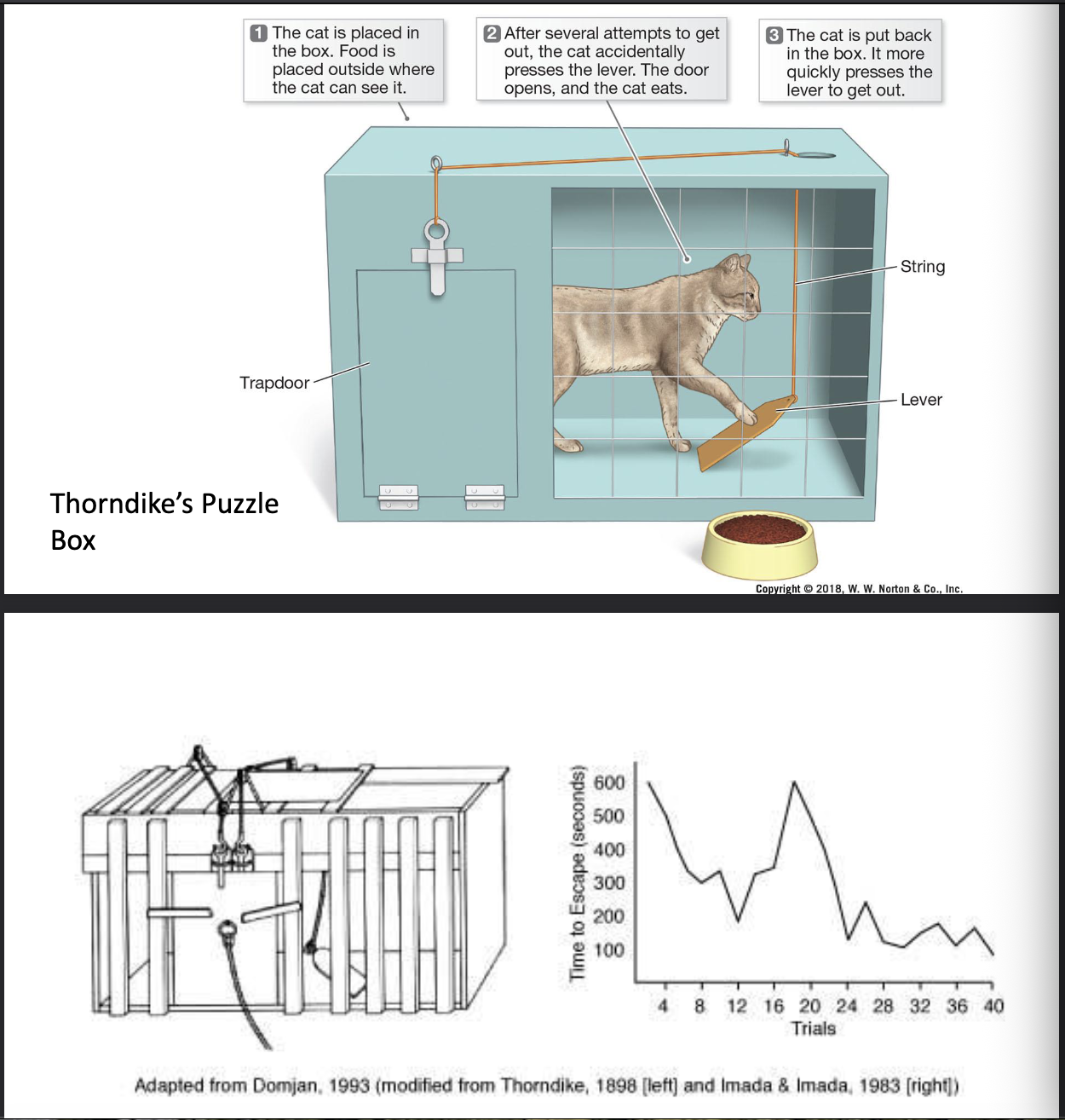
Law of effect was proposed by WHO
Edward Thorndike
Law of effect
Any behaviour that leads to a “satisfying state of affairs” is likely to occur again, and any behaviour taht leads to an “annoying state of affairs” is less likely to occur again
Law of effect: the likelihood of the occurrence of a behaviour is influenced by its WHAT
Law of effect: the likelihood of the occurrence of a behaviour is influenced by its CONSEQUENCES
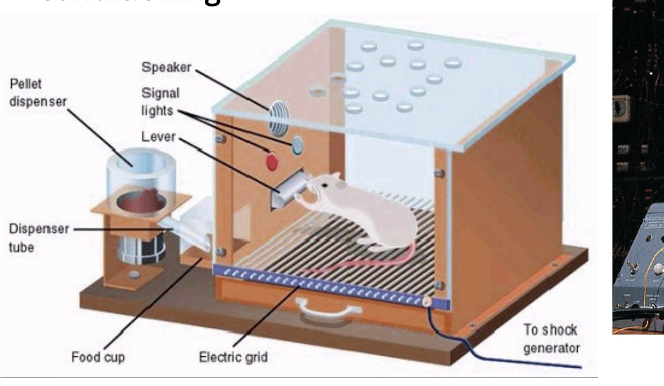
B.F. Skinner
Elaborated on Thorndike’s WHAT
Invented the WHAT
Developed the theory of WHAT
B.F. Skinner
Elaborated on Thorndike’s LAW of EFFECT
Invented the OPEANT CHAMBER
Developed the theory of OPERANT CONDITIONING
Classical conditioning: A type of learning in which a WHAT stimulus acquires the ability to evoke an WHAT (reflexive) response that was originally WHAT by another stimulus.
Classical conditioning: A type of learning in which a NEUTRAL stimulus acquires the ability to evoke an INVOLUNTARY (reflexive) response that was originally EVOKED by another stimulus.
Operant conditioning: A form of learning in which WHAT responses come to be controlled by their WHAT
Operant conditioning: A form of learning in which VOLUNTARY responses come to be controlled by their CONSEQUENCES
If its POSITIVE you WHAT
get something
If its NEGATIVE you WHAT
Something is removed
Reinforcement
will DO this again
Punishment
Will NOT do this again
Get something good, will do this again is labelled WHAT
Get something good, will do this again, is labelled POSITIVE REINFORCEMENT
Examples:
You go to a restaurant. The food is good. You will go to this restaurant again.
You pay your bill on time. You get a discount.
You will pay your bill on time again.
Get something bad, will not do this again this is labelled as: WHAT
Get something bad, will not do this again this is labelled as: POSITIVE PUNISHMENT
Examples:
You wear a new shirt. People make fun of you. You will not wear this shirt again.
You go to a restaurant. The food is bad. You will not go to this restaurant again.
Something bad is removed, will do this again this is labelled as: NEGATIVE REINFORCEMENT
Something bad is removed, will do this again this is labelled as: NEGATIVE REINFORCEMENT
Examples:
You call in sick. Your anxiety goes away. Next time when you need to do a presentation, you will call in sick again.
You drink coffee. Your headache disappears. You will drink coffee again when you have a headache
Something good is removed, will not do this again this is labelled as: WHAT
Something good is removed, will not do this again this is labelled as: NEGATIVE PUNISHMENT
Examples:
You drive over the speed limit. You get a speeding ticket and lose $100. You will not speed again.
You pay your bill late. You lose the discount.
You will not pay your bill late again
Positive Reinforcement
Behavior is followed by a FAVOURABLE stimulus; frequency of behaviors INCREASES
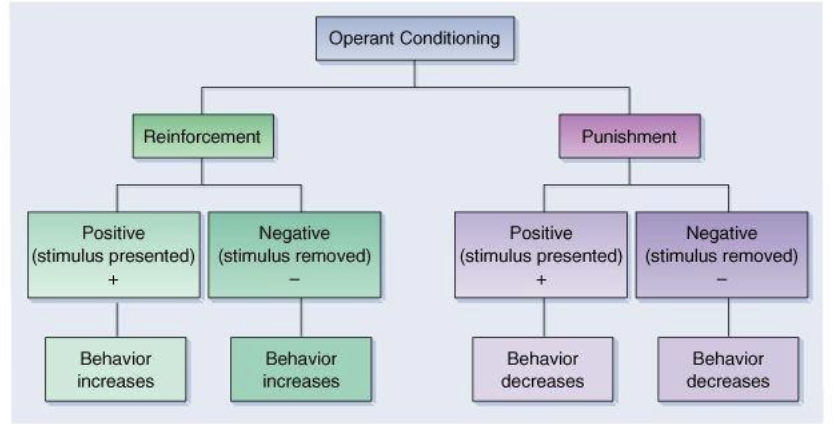
Negative Reinforcement
Behavior is followed by the REMOVAL of an UNFAVOURABLE stimulus; frequency of behaviors INCREASES
Positive Punishment
Behavior is followed by an UNFAVOURBALE stimulus; frequency of behaviors DECREASES
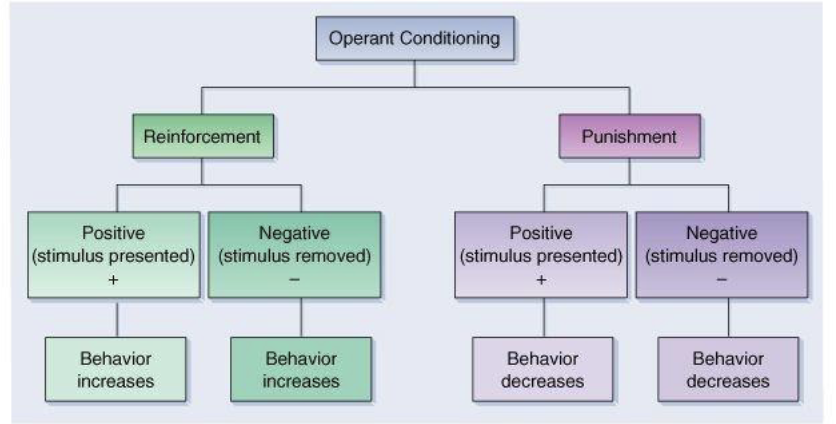
Negative Punishment
Behavior is followed by the REMOVAL of a FAVOURABLE stimulus; frequency of behaviors DECREASES
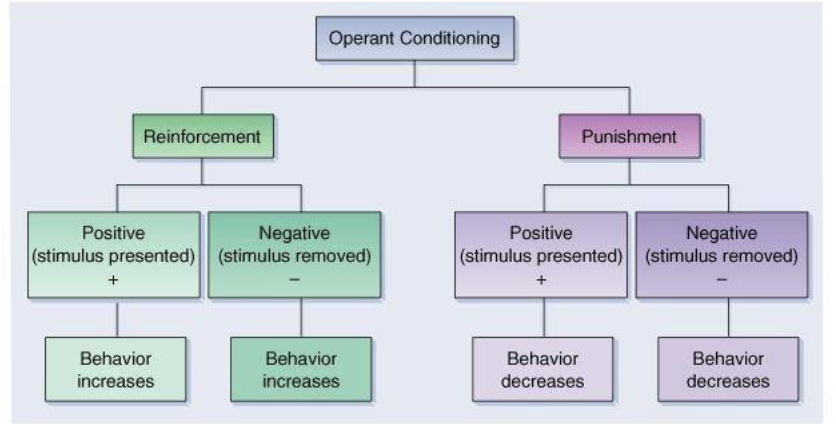
Skinner’s Demonstration: It’s all a matter of consequences
Process: Positive reinforcement
Antecedent: WHAT
Behaviour (response): Press lever
Consequence (stimulus): WHAT
Effect on behaviour: WHAT
Skinner’s Demonstration: It’s all a matter of consequences
Process: Positive reinforcement
Antecedent: FEELING HUNGRY
Behaviour (response): Press lever
Consequence (stimulus): FOOD DELIVERED
Effect on behaviour: Tendency to press lever INCREASES
Skinner’s Demonstration: It’s all a matter of consequences
Process: Negative reinforcement
Antecedent: WHAT
Behaviour (response): Press lever
Consequence (stimulus): WHAT
Effect on behaviour: WHAT
Skinner’s Demonstration: It’s all a matter of consequences
Process: Negative reinforcement
Antecedent: Presence of electric shock/ loud noises
Behaviour (response): Press lever
Consequence (stimulus): Turn off electric shock/loud noises
Effect on behaviour: Tendency to press lever INCREASES
Skinner’s Demonstration: It’s all a matter of consequences
Process: Punishment (positive)
Antecedent: WHAT
Behaviour (response): Press lever
Consequence (stimulus): WHAT
Effect on behaviour: WHAT
Skinner’s Demonstration: It’s all a matter of consequences
Process: Punishment (positive)
Antecedent: Feeling hungry
Behaviour (response): Press lever
Consequence (stimulus): turn on electric shock
Effect on behaviour: Tendency to press lever decreases
For punishment to be effective, we need to consider
WHAT
WHAT
WHAT
For punishment to be effective, we need to consider
Timing
Intensity
Consistency
Timing
Apply punishment WHEN after the WHAT
Timing
Apply punishment IMMEDIATELY after the MISBEHAVIOUR
Intensity
The intensity of the punishment should match the intensity of the WHAT (eg, if a parking ticket costs less than the parking fee, nobody will pay for parking)
Intensity
The intensity of the punishment should match the intensity of the MISBEHAVIOUR (eg, if a parking ticket costs less than the parking fee, nobody will pay for parking)
Consistency
Apply WHAT every time the misbehaviour occurs
Inconsistency leads to WHAT between the punishment and the misbehaviour. The misbehaviour tends to continue
Consistency
Apply PUNISHMENT every time the misbehaviour occurs
Inconsistency leads to WEAK ASSOCIATION between the punishment and the misbehaviour. The misbehaviour tends to continue